智能辅具

Search documents
银发商店为老年人提供沉浸式消费新空间
Xin Lang Cai Jing· 2026-01-19 17:08
Core Viewpoint - The opening of Shanghai's first silver-haired store represents a significant shift in the retail landscape for elderly products, providing an immersive shopping experience that meets the evolving needs of the aging population [3][4]. Group 1: Store Features and Offerings - The "Shanghai Silver-haired Store" integrates various elderly products, including smart aids, age-friendly home furnishings, functional clothing, and entertainment options, creating a comprehensive shopping environment [3]. - The store aims to address the "last mile" gap between technology products and the elderly, transitioning their consumption from mere functionality to comfort, health, and dignity [3]. Group 2: Market Impact and Consumer Behavior - The physical store complements online shopping platforms by alleviating concerns about product quality and after-sales service, thereby enhancing the confidence and trust of elderly consumers [4]. - This initiative is expected to accelerate the integration of elderly product innovations into daily life, shifting the silver economy from a "protection-oriented" model to a "quality-oriented" one [4]. Group 3: Societal and Economic Implications - The silver-haired store not only caters to the diverse and high-quality lifestyle demands of the elderly but also facilitates intergenerational consumption, easing the concerns of younger consumers about the suitability of products for their elderly relatives [4]. - There is an anticipation for more silver-haired stores to emerge in communities, which would effectively stimulate new economic momentum in the silver economy and improve the availability of quality elderly services and products [4].


探访上海首家银发商店感受银发经济新活力
Xin Lang Cai Jing· 2026-01-15 18:26
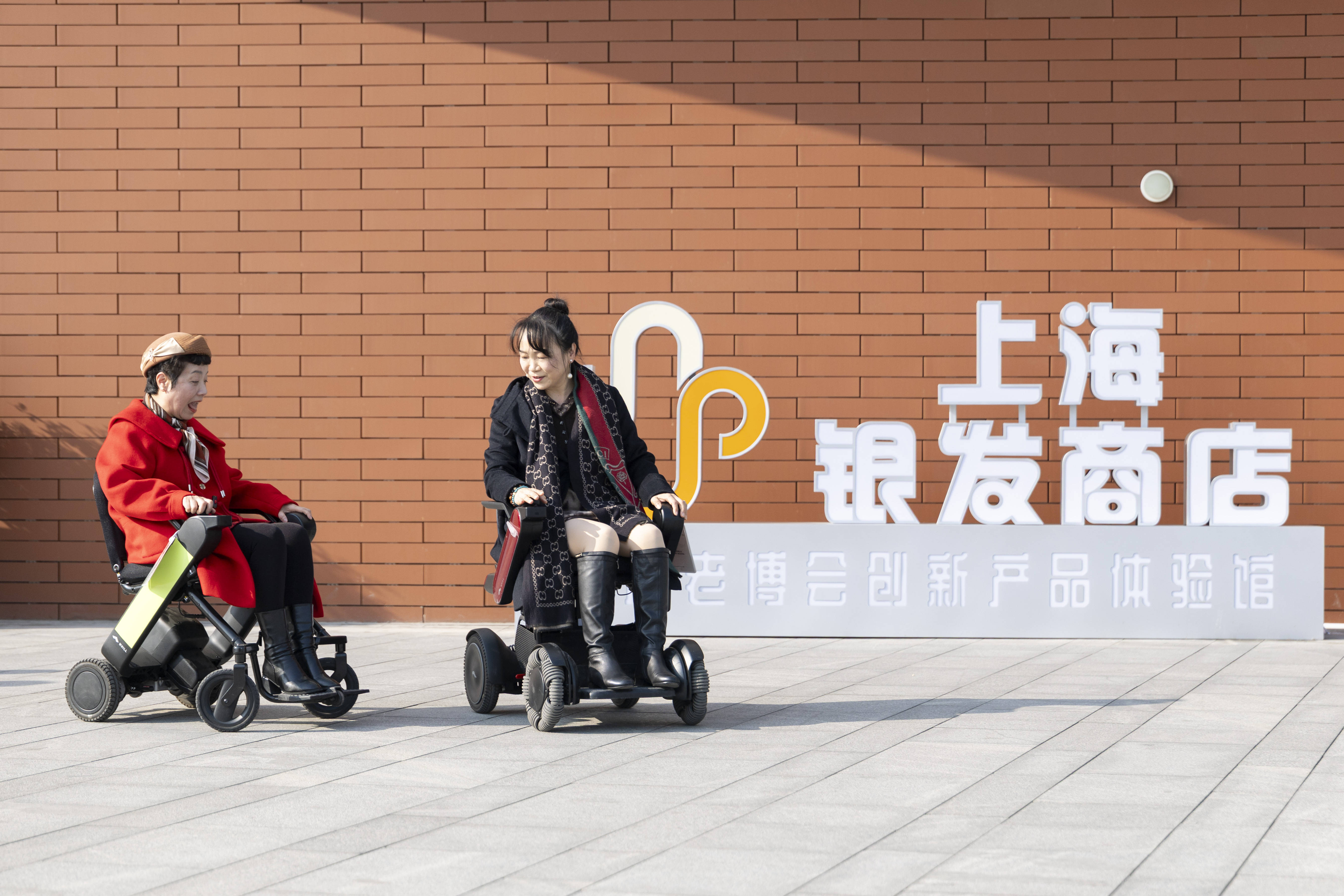
Group 1 - The core viewpoint of the article highlights the opening of Shanghai's first silver-haired store, which aims to provide a daily extension of the Shanghai Old Expo through innovative product experiences for the elderly [3] - The store features a variety of products tailored for the elderly, including smart assistive devices, age-friendly home furnishings, functional clothing, and entertainment options, creating an immersive shopping experience [3] - The store will regularly update its selection of preferred products to cater to the needs of the elderly demographic, indicating a commitment to continuous improvement and customer engagement [3]

探访上海首家银发商店 感受银发经济新活力
Sou Hu Cai Jing· 2026-01-15 12:48
Core Viewpoint - The "Shanghai Silver Hair Store," the first of its kind in Shanghai, has officially opened in the Putuo District, extending the experience of the recent "Shanghai Old Expo" into daily life, providing a new immersive shopping space for the elderly community [1]. Group 1 - The store features a variety of products tailored for the elderly, including smart assistive devices, age-friendly home furnishings, functional clothing, and entertainment options [1]. - The product selection will be regularly updated to ensure that the offerings remain relevant and appealing to the silver-haired demographic [1]. Group 2 - Customers can experience products such as electric wheelchairs and consult staff about age-appropriate modifications and products [5][12]. - The store aims to create a comprehensive shopping experience that caters specifically to the needs and preferences of older adults [1].
脑机接口专家解读电话会议
2026-01-07 03:05
Summary of Key Points from the Conference Call Industry Overview - The conference call focused on the **brain-computer interface (BCI)** technology, which is categorized into invasive, semi-invasive, and non-invasive types, each with its own advantages and disadvantages [1][3][4]. Core Insights and Arguments - **Non-invasive BCIs** are primarily used for typing communication (based on P300), device control (based on SSVEP), and rehabilitation training (based on motor imagery potentials). However, they face limitations due to skull interference, resulting in low amplitude brain waves and a need for improved decoding accuracy [1][11][13]. - **Invasive BCIs** have made progress in motor and language decoding, as well as visual and auditory reconstruction, but they carry risks such as bleeding, infection, and device reliability issues, leading to uncertainty in commercialization prospects [1][15]. - A research team is exploring a hybrid approach combining **EEG and EMG** to decode motor intentions by analyzing weak muscle signals, which has shown success in helping patients with arm injuries and strokes regain some limb function, with plans for commercial use by mid-2025 [1][16][17]. - The market potential for hand function rehabilitation in China is significant, with over **50 million** patients suffering from limb disabilities and an annual increase of **2 to 3 million** cases [1][18]. Additional Important Content - The **clinical application** of EEG differs from BCI research, requiring higher sampling rates (1,000 Hz to 20,000 Hz) for effective data quality in BCI applications compared to the lower rates used in clinical settings [2]. - The **hardware segment** of the BCI industry has high barriers to entry and substantial profit margins, making it a promising investment area, especially in the context of China's healthcare payment habits [24]. - **Neuralink**, a prominent player in the invasive BCI space, has raised questions about its valuation and the practical benefits of its technology compared to non-invasive alternatives [23][22]. - The **supply chain** for BCI products is influenced by the compatibility of cost control and healthcare payment systems, particularly for non-invasive rehabilitation and invasive surgeries [24]. - Future applications of BCI technology may extend to treating mental health disorders and cognitive enhancement, although these areas still face significant challenges in decoding complex brain functions [26]. This summary encapsulates the key points discussed in the conference call, highlighting the current state and future potential of brain-computer interface technology.
雷迪克:与傲意科技达成多层次战略合作
Xin Lang Cai Jing· 2026-01-05 07:50
Core Viewpoint - Leadrick (300652.SZ) has established a multi-level strategic partnership with Aoyi Technology, involving a significant investment and joint venture aimed at enhancing their capabilities in robotics and intelligent systems [1] Investment and Financing - Leadrick is investing 160 million yuan in Aoyi Technology's B3 round financing [1] - Both companies are jointly investing 100 million yuan to establish Zhejiang Leiao Robot Co., Ltd., with Leadrick holding 90% and Aoyi Technology holding 10% [1] Product Development and Collaboration - The new joint venture will serve as the core platform for the research and production of Leadrick's robotic joint modules and dexterous hand modules [1] - Aoyi Technology's dexterous hand has become a leading product in the domestic humanoid robot sector, collaborating with over 200 enterprises [1] Technological Synergy - The collaboration aims to integrate Leadrick's strengths in precision transmission component development with Aoyi Technology's advantages in technology, electrical control, and algorithms [1] - This partnership seeks to streamline the entire industrial chain from precision transmission components to final execution units and dexterous hand products [1] Healthcare Applications - In the medical and health sector related to brain-machine interfaces, Leadrick will provide mechanical structural support for Aoyi Technology's wearable exoskeletons and smart assistive devices [1]

四川10部门体系化推进科技助残 构建“需求—科研—产品”一体化链条
Si Chuan Ri Bao· 2025-12-03 00:42
Core Viewpoint - The event held on December 2 in Chengdu, themed "Technology with Love, Co-creating the Future," marks a new phase in the systematic promotion of technology-assisted support for people with disabilities in the province, as highlighted by the release of the "Implementation Opinions on Promoting Technology Assistance for the Disabled" by ten departments [1] Group 1: Implementation Opinions - The "Implementation Opinions" emphasize a "demand-driven, closed-loop linkage" mechanism, integrating resources from ten departments to form a collaborative effort in building a "demand-research-product" integrated chain [1] - The province will establish a list of "bottleneck" issues in assistive technology and a reserve of special projects for technology assistance, leveraging resources from top universities such as Sichuan University and University of Electronic Science and Technology of China to create high-level research platforms [1] Group 2: Research and Development Focus - The focus will be on tackling cutting-edge assistive technologies, particularly in areas where foreign monopolies exist and in basic research that has not yet been translated into applications, with an emphasis on major disabling diseases like autism and Alzheimer's [1] - The aim is to clarify the mechanisms of onset and control for these significant disabling conditions through foundational research [1] Group 3: Industry Development - The "Implementation Opinions" outline a strategic focus on developing five key frontier industries: smart assistive devices, exoskeleton rehabilitation robots, brain-computer interfaces and human-computer interaction, humanoid robots, and integrated smart home applications [1] - The goal is to accelerate the establishment of a nationally influential technology-assisted support industry cluster [1]
湖南具身智能创新中心启用 助力全球研发中心城市建设
Zhong Guo Xin Wen Wang· 2025-11-26 14:31
Core Insights - The establishment of the Hunan Embodied Intelligence Innovation Center in Changsha marks a significant step in Hunan's strategic development of embodied intelligence as a key future industry, supporting Changsha's goal of becoming a global R&D hub [1][4] - The center is a collaborative effort involving Changsha Economic Development Zone, Lens Technology, and leading enterprises in the industry chain, aiming to enhance research and innovation in artificial intelligence and robotics [1][3] Summary by Sections Innovation Center Overview - The center has attracted nearly 30 robotics ecosystem companies, covering various aspects such as joint modules, controllers, complete machine integration, and industry solutions [3] - It is led by Wang Yaonan, an academician from the Chinese Academy of Engineering, and aims to create a leading domestic research and innovation area for embodied intelligence [3] Applications and Demonstrations - The center showcases diverse applications of embodied intelligence in areas like smart homes, industrial operations, and specialized tasks, with over 120 robots displayed in various scenarios [3][6] - Specific applications include precision tasks in industrial settings and specialized robots for firefighting, high-altitude operations, and disaster rescue [3] Industry Ecosystem and Contributions - Lens Technology has established a vertically integrated system for the development, production, and assembly of core robotic components, while also fostering an open collaborative ecosystem [3] - During the launch, Lens Technology announced a donation of 200 sets of intelligent assistive devices to the Hunan Provincial Disabled Persons' Federation [3] Strategic Development and Policy Support - Changsha Economic Development Zone has actively integrated into national and provincial "Artificial Intelligence+" initiatives, focusing on AI chips, servers, terminals, and embodied intelligence [4] - The zone has introduced specialized policies and developed several future industry parks, attracting over 70 enterprises in the AI and robotics sectors [4] Commitment to Innovation and Growth - The leadership in Changsha emphasizes the center's role as a catalyst for innovation and rapid transformation of technological achievements, ensuring a supportive environment for project development and operational efficiency [6]


高盛:通往2075(全球老龄化的机会)未来30年养老市场大爆发
Xin Lang Cai Jing· 2025-06-09 01:29
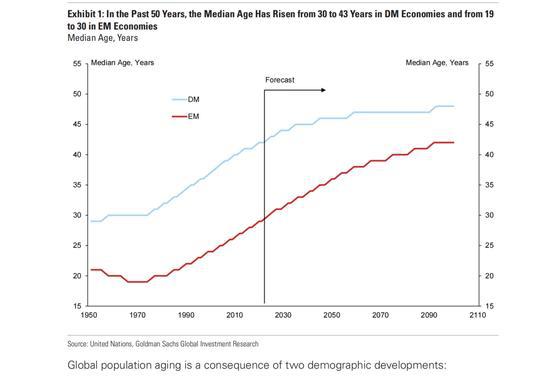
Global Population Trends - The median age of the global population has increased significantly over the past 50 years, with developed economies rising from 30 to 43 years and emerging economies from 19 to 30 years, projected to reach 47 and 40 years respectively by 2075 [2] - The average life expectancy has steadily increased, with developed economies rising from 72 to 82 years and emerging economies from 58 to 73 years, indicating a healthier aging population [4] - The global fertility rate has declined from 5.4 in 1963 to approximately 2.1 today, which is at the replacement level, but the actual threshold to maintain population stability is lower due to increased life expectancy [6] Labor Market Dynamics - Despite a decrease in the proportion of the working-age population in developed economies, the actual employment rate has increased, indicating a rise in labor force participation [10] - The trend of delayed retirement is largely driven by individuals' choices rather than policy changes, with many older adults opting to work longer due to improved health and longevity [11] - Women's participation in the labor force has also increased, contributing positively to overall employment rates and helping to mitigate the effects of an aging population [13] Longevity Economy - The aging population presents opportunities for economic growth through technological advancements and productivity improvements, particularly in sectors catering to elderly care [16] - The rise of "silver technology" is creating new markets, including smart healthcare solutions and elder care services, which are essential as the demand for elderly care increases [16] - The perception of older adults is shifting from being seen as a burden to being recognized as valuable consumers and contributors to the economy [16] China's Aging Population - China has officially entered a moderate aging phase, with over 310 million people aged 60 and above, representing 22% of the total population, indicating significant potential for the "silver economy" [18] - The market for silver economy in China is currently valued at approximately 8 trillion yuan and is rapidly expanding, driven by policy support and changing consumer demands [18] - The Chinese government is prioritizing the development of the silver economy as a national strategy, with various initiatives aimed at enhancing the quality of life for the elderly [19] Consumer Behavior Changes - The consumption patterns of older adults in China are evolving, with a shift from basic needs to quality consumption, including healthcare, cultural activities, and travel [20] - The demand for non-medical services among the elderly is expected to exceed 60% by 2030, indicating a significant market opportunity in sectors like entertainment and education [21] - The segmentation of the elderly population into different age groups allows for more targeted products and services, enhancing the potential for growth in the silver economy [21] Policy and Industry Development - China is actively developing its silver industry as a new driver of high-quality economic growth, focusing on urban-rural integration and technological innovation [22] - The silver economy encompasses a wide range of sectors, including smart devices, healthcare services, and financial products tailored for the elderly [22] - The integration of technology in elder care services is expected to enhance service quality and efficiency, leading to the emergence of a "smart elder care" ecosystem in China [22]