
智能阀门

Search documents
“十五五”深海阀门行业深度研究及趋势前景预判专项报告
Xin Lang Cai Jing· 2026-02-03 12:52
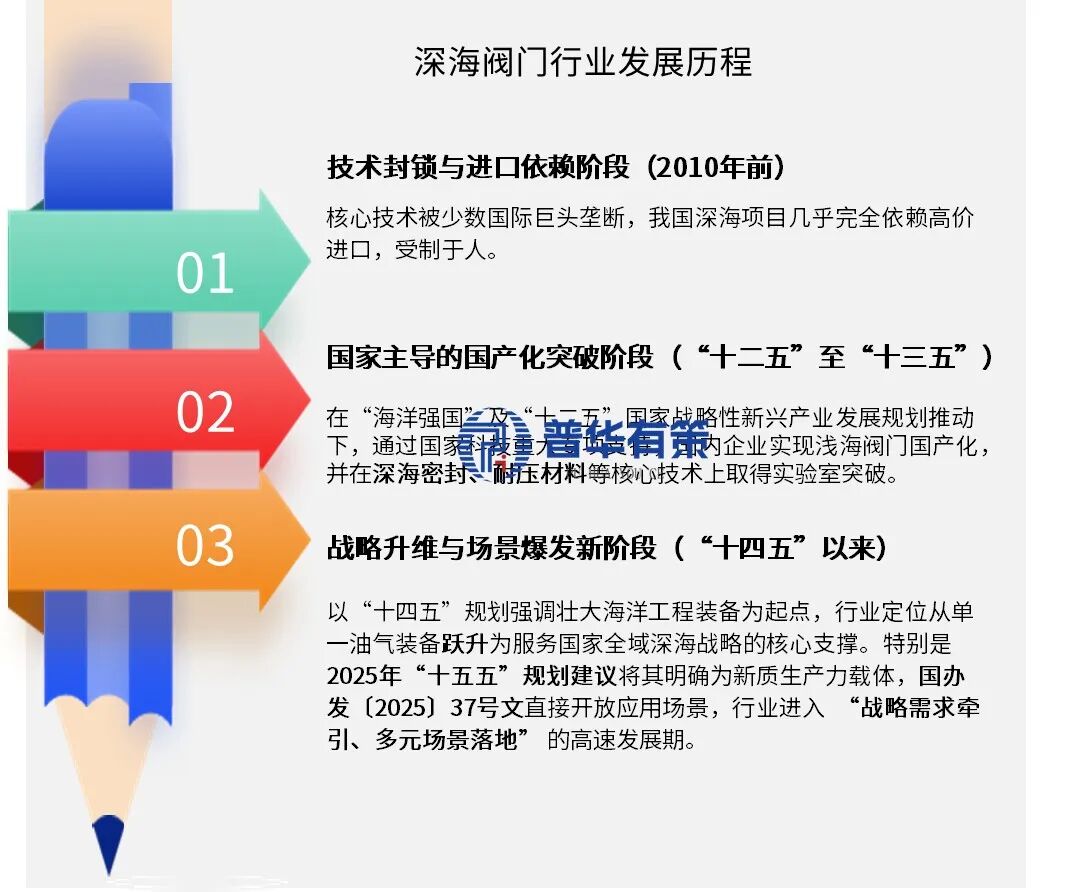
Industry Overview - The deep-sea valve industry is critical for controlling fluid flow in deep-sea and seabed pipeline systems, requiring extreme reliability and longevity under high pressure, low temperature, and corrosive seawater conditions [1][3][4] - Deep-sea valves must operate without failure for 20-30 years under pressures exceeding 110 MPa (equivalent to 11,000 meters of water depth) [3][22] Technological Characteristics - The technology integrates multiple disciplines, including materials science, fluid mechanics, sealing technology, mechanical engineering, and underwater electrical communication [4][22] - Leading companies possess advanced design capabilities and comprehensive testing systems, which are essential for ensuring product reliability [5][23] - The integration of AIoT technology allows for predictive maintenance and operational optimization, marking a shift from hardware to hardware plus data services [5][23] Driving Factors - National strategies and industrial policies are the primary drivers of the deep-sea valve industry, with the "14th Five-Year Plan" emphasizing the importance of deep-sea equipment [6][24] - The demand for energy and resource security has created a pressing need for domestically produced deep-sea development equipment [6][26] - Advances in materials science and intelligent manufacturing technologies are providing the necessary impetus for industry breakthroughs [6][27] - New industrial scenarios, such as deep-sea mining and carbon capture, utilization, and storage (CCUS), are creating significant market opportunities [6][28] Development Trends - Future valves will incorporate various sensors, enabling early leak detection and lifecycle management through digital twin technology [9][29] - The trend is shifting towards fully electric actuation systems, which are simpler and more efficient than traditional hydraulic systems [10][30] - Modular and standardized designs will become prevalent to reduce costs and delivery times [10][31] - Advanced materials and manufacturing processes will be increasingly utilized to meet the extreme conditions of deep-sea environments [10][32] - A collaborative ecosystem among material suppliers, manufacturers, and research institutions will emerge, enhancing innovation across the industry [10][32]

【新闻分析】“新三样”领跑 皖货畅销“一带一路”
Xin Lang Cai Jing· 2026-01-29 22:57
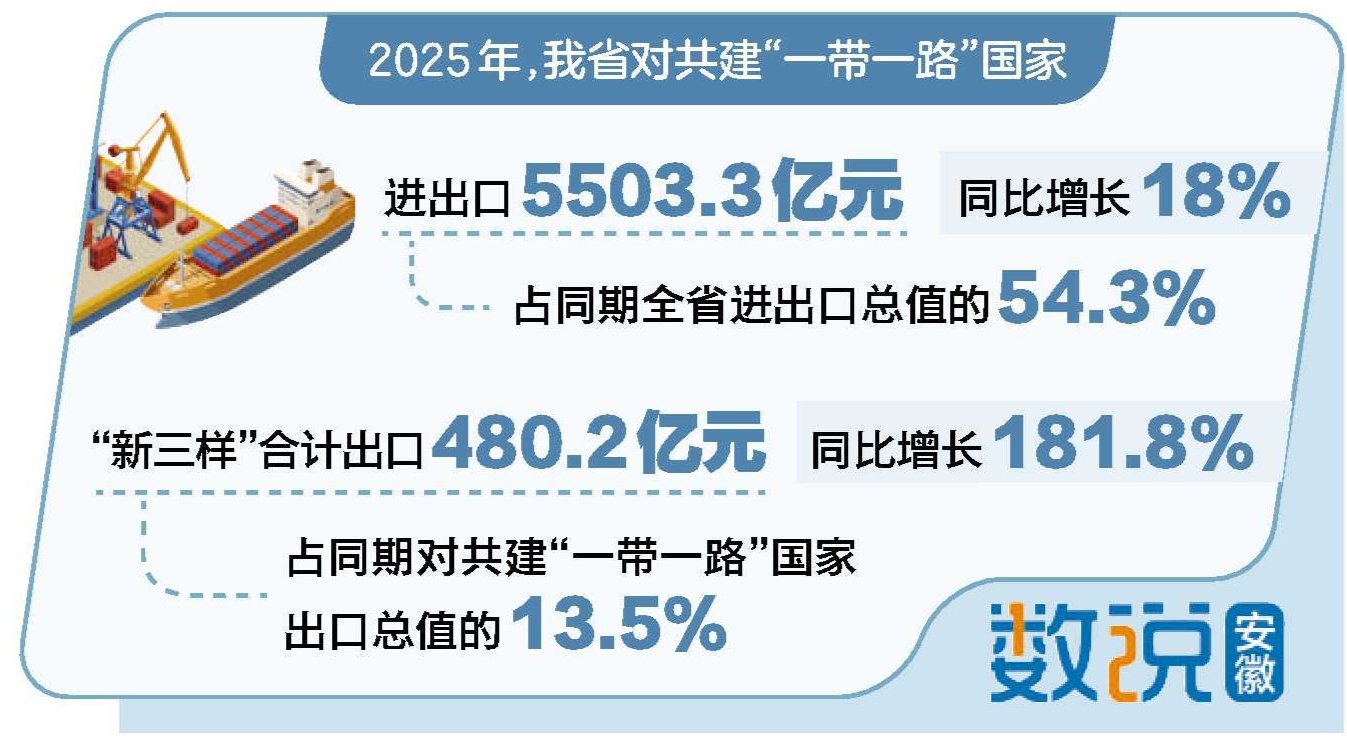
Core Viewpoint - The article highlights the significant growth in trade between Anhui Province and countries involved in the Belt and Road Initiative, with a focus on the increasing export and import activities driven by various industries, particularly in textiles, machinery, and electric vehicles. Group 1: Export Growth - The company Desheng Textile Dyeing (Anqing) Co., Ltd. reports a steady increase in orders from Bangladesh, aligning with the demand for environmentally friendly and durable products, projecting continued growth in exports to Bangladesh by 2025 [3] - Anhui Province's total exports to Belt and Road countries are expected to reach 3,553 billion yuan by 2025, marking a 15% year-on-year increase [3] - In December 2025, Anhui's exports to Belt and Road countries surpassed 600 billion yuan for the first time, achieving 618.2 billion yuan, a 37.9% increase year-on-year [4] Group 2: Key Trade Partners - The top three trade partners for Anhui Province with Belt and Road countries are Chile, Vietnam, and Peru, with respective trade volumes of 476 billion yuan, 458.1 billion yuan, and 356.3 billion yuan, showing year-on-year growth of 39.4%, 137%, and 25% [4] - Other active markets include Brazil, Thailand, Indonesia, Saudi Arabia, Ecuador, and Poland, all exhibiting double-digit growth rates [4] Group 3: Product Categories - Mechanical and electrical products dominate exports, with Anhui Province exporting 2,591.5 billion yuan in such products to Belt and Road countries in 2025, a 15% increase, accounting for 72.9% of total exports [4] - The automotive sector, including chassis, exported 831.3 billion yuan, reflecting a 6.9% increase and representing 23.4% of the total exports [4] Group 4: Import Trends - Anhui Province imported 410.9 million tons of copper ore and its concentrates from Belt and Road countries, a 20% increase, valued at 832.5 billion yuan, which is a 35.1% year-on-year growth [6] - The import of mechanical and electrical products reached 445 billion yuan, a 33.1% increase, while agricultural products imports totaled 154.1 billion yuan, growing by 10.7% [6]
从“中国制造”到“中国智造”:阀安格的创新突围之路
Zhong Guo Chan Ye Jing Ji Xin Xi Wang· 2025-06-24 03:34
Core Insights - VAG China has successfully differentiated itself in the competitive valve industry through an "innovation-driven, quality-based" strategy, achieving over 95% localization in production, which has significantly reduced costs and established a controllable supply chain [1][2] - The company has transitioned from being a "manufacturing base" to an "innovation engine," with 70% of its products being non-standard and innovative, contributing to global markets [2][3] - VAG China's unique business model and technological advancements have allowed it to break through local market limitations and accelerate its global expansion [1][4] Localization and Innovation - VAG China has implemented a fully localized supply chain, from raw material procurement to finished product delivery, enhancing its operational efficiency [4][5] - The company focuses on customized production, allowing rapid design, validation, and manufacturing processes to meet diverse market demands [3][4] - VAG China has developed products tailored to local needs, which have successfully been exported back to global markets, showcasing its innovative capabilities [3][4] Technological Leadership - The company maintains a leading position in technology by investing in R&D and establishing a rapid response mechanism to market demands, exemplified by the quick development of a large-diameter valve within 18 months [4][6] - VAG China's products are integrated into significant infrastructure projects, including major water treatment facilities, demonstrating its technical strength and commitment to quality [5][6] Global Market Expansion - VAG China has expanded its market reach globally, exporting to all continents except Antarctica, and is actively involved in major government projects that enhance its industry standing [5][11] - The company is focusing on the Southeast Asian market, recognizing the rapid growth and potential in countries like Indonesia, Vietnam, and Thailand [12] Sustainability and Environmental Impact - VAG China emphasizes energy-saving technologies in its products, contributing to sustainability goals and reducing energy consumption in various applications [6][7] - The company’s valves play a crucial role in wastewater treatment, enhancing efficiency and reducing environmental impact [7] Talent Management and Corporate Culture - VAG China fosters a strong corporate culture based on trust and collaboration, which enhances operational efficiency and employee satisfaction [9][10] - The company offers competitive benefits and a supportive work environment, resulting in low employee turnover and high morale [9][10]
2025年亚洲阀门市场行情分析:规模、竞争与趋势洞察
Sou Hu Cai Jing· 2025-05-25 06:44
Market Overview - The valve market in Asia is experiencing robust growth, with the market size reaching $50 billion in 2024 and projected to double to $100 billion by 2030, reflecting a compound annual growth rate (CAGR) of 5.1% from 2025 to 2030. This growth is driven by ongoing economic development and large-scale investment activities in the region [2]. - Significant investments in oil and gas exploration in India, including the establishment of the country's first green hydrogen plant by Indian Oil Corporation, are creating new opportunities for the valve market [2]. Municipal Infrastructure Investment - Asian governments are increasing investments in urban wastewater treatment infrastructure to protect natural water bodies and promote water resource recycling, leading to a surge in demand for valves like butterfly valves in the water treatment sector. For instance, India's "Jal Jeevan Mission" aims to invest ₹3.5 trillion over five years to provide piped water to all rural households, further stimulating valve market demand [3]. Competitive Landscape - The competitive landscape of the Asian valve market is characterized by a diverse mix of local and international companies. Local firms dominate the mid-to-low-end market due to cost advantages and familiarity with local markets, while international brands maintain leadership in the high-end market through advanced technology and product quality [4]. - Notably, companies like Wofei Valve (Shanghai) Co., Ltd. are excelling in various sectors, including oil, chemicals, and renewable energy, with significant market shares in fire protection systems and data centers [3][4]. Technological Trends Smart Technology - The integration of IoT, big data, and AI is driving the trend towards smart valves in the Asian market. Smart valves enhance automation and operational efficiency by enabling remote monitoring and automatic adjustments based on real-time data [6]. - Wofei Valve is actively investing in R&D for smart valves, which can automatically adjust based on pressure and flow changes, thereby ensuring stable operations in gas transmission networks [6]. Green Technology - The development and application of green valves are becoming a market focus, emphasizing the use of eco-friendly materials and manufacturing processes to minimize environmental impact. These valves are designed to be energy-efficient and reduce leakage [7]. - Wofei Valve is committed to green practices, producing low-leakage valves that are widely used in industries with high environmental standards, such as chemicals and food and beverage [7]. High-End Manufacturing - The demand for high-end valves is increasing in Asia, particularly in sectors like nuclear power and deep-sea oil extraction, which require valves with high performance and reliability. Companies are investing in R&D to develop new materials and manufacturing processes [8]. - Wofei Valve has made significant strides in high-end valve manufacturing, producing specialized valves that meet stringent requirements in challenging environments, showcasing its technical capabilities [8]. Conclusion - The Asian valve market presents both opportunities and challenges, with continuous growth providing a broad development space for companies. However, intense competition and evolving technological demands necessitate that companies focus on market trends, enhance innovation, and improve product quality and service levels to succeed in this competitive landscape [8].
第七届西洽会凸显西部发展新动能
Ren Min Wang· 2025-05-25 00:57
Group 1 - The seventh China Western International Investment and Trade Fair opened in Chongqing, showcasing various local "black technology" products, including smart medical devices and drones [1] - Chongqing Xishan Technology Co., Ltd. has established a medical-engineering transformation base with local hospitals, focusing on innovative medical projects and achieving complete domestic substitution for its products, with 80% of components self-researched and produced [1] - The "33618" modern manufacturing cluster in Chongqing has been enhancing its capabilities through collaboration among government, society, industry, and enterprises, promoting the integration of industrial, innovation, financial, and talent chains [1] Group 2 - Chongqing Kaima Medical Technology Co., Ltd. has applied full magnetic suspension technology to develop core components for life sciences and semiconductors, reducing product prices to half of imported counterparts, benefiting both patients and market expansion [2] - In 2023, Chongqing's Dianjiang County has attracted over 10 billion yuan to build a smart valve industry base, integrating raw material supply, component processing, and valve production, leading to a high-end smart valve industry chain [2] - Chongqing Huida Lemon Technology Group Co., Ltd. has opened markets in over 30 countries with its annual lemon production of around 70 tons, planning to export processed lemon products [2] Group 3 - The Tongan District has established a virus-free seedling center and a lemon product R&D base, aiming to increase the added value of lemons by over ten times, while collaborating with neighboring cities to create a national core lemon production area of 1 million acres and 1.2 million tons [3] - The Chengdu-Chongqing economic circle is being developed as a significant economic and technological innovation center, with both cities enhancing mutual development and attracting numerous domestic and foreign cooperative projects [3] - The Western International Investment and Trade Fair reflects the rising industrial vitality and enthusiasm for cooperation in China's western region, with expectations for deepening practical cooperation with ASEAN countries through new trade routes [3]
伟隆股份(002871) - 002871伟隆股份投资者关系管理信息20250512
2025-05-12 10:56
Group 1: Market Position and Strategy - The company has successfully launched smart valves and gas valves, which are now in mass production and sales [1] - The core competitive advantages include an experienced R&D team, a complete industry-university-research system, and multiple international certifications and patents [1] - The domestic market strategy focuses on municipal water supply and drainage, while expanding into emerging markets for smart and gas valves through a combination of direct sales and distribution [2] Group 2: Future Growth and Expansion - The company plans to establish its first production base in the Middle East by June 2025 and a manufacturing center in Southeast Asia (Thailand) by 2026 [2] - The strategy includes developing emerging markets and enhancing product ecosystems through strategic acquisitions [2] - The overseas factory in the Middle East is expected to achieve mass production by the end of June 2025, with the Thailand factory projected to be operational in 2026 [2]
