曙光scaleX万卡超集群系统

Search documents
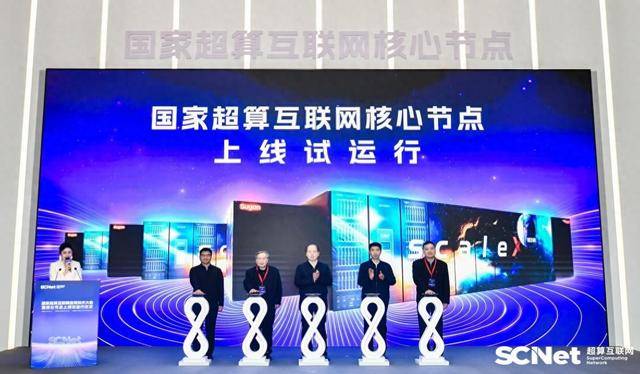
万卡集群,郑州抢跑!国家超算互联网核心节点上线试运行
Sou Hu Cai Jing· 2026-02-06 12:06
Core Insights - The National Supercomputing Internet Core Node has commenced trial operations, supported by the Shuguang scaleX WanKa supercluster system, providing over 30,000 domestic AI computing resources, marking the largest single domestic AI computing resource pool connected to the National Supercomputing Internet platform [1][3] - The core node aims to unify computing power distribution, effectively connecting supply and demand, and promoting the construction of an AI application ecosystem [3] - Zhengzhou's core node is designed for flexible scalability, capable of expanding to 100,000 or even 1,000,000 computing units, and is strategically located to enhance regional development [3][4] Infrastructure and Development - The core node will significantly enhance high-performance computing capabilities in Zhengzhou and the central region, facilitating nationwide unified scheduling of computing resources through high-speed communication networks [4] - Zhengzhou plans to integrate supercomputing resources with local industries, focusing on sectors such as intelligent sensors, new energy vehicles, high-end equipment, and new materials [4] - The establishment of a computing power trading system and emphasis on data security and privacy protection are also part of Zhengzhou's strategy to expand local computing service applications [4] Application and User Engagement - The supercomputing internet is transitioning to a model that emphasizes both construction and application, aiming to create a marketplace for computing applications similar to e-commerce platforms [5] - By the end of 2025, the platform is expected to serve over 1 million users, with more than 7,200 application products and a peak daily processing workload of 1.03 million tasks [5] - The core node's testing program includes lightweight trials and large-scale testing, offering resources for various user groups, including startups and students [7] Innovation and Research - The core node has achieved innovative applications in key areas such as artificial intelligence, watershed management, weather forecasting, molecular simulation, and industrial simulation, with over 400 mainstream models optimized [7] - The platform aims to provide efficient and accessible computing services for various cutting-edge application scenarios, promoting the free flow and usability of computing power [7]

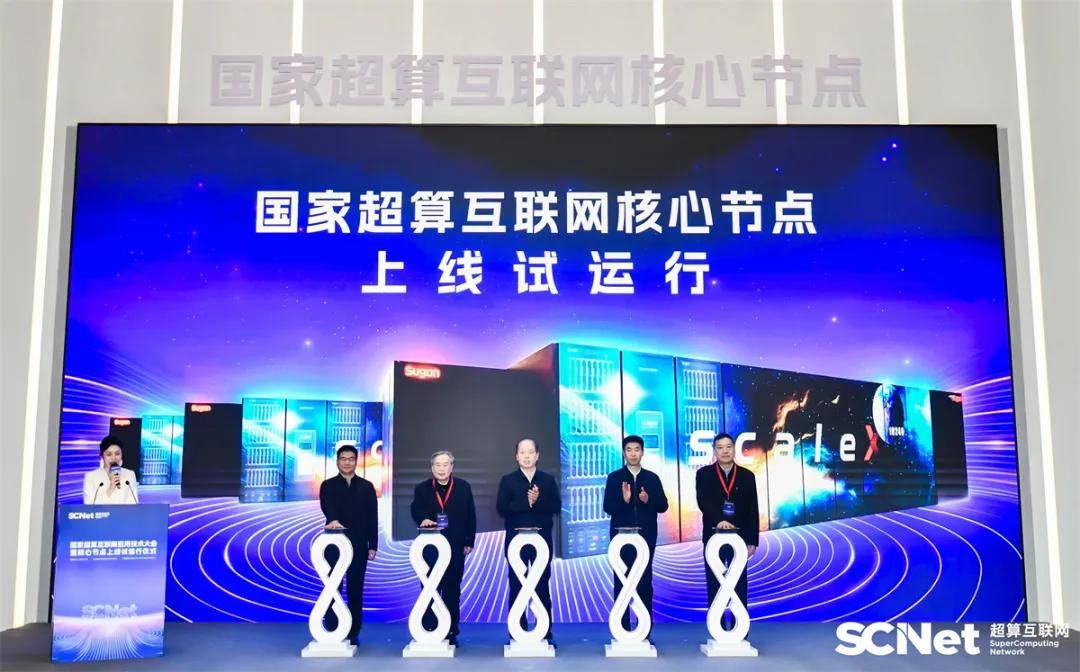
国家超算互联网核心节点上线试运行,托举中国AI算力应用关键一跃
Sou Hu Cai Jing· 2026-02-05 15:44
Core Insights - The National Supercomputing Internet Application Technology Conference marked the launch of the core node's trial operation, supported by various government agencies and experts in the field [1][3] - The newly launched computing resource pool, powered by the Dawning scaleX supercluster system, offers over 30,000 domestic AI computing units, making it the largest single domestic AI computing resource pool in the country [1][3] Group 1: National Supercomputing Internet Node - The trial operation of the national supercomputing internet core node addresses the critical bottleneck of insufficient computing resources, which has hindered industrial upgrades [3] - The Dawning scaleX supercluster is based on an open architecture for AI computing, compatible with mainstream software ecosystems, and supports mixed deployment of various domestic acceleration cards [3] - The national supercomputing internet aims to provide integrated computing resource scheduling and access to thousands of applications, enhancing the usability of Chinese AI computing for global users [3] Group 2: Regional Development and Innovation - The launch of the supercomputing internet core node signifies the emergence of a computing application hub in Central China, facilitating the integration of computing resources and application demands both nationally and globally [4] - The core node is expected to attract talent, data, and application scenarios, contributing to high-quality regional development [4] Group 3: Infrastructure and Application Development - The national supercomputing internet platform is transitioning to a phase of "building and using in parallel," promoting efficient and accessible computing services for various cutting-edge application scenarios [5] - The platform aims to serve over 1 million users by the end of 2025, with more than 7,300 application products and a peak daily processing capacity of 1.03 million jobs [5] - The supercomputing internet is becoming a core engine for activating industrial innovation, providing robust computing support for the "AI+" initiatives across various sectors [7]
国产算力再传喜讯!超算互联网落子破局算力围堵
Xin Lang Cai Jing· 2026-02-05 12:18
Core Insights - The National Supercomputing Internet has entered a new phase of scale, with the launch of a core node in Zhengzhou that provides over 30,000 domestic AI computing resources, marking the largest single domestic AI computing resource pool connected to the platform since its inception [2][12] - The platform aims to provide efficient and accessible computing services for various cutting-edge application scenarios, allowing computing power to flow freely and be easily utilized, similar to utilities like water and electricity [2][12] - The domestic AI computing industry faces a dichotomy of explosive demand for AI models and significant idle computing resources, primarily due to barriers in the "last mile" of computing application [2][12] Industry Challenges - Many intelligent computing centers possess substantial computing power but struggle to be directly utilized by end users due to heterogeneous technical barriers between centers and users, necessitating extensive adaptation and tuning work [3][4] - This situation has created cost and efficiency pressures for many small and medium-sized user groups, leading to a predicament of "too expensive and difficult to use" [5][12] Technological Advancements - The core node utilizes the Shuguang scaleX super cluster, designed on an open architecture for AI computing, fully compatible with mainstream software ecosystems like CUDA, and supports mixed deployment of various domestic acceleration cards [7][14] - This design allows for flexible scaling to tens of thousands or millions of computing units and facilitates integrated scheduling of computing resources across the supply chain [14] Service Model and User Engagement - The National Supercomputing Internet platform is transitioning towards a "computing power + application" integrated service model, akin to e-commerce platforms like JD.com and Taobao, which significantly lowers computing costs and usage barriers [14] - As of now, the platform has over 7,300 application products, peaks at 1.03 million jobs processed daily, and serves over 1 million users [16] Future Plans - The core node has announced an invitation for testing plans based on lightweight trials and large-scale testing, offering application adaptation tests from hundreds to tens of thousands of computing units for various industry users [18] - Target groups such as makers, startups, and students can access free trial resources, including thousands of computing hours, hundreds of gigabytes of storage, and millions of tokens [19] Industry Impact - The National Supercomputing Internet is addressing the growing contradiction between idle computing resources and demand, adopting a more open and platform-based approach, which is a positive development for the entire AI computing industry [20]

摩尔线程 突发大消息!
Zhong Guo Ji Jin Bao· 2025-12-20 13:32
Core Insights - Moore Threads unveiled its next-generation GPU architecture "Huagang" at the first MUSA Developer Conference, showcasing a full-stack technology system centered around its self-developed MUSA unified architecture [2][3] Group 1: New GPU Architecture - The "Huagang" architecture achieves significant breakthroughs in computing density, energy efficiency, precision support, interconnect capabilities, and graphics technology [3] - Key features include a 50% increase in computing density, substantial energy efficiency optimization, and support for full precision calculations from FP4 to FP64, along with new MTFP6/MTFP4 and mixed low precision support [3] - It integrates a new asynchronous programming model and self-developed MTLink high-speed interconnect technology, supporting the expansion of intelligent computing clusters with over 100,000 cards [3] Group 2: Future Chip Releases - Moore Threads announced two upcoming chips based on the "Huagang" architecture: "Huashan" focuses on AI training and inference integration for large-scale intelligent computing, serving as a robust foundation for the next-generation "AI factory" [4] - The "Lushan" chip specializes in high-performance graphics rendering, boasting a 64-fold increase in AI computing performance, a 16-fold increase in geometric processing performance, and a 50-fold increase in ray tracing performance [4] Group 3: Launch of Intelligent Computing Cluster - The company officially launched the "Kua'a" intelligent computing cluster, which offers full precision and general computing capabilities, achieving efficient and stable AI training and inference at a scale of 10,000 cards [5] - Core breakthroughs include a floating-point computing capability of 10 Exa-Flops, with training utilization rates of 60% on Dense models and 40% on MOE models, and a linear training expansion efficiency of 95% [5] Group 4: Competitive Landscape - Moore Threads did not showcase the products at the event, while Inspur unveiled the "Shuguang scaleX" ultra-cluster system, marking the first public appearance of a domestic 10,000-card computing cluster [6] - The industry is witnessing significant innovations in super-node architecture, high-speed interconnect networks, and storage performance optimization, with some technologies surpassing NVIDIA's 2027 roadmap milestones [6]
摩尔线程,突发大消息!
中国基金报· 2025-12-20 08:54
Core Viewpoint - Moore Threads has unveiled its new GPU architecture "Huagang" at the first MUSA Developer Conference, showcasing a comprehensive stack of technological achievements centered around its self-developed MUSA unified architecture [2][4]. Group 1: New GPU Architecture "Huagang" - The "Huagang" architecture features significant improvements in computing performance, with a 50% increase in computing density and optimized energy efficiency, supporting full precision calculations from FP4 to FP64 [4]. - It integrates a new asynchronous programming model and supports large-scale interconnection, enabling the expansion of computing clusters with over 100,000 cards through the self-developed MTLink high-speed interconnect technology [4]. - The architecture also includes an AI generative rendering framework and enhanced hardware ray tracing acceleration, fully supporting DirectX 12 Ultimate, facilitating a high degree of synergy between graphics rendering and intelligent computing [4]. Group 2: Future Chip Releases - Based on the "Huagang" architecture, Moore Threads announced two upcoming chips: "Huashan," which focuses on AI training and inference integration for large-scale intelligent computing, and "Lushan," which specializes in high-performance graphics rendering [5]. - The "Lushan" chip is expected to enhance AI computing performance by 64 times, geometric processing performance by 16 times, and ray tracing performance by 50 times, while significantly improving texture filling, atomic memory access, and video memory capacity [5]. Group 3: Launch of Kuaguo Computing Cluster - Moore Threads officially launched the Kuaguo computing cluster, which boasts full precision and general computing capabilities, achieving efficient and stable AI training and inference at a scale of ten thousand cards [7]. - The cluster's core breakthroughs include a floating-point computing capability of 10 Exa-Flops, with training utilization rates of 60% for Dense models and 40% for MOE models, and a linear scaling efficiency of 95% [7].

摩尔线程,突发大消息!
Zhong Guo Ji Jin Bao· 2025-12-20 08:50
Core Insights - Moore Threads unveiled its next-generation GPU architecture "Huagang" at the MUSA Developer Conference, showcasing a full-stack technology system centered around its self-developed MUSA unified architecture [1][2]. Group 1: New GPU Architecture - The "Huagang" architecture features significant improvements in computing performance, with a 50% increase in computing density and enhanced energy efficiency, supporting full precision from FP4 to FP64 [2]. - It integrates a new asynchronous programming model and MTLink high-speed interconnect technology, enabling scalability for over 100,000 card intelligent computing clusters [2]. - The architecture includes an AI generative rendering framework and supports DirectX 12 Ultimate, facilitating a high degree of synergy between graphics rendering and intelligent computing [2]. Group 2: Upcoming Chip Technologies - Moore Threads announced two upcoming chips based on the "Huagang" architecture: "Huashan," which focuses on AI training and inference for large-scale intelligent computing, and "Lushan," which specializes in high-performance graphics rendering [3]. - The "Lushan" chip is expected to enhance AI computing performance by 64 times, geometric processing performance by 16 times, and ray tracing performance by 50 times, along with improvements in texture filling and memory capacity [3]. Group 3: Intelligent Computing Cluster - The company launched the "Kua'e" intelligent computing cluster, capable of full precision and general-purpose computing, achieving a floating-point operation capability of 10 Exa-Flops [4]. - The training efficiency metrics include a 60% utilization rate for Dense large models and a 40% rate for MOE large models, with effective training time exceeding 90% and linear scaling efficiency reaching 95% [4]. Group 4: Competitive Landscape - Moore Threads did not showcase the products at the event, while another company, Inspur, presented its "scaleX" super cluster system, marking the first public appearance of a domestic ten-thousand-level computing cluster [5]. - The competitive landscape indicates that Moore Threads is proactively positioning itself for future computing scenarios, including the launch of the MT Lambda intelligent simulation training platform [5].
算力内卷时代,“开放架构”万卡超集群为何成刚需?
Xi Niu Cai Jing· 2025-12-20 04:47
Core Insights - The development of AI large models requires significant resources, including a large number of technical experts and substantial financial investment, with a critical need for powerful computing capabilities [1] - The demand for computing power is expected to grow exponentially across various industries, with IDC predicting that China's intelligent computing power demand will reach 2781 EFLOPS by 2028, reflecting an annual growth rate of 46.2% [1] - Traditional computing clusters face bottlenecks when scaling beyond thousands of cards, necessitating innovative solutions like the "ten-thousand card super cluster" [2] Group 1: ScaleX Ten-Thousand Card Super Cluster - The ScaleX ten-thousand card super cluster system was unveiled by Sugon at the HAIC2025 conference, designed to meet the extreme demands of AI infrastructure [3] - This system features 16 super nodes connected by a proprietary high-speed network, capable of supporting 10,240 AI accelerator cards, marking a significant advancement in domestic large-scale computing cluster technology [5] - The ScaleX system achieves a total computing power exceeding 5 EFLOPS, with a power usage effectiveness (PUE) value as low as 1.04, enhancing computing density by 20 times [5][9] Group 2: Technical Advantages - The ScaleX system utilizes a self-developed RDMA high-speed network, achieving 400 Gb/s bandwidth and under 1 microsecond communication latency, significantly improving communication performance [9] - The system incorporates deep optimization for storage, computing, and transmission, enhancing resource utilization by 55% during large model training [9] - It features a digital twin for intelligent scheduling and management, ensuring 99.99% availability and supporting the management of tens of thousands of nodes [9] Group 3: Open Architecture and Ecosystem Development - The ScaleX super cluster supports multiple brands of accelerator cards and mainstream computing ecosystems, promoting an open architecture for AI computing [10] - This initiative aims to lower the barriers for AI companies to develop intelligent computing clusters and foster a collaborative industrial ecosystem [10][12] - The open model allows users greater choice and compatibility with mainstream AI development frameworks, facilitating broader participation in the ecosystem [12][13]