
夸娥万卡智算集群

Search documents
预计增速超230%!摩尔线程2025年营收有望突破15亿元,国产全功能GPU迈入规模商用阶段
Mei Ri Jing Ji Xin Wen· 2026-01-22 09:44
Core Viewpoint - The domestic GPU sector is experiencing significant growth, with Moores Threads projecting a revenue increase of 230.70% to 246.67% in 2025, reaching between 1.45 billion to 1.52 billion yuan, marking a pivotal moment for the commercialization of domestic GPUs [1][2] Group 1: Revenue Growth and Market Demand - Moores Threads' revenue is expected to surge from 438 million yuan in 2024 to over 1.45 billion yuan in 2025, driven by external market demand and internal technological breakthroughs [2] - The year 2025 is identified as the "year of large-scale deployment of AI models," with a significant increase in demand for high-performance computing across various sectors, particularly under the ongoing domestic substitution policies [2][7] - The flagship product, MTT S5000, based on the fourth-generation GPU architecture, is set to achieve mass production in 2025, serving as the core engine for revenue growth [2][3] Group 2: Product Performance and Technological Advancements - The MTT S5000 supports large-scale model training and has demonstrated high efficiency and performance, achieving a linear expansion efficiency of 95% and effective training time exceeding 90% [2][3] - The S5000 has established new benchmarks for domestic inference performance, with throughput exceeding 4000 tokens/s for Prefill and 1000 tokens/s for Decode [3] - Moores Threads has successfully transitioned from technology development to large-scale commercialization, with the S5000 operating stably in complex scenarios [3][8] Group 3: Strategic Investment and R&D Commitment - The GPU industry is characterized by high capital and talent intensity, and Moores Threads has chosen a challenging path by focusing on full-function GPUs, which require breakthroughs in various computing capabilities [4][6] - The company has invested over 4.3 billion yuan in R&D from 2022 to mid-2025, with funds primarily directed towards developing new AI training and inference chips [6] - Moores Threads aims to build a comprehensive competitive strategy through sustained high-intensity R&D investments, reflecting its long-term vision [6][8] Group 4: Market Position and Future Outlook - The demand for domestic AI computing is projected to grow at an annual rate exceeding 50%, creating a substantial market for domestic GPUs [7] - Moores Threads is one of the few companies in China pursuing a full-function GPU technology route, which enhances user stickiness and ecosystem expansion [7] - The core team, with extensive experience from international GPU giants, is driving the company towards achieving competitive product performance and market presence [7][8]
摩尔线程去年预亏10亿,旗舰GPU量产
Guan Cha Zhe Wang· 2026-01-21 14:01
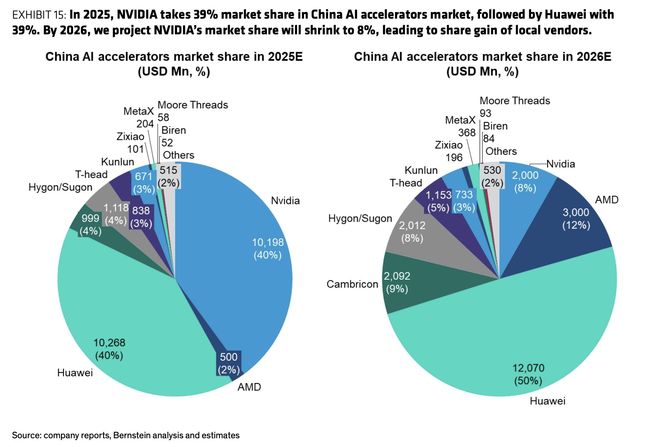
Core Viewpoint - The company, Moore Threads, forecasts a significant revenue increase for 2025, driven by the booming AI industry and strong demand for high-performance GPUs, despite expected net profit decline and ongoing research and development investments [1][2]. Financial Performance - Expected revenue for 2025 is projected between 1.45 billion to 1.52 billion yuan, representing a year-on-year growth of 230.70% to 246.67% [1]. - The anticipated net profit is estimated to be between 950 million to 1.06 billion yuan, reflecting a year-on-year decline of 34.50% to 41.30% [1]. - The company expects a non-recurring loss of 1.04 billion to 1.15 billion yuan, which is a reduction of 29.59% to 36.32% year-on-year [1]. Market Position and Competition - Moore Threads positions itself uniquely in the domestic market with its "AI + Graphics" dual-drive strategy, utilizing its MUSA architecture [2]. - The company claims to be the only domestic GPU capable of competing with NVIDIA, integrating AI computation acceleration, graphics rendering, scientific computing, and video codec capabilities [2]. - According to Bernstein Research, NVIDIA and Huawei are expected to dominate the Chinese AI accelerator market with 40% market share each by 2025, while other competitors like Haiguang and Pingtouge hold only 4% [2]. Research and Development - The GPU industry is characterized by high barriers to entry, significant R&D investment, and long development cycles, requiring comprehensive R&D capabilities [3]. - Moore Threads has invested over 4.3 billion yuan in R&D from 2022 to the first half of 2025, compared to 1.07 billion yuan by Cambrian for 2024 [3]. Technological Advancements - The company has achieved market-leading performance with its fourth-generation GPU architecture, the MTT S5000, which has reached a floating-point computing capability of 10 Exa-Flops in a cluster [5]. - The fifth-generation GPU architecture, "HuaGang," supports full precision calculations and will lead to the development of high-performance AI training chips and graphics rendering chips [5]. - Recent collaborations have demonstrated the capabilities of the MTT S5000 in training large models, marking significant advancements in the domestic GPU sector [6]. Funding and Future Projects - Moore Threads announced plans to use its own funds to meet the financial needs of its R&D projects, ensuring the smooth progress of GPU development [6]. - The funding will focus on three core R&D projects: next-generation AI training and inference chips, next-generation graphics chips, and next-generation AI SoC chips [6].

看2026|摩尔线程周苑:让国产算力从“可用”走向“好用”
Xin Jing Bao· 2025-12-29 09:16
Core Viewpoint - The enthusiasm in China's capital market is being fueled by the rise of "domestic GPUs," with companies like Moore Threads making significant strides in the industry and contributing to a broader transformation driven by autonomous computing [2] Group 1: Industry Trends and Developments - The central economic work conference for 2026 emphasizes "innovation-driven" growth and the cultivation of new economic drivers, particularly in the context of AI and domestic chip development [2] - The GPU industry is transitioning from "single-point breakthroughs" to "systematic challenges and ecosystem building," indicating progress in overcoming critical technological barriers [5][6] - The first MUSA Developer Conference (MDC 2025) highlighted the importance of building a developer ecosystem around the MUSA architecture, which aims to compete with NVIDIA's CUDA [5] Group 2: Company Strategy and Positioning - Moore Threads aims to enhance its core competitiveness through a strategy centered on a full-function GPU and the MUSA architecture, focusing on comprehensive computing capabilities from cloud to edge [6] - The company plans to increase R&D investment and foster collaboration between academia and industry to accelerate the development of the domestic GPU sector [6][7] - The recent release of the "Huagang" architecture, which boasts a tenfold performance improvement over previous generations, exemplifies the company's commitment to technological advancement [6] Group 3: Policy and Market Opportunities - The central government's focus on "AI+" and the promotion of core technology independence presents significant strategic opportunities for companies like Moore Threads [8][10] - The concept of "new momentum" in the intelligent computing sector includes building a self-sufficient technology base, integrating AI into various industries, and fostering a collaborative ecosystem centered around developers [10] Group 4: Regional Development and Ecosystem - The national strategy for regional integration is seen as a way to maximize resource advantages and create unprecedented collaborative opportunities for the domestic computing industry [11] - Moore Threads aims to position itself as a foundational player in Beijing's integrated circuit industry, leveraging the city's rich resources and supportive policies [12][14] - The company advocates for enhancing the resilience of the integrated circuit supply chain and promoting collaborative innovation across the Beijing-Tianjin-Hebei region [16][18]

摩尔线程周苑:扩大北京新一代信息技术产业集群优势
Xin Jing Bao· 2025-12-29 08:52
Core Viewpoint - The article discusses the upcoming five-year plan for China's economy, emphasizing the importance of innovation and the development of new driving forces, particularly in the context of the domestic GPU industry and its role in the broader economic landscape [1][3][7]. Group 1: Economic Context and Policy Direction - The Central Economic Work Conference highlighted the need for steady progress and quality improvement in economic work for 2026, focusing on stabilizing employment, enterprises, markets, and expectations [1]. - The conference outlined eight key tasks for 2026, including the acceleration of innovation-driven development and the cultivation of new economic drivers [3][7]. Group 2: GPU Industry and Company Strategy - The domestic GPU industry is experiencing a transformation, with companies like Moer Thread making significant strides, as evidenced by its recent listing on the STAR Market [3]. - Moer Thread aims to establish a comprehensive computing power platform through its MUSA architecture, focusing on full-stack development and continuous innovation [5][6]. - The company emphasizes the importance of building a developer ecosystem, which is crucial for the competitive landscape of the GPU industry [4][6]. Group 3: Technological and Ecological Development - Moer Thread's strategy includes a commitment to open-source innovation and empowering developers, which is seen as essential for creating a robust AI ecosystem [6][8]. - The company is expanding its product offerings from data centers to edge and endpoint solutions, thereby broadening its market reach and validating its technology in real-world applications [6][9]. Group 4: Regional Development and Industry Positioning - Moer Thread positions itself as a key player in Beijing's integrated circuit industry, benefiting from the city's rich resources and supportive policies [9][10]. - The company advocates for enhanced collaboration across the entire supply chain and the establishment of a resilient integrated circuit industry in Beijing [11].

看2026|摩尔线程周苑:扩大北京新一代信息技术产业集群优势
Bei Ke Cai Jing· 2025-12-29 08:40
Group 1 - The core message emphasizes the importance of innovation and the development of new driving forces in China's economy as it transitions into the "15th Five-Year Plan" period, with a focus on enhancing quality and efficiency [3][5][19] - The central economic work conference highlighted the need to stabilize employment, businesses, and market expectations while promoting effective qualitative improvements and reasonable quantitative growth [3][5] - The upcoming five-year journey starting in 2026 is seen as a critical period for economic development, with a call for collaboration among regulatory bodies, scholars, and leading entrepreneurs to interpret policy trends and changes [4][5] Group 2 - The domestic GPU industry is experiencing a surge, with companies like Moore Threads successfully entering capital markets, indicating a significant shift towards self-reliant computing capabilities [5][16] - Moore Threads aims to establish a comprehensive computing power platform through its MUSA architecture, focusing on continuous innovation and development across various applications, including AI and scientific computing [16][18] - The company is committed to fostering a developer ecosystem by hosting events and creating platforms to lower barriers for developers, which is crucial for building a robust AI ecosystem [17][24] Group 3 - The strategic focus of Moore Threads includes enhancing its core competitiveness through a full-stack GPU approach, emphasizing independent architecture and continuous R&D investment [16][20] - The company recognizes the significance of regional integration in fostering innovation, particularly in areas like Beijing, which boasts a complete integrated circuit industry chain [21][22] - Moore Threads plans to leverage its position in Beijing to contribute to the development of the new generation of information technology and the AI ecosystem, aligning with national policies [23][26] Group 4 - Recommendations for optimizing the integrated circuit industry ecosystem in Beijing include strengthening the entire supply chain, enhancing application-driven technology iterations, and fostering an open innovation environment for talent development [28][29][30] - The company believes that collaborative efforts across design, manufacturing, and application sectors will enhance the resilience and self-sufficiency of the integrated circuit industry [28] - By promoting real-world applications and feedback, Moore Threads aims to accelerate the maturity of domestic chips and AI models, driving innovation and industry growth [29]

国产GPU“四小龙”扎堆IPO,它们能平替英伟达吗?
Sou Hu Cai Jing· 2025-12-25 11:25
Core Viewpoint - The domestic GPU industry is experiencing a capital frenzy as several companies prepare for IPOs, with significant market valuations and investor enthusiasm, despite the underlying financial challenges and losses faced by these companies [2][3][10]. Group 1: IPO and Market Performance - Moer Technology became the first domestic GPU stock on the Sci-Tech Innovation Board, opening at 650 CNY per share, a 468.78% increase from its issue price of 114.28 CNY, with a market cap exceeding 300 billion CNY [2]. - Muxi Co. also listed on the Sci-Tech Innovation Board, seeing an opening surge of over 568%, with its market cap quickly surpassing 300 billion CNY [2]. - On the same day as Muxi's listing, Birun Technology passed the Hong Kong Stock Exchange hearing, positioning itself to become the first GPU stock in Hong Kong [2]. Group 2: Financial Performance and Challenges - Moer Technology, Muxi Co., and Birun Technology are currently operating at a loss, with Moer reporting a loss of 724 million CNY in the first three quarters of 2025, Muxi at 346 million CNY, and Birun at 1.601 billion CNY in the first half of the year [3]. - In comparison, Nvidia's revenue for a single quarter in 2025 exceeded 30 billion USD, while domestic GPU companies' revenues are only in the range of several hundred million to a few billion CNY [3]. Group 3: Market Drivers and Trends - The IPO wave of domestic GPU companies is driven by a growing demand for computing power, a need for domestic alternatives, and a shift in capital investment logic [3][6]. - The demand for computing power has surged since the global AI model boom initiated by ChatGPT in 2023, with predictions indicating that China's total computing power will reach 3442.89 EFLOPs by 2029, growing at a compound annual growth rate of 40% [5]. Group 4: Competitive Landscape and Differentiation - The four leading domestic GPU companies, referred to as the "Four Little Dragons," are pursuing differentiated paths in technology, product positioning, and application scenarios [7]. - Moer Technology focuses on a full-featured GPU similar to Nvidia, while Muxi Co. specializes in AI computing GPUs, and Birun Technology emphasizes extreme computing power with its BR100 chip [8][9]. Group 5: Future Outlook - The domestic GPU industry is expected to face challenges in competing with Nvidia's established ecosystem, but there are structural opportunities for growth supported by national policies and a rich landscape of AI application scenarios in China [10][11]. - The future of domestic GPUs will depend on their ability to develop core technologies, production capabilities, and clear commercialization paths, with a focus on ecosystem service and scenario adaptation [12][13].

ETF盘中资讯 | 摩尔线程发布新一代GPU架构!大数据ETF华宝(516700)微跌0.5%,机构:AI竞争转向思考链深度与场景渗透
Jin Rong Jie· 2025-12-23 05:53
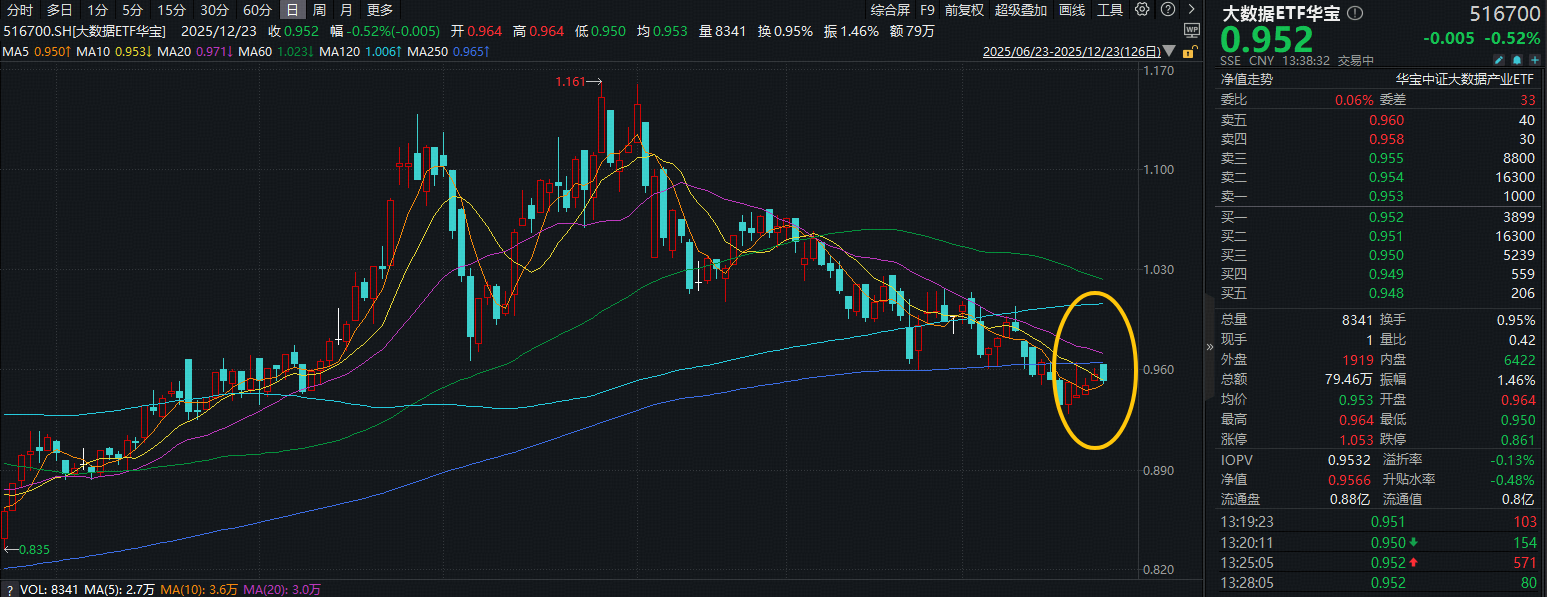
Group 1 - The big data industry ETF (516700) showed weak performance with a decline of 0.52% in intraday trading on December 23 [1] - Key stocks such as Qiming Star, Guotou Intelligent, and Qi Anxin performed strongly with increases of 2.17%, 1.49%, and 0.98% respectively, while Zhongke Star Map, Youkede, and Siwei Tuxin showed weaker performance with declines of 3.06%, 2.57%, and 2.0% respectively [1] Group 2 - Moore Threads released a new generation of full-featured GPU architecture "Huagang" on December 20, supporting full precision computing and launching high-performance AI training and inference chips, with its Kua'e Wanka intelligent computing cluster reaching international mainstream levels in multiple indicators [3] - Alibaba integrated its C-end business to establish the "Qianwen C-end Business Group" on December 15, aiming to develop the Qianwen APP into an AI super application entry point covering multiple intelligent service scenarios [3] - The focus of the global large model is shifting from "fast thinking" to "slow thinking," moving from computing power accumulation to algorithm and training paradigm optimization, with the industry focus transitioning from benchmark testing to real-world task execution [3] Group 3 - The big data industry ETF passively tracks the CSI Big Data Industry Index, heavily investing in sectors such as data centers, cloud computing, and big data processing, with key stocks including Zhongke Shuguang, Keda Xunfei, and Unisplendour [4] - Investors interested in technology self-reliance may focus on three catalytic aspects: the call for "technology to take the lead," the top-level design of digital China to activate digital productivity, and the acceleration of the domestic substitution process [5]
摩尔线程发布新一代GPU架构!大数据ETF华宝(516700)微跌0.5%,机构:AI竞争转向思考链深度与场景渗透
Xin Lang Ji Jin· 2025-12-23 05:47
Group 1 - The core viewpoint of the news highlights the performance of the big data industry ETF (516700), which showed a decline of 0.52% in intraday trading, while certain constituent stocks like Qimingxingchen, Guotou Intelligent, and Qi Anxin performed strongly with increases of 2.17%, 1.49%, and 0.98% respectively [1] - The article discusses the recent developments in the AI sector, particularly the launch of the new GPU architecture "Huagang" by Moore Threads, which supports full precision computing and high-performance AI training chips, achieving international mainstream levels in several metrics [3] - The focus of the AI industry is shifting from "fast thinking" to "slow thinking," emphasizing algorithm and training paradigm optimization, with a transition from benchmark testing to real-world task execution [3] Group 2 - The big data industry ETF (516700) passively tracks the CSI Big Data Industry Index, heavily investing in sectors such as data centers, cloud computing, and big data processing, with key stocks including Zhongke Shuguang, Keda Xunfei, and Unisplendour [4] - There are three main catalysts for investors interested in the direction of technological self-reliance: the call for "technology to lead," the top-level design of Digital China to activate digital productivity, and the acceleration of the domestic substitution process [4] - The article notes that the trend of "信创" (Xinchuang) is expected to accelerate, indicating a broad outlook for technological self-reliance [4]
MDC2025:全功能GPU路线清晰,MUSA生态进入规模化验证阶段
海通国际· 2025-12-23 05:14
Investment Rating - The report does not explicitly state an investment rating for the industry or specific companies involved. Core Insights - The MUSA 5.0 has established a comprehensive full-stack system that includes instruction sets, programming models, compilers, and communication libraries, achieving engineering performance close to international mainstream standards across key metrics [2][10] - The Huagang architecture, introduced at the MDC 2025, represents a significant upgrade in compute density, energy efficiency, precision coverage, and interconnect capabilities, supporting full-precision computing from FP4 to FP64 and introducing mixed low precision [2][10] - Moore Threads is one of the few domestic GPU vendors committed to a "full-function GPU" strategy rather than focusing solely on AI accelerators, indicating a long-term vision for broader ecosystem development [2][10] Summary by Sections Event Overview - The inaugural MUSA Developer Conference (MDC 2025) was held on December 20-21, 2025, in Beijing, focusing on sovereign computing and the developer ecosystem, unveiling the next-generation full-function GPU architecture Huagang and the Ku'e ten-thousand-card AI compute cluster [1][9] Technical Developments - The Huagang architecture emphasizes asynchronous programming and ultra-large-scale interconnect (MTLink), laying the groundwork for scaling to ten-thousand-card and hundred-thousand-card clusters [2][10] - The Ku'e ten-thousand-card AI compute cluster achieved approximately 60% MFU on dense models and 40% on MoE models, with a linear scaling efficiency of about 95% and effective training time exceeding 90% [3][11] Ecosystem and Strategy - The report outlines a clear roadmap for progressively open-sourcing core components, including compute libraries and communication libraries, to enhance the ecosystem [2][14] - The MT Lambda platform was launched, integrating physics engines, graphics rendering engines, and AI compute engines to create a full-stack framework for development, simulation, and training [3][12] Future Directions - The company has articulated a clear product segmentation path with a focus on unified AI training and inference, positioning itself as a foundation for next-generation AI factories [2][14] - The Huashan and Lushan architectures are designed to cater to AI training and high-performance graphics rendering, respectively, with significant improvements in various performance metrics [3][14]
技术突围与资本共振: 人工智能赛道涌现上市潮
Zhong Guo Zheng Quan Bao· 2025-12-22 20:37
Core Insights - The Chinese AI industry is experiencing a significant capital market influx, with companies like Zhipu and MiniMax aiming for IPOs, indicating a critical phase of commercialization in AI technology [1][2] - The AI sector is projected to grow rapidly, with the core industry expected to exceed 900 billion yuan in 2024 and potentially surpass 1.2 trillion yuan in 2025, reflecting a 24% growth rate [1][6] - Despite the rapid growth, challenges such as high costs and low returns in AI applications persist, necessitating patience from investors [1][7] Company Summaries - Zhipu, established in 2019, has empowered over 12,000 enterprise clients and 80 million terminal devices, leading the independent general-purpose AI model market in China with a 6.6% market share [2] - MiniMax, founded in early 2022, has rapidly developed a product matrix for both C-end and B-end users, reaching over 2.12 million personal users and 130,000 enterprise clients across more than 200 countries [2] - Both Zhipu and MiniMax have shown substantial revenue growth, with Zhipu's revenue increasing from 57.4 million yuan in 2022 to 312.4 million yuan in 2024, and MiniMax's revenue projected to grow from 3.46 million USD in 2023 to 30.52 million USD in 2024 [5] Market Trends - The demand for AI models is surging, with daily token consumption in China exceeding 30 trillion by mid-2023, reflecting a 300-fold increase within a year [5] - The AI chip market is also thriving, with companies like MoEr Thread and MuXi achieving significant market valuations, indicating a robust demand for underlying computational power [2][3] - The global AI market is expected to reach 900 billion USD by 2026, with China being one of the fastest-growing markets, projected to exceed a 30% growth rate [6] Application Challenges - The integration of AI into various industries is facing structural challenges, particularly in manufacturing, where AI's penetration remains limited due to data accessibility and reliability issues [7][8] - The high consumption of data and computational resources raises concerns about the unclear commercial return paths for AI investments, with many companies currently operating at a loss [8][9] - There is a pressing need for improved data sharing and high-quality datasets to enhance AI model performance and facilitate broader adoption, especially among SMEs [7][8]