本币债券

Search documents
花旗:全球大型资产管理公司看好新兴市场
Ge Long Hui· 2026-02-26 05:53
Group 1 - The core viewpoint is that global large asset management companies, managing over $20 trillion in assets, are increasing their investments in emerging market stocks, local currency bonds, and credit products, betting on strong global economic growth and a weaker dollar benefiting these markets [1] - Fund managers have increased their long positions in stocks from Asia, Latin America, and Europe, the Middle East, and Africa [1] - Emerging market bonds are preferred as duration investment targets, contrasting sharply with their short positions in U.S. Treasuries and core European sovereign debt [1] Group 2 - In terms of credit, the largest overweight is in emerging market bonds, while U.S. investment-grade bonds are generally underweighted [1]
花旗:新兴市场有望成为今年最受青睐的交易市场
Jin Rong Jie· 2026-02-26 04:23
Core Insights - Major global asset management firms, managing over $20 trillion in assets, are increasing their investments in emerging market stocks, local currency bonds, and credit products, betting on strong global economic growth and a weaker dollar benefiting these markets [1][1][1] - Despite recent market volatility due to concerns over artificial intelligence disrupting various sectors, emerging market assets have shown strong performance [1][1][1] - The MSCI Emerging Markets Index reached a historical high, rising by 0.7% on Thursday, indicating a shift in investor sentiment towards emerging markets amid uncertainty in developed markets [1][1][1] Market Trends - The trading volume of related thematic ETFs has surged significantly, reflecting a growing interest in emerging markets [1][1][1] - Developed markets are facing increased uncertainty due to policy unpredictability and fiscal concerns, leading to a rise in bond yields in the US, Japan, and Germany [1][1][1]

外债超3050亿美元!阿根廷推“去华尔街依赖”战略化解债务风险
Sou Hu Cai Jing· 2025-12-25 07:03
Core Viewpoint - The Argentine government, led by Economy Minister Luis Caputo, has announced a long-term strategy to reduce reliance on Wall Street, emphasizing the importance of economic sovereignty and minimizing external debt obligations [1][3]. Group 1: Policy Announcement - The government will not issue dollar-denominated bonds under foreign jurisdiction to repay $4.3 billion in debt due in January [1]. - President Milei supports this strategy, highlighting the government's commitment to reducing external debt binding [1]. Group 2: Economic Context - Argentina's total external debt is projected to reach $305.04 billion by the end of Q2 2025, marking a historical high [4]. - The country is the largest debtor to the International Monetary Fund (IMF), raising concerns about debt sustainability [4]. - Despite successful economic reforms that reduced inflation to 2.7% by October 2024, high debt levels and currency fluctuations remain significant challenges [4]. Group 3: Funding Strategies - The government has raised approximately $2.5 billion through bond buybacks and the sale of key assets like oil and gas [3]. - Future funding gaps will be addressed by expanding domestic financing and enhancing cooperation with regional multilateral institutions [3][4]. - The strategy aims to optimize domestic financing structures and increase the issuance of local currency bonds [4]. Group 4: Challenges Ahead - Transitioning away from dollar-denominated debt may increase short-term financing costs, and the capacity of the domestic capital market to meet debt financing needs is uncertain [4]. - Analysts suggest that Argentina must balance the shift away from reliance on international capital with the need to maintain liquidity security to avoid new debt default risks [4].


美国资产光环消退 全球政府美元债券发行量大跌
智通财经网· 2025-05-29 12:09
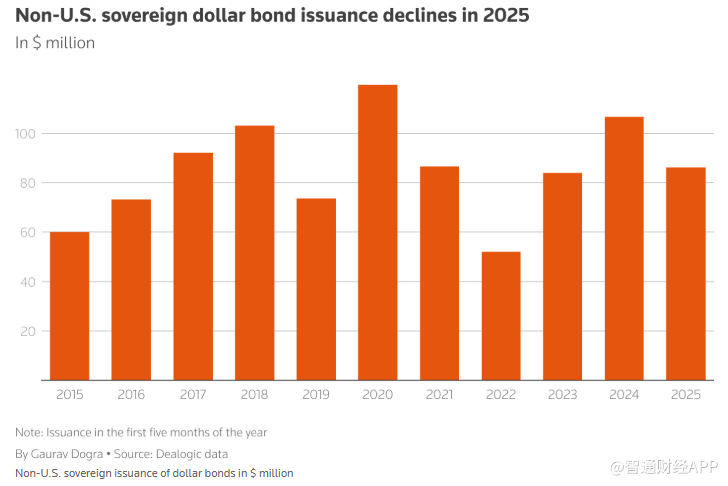
Core Insights - The issuance of dollar-denominated bonds by governments in Asia and Europe has significantly decreased, with a 19% year-on-year drop to $86.2 billion in the first five months of the year, marking the first decline in three years [1][2] - Global sovereign local currency bond issuance has risen to $326 billion, the highest level in five years, as investors withdraw from U.S. assets due to concerns over tariffs and the stability of U.S. financial dominance [2] Group 1 - The dollar bond issuance from Canada and Saudi Arabia fell by 31% and 29% respectively, amounting to $10.9 billion and $11.9 billion [2] - Israel and Poland also saw declines in dollar bond issuance by 37% and 31%, reaching $4.9 billion and $5.4 billion [2] - The decline in dollar bond issuance is accompanied by a notable increase in local currency bond issuance, driven by easing inflation pressures and lower local interest rates in countries like India, Indonesia, and Thailand [5] Group 2 - Brazil is considering issuing its first sovereign bonds in renminbi following a series of investment agreements and a currency swap deal with China [5] - Saudi Arabia raised €2.25 billion (approximately $2.36 billion) through euro-denominated bonds, including its first green bonds, aligning with its strategy to diversify away from dollar-linked financing [5] - The local currency bond market is expected to mature further, particularly in India, as its bonds are included in global bond indices, potentially expanding the investor base [5]