
标普高盛商品指数

Search documents
全球多资产跟踪月报2026.03:能源表现强势,多资产配置产品业绩分化-20260312
CMS· 2026-03-12 08:29
Quantitative Models and Construction Methods 1. Model Name: Risk Parity Strategy - **Model Construction Idea**: The model aims to allocate risk equally across asset classes, ensuring that no single asset class dominates the portfolio's risk exposure[4][59]. - **Model Construction Process**: - Identify risk factors such as growth, inflation, interest rates, and liquidity[59]. - Allocate capital to asset classes (e.g., equities, bonds, commodities) based on their risk contribution rather than nominal weights. - Use derivatives to adjust exposures and maintain risk parity across the portfolio[59]. - **Model Evaluation**: Demonstrates strong performance in diversified portfolios, particularly in volatile markets, by balancing risk exposure across asset classes[59]. 2. Model Name: Multi-Factor Framework (Mixed Strategy) - **Model Construction Idea**: Combines quantitative frameworks with subjective judgment to adjust asset allocation based on macroeconomic and fundamental indicators[58][59]. - **Model Construction Process**: - Use macroeconomic data (e.g., GDP, inflation, employment) and alternative data (e.g., climate change, central bank meetings) to generate signals through natural language processing[58]. - Incorporate fundamental indicators such as bond yields, credit risk, earnings growth, and valuation levels for specific asset classes[58]. - Adjust baseline quantitative weights based on subjective views to capture short-term opportunities[58]. - **Model Evaluation**: Provides flexibility to adapt to changing market conditions while maintaining a systematic foundation, offering a balance between stability and opportunism[58]. 3. Model Name: Covered Call Strategy (Income Strategy) - **Model Construction Idea**: Focuses on generating stable cash flows by combining equity holdings with options strategies[58]. - **Model Construction Process**: - Invest in high-dividend stocks to capture equity beta returns. - Sell call options on the underlying stocks to generate premium income. - Maintain a balance between equity exposure and option coverage to optimize risk-adjusted returns[58]. - **Model Evaluation**: Suitable for investors seeking stability and income, with lower volatility compared to pure equity strategies[58]. --- Model Backtesting Results 1. Risk Parity Strategy - **Fidelity Risk Parity Fund**: - 1-month return: -0.09% - 3-month return: 5.20% - 6-month return: 11.51% - YTD return: 4.72% - 1-year return: 21.37% - 1-year volatility: 11.55% - 1-year max drawdown: 3.46% - Return/volatility: 1.85 - Return/max drawdown: 2.29[68] - **Invesco Balanced-Risk Allocation Fund**: - 1-month return: 6.61% - 3-month return: 12.35% - 6-month return: 17.22% - YTD return: 12.62% - 1-year return: 19.20% - 1-year volatility: 8.91% - 1-year max drawdown: 3.74% - Return/volatility: 2.15 - Return/max drawdown: 2.49[68] 2. Multi-Factor Framework (Mixed Strategy) - **PIMCO Global Core Asset Allocation Fund**: - 1-month return: -0.77% - 3-month return: 5.68% - 6-month return: 11.56% - YTD return: 3.68% - 1-year return: 21.30% - 1-year volatility: 9.20% - 1-year max drawdown: 3.58% - Return/volatility: 2.32 - Return/max drawdown: 2.34[68] - **Blackrock Tactical Opportunities Fund**: - 1-month return: 1.69% - 3-month return: 3.38% - 6-month return: 1.19% - YTD return: 2.59% - 1-year return: 7.20% - 1-year volatility: 6.37% - 1-year max drawdown: 2.56% - Return/volatility: 1.13 - Return/max drawdown: 1.27[68] 3. Covered Call Strategy (Income Strategy) - **PIMCO Dividend and Income Fund**: - 1-month return: 0.13% - 3-month return: 5.70% - 6-month return: 10.28% - YTD return: 4.60% - 1-year return: 19.11% - 1-year volatility: 7.56% - 1-year max drawdown: 2.66% - Return/volatility: 2.53 - Return/max drawdown: 2.75[68] --- Quantitative Factors and Construction Methods 1. Factor Name: Growth - **Factor Construction Idea**: Measures economic expansion through GDP growth and corporate earnings[59]. - **Factor Construction Process**: - Collect macroeconomic data on GDP and corporate earnings. - Normalize data to account for seasonal and cyclical variations. - Use the factor to overweight equities and commodities during periods of strong growth[59]. 2. Factor Name: Inflation - **Factor Construction Idea**: Captures the impact of rising prices on asset classes such as bonds and commodities[59]. - **Factor Construction Process**: - Track inflation indicators such as CPI and PPI. - Adjust bond and commodity exposures based on inflation trends. - Hedge inflation risk using TIPS or commodity futures[59]. 3. Factor Name: Liquidity - **Factor Construction Idea**: Assesses market liquidity conditions to optimize asset allocation[59]. - **Factor Construction Process**: - Monitor central bank policies, interest rates, and money supply. - Increase exposure to liquid assets during tightening cycles. - Use derivatives to manage liquidity risk[59]. --- Factor Backtesting Results 1. Growth Factor - Positive correlation with equity and commodity returns during periods of economic expansion[59]. 2. Inflation Factor - Strong performance in inflationary environments, particularly for TIPS and commodities[59]. 3. Liquidity Factor - Effective in managing drawdowns during periods of market stress by increasing exposure to liquid assets[59].
当前股票回报是否过高
Guo Ji Jin Rong Bao· 2025-09-29 02:54
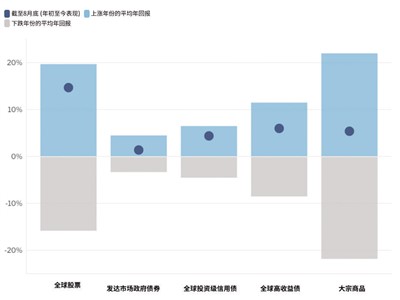
Core Insights - Global stock markets have shown strong performance since the beginning of 2025, with the MSCI Global Index rising approximately 15% year-to-date, continuing a robust trend from previous years [1] - The average annual return for global stocks since the end of the 2022 bear market has reached 20%, which may surprise some investors who typically anchor their expectations around a long-term average return of 7%-10% [1] - This strong performance is not an anomaly but a recurring feature in market cycles, with investment-grade credit bonds historically yielding 6%-7% during economic expansions, while high-yield credit bonds have averaged returns of 11%-12% [1] Investment Insights - Investors should not be deterred by strong market performance; the 15%-20% rise in stocks this year should not be a reason for concern unless an economic downturn is anticipated [2] - Managing downside risk is crucial for enhancing long-term average returns; investors may consider funds that maintain strong participation in rising markets while minimizing downside risk, such as defensive equity funds and hedge funds [2] - Assets with favorable return characteristics, such as credit bonds, are particularly valuable for asset allocators, as they tend to perform well in up years and experience smaller losses in down years [2] Areas of Focus - Key structural growth catalysts to watch include fiscal stimulus, policy reforms, and potential interest rate cuts by central banks [3] - Monitoring inflation trends and the potential rise in cross-asset correlations is essential, despite significant progress made by central banks in controlling inflation [3] - The ability of corporate earnings growth to extend beyond large tech companies to a broader range of industries will be critical for achieving a more balanced and sustainable market rally [5]

中证商品期货指数窄幅震荡:中证商品期货指数上半年评论
Zhao Shang Qi Huo· 2025-07-14 12:40
1. Report Industry Investment Rating No relevant content provided. 2. Core Viewpoints of the Report - In H1 2025, the commodity market showed a narrow - range oscillation, with the CSI Commodity Futures Index rising slightly by 0.20%. Positive returns mainly came from gold, silver, and copper, while negative returns were mainly from rebar, rubber, and soda ash [2]. - The CSI Commodity Index's year - on - year sequence has bottomed out and rebounded, potentially indicating that the PPI sequence is in the process of bottoming out and rebounding. Microscopically, the sector index trends reflect certain operational pressures in the steel and chemical industries [2]. - Investors should gradually reduce their reliance on fixed - income assets and practice the methodology of stock - bond - commodity asset allocation, increasing the proportion of commodities in the portfolio [2]. - The CSI Commodity Index has shown a relatively independent and excellent performance compared to overseas indices, but the recent increase in correlation needs attention. Adding an appropriate amount of commodities to the traditional stock - commodity portfolio can significantly improve the return - risk ratio of the portfolio [2]. 3. Summary According to the Directory 3.1 Market Review - In H1 2025, the commodity market presented a narrow - range oscillation. The CSI Commodity Index rose slightly by 0.20% annually, with an amplitude of only 10.27%. It was difficult to form a long - term trend, showing an inverted V - shaped oscillation after a strong start [9]. - Driven by frequent macro - events, the commodity market was repeatedly disturbed by policies and geopolitics. With the global economy still bottoming out, the demand side was weak, especially for industrial products. Three macro black - swan events occurred in H1 [12][14]. - There were two obvious characteristics in the commodity market: the significant differentiation between agricultural and industrial products, and the further differentiation within commodities due to different types of event shocks [15]. 3.2 Index Return Attribution 3.2.1 Roll Yield Contribution - The roll yield in H1 2025 was positive overall, at 1.07%, an improvement compared to 2024, possibly suggesting that the global economic growth is bottoming out. Most months had positive roll yields, except for March which had a large negative value [20]. 3.2.2 Sector Return Contribution - In H1 2025, the trends of industrial and agricultural products diverged. The agricultural product market had a small price increase and relatively low volatility, while the industrial product market had a large price decline and relatively large amplitude fluctuations. Agricultural products outperformed industrial products in most months [23]. 3.2.3 Variety Return Contribution - At the sector level, black and energy - chemical sectors mostly made negative return contributions, while precious metals, non - ferrous metals, and agricultural products mostly made positive return contributions. At the variety level, gold, silver, and copper had large positive return contributions, while rebar, rubber, and soda ash had large negative return contributions [24]. 3.3 Macro - Micro Representativeness 3.3.1 Macro Level: The CSI Commodity Index Leads PPI by About 2 Months - The CSI Commodity Index's year - on - year sequence is highly correlated with the PPI year - on - year and can lead by about 2 months. Recently, the commodity index's year - on - year sequence has bottomed out and rebounded, perhaps indicating that the PPI sequence is bottoming out and rebounding [25]. 3.3.2 Micro Level: The Sector Index Moves in Sync with the Industry's Total Profits - The year - on - year sequence of the sub - sector index is highly correlated with the year - on - year sequence of the corresponding industry's total profits. The energy - chemical futures index is in the process of bottoming out, and the steel futures index is still finding its bottom [29]. 3.4 Comparison of Major Asset Classes - In the long - term, the commodity market has similar returns but lower risks compared to the equity market. In H1 2025, the commodity market's risk indicators were still better than those of the equity market [38][39]. - The current risk - free interest rate is quite low, and the investment cost - performance of bonds has declined significantly. Investors should gradually practice the methodology of major asset allocation and increase the proportion of commodities in the portfolio [40]. - Since 2024, the correlation between the commodity market and the equity market has been increasing. In H1 2025, the correlation remained relatively high, but it decreased rapidly at the end of June [43]. 3.5 Comparison with Overseas Indices - In the long - term, the CSI Commodity Index has obvious advantages in both returns and risks compared to overseas mainstream commodity indices. In H1 2025, it still had better performance in risk control [47][48]. - The correlation between the CSI Commodity Index and overseas mainstream commodity indices increased rapidly in early April and remained high in Q2, mainly due to the impact of the tariff shock [50]. 3.6 Application Cases - Adding an appropriate amount of commodities to the traditional stock - commodity portfolio can significantly improve the return - risk ratio of the portfolio. Replacing half of the stocks in the traditional 40 - 60 stock - bond portfolio with commodities can significantly reduce the portfolio's volatility and drawdown while keeping the returns similar [54][60].