
水路客运服务

Search documents
2026年春节假期期间广西营业性客运量约1032万人次
Zhong Guo Xin Wen Wang· 2026-02-24 13:41
Core Insights - During the 2026 Spring Festival holiday, Guangxi's passenger transport volume reached approximately 10.32 million, with a significant increase in travel due to the longest holiday period in history and free highway access for small vehicles [1][2] Transport Volume Summary - The total inter-regional personnel flow in Guangxi was 129 million people, with a notable increase in various transport modes [1] - Road transport accounted for 4.85 million passengers, with an average daily volume of 538,800, reflecting a year-on-year increase of 3.52% [1] - Railway transport recorded 4.07 million passengers, averaging 452,400 daily, up by 7.79% [1] - Civil aviation saw a total of 822,700 passengers, averaging 91,400 daily, marking a 19.58% increase [1] - Water transport had 576,100 passengers, averaging 64,000 daily, with a significant rise of 49.94% [1] Highway Traffic Summary - The total vehicle flow at highway entrances and exits reached 48.97 million, with an average of 5.44 million daily, an increase of 11.59% [2] - Small vehicles accounted for 47.30 million, averaging 5.26 million daily, up by 11.44% [2] - New energy vehicles totaled 10.15 million, averaging 1.13 million daily, reflecting a substantial increase of 39.77% [2] Postal and Rail Transport Summary - The postal and express delivery sector handled 16.33 million packages, averaging 1.81 million daily, an increase of 45.04% [2] - The rail transit system operated 13,900 trains, with a total passenger volume of 5.68 million, averaging 631,000 daily, up by 7.40% [2] Overall Transport Coordination - Various transport modes in Guangxi effectively coordinated to meet the high travel demand during the holiday, supported by optimized resource allocation and safety measures [2]
创新高!透过春运数据看“流动的中国”蓬勃活力
Yang Shi Wang· 2026-02-22 01:31
Core Viewpoint - The transportation sector is preparing for a peak in return travel as the Spring Festival holiday concludes, with measures in place to ensure safe and orderly travel for the public [1]. Group 1: Travel Volume and Trends - During the first five days of the Lunar New Year, the total inter-regional movement of people is expected to exceed 1.6 billion, averaging 320 million per day, representing a year-on-year increase of over 11% [3]. - The cumulative inter-regional movement of people in the first 20 days of the Spring Festival is projected to reach 5.08 billion, with a daily average of 250 million, marking a 5.6% increase compared to the same period in 2025, setting a historical high [5]. - On February 21, the inter-regional movement of people is expected to exceed 360 million, with the railway sector anticipating the dispatch of 16.8 million passengers [5]. Group 2: Transportation Modes and Capacity - The transportation capacity across various modes has improved, with commercial passenger volumes increasing by 4.7% for rail, 6.5% for road, 21.8% for water, and 6.1% for air transport [5]. - The road transport volume is expected to exceed 33.9 million on February 21, showing a 12% increase compared to 2025 [6]. - Waterway passenger volume is projected at 1.81 million, reflecting a 27.6% increase compared to 2025, while civil aviation passenger volume is expected to reach 2.63 million, an 8.3% increase [6]. Group 3: Safety and Management - The overall traffic safety situation remains stable, with no reports of long-term congestion or significant accidents on major highways and national roads as of February 21 [8]. - Authorities are advising drivers to conduct thorough vehicle checks before returning home, emphasizing safe driving practices during the peak travel period [8]. Group 4: Regional Focus - Hainan - Hainan is experiencing a peak in return travel, with tight availability of vehicle ferry tickets due to increased passenger flow [10]. - As of February 21, a total of 282 ferry trips have been made, transporting 122,700 passengers and 25,700 vehicles, including 5,290 new energy vehicles [12]. - The local transportation department is coordinating resources to ensure safe and efficient ferry services for self-driving travelers, with a ticket reservation system in place to manage demand [12].


春运首周预计全社会跨区域人员流动量超14亿人次
Ren Min Ri Bao· 2026-02-08 23:43
Group 1 - The core viewpoint of the articles highlights the significant increase in cross-regional passenger flow during the Spring Festival travel season, with a total of 224.28 million trips expected on February 8, marking a 0.8% increase from the previous day and the same percentage increase compared to last year [1] - The total cross-regional passenger flow for the first week of the Spring Festival is projected to reach 1.413 billion trips, averaging 20.19 million trips per day, which is a 2.0% increase year-on-year [1] - Railway passenger volume is expected to accumulate to 86.02 million trips, with a daily average of 1.23 million trips, reflecting a 0.2% increase compared to last year [1] - Waterway passenger volume is projected to reach 4.89 million trips, with a daily average of 699,000 trips, showing a significant year-on-year increase of 14.7% [1] - Civil aviation passenger volume is expected to total 16.32 million trips, averaging 233,200 trips per day, which is a 6.1% increase from the previous year [1] Group 2 - Self-driving travel has become the primary mode of transportation during the Spring Festival, with road passenger flow, including non-commercial vehicles and public transport, accumulating to 1.30599 billion trips, averaging 18.66 million trips per day, a 2.1% increase year-on-year [1] - Didi Chuxing reports a 23% increase in demand for intercity rides since the start of the Spring Festival, indicating a growing trend of "reverse New Year" travel, with a projected 21% increase in ride-hailing demand in first-tier cities before the Spring Festival [1] - Car rental has emerged as a new choice for public transportation, with an expected double-digit growth in daily orders during the Spring Festival holiday, and Shenzhou Car Rental reporting over a 70% increase in cross-city orders and a sixfold increase in bookings for new energy vehicles [2] - Overall, passenger flow is gradually radiating outward from central cities, with a continuous five-day increase in cross-regional passenger flow from February 4 to 8, and an accelerating growth trend, with expectations of reaching peak travel volume around February 14 [2]
春运首周,全社会跨区域人员流动量累计超14亿人次
Ren Min Ri Bao· 2026-02-08 08:16
Group 1 - The core viewpoint of the articles highlights the significant increase in cross-regional passenger flow during the Spring Festival travel season, with a notable shift towards self-driving and rental car options [1][2] Group 2 - On February 8, the expected cross-regional passenger flow reached 224.28 million trips, showing a 0.8% increase compared to the previous week and the same period last year [1] - From February 2 to February 8, the cumulative cross-regional passenger flow was 1.413 billion trips, with a daily average of 20.189 million trips, marking a 2.0% increase year-on-year [1] - Railway passenger volume reached 86.02 million trips, with a daily average of 12.29 million trips, reflecting a 0.2% increase year-on-year [1] - Waterway passenger volume totaled 4.89 million trips, with a daily average of 0.699 million trips, showing a significant 14.7% increase year-on-year [1] - Civil aviation passenger volume was 16.32 million trips, with a daily average of 2.33 million trips, indicating a 6.1% increase year-on-year [1] - Road transport, including non-commercial and commercial passenger vehicles, accounted for 1.30599 billion trips, with a daily average of 18.657 million trips, up 2.1% year-on-year [1] - Didi Chuxing reported a 23% increase in intercity ride-hailing demand since the start of the Spring Festival, with a projected 21% increase in ride-hailing demand in first-tier cities before the holiday [1] Group 3 - Rental car usage is emerging as a new choice for public transportation, with an expected double-digit growth in daily orders during the Spring Festival holiday [2] - Shenzhou Car Rental reported over a 70% increase in cross-city travel orders since the start of the Spring Festival, with a sixfold increase in bookings for new energy vehicles [2] - The flow of passengers is gradually radiating from central cities, with a continuous increase in cross-regional passenger flow for five consecutive days from February 4 to February 8, indicating a trend of accelerating growth [2] - The peak of passenger flow is expected to occur around February 14, just before the Spring Festival [2]
透过数据看“流动的中国”一派勃勃生机 各部门加强春运服务保障平安出行
Yang Shi Wang· 2026-02-06 06:09
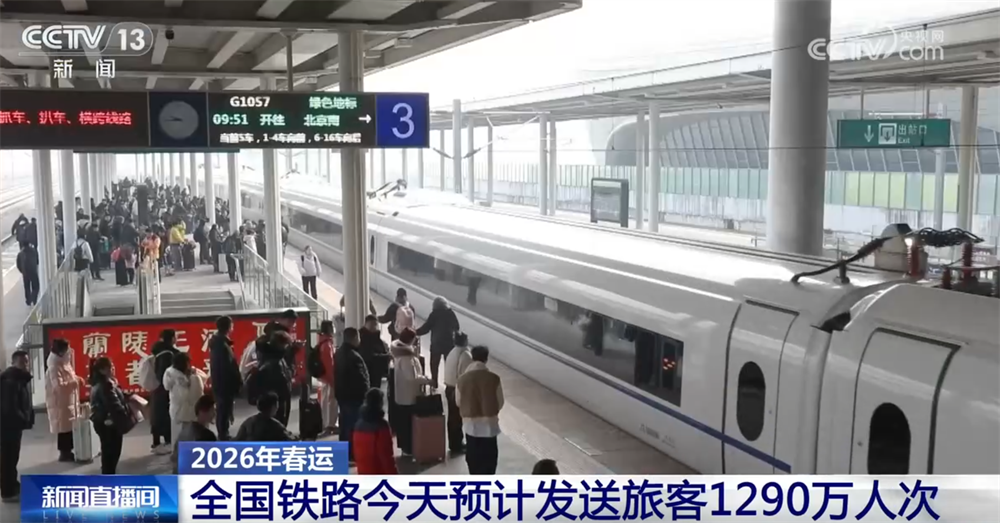
Group 1: Railway Industry - On February 6, the national railway is expected to send 12.9 million passengers, with 1,209 additional passenger trains planned [1] - Since the beginning of the Spring Festival travel season, passenger flow has remained above 10 million for five consecutive days [1] - Beijing Station has implemented full coverage of intelligent security inspection equipment, achieving an accuracy rate of over 98.5% for identifying prohibited items, and reducing the passage time for individual luggage from 6 seconds to 2 seconds [1] Group 2: Maritime Industry - On the morning of February 6, ferry services in the Qiongzhou Strait were temporarily suspended due to fog, prompting the launch of an emergency transport mode to ensure safety and smooth transport for vehicles and passengers after resumption [3] Group 3: Aviation Industry - On February 6, the national civil aviation sector is expected to operate 20,269 flights, transporting 2.4 million passengers [6] - The expected passenger volume for civil aviation is 2.36 million, reflecting a month-on-month increase of 1.9% and a year-on-year increase of 5.6% compared to the same period in 2025 [14] Group 4: Overall Transportation Trends - On February 5, the total inter-regional personnel flow is expected to exceed 196 million, with a month-on-month increase of 3.4% [7] - The expected road passenger flow is over 18 million, also showing a month-on-month increase of 3.4% [12] - The expected waterway passenger volume is 620,000, marking a 3.9% increase compared to the same period in 2025 [12]
今天是春运第四天 预计全社会跨区域人员流动量达1.96亿人次
Xin Lang Cai Jing· 2026-02-05 06:55
Group 1 - The core viewpoint of the article highlights the expected increase in cross-regional personnel flow during the 2026 Spring Festival, with an estimated total of 196.4 million trips, reflecting a month-on-month growth of 3.4% [1][2] Group 2 - The railway passenger volume is projected to reach 11.85 million trips, showing a month-on-month increase of 6.1% [2] - The road transport volume, which includes both commercial and non-commercial passenger traffic, is expected to be 181.57 million trips, with a month-on-month growth of 3.4% [2] - Among road transport, the commercial passenger volume is estimated at 31.08 million trips, reflecting a month-on-month increase of 2.9% and a year-on-year growth of 1.2% compared to the same period in 2025 [2] - The non-commercial passenger traffic on highways and ordinary national and provincial roads is expected to be 150.49 million trips, with a month-on-month increase of 3.4% [2] - Waterway passenger volume is anticipated to be 620,000 trips, representing a year-on-year increase of 3.9% compared to 2025 [2] - The civil aviation passenger volume is projected at 2.36 million trips, with a month-on-month growth of 1.9% and a year-on-year increase of 5.6% compared to 2025 [2]
春运全社会跨区域人员流动量预计创历史新高
Xin Lang Cai Jing· 2026-01-29 18:46
Core Insights - The 2026 Spring Festival travel season will begin on February 2 and end on March 13, lasting for 40 days, with a record high in cross-regional passenger flow expected, primarily driven by self-driving trips, which will account for approximately 80% of total travel [1] Group 1: Transportation Capacity and Measures - The railway sector will implement a new train operation schedule, with the capacity expected to increase by 5.3% year-on-year, allowing for over 14,000 passenger trains to operate on peak days [2] - The Civil Aviation Administration plans to increase flights to hub airports and popular tourist destinations, with an expected daily average of 19,400 flights, a 5% increase compared to the previous year [3] - Measures will be taken to enhance the charging infrastructure for new energy vehicles, including mobile emergency charging devices and optimizing charging times [4] Group 2: Ticketing and Travel Trends - The 12306 ticketing system will undergo resource enhancements to improve bandwidth and ticket availability, prioritizing official orders over third-party platforms [2] - New travel trends such as "reverse Spring Festival travel" and "return home then travel" are emerging, reflecting changing consumer behavior [2] - The focus will be on meeting diverse travel needs, including domestic and international tourism, with specific attention to winter sports and warm-weather destinations [3]
事关2026年春运,多部门发声
Zhong Guo Xin Wen Wang· 2026-01-29 04:17
Core Insights - The 2026 Spring Festival travel season will start on February 2 and last for 40 days, with an expected record high of 9.5 billion trips across regions, primarily driven by personal vehicle travel, which will account for about 80% of the total [3][4] - The railway and civil aviation sectors anticipate passenger volumes of 540 million and 95 million, respectively, with both overall scale and peak daily volumes expected to exceed historical records [3] Group 1: Travel Volume and Trends - The total cross-regional passenger flow during the 2026 Spring Festival is projected to reach 9.5 billion trips, marking a historical high [3] - Personal vehicle travel will dominate, making up approximately 80% of the total travel volume [3] - Railway and civil aviation are expected to handle 540 million and 95 million passengers, respectively, with both sectors poised to surpass previous peak levels [3] Group 2: Weather Conditions - The overall weather during the Spring Festival is characterized by significant fluctuations in temperature, with more precipitation expected in the north and less in the south [4] - Two cold air masses are forecasted to impact northern, eastern, central, and southwestern regions from February 2 to 14, potentially leading to severe cold and snow in northern areas [4] Group 3: Transportation Capacity and Services - The National Development and Reform Commission plans to enhance transportation capacity, with over 14,000 passenger trains expected to operate on peak days, reflecting a 5.3% increase in seating capacity [5] - Civil aviation will increase flights to key airports and popular tourist destinations, with an average of 19,400 flights per day, a 5% year-on-year increase [5] - The introduction of a telephone booking service for elderly passengers and a new policy for free refunds on mistakenly purchased tickets within 30 minutes are aimed at improving customer service [6][7] Group 4: Emergency Preparedness - The Ministry of Emergency Management has pre-positioned over 40,000 emergency rescue personnel and equipped them with various rescue tools to respond swiftly to low-temperature and snow-related disasters [9] - Emergency supplies and specialized equipment for snow removal and ice breaking have been adequately stocked in key regions [9] Group 5: Support for Electric Vehicle Owners - The Ministry of Transport will implement measures to ensure charging needs for electric vehicle owners during the holiday, including mobile charging units and real-time updates on charging station availability [10]

八天长假江苏公路水路发送旅客858.6万人次
Xin Hua Ri Bao· 2025-10-08 23:36
Core Insights - The provincial transportation department reported travel data for the Mid-Autumn and National Day holidays from October 1 to 8, indicating a total of approximately 8.586 million passengers were expected to travel, with a daily average of about 1.073 million, representing a 6.1% decrease compared to the same period in 2024 [1] Group 1: Travel Statistics - During the holiday period, road travel accounted for approximately 8.101 million passengers, while waterway travel accounted for about 0.485 million passengers [1] - On October 8, a peak return flow was anticipated, with a total of 1.097 million passengers expected to travel, reflecting a 0.2% increase compared to 2024 [1] - The expected road travel on October 8 was about 1.084 million passengers, and waterway travel was projected at 0.013 million passengers, indicating a stable and orderly overall transportation [1] Group 2: Highway Traffic - On October 8, the total expected exit flow on highways was 3.9 million vehicles, which is an 8.5% increase compared to 2024 [1] - Among these, passenger vehicle flow was expected to reach 3.65 million, marking a 13.4% increase from 2024 [1] - The average daily exit flow on highways during the holiday was 4.562 million vehicles, representing an 8.9% increase compared to 2024 [1] Group 3: Safety and Enforcement - To ensure smooth traffic and safety during the holiday, a total of 7,723 personnel were deployed for enforcement, conducting 4,165.54 vehicle hours of inspections [1] - Various machinery and vehicles totaling 2,392 were utilized, along with 1,727 drone takeoffs for monitoring [1] - A total of 2,027 vehicles were inspected, resulting in 68 cases of traffic violations being prosecuted [1]
国庆中秋假期累计跨区域人员流动量预计超24亿人次
Ren Min Ri Bao· 2025-10-08 20:47
Core Insights - The total inter-regional mobility during the National Day and Mid-Autumn Festival holiday from October 1 to 8 is expected to reach 2.432 billion trips, averaging 304 million trips per day, which represents a year-on-year increase of 6.2% [1] Transportation Modes Summary - Railway passenger volume is projected to be approximately 153.96 million trips, averaging 19.24 million trips per day, with a year-on-year growth of 2.6% [1] - Waterway passenger volume is expected to be around 11.67 million trips, averaging 1.46 million trips per day, reflecting a year-on-year increase of 4.2% [1] - Civil aviation passenger volume is anticipated to reach 19.17 million trips, averaging 2.4 million trips per day, showing a year-on-year growth of 3.4% [1] - Road mobility, including both non-commercial passenger car trips and commercial passenger transport, is estimated at about 2.2475 billion trips, averaging over 280 million trips per day, with a year-on-year increase of 6.5% [1] - As the main mode of travel, self-driving cars are expected to account for an average of 240 million trips per day, representing about 80% of the total travel volume [1]