
物理AI开放数据集

Search documents
英伟达开源Alpamayo系列模型,有望重塑端到端自动驾驶
Changjiang Securities· 2026-01-07 10:46
Investment Rating - The report maintains a "Positive" investment rating for the industry [7]. Core Insights - NVIDIA has released the Alpamayo series of open-source AI models, simulation tools, and datasets aimed at advancing the development of safe and reliable inference-based assisted driving vehicles. This initiative is expected to accelerate the commercialization of advanced intelligent driving technologies [2][4]. - The intelligent driving industry is anticipated to benefit from new technologies, leading to accelerated scaling and commercialization, positively impacting the entire industry chain. The report suggests focusing on intelligent driving hardware providers and autonomous driving operation platforms like Robotaxi [10]. Summary by Sections Event Description - NVIDIA launched the Alpamayo series on January 5, 2026, to promote the development of safe and reliable inference-based assisted driving vehicles [4]. Event Commentary - The Alpamayo model introduces a visual-language-action (VLA) reasoning model for assisted driving decisions, showcasing the logic behind each decision and identifying unique driving situations that may not occur during normal driving. The model is based on a 10 billion parameter architecture, with future models expected to have larger parameter scales and enhanced reasoning capabilities [10]. - NVIDIA also released the open-source simulation framework AlpaSim and a large-scale open dataset containing over 1,700 hours of driving data, which supports high-fidelity autonomous driving development and rapid validation and strategy optimization [10]. - The Alpamayo model has garnered significant attention from leading companies in the mobility sector, such as Lucid, Jaguar Land Rover, and Uber, as well as experts from institutions like S&P Global and Berkeley DeepDrive. The core value of Alpamayo lies in advancing physical AI development and addressing unpredictable driving scenarios [10].

自动驾驶巨头放大招,产业迎加速期
Huan Qiu Wang· 2026-01-06 07:33
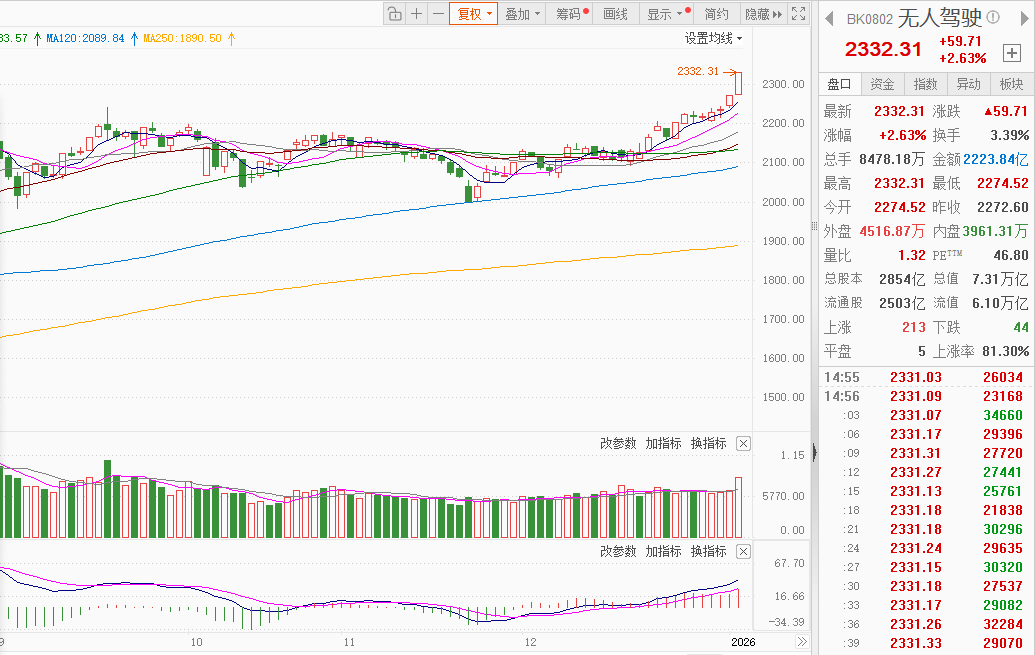
Group 1: Market Performance - The A-share market's autonomous driving sector experienced a strong surge, with multiple stocks hitting the daily limit in a short time, indicating high investor interest and willingness to invest [1] - Companies such as Hezhong Zhizhuang and Zhejiang Shibao quickly reached their daily limits within minutes of market opening, showcasing robust market activity [1] Group 2: Technological Advancements - Nvidia announced the launch of the Alpamayo series of open-source AI models and simulation tools at CES 2026, focusing on the development of reasoning-based assisted driving and autonomous driving systems [3] - The Alpamayo 1 model features 10 billion parameters, enabling autonomous vehicles to not only perceive but also logically reason and act in complex traffic scenarios [3][4] - Nvidia's new Rubin platform boasts a 3.5 times improvement in training performance and a 5 times enhancement in running AI software performance, with plans for delivery in the second half of the year [3] Group 3: Industry Developments - Nvidia's founder, Jensen Huang, highlighted the critical reasoning capabilities brought by Alpamayo, allowing autonomous vehicles to drive safely in complex environments, with major companies like Lucid and Uber adopting the platform [4] - In China, the autonomous driving industry is set to achieve significant breakthroughs by 2025, with the Ministry of Industry and Information Technology granting the first L3-level conditional autonomous driving vehicle licenses [4] - The issuance of L3-level licenses marks a pivotal shift from testing to commercial application in China's autonomous driving sector, with companies like Pony.ai exceeding their operational targets for Robotaxi fleets [4] Group 4: Future Outlook - Analysts suggest that the continuous empowerment from tech companies like Nvidia is breaking through the computational and algorithmic reasoning bottlenecks in autonomous driving, significantly shortening the timeline for L4-level commercialization [5] - The transition of responsibility from drivers to vehicle manufacturers or system suppliers in L3-level autonomous driving will raise the technical and risk management requirements for car manufacturers [5] - Companies with advanced intelligent technology, strong system engineering capabilities, and effective supply chain management are expected to benefit first from the upcoming industry wave [5]

NVIDIA推出Alpamayo系列开源AI模型与工具,加速安全可靠的推理型辅助驾驶汽车开发
Xin Lang Cai Jing· 2026-01-06 04:37
Core Insights - NVIDIA has launched the Alpamayo series of open-source AI models, simulation tools, and datasets aimed at advancing the development of safe and reliable inference-based autonomous driving vehicles [1][3] Group 1: Technology and Features - The Alpamayo series introduces a VLA reasoning model based on chain-of-thought, enhancing decision-making capabilities in autonomous driving systems to handle rare and complex scenarios [1][3] - Alpamayo 1 is the first reasoning model designed for the autonomous driving research community, featuring a 10 billion parameter architecture that generates driving trajectories from video input while providing reasoning insights [3][4] - AlpaSim is a fully open-source end-to-end simulation framework that offers realistic sensor modeling and configurable traffic dynamics, supporting rapid validation and strategy optimization [4] Group 2: Data and Ecosystem - NVIDIA provides a diverse large-scale open dataset for autonomous driving, containing over 1,700 hours of driving data across various geographic areas and environmental conditions, essential for developing reasoning architectures [4] - The Alpamayo ecosystem integrates open models, simulation frameworks, and datasets into a unified system, allowing developers and research teams to build upon it for their projects [3][4] Group 3: Industry Support and Impact - Leading companies in the mobility sector, including Lucid, Jaguar Land Rover, and Uber, have shown significant interest in Alpamayo, aiming to develop reasoning-based autonomous driving stacks for achieving Level 4 autonomy [5] - Industry experts emphasize the growing need for AI systems that not only process data but also possess reasoning capabilities to handle real-world behaviors, highlighting the importance of advanced simulation environments and rich datasets [5] - The open-source nature of Alpamayo is expected to accelerate innovation across the industry, enabling partners to adjust and optimize models according to their unique needs [5]

5分钟,封死涨停!刚刚,重磅利好来袭!
Zheng Quan Shi Bao Wang· 2026-01-06 03:38
Core Viewpoint - The automatic driving sector is experiencing significant momentum following NVIDIA's announcement of the Alpamayo series of open-source AI models and simulation tools, aimed at enhancing the development of autonomous vehicles [1][2][3] Group 1: NVIDIA's Announcement - NVIDIA introduced the Alpamayo series, which includes open-source AI models, simulation tools, and datasets to accelerate the development of reasoning-based autonomous vehicles [2] - Alpamayo 1 features a 100 billion parameter model that enables autonomous vehicles to perceive, reason, and act in rare or complex scenarios [2] - The Rubin platform, part of this release, offers a tenfold reduction in reasoning costs compared to the previous Blackwell platform, with training performance improved by 3.5 times and AI software performance enhanced by five times, expected to ship in the second half of the year [2] Group 2: Industry Impact - Following NVIDIA's announcement, multiple stocks in the A-share automatic driving sector quickly reached their daily limit up, indicating strong market enthusiasm [4] - The automatic driving industry is entering an accelerated phase, with ride-hailing platforms and Robotaxi manufacturers speeding up their deployment processes, particularly in major cities like Beijing, Shanghai, Guangzhou, and Shenzhen [5] - The Ministry of Industry and Information Technology in China has granted the first L3-level conditional autonomous driving vehicle licenses, marking a significant step towards commercial application [5] - By the end of 2025, Pony.ai announced that its Robotaxi fleet has surpassed 1,159 vehicles, exceeding its strategic goal of 1,000 vehicles [5] - Analysts suggest that the development of the Robotaxi industry is entering a rapid growth phase, with companies possessing advanced intelligent technology and system capabilities likely to benefit first [5]