AlpaSim仿真框架

Search documents
英伟达开源Alpamayo系列模型,有望重塑端到端自动驾驶
Changjiang Securities· 2026-01-07 10:46
Investment Rating - The report maintains a "Positive" investment rating for the industry [7]. Core Insights - NVIDIA has released the Alpamayo series of open-source AI models, simulation tools, and datasets aimed at advancing the development of safe and reliable inference-based assisted driving vehicles. This initiative is expected to accelerate the commercialization of advanced intelligent driving technologies [2][4]. - The intelligent driving industry is anticipated to benefit from new technologies, leading to accelerated scaling and commercialization, positively impacting the entire industry chain. The report suggests focusing on intelligent driving hardware providers and autonomous driving operation platforms like Robotaxi [10]. Summary by Sections Event Description - NVIDIA launched the Alpamayo series on January 5, 2026, to promote the development of safe and reliable inference-based assisted driving vehicles [4]. Event Commentary - The Alpamayo model introduces a visual-language-action (VLA) reasoning model for assisted driving decisions, showcasing the logic behind each decision and identifying unique driving situations that may not occur during normal driving. The model is based on a 10 billion parameter architecture, with future models expected to have larger parameter scales and enhanced reasoning capabilities [10]. - NVIDIA also released the open-source simulation framework AlpaSim and a large-scale open dataset containing over 1,700 hours of driving data, which supports high-fidelity autonomous driving development and rapid validation and strategy optimization [10]. - The Alpamayo model has garnered significant attention from leading companies in the mobility sector, such as Lucid, Jaguar Land Rover, and Uber, as well as experts from institutions like S&P Global and Berkeley DeepDrive. The core value of Alpamayo lies in advancing physical AI development and addressing unpredictable driving scenarios [10].

英伟达全面入局,自动驾驶将迎来“蝶变时刻”?
3 6 Ke· 2026-01-07 02:55
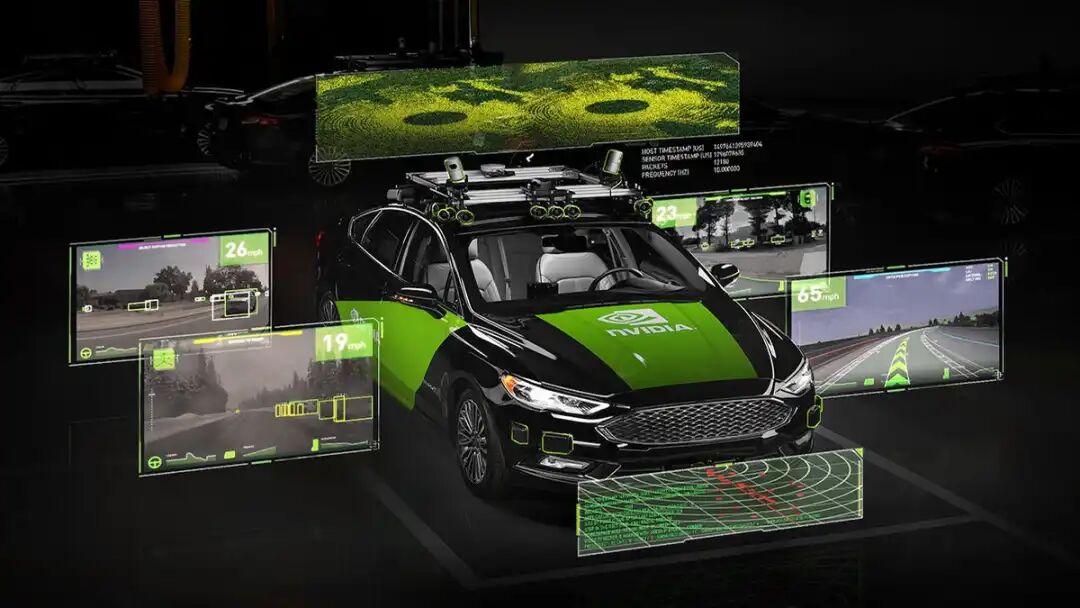
Core Insights - Nvidia's CEO Jensen Huang announced the launch of a comprehensive autonomous driving ecosystem named Alpamayo at CES 2026, marking a significant shift in the industry towards commercializing Level 4 autonomous driving [1][6] - Alpamayo is not just a single product but a "toolbox" for autonomous driving development, consisting of a large model, a global driving dataset, and a high-fidelity simulation framework [3][4] - The introduction of Alpamayo is seen as a pivotal moment for the industry, potentially transforming the landscape of autonomous driving from testing to commercial deployment by 2026 [1][7] Summary by Sections Alpamayo Overview - Alpamayo consists of three main components: the Alpamayo-R1 model, a global driving dataset, and the AlpaSim simulation framework, creating a closed-loop system for model training, data support, and simulation validation [3][4] - The Alpamayo-R1 model features 10 billion parameters and represents a paradigm shift from "perception prediction" to "reasoning planning," enabling vehicles to make decisions based on complex scenarios [3][4] Open Source Strategy - Nvidia has chosen to open-source the underlying code of Alpamayo-R1 on the Hugging Face platform, allowing developers from various sectors to access and customize the model, thus lowering the barriers for high-level autonomous driving development [4][11] - The global driving dataset includes 1,727 hours of driving data from over 2,500 cities across 25 countries, capturing diverse traffic conditions and scenarios, which can be used in conjunction with synthetic data generated by Nvidia's Cosmos model [4][6] Simulation Framework - The AlpaSim simulation framework, now available on GitHub, provides a virtual testing environment for developers to conduct large-scale safety tests, significantly reducing the costs and risks associated with real-world testing [6][10] - Alpamayo's core value lies in its ability to enable autonomous systems to not only drive but also reason and explain their actions, enhancing decision-making capabilities in complex situations [6][10] Industry Impact - The open-sourcing of Alpamayo is expected to redefine the competitive landscape of the autonomous driving industry, shifting from a focus on in-house development to ecosystem collaboration [11][12] - Traditional automakers are likely to benefit from the open-source model, allowing them to focus on optimizing user experience and specific scenarios rather than building foundational models from scratch [11][12] Market Dynamics - The launch of Alpamayo is anticipated to shift demand in the chip and computing industry from "brute force computing" to "efficient reasoning," prompting chip manufacturers to innovate in architecture and design [12][13] - The introduction of Alpamayo may also lead to the emergence of new job roles within the industry, such as autonomous driving AI trainers and scenario definition engineers, reflecting a shift in talent requirements [12][13] Challenges and Opportunities - While Alpamayo offers powerful tools, challenges remain in addressing the "long tail" problem of rare driving scenarios, which require extensive localized data and scenario engineering [14][15] - The open-source nature of Alpamayo could lead to increased competition based on data acquisition and processing capabilities, making data the new core competitive advantage [15][19] Regulatory and Consumer Considerations - The regulatory landscape poses challenges for the commercial deployment of autonomous driving technologies, with issues related to liability, data privacy, and insurance needing to be addressed [15][16] - Consumer understanding and acceptance of autonomous driving systems are critical, as misconceptions about the technology could lead to safety risks [16][19] Future Outlook - The year 2026 is seen as a critical juncture for the autonomous driving industry, with the potential for significant advancements in technology and commercial viability [19][20] - The successful integration of Alpamayo into real-world applications will depend on collaborative efforts across technology, regulation, and consumer education [19][20]

今年CES,芯片厂商又开始“神仙打架”
3 6 Ke· 2026-01-07 00:42
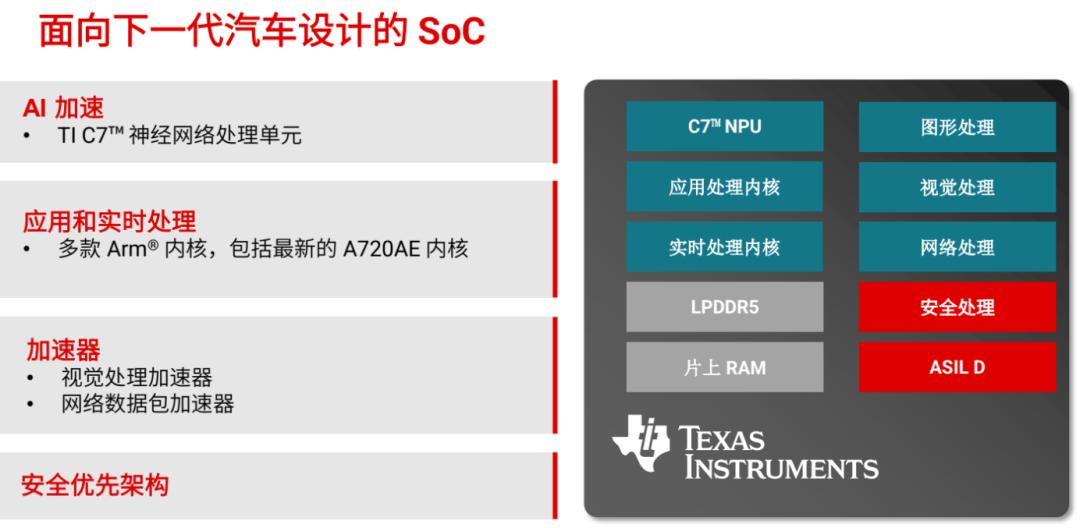
Group 1: TI's Automotive Innovations - TI launched three powerful automotive products at CES: the TDA5 series SoC, AWR2188 radar transmitter, and DP83TD555J-Q1 Ethernet PHY [1][4][7] - The TDA5 SoC features a maximum performance of 1200 TOPS and an energy efficiency of over 24 TOPS/W, with a 12-fold increase in AI computing power compared to previous generations [1] - AWR2188 is the industry's first single-chip 8x8 radar solution, enhancing performance by 30% and achieving high-precision detection for targets over 350m [4] - The DP83TD555J-Q1 Ethernet PHY supports nanosecond-level time synchronization and can transmit power and data over the same line, reducing cable design complexity and costs [7] Group 2: ADI's Diverse Solutions - ADI showcased various solutions in automotive, consumer, and robotics sectors, highlighting the A²B 2.0 solution with four times the bandwidth of its predecessor [10] - The automotive solutions include advanced lighting control and ADAS systems utilizing machine vision inputs [10][11] Group 3: NXP's High-Integration Processor - NXP introduced the S32N7 processor series, which integrates multiple vehicle functions on a single chip, potentially reducing total cost of ownership (TCO) by up to 20% [12][15] Group 4: Microchip's Demonstrations - Microchip presented demos including the ASA Motion Link for Qualcomm's Ride platform and a software-free intelligent headlight system using 10BASE-T1S technology [17][18] Group 5: Silicon Labs' New SDK - Silicon Labs launched a new Simplicity SDK for Zephyr, enhancing support for embedded systems and showcasing advancements in Bluetooth wireless technology [19] Group 6: Infineon's Development Kit - Infineon and Flex unveiled a modular development kit for regional control units, aimed at accelerating the development of software-defined vehicle architectures [20] Group 7: ST's Automotive Gateway - ST displayed the Osdyne Automotive Gateway, which enhances vehicle communication and security while reducing wiring complexity [22] Group 8: Ambarella's AI Vision Chip - Ambarella released the CV7 AI vision SoC, built on a 4nm process, achieving over 20% power reduction and more than 2.5 times the AI performance of its predecessor [25] Group 9: NVIDIA's Revolutionary Products - NVIDIA introduced the Rubin platform with six new chips and launched the Alpamayo series for AI-assisted driving development [26][28] Group 10: AMD's AI Innovations - AMD announced several new products, including the MI455X GPU and Ryzen AI 400 series processors, emphasizing its comprehensive AI capabilities [29][30] Group 11: Arm's Technology Trends - Arm focused on five key technology trends at CES, including advancements in autonomous driving, robotics, and smart home devices [31][32] Group 12: Industry Trends - The CES highlighted three major trends: the penetration of AI across all technology layers, the shift towards centralized and software-defined automotive electronics, and the importance of ecosystem collaboration over isolated technology competition [33]



黄仁勋CES最新演讲:Rubin 今年上市,计算能力是 Blackwell 5 倍、Cursor 彻底改变了英伟达的软件开发方式、开源模型落后先进模型约6个月
AI前线· 2026-01-06 00:48
Core Insights - The article highlights a significant shift in AI technology, moving from understanding language to transforming the physical world, as announced by NVIDIA CEO Jensen Huang at CES 2026 [2] - NVIDIA has unveiled its latest technology roadmap for "Physical AI," aiming to create a comprehensive stack of computing and software systems to enable AI to understand, reason, and act in the real world [2] Group 1: AI Development and Breakthroughs - Huang emphasized the "dual platform migration," where computing shifts from traditional CPUs to GPU-centric accelerated computing, and application development transitions from predefined code to AI-based training [4] - In 2025, open-source models achieved key breakthroughs but still lagged behind advanced models by about six months, with explosive growth in model downloads as various sectors engage in the AI revolution [3][9] - The emergence of autonomous thinking agent systems in 2024 marks a pivotal development, with models capable of reasoning, information retrieval, and future planning [8] Group 2: Physical AI and New Models - NVIDIA's Physical AI models are categorized into three series: Cosmos World models for world generation and understanding, GROOT for general robotics, and the newly released AlphaMayo for autonomous driving [12] - AlphaMayo, an open-source AI model, enables autonomous vehicles to think like humans, addressing complex driving scenarios by breaking down problems and reasoning through possibilities [16][18] - GROOT 1.6, the latest open-source reasoning model for humanoid robots, enhances reasoning capabilities and coordination for executing complex tasks [22][24] Group 3: AI Supercomputing and Vera Rubin - NVIDIA introduced the Vera Rubin supercomputer, designed to meet the escalating computational demands of AI, with the first products expected to launch in late 2026 [32] - The Vera Rubin architecture features a collaborative design of six chips, providing 100 Petaflops of AI computing power, significantly enhancing performance and efficiency [40][42] - The system incorporates advanced cooling and security features, ensuring data protection and energy efficiency, which is crucial for modern AI workloads [47][49] Group 4: Ecosystem and Collaboration - NVIDIA's collaboration with Hugging Face connects a vast community of AI developers, facilitating the integration of NVIDIA's tools into existing workflows [30] - The launch of the Isaac Lab Arena provides a framework for safely testing robot skills in simulation, addressing the challenges of verifying robotic capabilities in real-world scenarios [27] - The open-source approach to AI and robotics is driving rapid advancements across various industries, with numerous companies leveraging NVIDIA's platforms for their next-generation AI systems [29]