
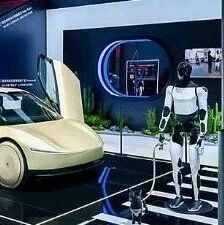
特斯拉Optimus Gen3

Search documents
特斯拉人形机器人三年未售出一台,新款量产倒计时,A股供应链动作频频
21世纪经济报道· 2026-03-29 11:21
Core Viewpoint - Tesla's Optimus humanoid robot, initially anticipated to be a significant product, has yet to sell any units, while its development has progressed to Gen3, which is now set for mass production by 2027 [1][5]. Group 1: Technological Advancements - The Gen3 iteration focuses on significant upgrades in the reducer and dexterous hand, utilizing harmonic reducers for upper limbs and planetary reducers for lower limbs, with testing ongoing for high-load applications [3][5]. - The dexterous hand features 22 degrees of freedom and precision of 0.08 mm, employing a hybrid transmission scheme that enhances efficiency and load capacity [3][5]. - The relocation of motors from the hand to the forearm simplifies maintenance and allows for the use of more cost-effective micro brushless motors [5]. Group 2: Production Timeline and Supply Chain - Elon Musk announced that Gen3 is in the final development stage, with production expected to start in summer 2026 and large-scale manufacturing by 2027 [5]. - Tesla's robot team has begun factory audits of major Chinese supply chain partners, indicating a countdown to mass production [7]. - Companies like Zhejiang Rongtai and Zhenyu Technology are adjusting their production plans to align with Tesla's requirements for core components, reflecting the anticipated demand for linear actuators [7][8]. Group 3: Financial and Market Implications - Top Group reported sales of robot actuators amounting to 13.591 million yuan in 2025, highlighting the financial potential of actuator components in robotics [8]. - Zhaowei Electromechanical is seen as a key potential supplier for Tesla's dexterous hand micro-drive systems, with its third-generation technology entering the supply chain review phase [9]. - Several companies related to Tesla's humanoid robot supply chain are advancing their capital operations, including IPOs and refinancing plans [9].



把握汽车行业主线价值,智能汽车ETF(159889)收涨超2%
Mei Ri Jing Ji Xin Wen· 2026-02-09 12:40
Core Viewpoint - The automotive industry is focusing on three main themes: smart technology, overseas expansion, and AI integration, with significant growth expected in these areas by 2026 [1] Group 1: Smart Technology - The trend of equal access to intelligent driving in China is gradually establishing, with high-level autonomous driving penetration expected to continue increasing due to the L3 autonomous driving policy and technological iterations by 2026 [1] - Key components to watch include intelligent driving chips and cockpit domain controllers [1] Group 2: Overseas Expansion - The penetration rate of new energy vehicles in Europe is continuously rising, and domestic automotive parts companies are expected to leverage overseas production capacity, cost, and technological advantages for expansion [1] Group 3: AI Integration - The Robotaxi industry is accelerating, with multiple Robotaxi models set for large-scale production and expanding operational areas [1] - Tesla's Optimus Gen3 is expected to achieve mass production by 2026, while domestic automakers are rapidly developing humanoid robots, creating new growth opportunities for local automotive parts companies [1] - Liquid cooling technology, which is relevant for vehicle thermal management and server systems, presents an opportunity for domestic automotive parts companies to enter the supply chain of overseas manufacturers [1] Group 4: ETF Information - The Smart Automotive ETF (159889) tracks the CS Smart Automotive Index (930721), which selects listed companies involved in autonomous driving, vehicle networking, terminal perception, and platform applications to reflect the overall performance of related securities [1]
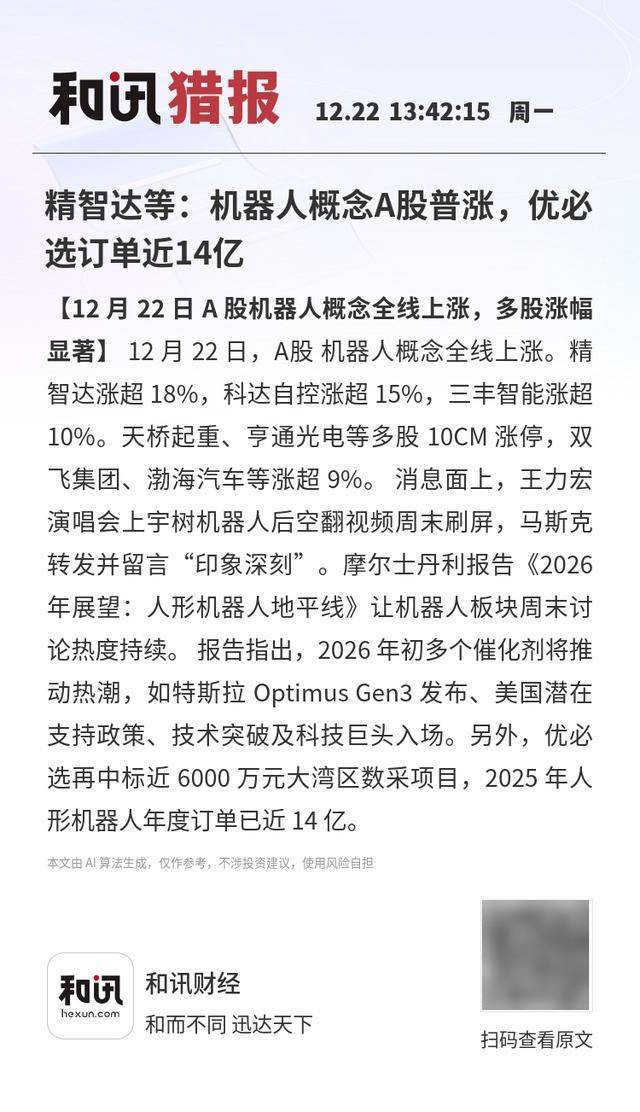
精智达等:机器人概念A股普涨,优必选订单近14亿
Sou Hu Cai Jing· 2025-12-22 06:21
Core Insights - The A-share robotics sector experienced a significant rally on December 22, with multiple stocks showing notable gains, including Jingzhida rising over 18%, Keda Control up more than 15%, and Sanfeng Intelligent increasing by over 10% [1] - The surge in the robotics sector was fueled by a viral video of a robot performing a backflip at a concert, which was shared by Elon Musk, and a report from Morgan Stanley titled "2026 Outlook: The Horizon of Humanoid Robots" that highlighted upcoming catalysts for growth [1] Market Performance - Several stocks hit the 10% daily limit, including Tianqiao Hoisting and Hengtong Optic-Electric, while others like Shuangfei Group and Bohai Automobile saw increases exceeding 9% [1] - The report from Morgan Stanley indicated that by early 2026, multiple catalysts such as the release of Tesla's Optimus Gen3, potential supportive policies in the U.S., technological breakthroughs, and the entry of tech giants will drive the robotics sector [1] Project Developments - UBTECH secured a new project worth nearly 60 million yuan in the Greater Bay Area for data collection, with annual orders for humanoid robots projected to reach nearly 1.4 billion yuan by 2025 [1]

人形机器人遇风险提示:警惕扎堆与低水平重复
Jing Ji Guan Cha Wang· 2025-11-29 09:31
Core Viewpoint - The National Development and Reform Commission (NDRC) has issued a risk warning regarding the humanoid robot industry, highlighting concerns about product homogeneity and compressed R&D space as the industry rapidly develops [1][2][7]. Industry Overview - The humanoid robot industry in China has over 150 companies, with more than half being startups or companies from other sectors, leading to a significant issue of product homogeneity [2][3]. - The industry is experiencing rapid growth, with a projected market size of 100 billion yuan by 2030, driven by innovation and demand [2]. Identified Risks - **Risk One: Low-level Repetition** The industry faces a major concern of low-level repetitive products crowding the market, which compresses the R&D space and stifles innovation. The current focus on exhibition and demonstration rather than industrial application limits the true potential of humanoid robots [3][4]. - **Risk Two: Capital Dispersal and Overheated Expectations** The influx of capital into the humanoid robot sector has led to dispersed financing and inflated expectations. The average financing for the 150 companies is only around 100 million yuan, with significant disparities compared to leading global firms [4][5]. - **Risk Three: Delayed Commercialization and Industry Chain Coordination** The transition from demonstration to practical application is lagging, with a lack of effective collaboration across the industry chain. This includes issues with component procurement, data sharing, and standardization, which hinder the overall efficiency and integration of the industry [5][6]. Government Response - The NDRC is conducting in-depth research to strengthen policy guidance, accelerate technological breakthroughs, and promote the application of results to ensure the healthy and standardized development of the humanoid robot industry [6][7].

特斯拉股东大会前瞻,Optimus利好已至!
Robot猎场备忘录· 2025-11-07 00:04
Core Insights - The article discusses the upcoming Tesla shareholder meeting on November 6, focusing on Elon Musk's $1 trillion compensation plan, which is crucial for his continued role as CEO [2][3] - The article highlights the mixed reactions from major shareholders, including the Norwegian government pension fund and CalPERS, both of which hold minimal shares in Tesla [2] - The article suggests that the approval of Musk's compensation plan is highly likely, given its performance-based structure tied to ambitious targets for Tesla over the next decade [3] Summary by Sections Tesla Shareholder Meeting - The Tesla shareholder meeting is set for November 6, with a key topic being Musk's $1 trillion compensation plan, which includes granting him 12% of Tesla's shares [2] - Major shareholders have expressed opposition to the plan, but their influence is limited due to their small ownership stakes compared to Musk's 13% [2] Market Reactions - The article notes that the robot sector is experiencing a downturn as investors await the shareholder meeting, indicating a potential "washout" of stocks in the sector [5] - The article anticipates that the adjustment period for the T-chain companies will soon conclude, with the shareholder meeting expected to provide clarity [6] Industry Developments - The article mentions that despite delays in the release of Tesla's Optimus Gen3 robot, positive feedback from the supply chain has been accumulating, indicating readiness for mass production [7] - Recent updates from key suppliers in the Tesla Optimus supply chain have shown progress in product development and production guidance [9] Other Companies in the Sector - The article highlights advancements from other companies, such as XPeng Motors, which unveiled a new humanoid robot, and Seres, which raised $1.8 billion for expansion into humanoid robotics [15][17] - The article emphasizes that the fourth quarter will bring numerous catalysts for the robot sector, suggesting a period of significant activity and potential growth [18]
特斯拉Optimus Gen3发布推迟,产业链上市公司难迎催化
Robot猎场备忘录· 2025-10-23 16:08
Core Viewpoint - Tesla's Optimus Gen3 release has been delayed, now expected in Q1 next year, which has impacted the stock price negatively after the Q3 earnings report showed revenue growth without profit increase [2][3]. Group 1: Tesla's Optimus Developments - The first production line for Optimus is under construction, with hopes to start production by the end of next year [2]. - Elon Musk reiterated that Optimus could become the greatest product in history, despite the delays in its release [2]. - The market reaction to the news has been mixed, with the robotics sector experiencing volatility and a lack of core positive catalysts [2][3]. Group 2: Market Conditions and Reactions - The stock market has been fluctuating due to various uncertainties, including tariff issues and the Q3 earnings season, leading to a defensive strategy among institutions [2]. - The robotics sector has seen a rollercoaster market performance, with T-chain stocks leading but still following the overall market trend [2][3]. Group 3: Upcoming Catalysts - Several key events related to Optimus are anticipated in Q4, including factory audits, the final draft of Optimus Gen3, and the shareholder meeting in November [3][5]. - The current audit process is progressing well, with positive news from various audit targets, although a lack of core positive news remains [5]. Group 4: Industry Players and Developments - A comprehensive list of nearly 70 companies in the Tesla Optimus supply chain has been compiled, highlighting key players and their roles [6]. - Other positive developments in the robotics sector include new product launches and significant orders for companies like Figure AI and UBTECH [7].

特斯拉、小鹏、优必选、智元等,产业链上市公司周速递
Robot猎场备忘录· 2025-10-19 00:03
Core Viewpoint - The article discusses the volatile performance of the robotics sector, particularly influenced by news surrounding Tesla's Optimus project and tariff issues, highlighting both positive and negative catalysts affecting the market [2][3]. Summary by Sections Market Performance - The robotics sector experienced a rollercoaster market performance, with significant fluctuations driven by external news and internal developments, particularly the T-chain companies [2][3]. - The market saw a decline in the first half of October, with the robotics sector underperforming compared to the broader market, primarily due to a cautious approach from institutional investors [2][4]. Key Developments - On October 13, it was rumored that T-chain company New Sword CD secured an order for over 1,000 units of Tesla's dexterous hands, marking a significant milestone as it includes complete assembly orders rather than just components [4]. - This news, although unconfirmed, was expected to positively impact related companies in the supply chain, setting the stage for a potential rally in stock prices [4]. Notable Events - On October 15, a false report about Sanhua Intelligent Control receiving a $685 million order from Tesla led to a temporary surge in stock prices, but was later denied by the company [6][10]. - Despite the denial of the false information, the robotics sector showed resilience, with limited declines compared to other sectors, indicating strong underlying demand [14]. Future Outlook - The article emphasizes the upcoming catalysts for the robotics sector, particularly related to Tesla's Optimus project, with multiple events scheduled in the fourth quarter that could drive further interest and investment [15][16]. - The article also notes that many key players in the Tesla Optimus supply chain have established production bases overseas, mitigating potential trade risks [16]. Additional Highlights - Other positive developments in the robotics sector include new orders for companies like Ubtech and the anticipated release of new humanoid robots from various manufacturers [15]. - The article suggests that the robotics sector is poised for significant growth, driven by advancements in technology and increasing demand for humanoid robots [17].


人形机器人迈入量产 把握赛道投资机遇
Zhong Guo Zheng Quan Bao - Zhong Zheng Wang· 2025-10-17 00:57
Core Insights - The humanoid robot industry is transitioning from technical exploration to large-scale production, driven by policy guidance and collaboration with the electric vehicle supply chain [1][4] - The industry is expected to experience significant growth over the next two decades, with a projected demand increase of five to ten times by 2026 [3][6] Technological Development - The focus has shifted from developing functional robots to rapid scaling, with breakthroughs across the software, hardware, and supply chain [2][3] - Tesla's Optimus Gen3 is becoming an industry benchmark, with its design nearing completion and expected to launch by the end of this year [2][6] Market Expansion - Domestic companies are securing substantial contracts, with the likes of UBTECH's Walker series winning contracts worth hundreds of millions, primarily from state-owned enterprises and government departments [3][4] - The supply chain for humanoid robots in China is now one of the most complete globally, facilitating mass production [3][5] Policy Support - China is providing leading global support for the humanoid robot industry, with systematic and precise policies aimed at fostering key component breakthroughs [4][5] - Local governments are implementing substantial support measures, including targeted subsidies for research, manufacturing, and application promotion [4] Synergy with Electric Vehicle Industry - The collaboration with the electric vehicle industry is enhancing the humanoid robot sector through shared data, technology, and supply chain efficiencies [5][6] - The automotive industry's manufacturing capabilities and cost control experiences are being leveraged for robot production [5] Investment Opportunities - Key investment strategies include focusing on core components linked to leading companies like Tesla, domestic industry leaders, and niche areas with unique technologies [6][7] - The industry is characterized by non-linear growth, suggesting that current valuations may not be excessive given the potential for rapid expansion once mass production begins [6][7] Competitive Landscape - The competitive landscape will likely favor leading companies and their core component suppliers, with a focus on those with technological advantages and proven supply chain capabilities [7]
开源证券孟鹏飞:人形机器人迈入量产 把握赛道投资机遇
Zhong Guo Zheng Quan Bao· 2025-10-17 00:55
Core Insights - The humanoid robot industry is transitioning from technical exploration to large-scale production, driven by policy support and collaboration with the electric vehicle supply chain [1][4][6] - The industry is expected to experience significant growth over the next two decades, with a projected demand increase of five to ten times by 2026 [3][6] Industry Transition - Initially, the focus was on developing robots for specific scenarios, with companies like Utree, Zhiyuan, and UBTECH leading in research and entertainment applications [2] - Recent advancements have shifted the consensus towards rapid scaling, with breakthroughs across software, hardware, and supply chains [2][3] - The development of Tesla's Optimus Gen3 is seen as a pivotal moment, with its design nearing completion and expected to launch by the end of this year [2][6] Market Dynamics - Domestic companies are securing significant contracts, with UBTECH's Walker series winning contracts worth hundreds of millions, primarily from state-owned enterprises and government departments [3][4] - The supply chain for humanoid robots in China is now one of the most complete globally, facilitating mass production [3][4] Policy and Collaboration - China's support for the humanoid robot industry is unparalleled, with systematic policies and financial investments aimed at fostering technological breakthroughs [4][5] - The collaboration with the electric vehicle industry enhances data sharing, technology reuse, and supply chain efficiencies, driving down costs and accelerating production [5][6] Investment Opportunities - Key investment strategies include focusing on core components linked to leading companies like Tesla, as well as domestic leaders such as Utree and Zhiyuan [6][7] - The industry is characterized by non-linear growth, suggesting that once mass production begins, the resulting order influx will significantly boost valuations for leading firms [6][7] - Investors are advised to prioritize companies with technological advantages and proven supply chain capabilities while avoiding those lacking core technologies [7]
开源证券孟鹏飞: 人形机器人迈入量产 把握赛道投资机遇
Zhong Guo Zheng Quan Bao· 2025-10-16 22:22
Core Insights - The humanoid robot industry is transitioning from technical exploration to mass production, driven by policy support and collaboration with the electric vehicle supply chain [1][4][5] - The industry is expected to experience significant growth over the next two decades, with a focus on leading companies and core supply chains as key investment opportunities [1][6] Technological Development - The industry has shifted from laboratory experiments to rapid scaling, with breakthroughs across software, hardware, and supply chains [2][3] - Tesla's Optimus Gen3 is becoming an industry benchmark, with its design nearing completion and expected to launch by the end of the year [2] - Domestic companies like Yushun and Zhiyuan are also achieving significant technological advancements, such as the DR02 humanoid robot's IP66 protection level [2][3] Market Expansion - Leading overseas companies are expanding beyond factory settings into social domains like restaurants and homes, while domestic firms are leveraging policy orders and scenario validation to accelerate growth [3][4] - The domestic humanoid robot supply chain is now one of the most complete globally, facilitating mass production [3] Policy and Industry Synergy - China's support for the humanoid robot industry is unparalleled, with systematic and precise policies promoting key component breakthroughs [4][5] - Local governments are providing targeted support for research, manufacturing, and application promotion, which is reflected in the growing number of orders from companies like Yushun and Zhiyuan [4] Investment Strategy - The industry is at a critical juncture, with Tesla's Optimus Gen3 expected to achieve mass production of 50,000 units by 2026, aiming for one million units by 2030 [6] - Investment strategies should focus on core components linked to leading companies, domestic industry leaders, and niche areas with technological scarcity [7] - The competitive landscape will favor leading companies and their core suppliers, emphasizing the importance of technological and supply chain advantages [7]