理财型保险

Search documents
治理销售“错配”与“误导” 保险业全面落实适当性管理要求
Jin Rong Shi Bao· 2026-02-13 01:52
Core Viewpoint - The implementation of the "Financial Institutions Product Appropriateness Management Measures" aims to enhance the protection of financial consumers' rights and standardize the appropriateness management of financial institutions, particularly in the insurance sector [1][2]. Group 1: Appropriateness Management - Appropriateness management involves financial institutions identifying, advising, matching, selling, and transacting based on product attributes, risk characteristics, and customer financial needs and risk tolerance [2]. - The new measures require insurance companies to understand both products and customers, ensuring compliance in sales through categorization and risk assessment [2][3]. - Insurance companies are establishing tiered management systems for product risks and sales qualifications, ensuring that sales personnel are appropriately authorized based on their capabilities [3][4]. Group 2: Sales Management System Reconstruction - Insurance companies are restructuring their sales management systems to ensure that suitable products are sold through appropriate channels to the right customers [3][5]. - Companies like Dajia Life have formed special task forces to implement the new measures, revising internal control requirements and management guidelines to align with the new regulations [3][4]. - The implementation of the appropriateness management measures includes embedding assessment questionnaires in the sales process to gather critical information about the policyholders [6]. Group 3: Consumer Education - Companies are enhancing consumer education to ensure that the new measures are effectively communicated and understood by consumers [7][8]. - Innovative educational formats, such as using cultural references and multimedia, are being employed to make the principles of appropriateness more accessible to consumers [7][8]. - The insurance industry views the new measures as a benchmark for assessing the level of appropriateness management, with a focus on integrating these principles into core business practices to protect consumer rights [8].
治理销售“错配”与“误导” 保险业全面落实适当性管理要求
Jin Rong Shi Bao· 2026-02-11 01:21
Core Viewpoint - The implementation of the "Financial Institutions Product Appropriateness Management Measures" aims to enhance the appropriateness management of financial products and protect consumer rights in the insurance industry, necessitating a comprehensive restructuring of sales management systems within insurance companies [1][2]. Group 1: Appropriateness Management - Appropriateness management involves matching financial products with customer needs, financial status, and risk tolerance, addressing issues of sales misguidance and product mismatches that have arisen in a rapidly developing insurance market [2][3]. - Insurance companies are required to establish tiered management systems for product risk and sales qualifications, ensuring that products are categorized and sales personnel are graded according to their capabilities [2][3]. Group 2: Sales Management System Restructuring - Insurance companies are restructuring their sales management systems by revising internal control requirements and updating relevant management measures to ensure compliance with the new regulations [3][4]. - The implementation of the new measures includes the establishment of specialized working groups across various departments to coordinate efforts in compliance and consumer protection [3][5]. Group 3: Consumer Education and Engagement - Companies are enhancing consumer education by utilizing innovative methods to communicate the importance of appropriate product selection and risk assessment, aiming to instill a rational investment mindset among consumers [7][8]. - Initiatives include the use of multimedia resources and community engagement activities to promote understanding of insurance products and the significance of the appropriateness management measures [7][8].
3大保险公司已破产!但你的保单还安全吗?国家其实早有准备
Sou Hu Cai Jing· 2025-10-21 02:56
Core Viewpoint - The recent bankruptcies of three insurance companies do not affect the validity of existing policies, as the government has established mechanisms to protect policyholders' rights and ensure continuity of coverage [1][2]. Group 1: Company Bankruptcies - Three insurance companies have officially exited the market: - Chubb Insurance Co. was approved for dissolution, with all its insurance business and liabilities transferred to Huatai Insurance, ensuring existing policies remain valid [1]. - Yi'an Property Insurance entered bankruptcy reorganization, continuing operations during the process and later rebranded as BYD Property Insurance, maintaining policy obligations [1]. - Anbang Insurance Group announced its dissolution, with all policies assumed by the People’s Insurance Group, ensuring full payment of 1.5 trillion yuan in short-term investment insurance without any defaults [2]. Group 2: National Safety Nets - The government has established two key mechanisms to safeguard policyholder interests: - Legal mandates require that life insurance policies must be transferred to another insurer in the event of a company’s dissolution, ensuring that policy responsibilities are maintained [4]. - A guarantee fund of 243.1 billion yuan is in place to support policyholders in case of insurance company failures, providing an additional layer of security [4]. Group 3: Compensation Rules - Different insurance types have specific compensation standards: - Life insurance policies are fully guaranteed, with the insurance guarantee fund providing financial support to the acquiring company, ensuring no claims are denied due to company issues [5]. - For property insurance, personal policies under 50,000 yuan are fully compensated, while those above receive 90% compensation; for businesses, policies under 500,000 yuan are fully compensated, and those above receive 80% [5]. - Investment-type insurance, such as Anbang's, is fully compensated by the acquiring company, with no defaults reported [5]. Group 4: Practical Advice - To ensure policy safety, individuals can take the following steps: - Check the policy status through official channels to confirm the operating status of the insurance company [6]. - Focus on the solvency ratio when purchasing insurance, ensuring it meets regulatory standards [6]. - Avoid relying solely on the reputation of large companies, as all insurers are subject to the same regulatory framework [6].


牛市赚钱策略:谁是行情推手?紧盯这两路“聪明钱”!(下)
市值风云· 2025-08-29 10:16
Group 1 - The core viewpoint of the article emphasizes that incremental capital is a direct driving force behind the rise of stocks and the stock market, highlighting the importance of understanding where this capital is flowing [3]. - The previous article discussed how high-net-worth individuals are channeling funds into the stock market through wealth management insurance and private equity, indicating a trend in capital movement [3]. - This article aims to explore two additional channels through which incremental capital is entering the stock market, suggesting a broader analysis of capital flows [3].

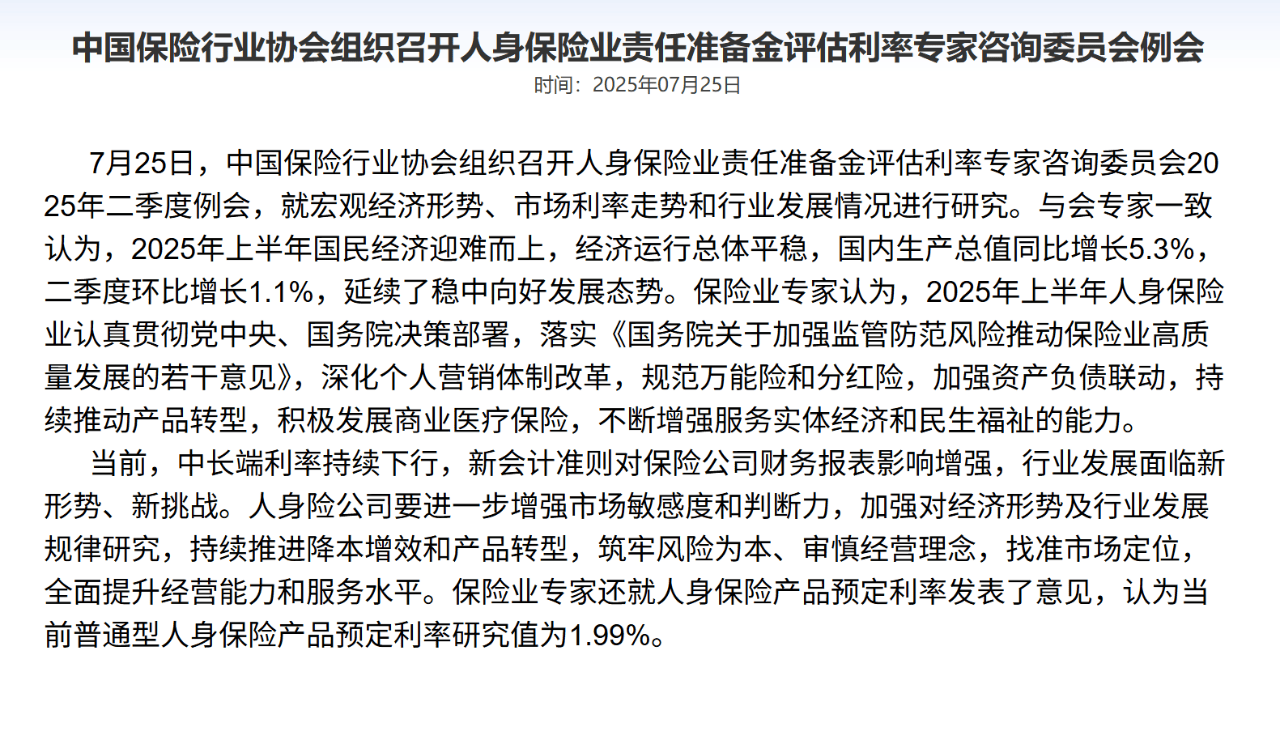
人身险预定利率研究值再下调 保险公司“抢2.5”战来了!
Sou Hu Cai Jing· 2025-07-26 08:19
Core Insights - The China Insurance Industry Association announced a new benchmark interest rate for ordinary life insurance products at 1.99%, a decrease of 14 basis points from the previous rate, indicating a trend of declining interest rates in the insurance sector [1][4][5] - Major insurance companies, including China Life and Ping An Life, have announced adjustments to their insurance product interest rates, with the maximum rate for ordinary insurance products set at 2.0% [5][9] - The downward adjustment of the benchmark interest rate is seen as a necessary response to the ongoing decline in market interest rates, which helps insurance companies manage their financial stability and reduce liability costs [9][14] Industry Adjustments - The new maximum interest rates for various insurance products are as follows: ordinary insurance products at 2.0%, participating insurance products at 1.75%, and universal insurance products at a maximum guaranteed rate of 1.0% [5] - The adjustment aligns with the regulatory framework established earlier this year, which mandates that if the maximum interest rate for insurance products exceeds the benchmark rate by 25 basis points for two consecutive quarters, it must be lowered [4] Market Reactions - Insurance agents are leveraging the current market conditions to promote sales, emphasizing the urgency for consumers to secure higher rates before further declines [10][13] - The trend indicates a shift towards participating insurance products as the maximum interest rates for fixed-income products decrease, which may enhance the appeal of variable yield products [13] Expert Opinions - Experts suggest that the adjustment in interest rates reflects the need for insurance products to align with market realities, thereby improving pricing strategies and reducing the risk of interest rate mismatches [9][14] - There is a cautionary note regarding potential marketing practices that may exaggerate the impact of interest rate changes, which could mislead consumers [14]