
电建一号

Search documents
多枚可重复使用火箭今年有望首飞
Zheng Quan Ri Bao· 2026-01-29 17:29
Core Viewpoint - The Chinese commercial rocket industry is poised for significant advancements in reusable rocket technology, with multiple launches and recovery attempts expected in 2026, marking a critical year for the sector [1][4]. Group 1: Company Developments - China Aerospace Science and Technology Corporation (CASC) emphasizes the importance of 2026 as a foundational year for the commercial rocket sector, focusing on resource integration and successful launches and recoveries [1]. - The successful launch of the Zhuque-3 rocket by private company Landspace and the Long March 12 rocket by CASC highlights the collaborative efforts between state-owned and private enterprises in advancing reusable rocket technology [2][3]. - The Long March 12 rocket, measuring approximately 70.4 meters in length and weighing about 437 tons, aims for "first-stage reuse" as a core feature, although it did not achieve the recovery goal during its recent flight [2]. Group 2: Industry Trends - The collaboration between state-owned and private enterprises is fostering a strong synergy in the development of reusable rockets, combining the technical expertise of state firms with the agility of private companies [3]. - The anticipated launches of multiple domestic reusable rockets, including the Hyperbola-3 and Xingyun-1, are expected to occur in 2026, further pushing the boundaries of China's capabilities in this field [4]. - The breakthrough in reusable rocket technology is seen as a key factor in reducing launch costs, which could lead to new opportunities in satellite networking and space infrastructure [5]. Group 3: Future Opportunities - The successful recovery of reusable rockets is expected to open up new avenues in the commercial space sector, with companies actively preparing for developments such as space tourism [5][6]. - The Lihong-2 vehicle is set to conduct a 100-kilometer recovery technology verification in 2026, aiming to significantly lower launch costs and validate recovery technologies [6]. - Ongoing research and development in commercial space technology will require substantial investment and collaboration among government, local authorities, and private capital to achieve breakthroughs in core technologies [6].

“算力上天”成为全球科技竞争新焦点
Zheng Quan Ri Bao· 2026-01-27 16:37
Core Insights - The AI industry is rapidly expanding, with data center construction booming, and the core bottleneck has shifted to energy constraints, making "computing in space" a crucial path to break this bottleneck and a new focus in global tech competition [1] Group 1: Development of Space Computing - The transition from "ground sensing and computing" to "space computing" is accelerating in China, with the deployment of data centers and computing capabilities in space [2] - China has established a multi-dimensional approach led by national teams, with commercial space following and deep integration of industry, academia, and research, achieving significant breakthroughs [2] - The "Xingcan" plan by Guoxing Aerospace aims to create a space computing network of 2,800 satellites, focusing on AI model inference and training, marking a global first in deploying a general model in orbit [2] Group 2: Innovations in Energy Monitoring - The "Dianjian No. 1" satellite, China's first energy engineering-specific satellite, offers a new solution for energy infrastructure monitoring, overcoming traditional monitoring challenges [3] - The satellite features X-band synthetic aperture radar (SAR) for all-weather observation, enabling precise monitoring even in adverse weather conditions [3] - Future plans include collaboration with "Dianjian No. 2" to create a comprehensive space information support system for the entire lifecycle of energy engineering [3] Group 3: Challenges in Space Computing - The development of space computing is a complex system engineering challenge, requiring advancements in radiation-resistant chips, high-speed inter-satellite communication, and cost-effective launch capabilities [4] - The commercial viability of space computing hinges on breaking the cost and capacity bottlenecks in commercial spaceflight, with a target launch cost of approximately $200 per kilogram [5] - The industry faces deeper challenges in building business models and application ecosystems, as 90% of space data remains underutilized, necessitating high-value application scenarios to support significant investments [5]
积极履行社会责任 更好展现担当作为
Ren Min Wang· 2025-12-28 22:35
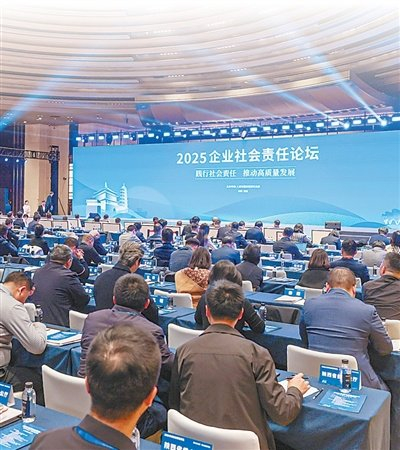
Group 1 - China Electric Power Construction Group Co., Ltd. emphasizes its role in national development, executing nearly 4,000 projects in 139 countries, contributing to local economic growth and improving livelihoods [2] - The company has over 50 million kilowatts of installed capacity in renewable energy projects and actively participates in global energy governance, having developed 13 international standards and translated over 1,100 advanced standards [2] - China Electric Power integrates innovation with responsibility, overcoming key technical challenges in major projects and developing advanced technologies such as laser 3D scanning and underwater robots [2] Group 2 - Kweichow Moutai focuses on high-quality development through industrial transformation, leveraging its unique brewing ecosystem and exploring high-value utilization of by-products [3][4] - The company has invested over 400 million yuan in watershed protection and has achieved a vegetation coverage rate of 49.7% in the Chishui River basin, promoting a positive cycle of ecological protection and industrial development [4] - Moutai has contributed over 500 million yuan to social welfare projects, benefiting more than 5 million people through various initiatives [4] Group 3 - Lenovo Holdings integrates social responsibility into its overall strategy, focusing on innovation to overcome development bottlenecks and drive industrial upgrades [5] - The company has supported over 3,000 students from underdeveloped areas through its "Lenovo Progress Class" project and has helped over 400 rural women start their own businesses [5] - Lenovo promotes green development through its green carbon reduction system, contributing to the low-carbon transition in the industry [5] Group 4 - 3D printing technology is becoming a key driver of innovation in modern manufacturing, significantly shortening product development cycles and enabling low-cost production of complex structures [6] - The technology is widely applied in various sectors, including aerospace, military, and automotive, enhancing manufacturing precision and performance [6] - Companies are encouraged to focus on integrating technology development with industrial innovation to maintain a competitive edge in the global additive manufacturing landscape [6] Group 5 - Shaanxi Yanchang Petroleum Group has maintained stable oil production for 19 years, with a natural gas output exceeding 12 billion cubic meters, aiming for an oil and gas equivalent of over 20 million tons in 2024 [9] - The company achieved a profit of 60 billion yuan during the 14th Five-Year Plan period, marking a sixfold increase compared to the previous period [9] - Yanchang Petroleum has built over 50 high-quality projects, contributing to infrastructure improvement and industrial transformation in the Shaanxi region [10] Group 6 - Shaanxi Construction Holding Group integrates social responsibility into its development strategy, establishing local companies across the country to support national strategic initiatives [12] - The group has invested over 41 million yuan in skill training for farmers and has completed numerous projects in healthcare, education, and housing, benefiting over 2.3 million people [12] - The company is committed to high-quality development while addressing national strategic needs and enhancing industrial upgrades [12] Group 7 - China Copper Corporation emphasizes high standards in social responsibility, integrating it into its development framework [13][14] - The company has established 12 national and 13 provincial-level green factories, focusing on sustainable resource supply and low-carbon upgrades in its operations [14] - China Copper is involved in rural revitalization projects, supporting collective economies and education in various regions [14] Group 8 - Samsung has been committed to sharing its business success with society, focusing on rural development, technology education, and environmental protection [16] - The company has launched initiatives to support rural revitalization and has provided technology training to over 70,000 young people [16] - Samsung integrates low-carbon principles into its product lifecycle management and collaborates with nearly 3,000 supply chain partners to promote green development [16] Group 9 - JD.com prioritizes employee welfare, providing comprehensive benefits and investing in housing for delivery personnel [18] - The company emphasizes customer trust and community growth, sharing profits with employees and partners [18] - JD.com has initiated green logistics and supply chain projects to promote environmental sustainability [18] Group 10 - Gu Yu Biotechnology Group combines technology and culture to drive brand vitality and high-quality development [19] - The company has established a research center and is expanding its raw material library to enhance innovation capabilities [19] - Gu Yu is committed to sustainable practices, including eco-friendly production methods and community engagement through environmental initiatives [19]

能源工程专用卫星制成
Ke Ji Ri Bao· 2025-12-12 00:48
Core Viewpoint - The successful launch of China's first energy engineering dedicated satellite, "Dianjian No. 1," marks a significant advancement in geological disaster monitoring and safety warning systems, transitioning from traditional ground-based methods to an integrated "sky-ground" collaborative model [1]. Group 1: Satellite Overview - "Dianjian No. 1" is a high-performance radar remote sensing satellite equipped with X-band synthetic aperture radar (SAR) payload, capable of all-weather and all-time observation [1]. - The satellite was jointly developed by China Power Construction Group's Chengdu Survey and Design Research Institute and China University of Geosciences (Wuhan) [1]. Group 2: Monitoring Capabilities - The satellite can detect millimeter-level subtle deformations of the Earth's surface and structures from a space orbit 500 kilometers away, effectively monitoring slow displacements and settlements of critical energy infrastructure such as mountain slopes, dams, and power plants [1]. - It provides high-precision and high-frequency space monitoring support for engineering safety [1]. Group 3: Strategic Importance - The launch of "Dianjian No. 1" is a crucial step in the strategic layout of China Power Construction Group's integrated perception system, which combines sky, ground, and water elements, and is essential for developing new productive forces in the engineering sector [1].
