百度文心

Search documents
春节红包超80亿,留存率或不足5%!究竟能换来多少「真用户」?
Xin Lang Ke Ji· 2026-02-14 01:49
Core Viewpoint - The upcoming Spring Festival will see a fierce competition among major internet companies in the "red envelope war," with total investments exceeding 8 billion yuan, and potential cumulative spending reaching 10 billion yuan when including undisclosed amounts from various platforms [1][4]. Group 1: Investment and Participation - Major players in the red envelope competition include Alibaba, Tencent, Baidu, JD.com, ByteDance, and Kuaishou, with total disclosed amounts exceeding 8 billion yuan [4]. - Alibaba is leading with a 3 billion yuan investment through its Qianwen app, focusing on integrating user consumption behaviors with its ecosystem [6]. - Tencent has allocated 1 billion yuan for its Yuanbao app, aiming to enhance user interaction and experience [6]. - Baidu has committed 500 million yuan for its Wenxin assistant, targeting user engagement within its app [6]. - JD.com and Kuaishou have also announced significant investments, with JD.com planning to distribute 3 billion yuan in red envelopes [3][6]. Group 2: User Engagement and Retention - Experts warn that relying solely on red envelopes may lead to low user retention rates, with 7-day retention below 20% and 30-day retention potentially dropping below 5% [8][9]. - The effectiveness of red envelopes in retaining users is questioned, as they primarily address initial user acquisition rather than long-term engagement [9][10]. - Companies are encouraged to focus on product design and technological capabilities to meet user needs, rather than solely on promotional tactics like red envelopes [10]. Group 3: Competitive Landscape and Strategy - The competition is intensified by the emergence of generative AI technologies, with companies vying for user attention through innovative applications [5]. - ByteDance's Doubao is expected to benefit significantly from its collaboration with the Spring Festival Gala, leveraging its large user base for engagement [7]. - The strategies employed by different companies reflect their long-term visions, with Alibaba focusing on integrating user experiences and Tencent emphasizing social interaction [6][7].


春节红包超80亿,留存率或不足5%!究竟能换来多少“真用户”?
Xin Lang Cai Jing· 2026-02-14 01:37
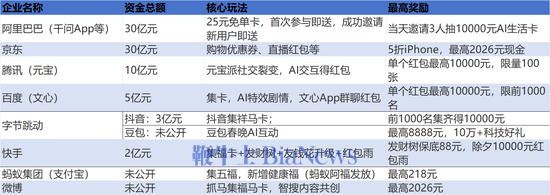
Core Viewpoint - The upcoming Spring Festival will see a significant "red envelope war" among major internet companies, with total investments exceeding 8 billion yuan, and potential total funding reaching 10 billion yuan when including undisclosed amounts from various platforms [2][16]. Group 1: Investment Amounts and Strategies - Alibaba is investing 3 billion yuan through its Qianwen app, offering a 25 yuan free order card and incentives for new user referrals [3][14]. - JD.com is also contributing 3 billion yuan, providing shopping coupons and cash prizes, including a 50% discount on iPhones [3][14]. - Tencent is allocating 1 billion yuan for its Yuanbao app, focusing on social interaction and AI-driven features [3][14]. - Baidu is investing 500 million yuan in its Wenxin app, promoting card collection and AI-enhanced interactions [3][14]. - ByteDance's Douyin is contributing 300 million yuan, while the exact amount for its Doubao platform remains undisclosed [3][14]. - Kuaishou is investing 200 million yuan, utilizing various interactive features to engage users [3][14]. - Ant Group (Alipay) and Weibo have not disclosed their investment amounts but are participating in the red envelope activities [3][14]. Group 2: User Retention Concerns - Experts warn that relying solely on red envelopes may lead to low user retention rates, with 7-day retention below 20% and 30-day retention potentially dropping below 5% [8][21]. - The red envelope strategy addresses initial user engagement but fails to ensure long-term usage [8][21]. Group 3: Competitive Landscape and AI Integration - The competition is intensified by the emergence of generative AI technologies, with companies like Alibaba, Tencent, and Baidu leveraging their AI applications as key platforms for distributing red envelopes [6][16]. - The red envelope war reflects a shift in focus towards AI capabilities, with companies aiming to establish a competitive edge in the evolving digital landscape [6][16]. - ByteDance's Doubao is expected to benefit significantly from its collaboration with the Spring Festival Gala, potentially positioning it as a major winner in this year's competition [19].


春节档大模型“超级周”来临,半导体设备ETF(159516)强势吸金
Mei Ri Jing Ji Xin Wen· 2026-02-13 02:18
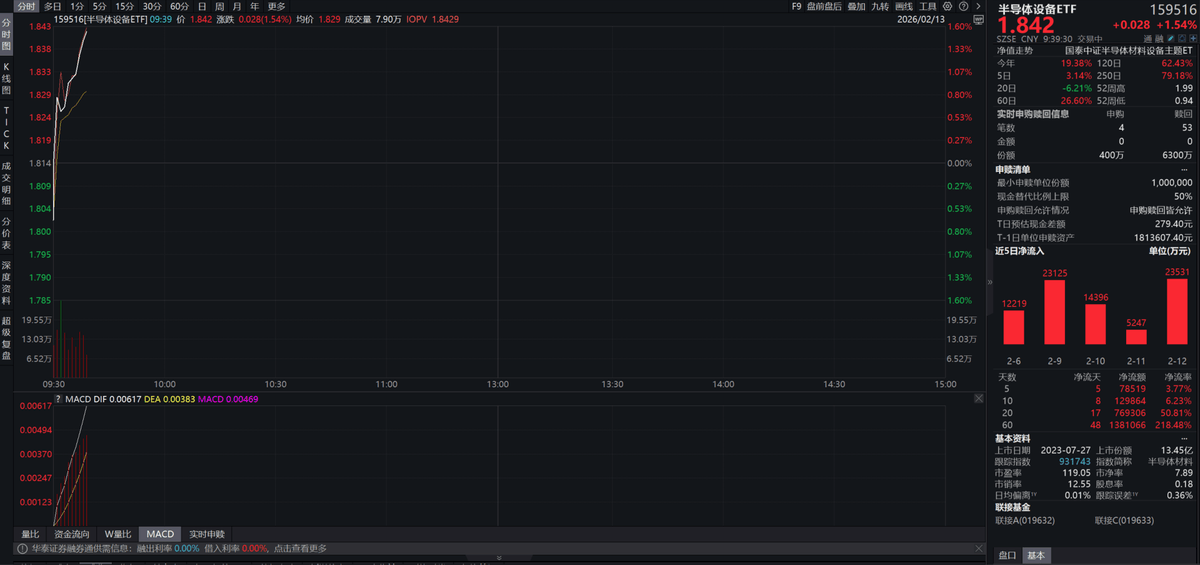
Core Insights - The Chinese AI industry is experiencing a significant shift from "single-point breakthroughs" to "systematic iterations," as multiple domestic model manufacturers release flagship models simultaneously, enhancing market confidence in AI commercialization [1][3][4]. Group 1: Industry Developments - Major Chinese AI companies, including ByteDance, Zhipu, DeepSeek, and MiniMax, have launched new flagship models across various domains such as video generation, image generation, and programming, marking a collective advancement in the industry [1][3]. - Morgan Stanley has termed this phenomenon as the "Spring Festival release cycle," indicating that the simultaneous updates from multiple companies will accelerate market comparisons and shift market share towards the best performers [3][4]. Group 2: Market Dynamics - The perception of domestic large models has evolved from being "followers" to being competitive with global leaders in areas like coding and context handling, leading to increased willingness to pay and higher API workload retention rates [4]. - The marketing battle among AI applications during the Spring Festival has led to a surge in user engagement, validating the potential for explosive consumer traffic and creating a non-linear growth trajectory for inference computing demand [5][6]. Group 3: Long-term Trends - The AI investment narrative is shifting from "training-driven" to "inference-driven," with inference demand expected to become the main engine for computing growth starting in 2026, significantly expanding the market space compared to training [10][19]. - The supply side is undergoing generational upgrades, particularly in optical modules, with a projected demand increase of over tenfold for 1.6T optical modules by 2026 [12][19]. Group 4: Competitive Landscape - The commoditization of large models is leading to a redistribution of power in the platform layer, where differentiation is increasingly based on marketing capabilities, workflow ownership, and product iteration speed rather than just model strength [14][19]. - The semiconductor equipment sector is now closely tied to global AI computing cycles, with increased capital expenditures from overseas storage leaders driving expectations for domestic equipment companies [15][19]. Group 5: Investment Opportunities - The semiconductor equipment ETF (159516) is highlighted as a core investment vehicle, providing exposure to leading companies in the semiconductor equipment and materials sectors, with a current scale exceeding 20 billion [16][19].
“春晚+” AI营销的国民初体验
Bei Jing Shang Bao· 2026-02-12 13:35
Core Insights - The AI marketing battle for the 2026 Spring Festival has been ignited early, with major players like Tencent and Alibaba investing heavily in cash incentives to attract users [1][6] - Doubao's Spring Festival activities will launch in two phases, focusing on user engagement through AI features rather than just cash prizes [4][5] - The event aims to showcase the practical benefits of AI technology in everyday life, encouraging broader participation in technological innovation [5] Group 1: Doubao's Spring Festival Activities - Doubao plans to launch its Spring Festival activities on February 13 and February 16, allowing users to experience AI-generated greetings and participate in cash prize draws [4][6] - The second phase will feature a live interaction during the Spring Festival Gala, offering prizes including cash up to 8,888 yuan and tech products integrated with Doubao's AI capabilities [4][8] - The tech prizes include 17 popular items, such as 3D printers and electric vehicles, showcasing the integration of Doubao's AI models in consumer products [4][6] Group 2: Competitive Landscape - Competitors like Tencent and Alibaba have emphasized cash prizes in their marketing strategies, with Tencent investing 10 billion yuan and Alibaba 20 billion yuan [6][9] - The differentiation between cash prizes and tech gifts is seen as a strategic move to enhance user engagement and demonstrate the leading edge of AI ecosystems [6][9] - The competition for user attention is fierce, with Doubao's daily active users nearing 7.87 million, while competitors like Alibaba's Qianwen reached 73.52 million [9][10] Group 3: Technological Integration and Future Outlook - The Spring Festival Gala has increasingly incorporated advanced technologies like VR, AR, and AI, with Doubao becoming a key player in this trend [7][8] - The collaboration with AI cloud computing partners marks a significant shift in how technology is presented to the public during major events [8] - The ongoing advancements in video generation technology, such as ByteDance's Seedance 2.0, highlight the rapid evolution of AI applications in marketing [10]

ETF日报:当前电网领域呈现内外需求共振格局 关注电网ETF
Xin Lang Cai Jing· 2026-02-12 11:49
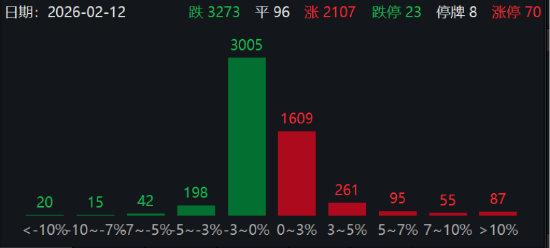
Market Overview - The A-share market experienced narrow fluctuations, with the Shanghai Composite Index closing up 0.05% at 4134.02 points, while the Shenzhen Component Index rose by 0.86%, the ChiNext Index by 1.32%, and the STAR Market Index by 1.56% [1][8] - Overall trading sentiment was subdued ahead of the Spring Festival, with a total trading volume of 2.16 trillion yuan, slightly up from 2 trillion yuan the previous trading day [1][8] - There was a divergence in individual stock performance, with over 3200 stocks declining, while sectors such as artificial intelligence, computing power, and electric grid saw gains [1][8] Artificial Intelligence Sector - The AI sector continued to strengthen, with the Guotai AI ETF (159388) and the STAR Market AI ETF (589110) both rising by 3.97% [3][10] - Major developments included the launch of new AI models and significant price adjustments for existing services, indicating a shift towards commercial viability in the AI market [3][10] - The introduction of the GLM-5 model and the "director-level" video AI Seedance2.0 showcased advancements in AI capabilities, enhancing user experience and market expectations [3][10][11] Electric Grid Sector - The electric grid sector saw significant gains driven by favorable policy announcements, including the State Council's implementation plan for a unified national electricity market by 2030 [6][14] - The plan aims for market-based transactions to account for 70% of total electricity consumption by 2030, with further improvements expected by 2035 [6][14] - The sector is experiencing a dual demand boost from both domestic infrastructure projects and international market needs, particularly in data center construction and AI computing power [6][14] Investment Opportunities - Investors are encouraged to monitor the Guotai AI ETFs (589110, 159388) and the electric grid ETF (561380) as potential investment opportunities due to the ongoing developments in AI and electric grid sectors [5][14]
恒生科技本轮最大回撤超20% 龙头企业应向“质量型增长”转变
证券时报· 2026-02-12 04:38
Core Viewpoint - The Hang Seng Technology Index has experienced a significant downturn since October 2025, with a maximum drawdown exceeding 20%, impacting major Hong Kong internet companies that are part of the index [1][4]. Group 1: Market Dynamics - Analysts attribute the decline in the Hang Seng Technology Index and internet stocks to concerns over an AI bubble, profit-taking pressures, and ongoing competition characterized by "burning money" strategies [2][5]. - The market confidence has been affected by irrational spending, which has led to a lack of trust in the sustainability of internet companies' profitability [5][6]. Group 2: Historical Performance - From early 2025 to October, the Hang Seng Technology Index saw a maximum increase of over 50%, with Tencent's stock rising from a low of 361 HKD to 683 HKD, and Alibaba's stock increasing from 76 HKD to 186 HKD [4]. - The intense competition during the 2025 food delivery battle resulted in significant losses for major players, with Meituan reporting its largest loss since its IPO and Alibaba's operating profit plummeting by 85% [4][5]. Group 3: Shifts in Competitive Strategy - The traditional model of "burning money for scale" is becoming less effective as the industry faces diminishing returns on investment, leading to a fundamental shift in competition logic from user data to industrial value [9][10]. - Companies are now focusing on technology-driven growth and improving business efficiency rather than merely acquiring users through subsidies [9][10]. Group 4: AI Investment and Future Growth - As companies move away from the "burning money" mindset, they are increasingly investing in AI, which is seen as a core area for future growth and market interest [9][10]. - Major players like Alibaba and Tencent are committing substantial resources to AI infrastructure, with Alibaba planning to invest 380 billion CNY in AI initiatives [9][10]. Group 5: Implications of AI Red Packet War - The recent AI red packet competition, while still involving significant spending, is on a smaller scale compared to previous battles, indicating a more restrained approach to market competition [7][8]. - The AI red packet war is expected to have a dual impact: it can enhance user engagement with AI technologies while also raising concerns about excessive subsidies that could harm smaller players [10].

百度文心MAU涨4倍
Mei Ri Jing Ji Xin Wen· 2026-02-12 02:35
Core Viewpoint - Baidu Wenxin reported a significant increase in user engagement and feature usage since the launch of its Spring Festival red envelope campaign, indicating strong growth in its AI capabilities and user adoption [1] Group 1: User Growth - Wenxin Assistant's Monthly Active Users (MAU) have increased fourfold year-on-year since the campaign began [1] Group 2: Feature Usage - The usage of the "Shengtu" (生图) feature has surged by 50 times year-on-year [1] - The "Shengshipin" (生视频) feature has seen a 40 times year-on-year increase in usage [1] - The AI calling feature has experienced nearly a fourfold growth [1]
OpenClaw带动AIAgent渗透提速
Guoxin Securities Co., Ltd· 2026-02-11 07:25
Investment Rating - The industry investment rating is "Positive" with expectations that the industry index will outperform the market index by over 5% in the next six months [17]. Core Insights - The AI sector has transitioned from "dialogue interaction" to "agent action," with the OpenClaw project marking a significant milestone, demonstrating the feasibility and practicality of AI agents [2][9]. - The demand for AI agents is accelerating in the consumer market, with major tech companies like Google, Tencent, and Baidu expanding their offerings, indicating a shift from niche applications to mainstream tools [2][10]. - The infrastructure supporting AI agents faces dual challenges of performance and cost, as prices for essential hardware components like storage chips and CPUs are rising, increasing operational costs for cloud service providers [2][11]. - The expansion of demand is driving significant capital investments from cloud providers, with Alphabet planning capital expenditures of $175 billion to $185 billion and Amazon increasing its spending to $200 billion, a 56% year-on-year increase [2][12][13]. - Security concerns are paramount, as OpenClaw has been reported to have hundreds of vulnerabilities, highlighting the need for robust security measures in commercial applications [2][14]. Summary by Sections Transition from "Dialogue Interaction" to "Agent Action" - The AI agent paradigm shift is exemplified by the rapid rise of OpenClaw, which has gained significant attention in the tech community, indicating broad market acceptance and validation of AI agent technology [9]. Acceleration of Personal AI Assistants in the Consumer Market - The application of AI agents is moving quickly from early developers to the general public, with major companies integrating AI capabilities into their platforms, thus driving demand for computational and storage resources [10]. Infrastructure Challenges - The global AI infrastructure is undergoing performance upgrades while facing increased operational costs due to rising prices of key hardware components, which has led cloud service providers to raise service prices [11]. Demand Expansion Driving Strategic Investments by Cloud Providers - The increasing use of AI agents is prompting cloud companies to significantly boost their capital expenditures, with Alphabet and Amazon announcing substantial increases in their spending plans for 2026 [12][13]. Security Issues - The enhancement of AI agent capabilities brings security risks, as OpenClaw has been found to have numerous vulnerabilities, necessitating effective measures to prevent malicious command injections and manage high-level access [14]. Investment Clues - The development of AI agents presents clear investment opportunities, particularly in the cloud services and computing supply chain, as well as in hardware sectors like edge computing devices and vector databases, which are essential for the deployment of AI technologies [3][15].


传媒互联网:互联网周思考:投还是不投
2026-02-10 03:24
Summary of Conference Call Notes Industry Overview - **Industry**: Media and Internet - **Market Performance**: - US KWEB index decreased by 5.7% - Hong Kong Hang Seng Tech Index fell by 6.5% - US Nasdaq index dropped by 1.8% during the week of February 2 to February 6, 2026 [5][11] Key Insights - **AI Capital Expenditure**: - A new narrative is emerging in overseas markets regarding AI capital expenditures. Initially, companies with aggressive capital investments were seen as the most likely to benefit from AI advancements. However, as the industry matures, there is growing concern about the cash flow pressures associated with high capital expenditures, even for leading companies like Google and Amazon [6][7]. - Google is experiencing accelerated growth in cloud revenue and improved profit margins, yet its capital expenditure is expected to double in 2026, raising cash flow concerns. Conversely, Amazon faces skepticism regarding its $200 billion capital expenditure and the return on investment for its AWS business [6]. - Tencent's conservative approach to AI investments has led to market fears of missing out on industry opportunities, resulting in a nearly 10% drop in its stock price, contributing to a significant decline in the internet sector [6][7]. - **Investment Strategies**: - The current investment landscape in AI is complex, with both aggressive and conservative strategies being justified through various rationales. Long-term, continuous investment in AI is deemed essential, but companies must align their investment strategies with their unique capabilities and growth trajectories [7]. - Recent promotional activities by Tencent, Alibaba, and Baidu, such as social engagement campaigns, are viewed as lacking substantive value in building core AI capabilities, potentially distancing these companies from genuine growth opportunities in the AI sector [7]. Company-Specific Insights - **Stock Ratings and Price Targets**: - Tencent Holdings: Target price of 700.00, P/E of 15.1 for 2026E and 12.9 for 2027E - Meituan: Target price of 125.00, P/E not meaningful for 2026E, 16.5 for 2027E - Kuaishou: Target price of 89.00, P/E of 12.9 for 2026E and 10.9 for 2027E - NetEase: Target price of 177.00, P/E of 12.8 for 2026E and 12.0 for 2027E - Alibaba: Target price of 204.00, P/E of 27.7 for 2026E and 19.0 for 2027E - JD.com: Target price of 41.00, P/E of 7.6 for 2026E and 7.1 for 2027E - Pinduoduo: Target price of 148.00, P/E of 7.9 for 2026E and 6.2 for 2027E - Trip.com: Target price of 92.50, P/E of 14.5 for 2026E and 12.7 for 2027E [4][10]. Risks - **Market Risks**: - Uncertainties in the macroeconomic environment and international relations - Regulatory policy risks - Intensifying industry competition [9]. Additional Noteworthy Information - **Recent Developments**: - Meituan is planning to acquire Dingdong Maicai to strengthen its competitive position in the front warehouse sector [10]. - Google has exceeded expectations in cloud computing, leading to a significant increase in capital expenditure [10]. - Uber's delivery business remains robust, with multiple partnerships driving advancements in autonomous driving [10]. Conclusion - The media and internet industry is currently facing significant challenges and opportunities, particularly in the realm of AI investments. Companies must navigate complex market dynamics while aligning their strategies with long-term growth potential. The performance of key players like Tencent, Alibaba, and others will be critical in shaping the future landscape of the industry.


字节不发AI红包,却在一统江湖
Sou Hu Cai Jing· 2026-02-09 12:51
Core Viewpoint - The competition among major internet companies for user engagement through monetary incentives is contrasted with ByteDance's strategic focus on technological innovation, exemplified by the launch of its AI video tool Seedance 2.0, which aims to redefine content creation in the video sector [3][19]. Group 1: Competitive Landscape - Tencent, Baidu, and Alibaba are engaging in a "red envelope war," collectively investing 4.5 billion yuan to attract users to their AI applications [3]. - ByteDance, despite being the leader in AI application downloads, has opted for a different approach by launching Seedance 2.0 without monetary incentives, emphasizing its established market position [3][19]. - Data shows that ByteDance's Doubao has over 100 million daily active users, significantly outpacing Tencent and Alibaba's offerings [3]. Group 2: Seedance 2.0 Features - Seedance 2.0 allows for a qualitative leap in content creation, supporting multiple input modalities and enabling creators to easily reference various media elements [5]. - The tool lowers the barrier for non-professionals to create high-quality video content by automating scene planning and maintaining consistency across multiple shots [7]. - It addresses common issues in AI video generation, such as audio-visual synchronization, enhancing the overall user experience [9]. Group 3: Cost Efficiency and Market Impact - Seedance 2.0 significantly improves the usability rate of generated videos from an industry average of 20% to 80-90%, reducing costs by over 60% [10]. - The cost of producing a 90-minute project can drop from tens of thousands to a few thousand yuan, revolutionizing the commercial model for video content [10]. - The tool's rapid production capabilities can shorten project timelines from days to minutes, potentially disrupting the short drama industry by drastically reducing production costs [10]. Group 4: Strategic Positioning - ByteDance's strategy focuses on long-term technological investment rather than short-term user acquisition through subsidies, aiming to build sustainable competitive advantages [23]. - The company is fostering internal competition among teams to drive innovation, which is seen as a core motivator for continuous improvement [17]. - ByteDance's approach contrasts with competitors' reliance on promotional tactics, emphasizing the importance of product quality in retaining users [21][19].