科创人工智能ETF易方达

Search documents
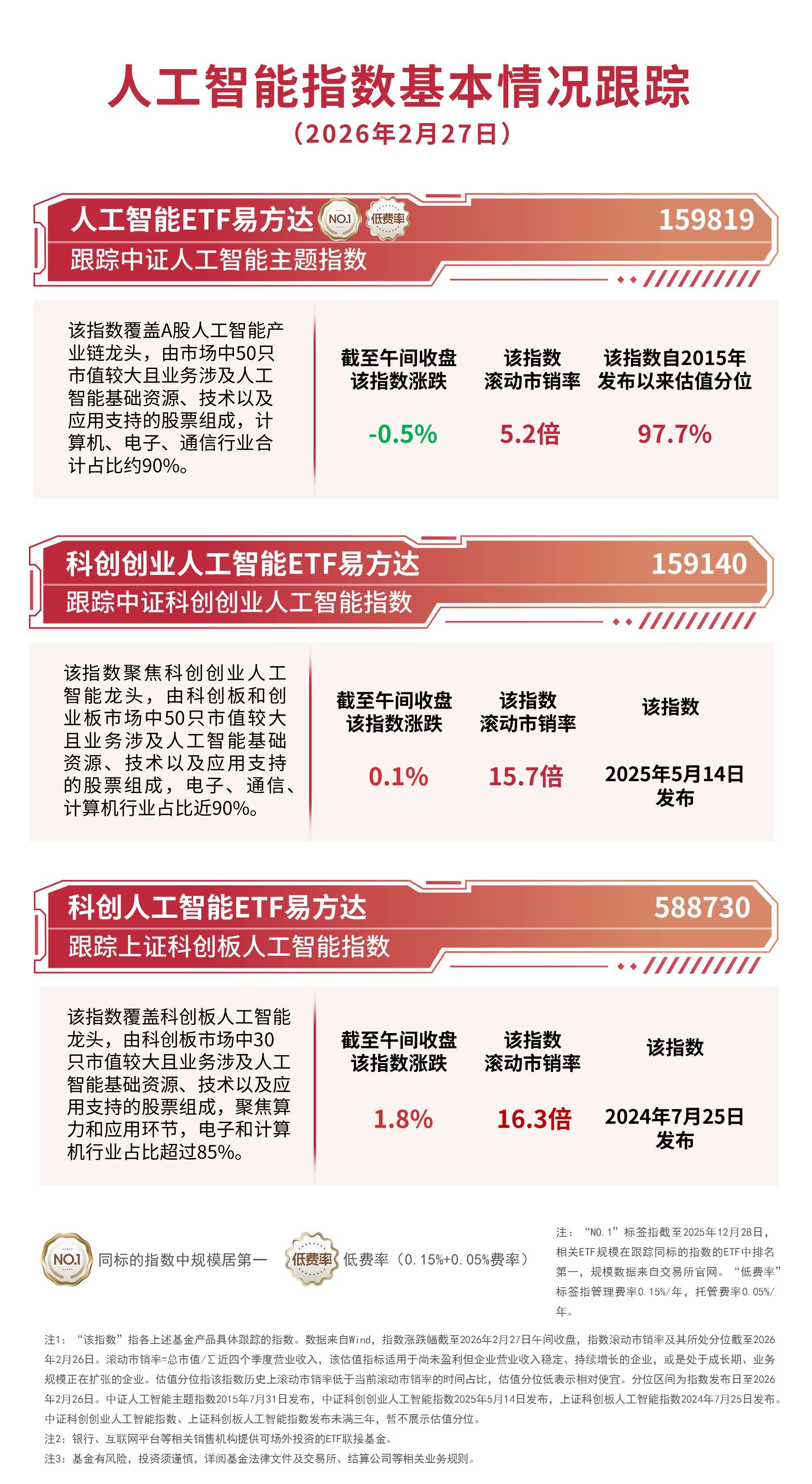
AI产业链方向震荡分化,软件板块走强,科创人工智能ETF易方达(588730)标的指数涨近2%
Sou Hu Cai Jing· 2026-02-27 04:39
Core Viewpoint - The AI industry chain is experiencing mixed performance, with the software sector showing strength, as indicated by the rise in relevant indices and significant capital inflow into AI-focused ETFs [1][5]. Group 1: Index Performance - The Shanghai Stock Exchange Sci-Tech Innovation Board Artificial Intelligence Index increased by 1.8% [1]. - The CSI Artificial Intelligence Theme Index decreased by 0.5% [1]. - The CSI Sci-Tech Innovation and Entrepreneurship AI Index saw a slight increase of 0.1% [1]. Group 2: ETF Inflows - The E Fund AI ETF (588730) attracted over 80 million yuan in the last four trading days [1]. - This ETF tracks the Shanghai Stock Exchange Sci-Tech Innovation Board AI Index, which consists of 30 large-cap stocks involved in AI foundational resources, technology, and application support [5]. Group 3: Sector Composition - The indices focus on leading companies in the AI sector, with nearly 90% of the stocks in the indices coming from the electronics, communications, and computer industries [3]. - The E Fund AI ETF emphasizes computing power and application segments, with over 85% of its holdings in the electronics and computer sectors [5].

芯片ETF领涨;多家公募机构看好持股过节丨ETF晚报
2 1 Shi Ji Jing Ji Bao Dao· 2026-02-12 14:31
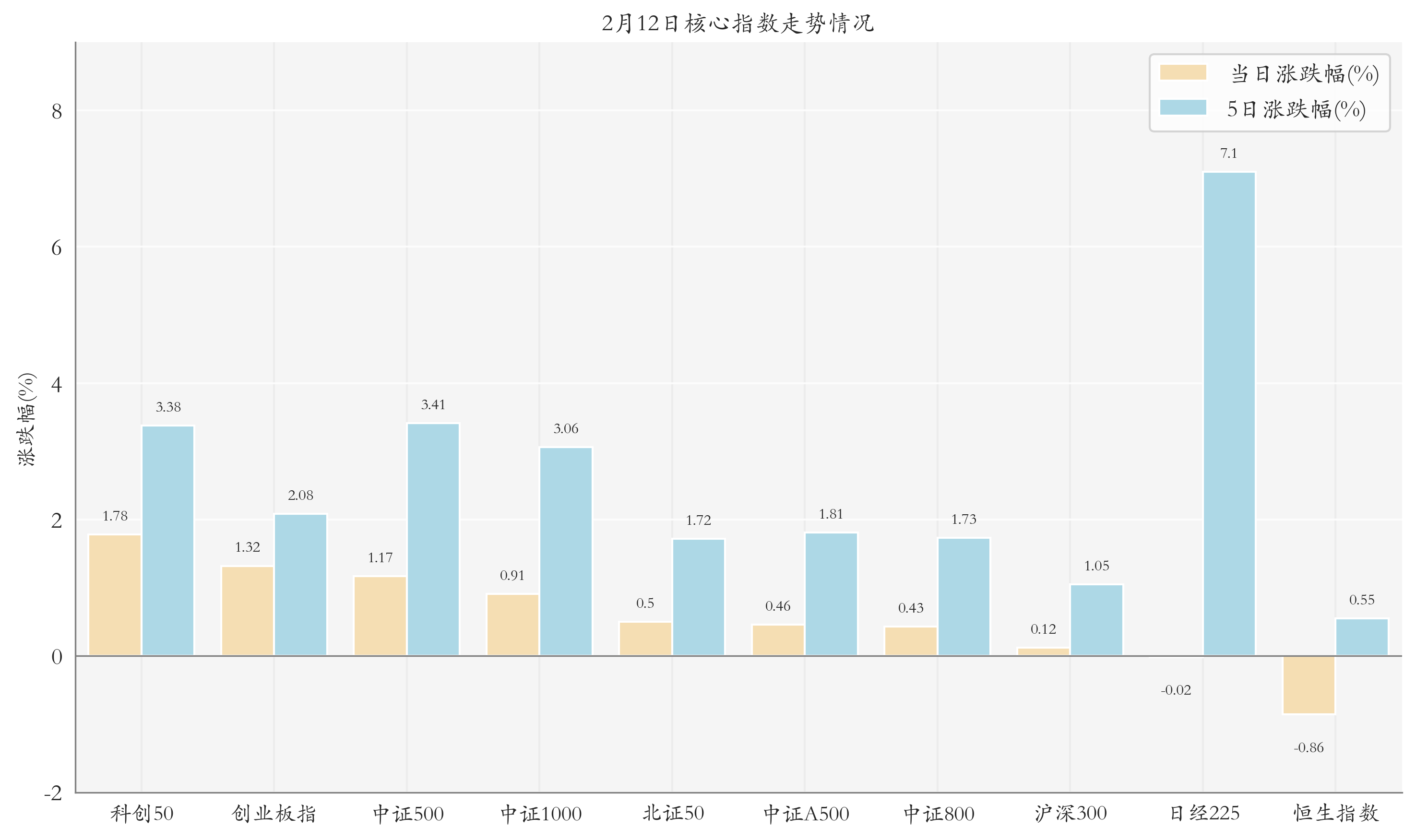
ETF Industry News - The three major indices collectively rose, with the electronic sector ETFs leading the gains. The Kweichow Moutai ETF (588780.SH) increased by 4.43%, while the E Fund AI ETF (588730.SH) and Bosera AI ETF (588790.SH) rose by 4.20% and 4.15% respectively. Conversely, several bank sector ETFs declined, with E Fund Bank ETF (516310.SH) down by 1.52% [1] - CITIC Securities reported a continuous price increase trend in the electronic components industry, with recent price hikes observed in mid-to-low voltage MOSFETs, built-in storage SOCs, and LED drivers. The report suggests that the price increase trend will continue, particularly benefiting segments like storage, CCL, BT substrates, wafer foundry, and packaging [1] Market Overview - The A-share market saw all three major indices rise today, with the Shanghai Composite Index up by 0.05% to 4134.02 points, the Shenzhen Component Index up by 0.86% to 14283.0 points, and the ChiNext Index up by 1.32% to 3328.06 points. The highest daily increases were recorded by the Sci-Tech 50 and ChiNext indices, with daily gains of 1.78% and 1.32% respectively [4] - In terms of sector performance, the comprehensive, electronic, and power equipment sectors ranked highest, with daily increases of 5.31%, 1.73%, and 1.65% respectively. Conversely, the beauty care, commercial retail, and textile sectors lagged behind with declines of -1.77%, -1.57%, and -1.49% [7] ETF Market Performance - The overall performance of ETFs showed that the stock-themed ETFs had the best average daily increase of 0.92%, while cross-border ETFs had the worst performance with an average decline of -0.76% [10] - The top-performing ETFs today included the Kweichow Moutai ETF (588780.SH), the Kweichow Moutai ETF Guangfa (589210.SH), and the E Fund AI ETF (588730.SH), with returns of 4.43%, 4.28%, and 4.20% respectively [13] - The highest trading volumes were recorded for the A500 ETF Fund (512050.SH) at 12.228 billion, followed by the A500 ETF Huatai Bairui (563360.SH) at 9.240 billion, and the A500 ETF Southern (159352.SZ) at 7.004 billion [16]

概念研究所-CPO和可拔插光模块的区别
Xin Lang Cai Jing· 2026-02-06 06:54
Core Viewpoint - CPO technology is emerging as a key solution for the next generation of AI infrastructure, driven by the need for high-speed data interconnectivity in AI model training, while traditional pluggable optical modules face significant limitations in power consumption, density, and cost [1][2][3][4]. Group 1: Differences Between CPO and Pluggable Optical Modules - CPO (Co-Packaged Optics) integrates optical engines with switching chips on the same substrate, enhancing performance and efficiency at the cost of modularity [1]. - Pluggable optical modules are standardized, hot-swappable components that prioritize flexibility but incur connection losses [1]. - The fundamental difference lies in "integration" versus "separation," with CPO aiming for maximum performance and efficiency [1]. Group 2: Impact of AI on CPO Demand - The explosion of AI model training has led to a surge in demand for optical interconnects, with sales of AI-related optical devices expected to grow significantly from 2023 to 2025 [2]. - Traditional pluggable solutions face three major bottlenecks: power consumption, density limitations, and escalating costs due to high-speed requirements [2][3]. Group 3: Changes in the Industry Chain Due to CPO - CPO represents not just a product upgrade but a reconfiguration of the optical communication industry chain, shifting value towards silicon photonics and advanced packaging [5]. - The traditional modular approach is being replaced by a collaborative design that integrates optics, electronics, and packaging, breaking down barriers between switch manufacturers, chip makers, and optical module producers [5]. - There are opportunities for domestic companies to catch up in key areas like silicon photonics and high-speed lasers, despite current low domestic production rates [5]. Group 4: Market Demand and Technical Outlook - The global CPO technology market is projected to grow rapidly, from approximately $46 million in 2024 to about $947 million by 2031, reflecting a compound annual growth rate of 41.9% [7]. - CPO is expected to penetrate 2.9%, 9.5%, and 50.6% of the 800G, 1.6T, and 3.2T optical module markets by 2029, respectively [7]. - In the short term, pluggable modules will remain dominant, but CPO is anticipated to become the preferred solution for AI networks as demand scales up post-2026 [7]. Group 5: Investment Strategies in AI Computing Power - The rise of CPO technology signifies a shift in hardware logic, suggesting that investors may consider diversified exposure to the AI hardware supply chain through index tools [8]. - Specific investment vehicles include ETFs that track AI-related indices, covering a range of companies involved in AI chips, software, and applications [8].
ETF互联互通标的扩至364只
Zheng Quan Ri Bao· 2026-01-18 17:17
Core Viewpoint - The recent expansion of the ETF (Exchange-Traded Fund) interconnection marks a significant increase in the number of ETFs available for northbound trading, enhancing investment opportunities for both domestic and international investors [1] Group 1: ETF Interconnection Expansion - On January 19, a total of 98 ETFs were officially included in the northbound trading of the Shanghai and Shenzhen Stock Connect, increasing the total number of products in the "ETF Connect" from 273 to 364, representing a growth of over 30% [1] - The inclusion of more ETFs is expected to enrich the investment options for overseas institutional investors and promote the institutionalization of the A-share market [1] Group 2: Fund Management Perspective - A total of 29 fund companies had products included in the "ETF Connect," with China Asset Management leading with 14 ETFs, followed by E Fund with 10, and FT Fund with 7 [1] - The newly included products cover a wide range of types, including broad-based ETFs and industry-themed ETFs, which are expected to attract significant market attention [2] Group 3: Market Impact and Future Outlook - The expansion of the ETF interconnection is anticipated to enhance the international competitiveness and influence of China's capital market by attracting more professional investors and incremental capital [3] - Since the formal introduction of ETFs into the interconnection mechanism in July 2022, the total trading volume of northbound funds in 2025 is projected to reach 816.58 billion yuan, marking a 76% increase from 2024 [3]