科创200ETF易方达

Search documents
科创50指数样本“换血”,关注科创50ETF易方达(588080)等产品投资价值
Sou Hu Cai Jing· 2026-02-27 11:35
Core Viewpoint - The STAR Market indices collectively rose this week, with the STAR 200 Index increasing by 4.0%, while the STAR Growth Index and STAR Composite Index both rose by 2.2%, the STAR 100 Index by 1.3%, and the STAR 50 Index by 1.2% [1]. Index Performance - The STAR 50 Index had a weekly increase of 1.2% [3]. - The STAR 100 Index rose by 1.3% this week [3]. - The STAR 200 Index saw the highest increase at 4.0% [3]. - Both the STAR Growth Index and STAR Composite Index increased by 2.2% [3]. Index Adjustments - On February 27, the Shanghai Stock Exchange and China Securities Index Co., Ltd. announced adjustments to the STAR 50 Index, adding Guoshun Quantum, Zhongke Feimeng, and Zhongke Xingtou, while removing Junshi Biosciences, Yingxishi Network, and Tianneng Co., Ltd. This adjustment will take effect after the market closes on March 13, 2026 [1]. Index Composition - The STAR 100 Index consists of 100 medium-sized stocks with good liquidity, focusing on small and medium-sized innovative enterprises, with over 80% of its composition in the electronics, biomedicine, computer, and power equipment sectors [5]. - The STAR 200 Index includes 200 smaller, liquid stocks, focusing on "growth potential" innovative enterprises, with nearly 70% in electronics, biomedicine, and machinery sectors [5]. - The STAR Composite Index covers all market securities, focusing on core frontier industries such as artificial intelligence, semiconductors, new energy, and innovative pharmaceuticals, encompassing all 17 primary industries listed on the STAR Market [5]. - The STAR Growth Index is composed of 50 stocks with high growth rates in revenue and net profit, with over 95% in high-growth sectors like electronics, power equipment, biomedicine, and automotive [5]. ETF Tracking - There are currently 19 ETFs tracking the STAR 50 Index, 13 for the STAR 100 Index, 9 for the STAR 200 Index, 15 for the STAR Composite Index, and 4 for the STAR Growth Index [5].


科创板系列指数集体飘红,关注科创200ETF易方达(588270)、科创50ETF易方达(588080)后续表现
Mei Ri Jing Ji Xin Wen· 2026-02-26 05:24
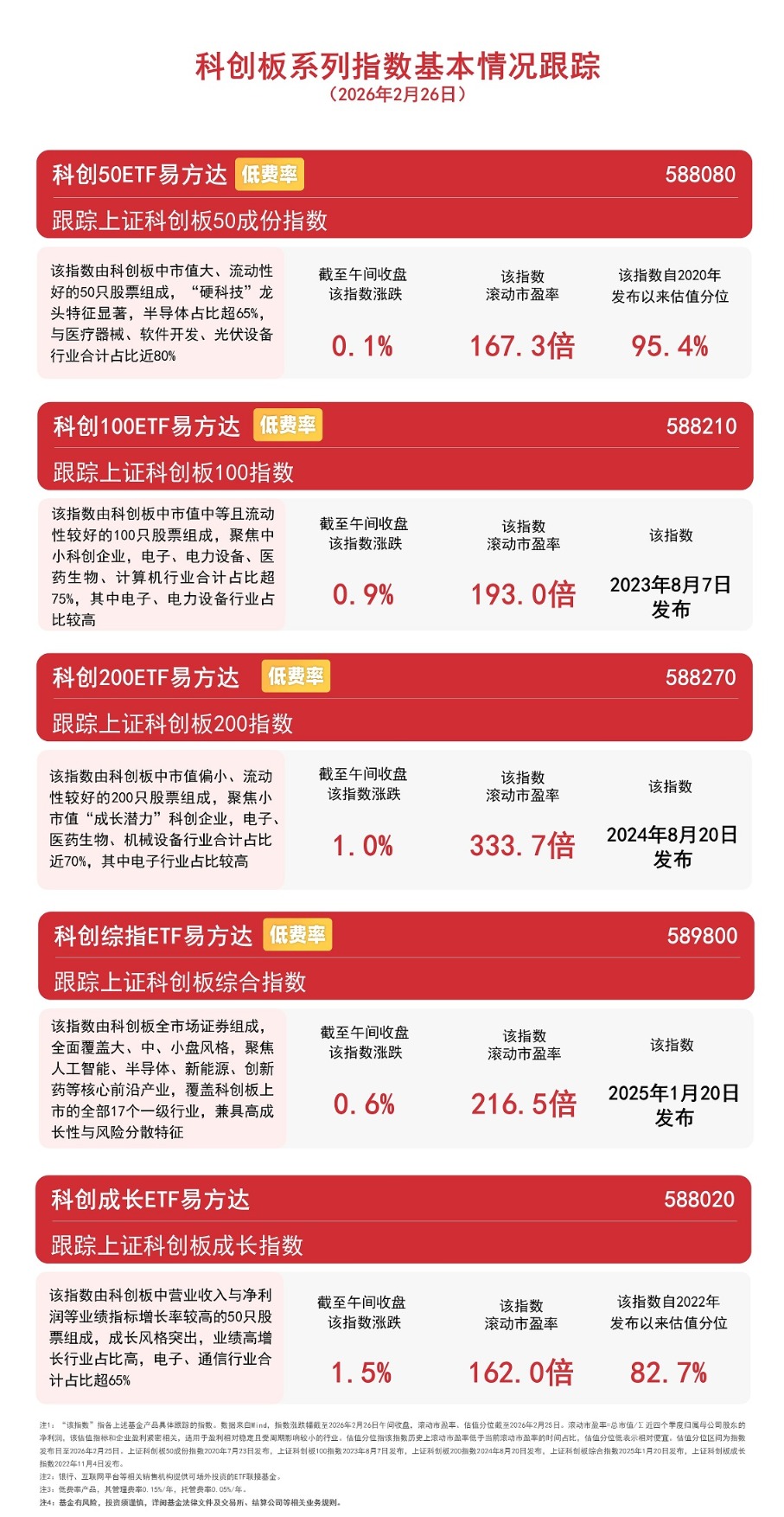
Group 1 - The Sci-Tech Growth Index rose by 1.5%, the Sci-Tech 200 Index increased by 1.0%, the Sci-Tech 100 Index went up by 0.9%, the Sci-Tech Composite Index climbed by 0.6%, and the Sci-Tech 50 Index saw a slight increase of 0.1% as of the midday close [1] Group 2 - The Sci-Tech 50 ETF tracks the Shanghai Stock Exchange Sci-Tech 50 Index, which consists of 50 large-cap stocks with significant liquidity from the Sci-Tech Board, prominently featuring "hard technology" companies, with over 65% in semiconductors and nearly 80% combined in medical devices, software development, and photovoltaic equipment [3] - The Sci-Tech 100 ETF follows the Shanghai Stock Exchange Sci-Tech 100 Index, comprising 100 medium-cap stocks with good liquidity, focusing on small and medium-sized Sci-Tech enterprises, with over 75% in electronics, electric equipment, and biomedicine, where the electronics and electric equipment sectors have a relatively high representation [3] - The Sci-Tech 200 ETF tracks the Shanghai Stock Exchange Sci-Tech 200 Index, which includes 200 small-cap stocks with good liquidity, focusing on "growth potential" Sci-Tech companies, with nearly 70% in electronics, biomedicine, and mechanical equipment, where the electronics sector has a higher proportion [3] - The Sci-Tech Growth ETF tracks the Shanghai Stock Exchange Sci-Tech Growth Index, consisting of 50 stocks with high growth rates in revenue and net profit, with a significant representation from the electronics and communication sectors, exceeding 65% [6]
半导体板块强势上涨,科创成长ETF易方达(588020)、科创50ETF易方达(588080)助力布局板块龙头
Sou Hu Cai Jing· 2026-02-25 11:18
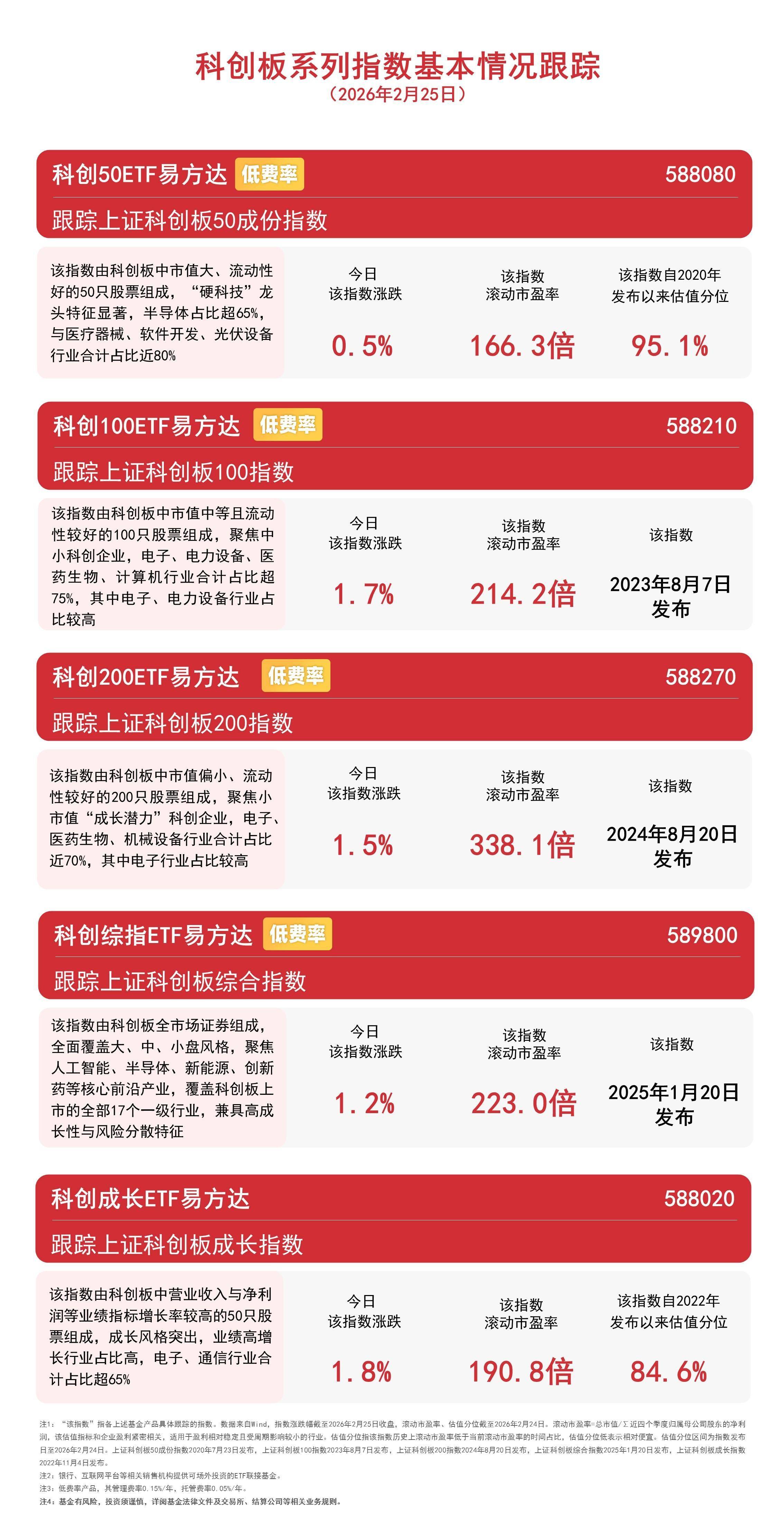
Group 1 - The semiconductor sector led the market gains, with companies such as Hailin Micro and Youyan Silicon hitting the daily limit, and Fuchuang Precision rising over 12% [1] - The closing performance of various indices showed positive growth: the Sci-Tech Growth Index increased by 1.8%, the Sci-Tech 100 Index by 1.7%, the Sci-Tech 200 Index by 1.5%, the Sci-Tech Composite Index by 1.2%, and the Sci-Tech 50 Index by 0.5% [1] Group 2 - The Sci-Tech 100 Index consists of 100 stocks with good liquidity, focusing on small and medium-sized innovative enterprises, with over 75% of its composition in the electronics, power equipment, and pharmaceutical industries [5] - The Sci-Tech 200 Index tracks 200 small-cap stocks from the Sci-Tech Board, with nearly 70% of its composition in electronics, biomedicine, and machinery equipment sectors [7] - The Sci-Tech Composite Index ETF aims to cover the entire market of the Sci-Tech Board, focusing on artificial intelligence, semiconductors, and new energy [7]


算力硬件方向领涨,科创200ETF易方达(588270)、科创50ETF易方达(588080)助力把握产业投资机遇
Sou Hu Cai Jing· 2026-02-12 10:27
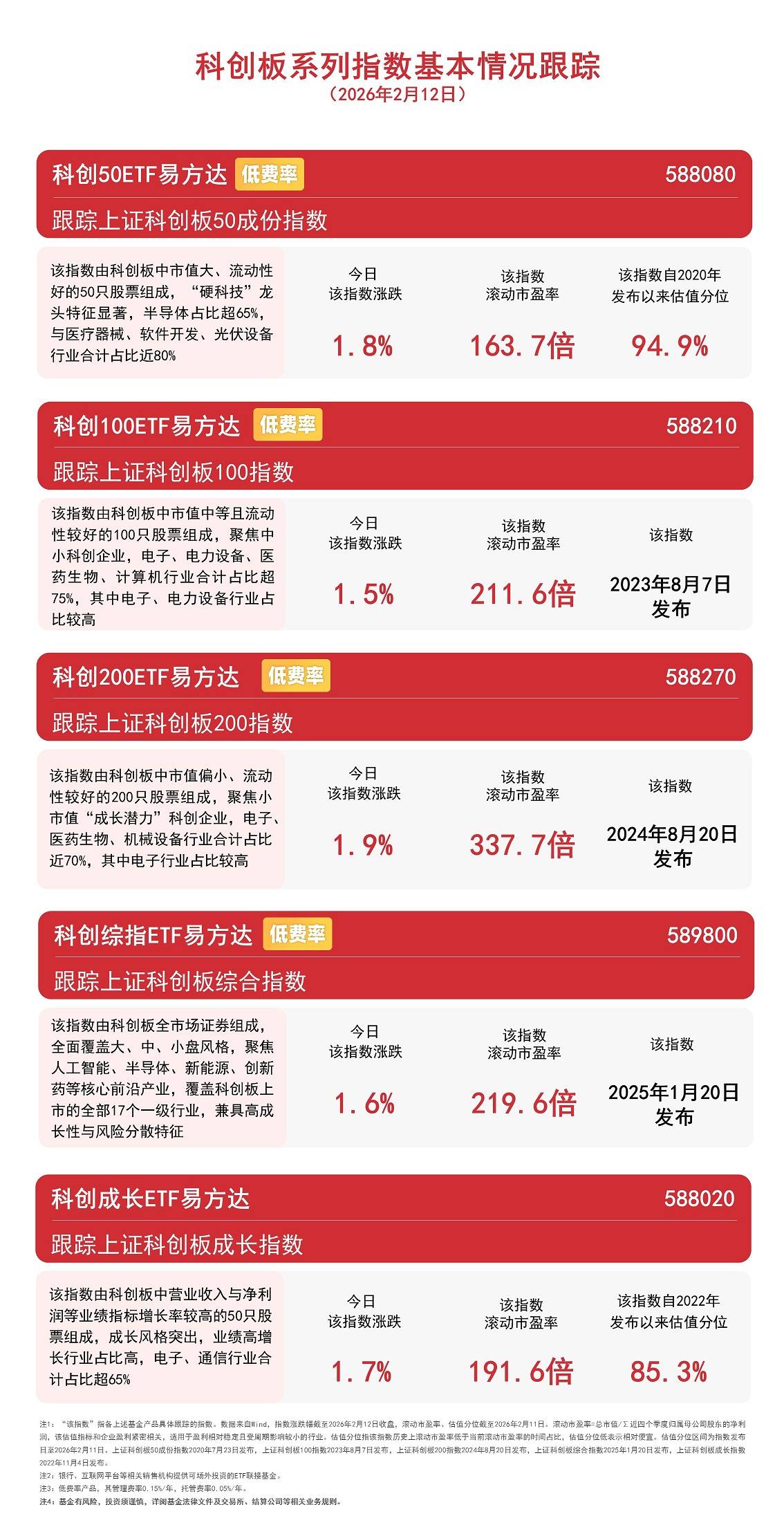
Group 1 - The semiconductor sector experienced a collective rise, with notable stocks such as Oulain New Materials hitting a 20% limit up, and other companies like Aosheng Technology and Chipone rising over 12% [1] - The computing rental concept also strengthened, with companies like Yuke De and Pinggao shares seeing significant increases of 20% and over 10% respectively [1] - Major indices such as the Sci-Tech 200 Index rose by 1.9%, while the Sci-Tech 50 Index and Sci-Tech Growth Index increased by 1.8% and 1.7% respectively, indicating a positive trend in the market [1] Group 2 - The Sci-Tech 50 ETF, tracking the top 50 stocks on the Sci-Tech board, has a significant semiconductor representation of over 65%, with a total of nearly 80% in combination with medical devices and software development [3] - The Sci-Tech 100 ETF focuses on medium-sized stocks, with over 75% in electronics, electric equipment, and biomedicine, reflecting a strong emphasis on growth potential in these sectors [3] - The Sci-Tech 200 ETF targets smaller market cap companies, with a high concentration in electronics and biomedicine, indicating a focus on growth potential in these industries [5]
“硬科技”回归,科创板系列指数单边走强,科创50ETF易方达(588080)等产品受市场关注
Mei Ri Jing Ji Xin Wen· 2026-02-09 12:40
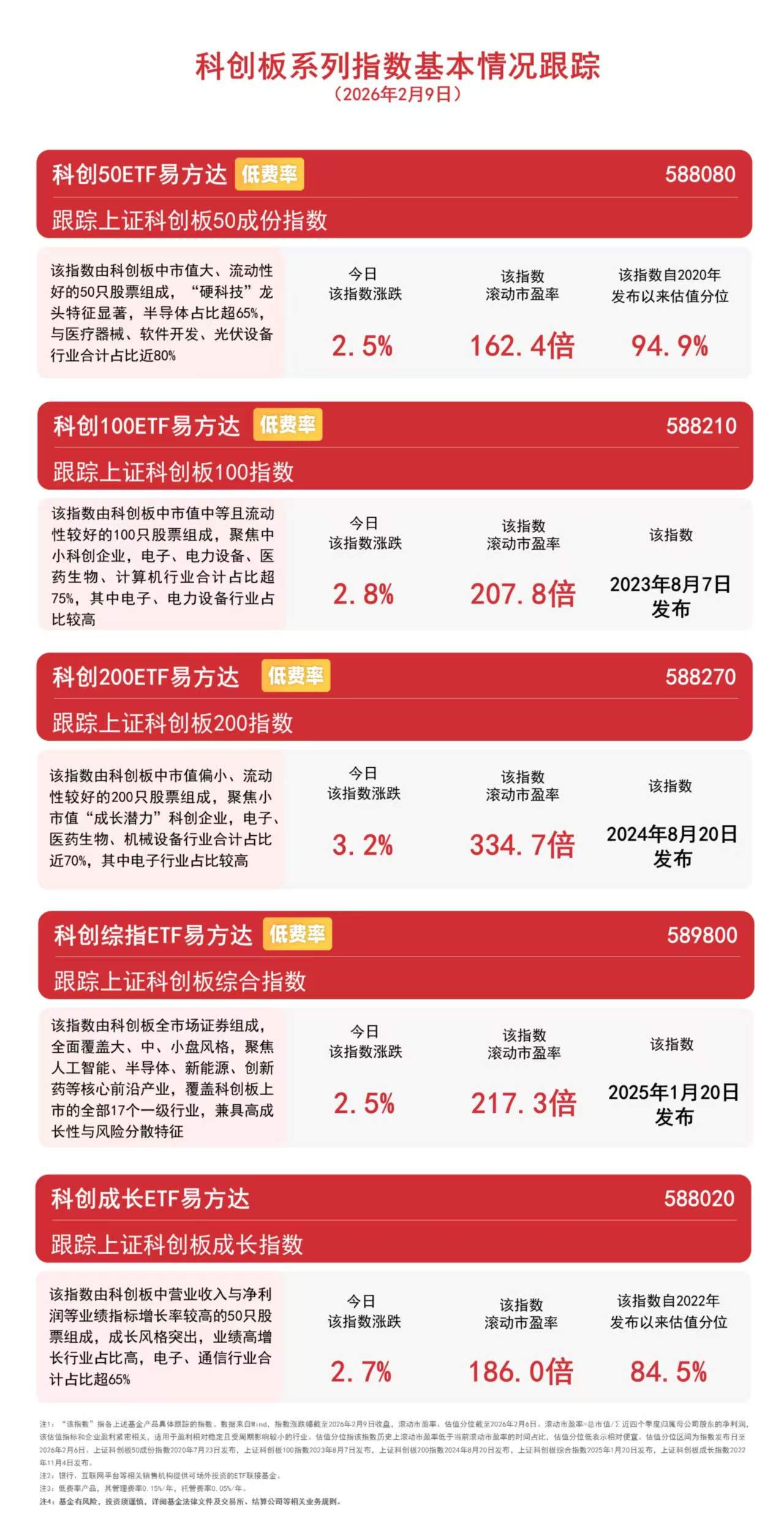
Group 1 - The core focus of the news is on the performance and characteristics of various ETFs tracking the STAR Market indices, highlighting their composition and market trends [2][3][4] - The STAR 50 ETF consists of 50 large-cap stocks with significant liquidity, primarily in the "hard technology" sector, with over 65% in semiconductors and nearly 80% in total for semiconductors, medical devices, software development, and photovoltaic equipment [2] - The STAR 100 ETF includes 100 mid-cap stocks with good liquidity, focusing on small and medium-sized innovative enterprises, with over 75% in electronics, power equipment, and pharmaceutical biology [3] - The STAR 200 ETF tracks 200 small-cap stocks with good liquidity, emphasizing growth potential in small-cap innovative enterprises, with nearly 70% in electronics, pharmaceutical biology, and machinery equipment [4] Group 2 - The STAR 50 ETF has a rolling price-to-earnings (P/E) ratio of 162.4 times, while the STAR 100 ETF has a rolling P/E ratio of 207.8 times, indicating varying valuation levels among these indices [2][3] - The STAR 50 index experienced a daily change of 2.5%, while the STAR 100 index saw a daily change of 2.8%, reflecting market volatility [2][3]
科创板系列指数集体走强,科创50ETF易方达(588080)上周净流入近10亿元
Mei Ri Jing Ji Xin Wen· 2026-02-09 05:24
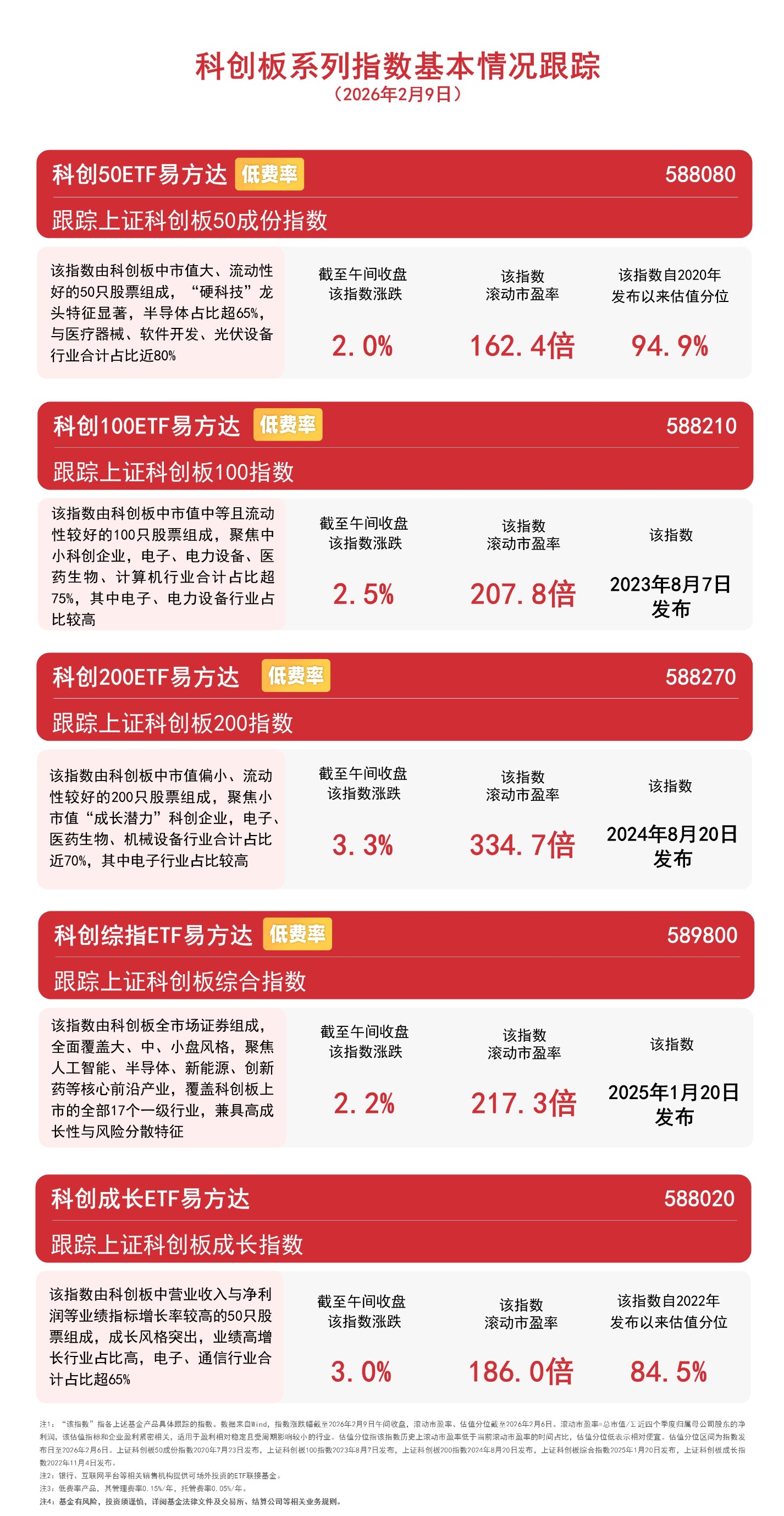
Group 1 - The article discusses the performance and characteristics of various ETFs tracking the STAR Market indices, highlighting their focus on high-growth sectors such as semiconductors, medical devices, and software development [2][3] - The STAR 50 ETF tracks the STAR Market 50 Index, which consists of 50 stocks with large market capitalization and good liquidity, with over 65% of its composition in the semiconductor sector [2] - The STAR 100 ETF follows the STAR Market 100 Index, focusing on medium-sized innovative companies, with over 75% of its composition in electronics, power equipment, and pharmaceutical industries [2] - The STAR 200 ETF tracks the STAR Market 200 Index, which includes 200 smaller-cap stocks, emphasizing growth potential, with a significant portion in electronics and biomedical sectors [2] - The STAR Composite Index ETF covers the entire STAR Market, focusing on core industries like artificial intelligence and new energy, and includes all 17 primary sectors listed on the STAR Market [3] - The STAR Growth ETF tracks the STAR Market Growth Index, consisting of 50 stocks with high growth rates in revenue and net profit, with over 65% in electronics and communications sectors [3] Group 2 - As of the midday close on February 9, 2026, the STAR 50 Index increased by 2.0%, while the STAR 100 Index rose by 2.5% [2] - The STAR Composite Index saw a rise of 2.2%, and the STAR Growth Index increased by 3.0% as of the same date [3] - The rolling price-to-earnings (P/E) ratios for the STAR 50, STAR 100, STAR 200, STAR Composite, and STAR Growth indices are reported at 207.8, 162.4, 217.3, and 186.0 times, respectively [2][3]
科创板系列指数震荡调整,科创50ETF易方达(588080)近10个交易日合计净流入超12亿元
Mei Ri Jing Ji Xin Wen· 2026-02-05 14:06
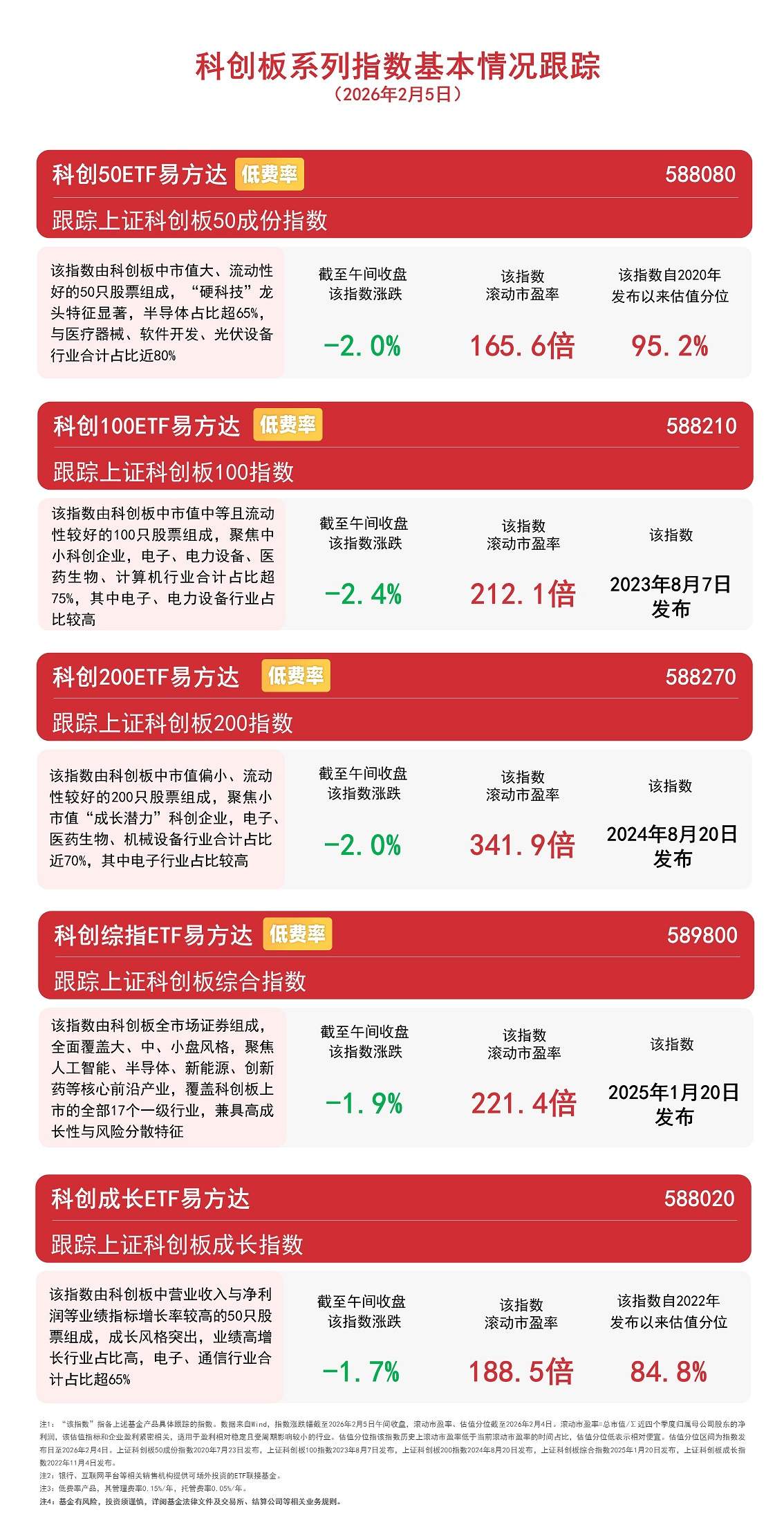
Group 1 - The article discusses the performance and characteristics of various indices tracking the Sci-Tech Innovation Board (科创板) in China, highlighting the focus on high-tech sectors such as semiconductors, medical devices, and software development [2][3] - The Sci-Tech 50 ETF tracks the Sci-Tech 50 Index, which consists of 50 stocks with large market capitalization and good liquidity, with over 65% of its composition in the semiconductor sector and nearly 80% in hard technology sectors [2] - The Sci-Tech 100 ETF follows the Sci-Tech 100 Index, comprising 100 stocks with medium market capitalization, focusing on small and medium-sized innovative enterprises, with over 75% of its composition in electronics, power equipment, and pharmaceutical industries [2][3] Group 2 - The Sci-Tech 200 ETF tracks the Sci-Tech 200 Index, which includes 200 stocks with smaller market capitalization, emphasizing growth potential in small-cap innovative companies, with a significant portion in the electronics sector [2] - The Sci-Tech Comprehensive Index ETF covers all stocks listed on the Sci-Tech Innovation Board, focusing on core industries such as artificial intelligence, semiconductors, new energy, and innovative pharmaceuticals, encompassing all 17 primary industries on the board [3] - The Sci-Tech Growth ETF tracks the Sci-Tech Growth Index, which consists of 50 stocks with high growth rates in revenue and net profit, with over 65% of its composition in the electronics and communication sectors [3]
半导体板块持续回调,资金连续3日净流入科创50ETF易方达(588080)
Mei Ri Jing Ji Xin Wen· 2026-02-05 07:43
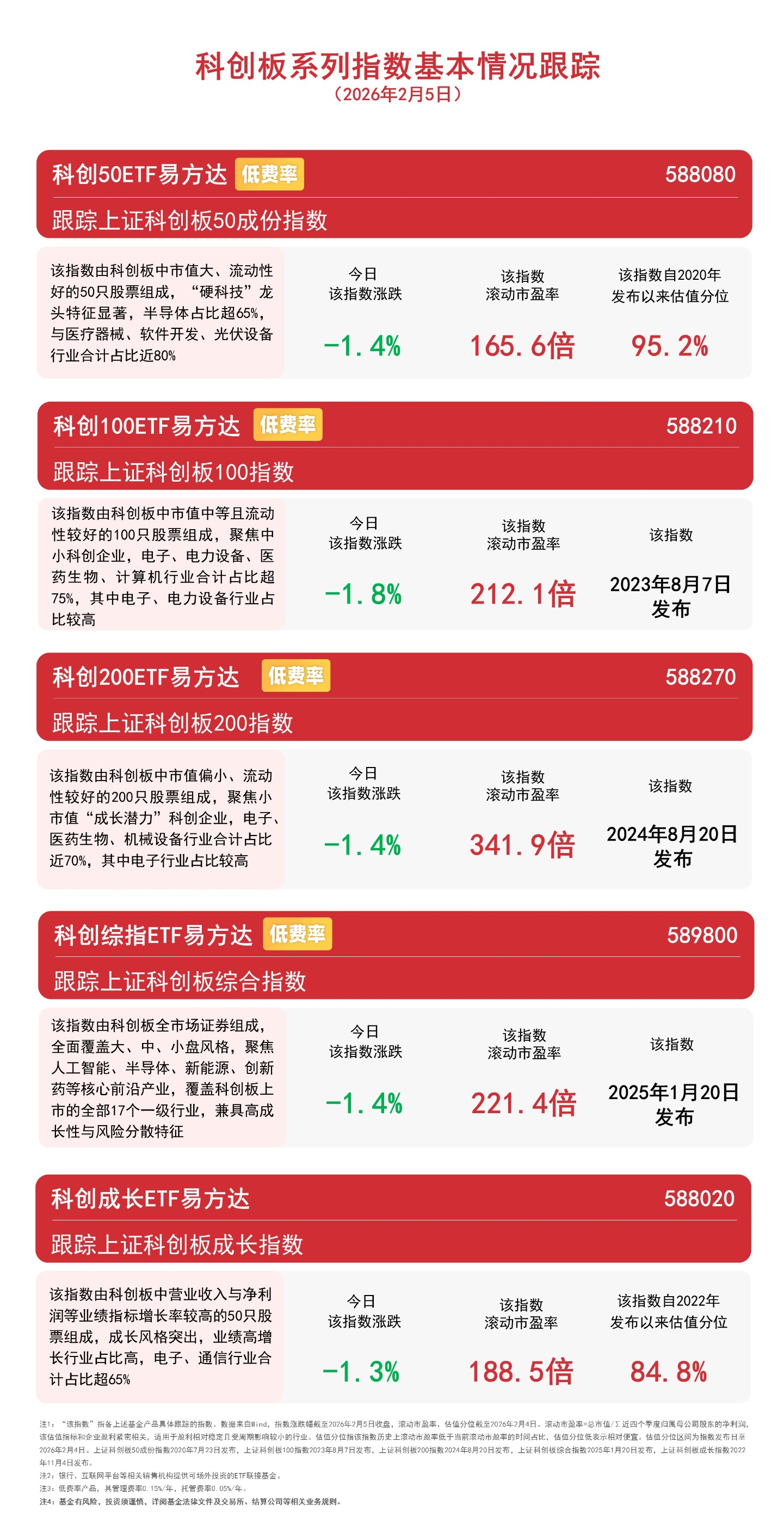
Group 1 - The article discusses various ETFs tracking the STAR Market indices, highlighting their focus on high-growth technology companies in China [2][3] - The STAR 50 ETF tracks the top 50 stocks by market capitalization and liquidity on the STAR Market, with a significant focus on "hard technology" sectors, particularly semiconductors, which account for over 65% of the index [2] - The STAR 100 ETF focuses on medium-sized companies with good liquidity, with over 75% of its composition in electronics, power equipment, and biomedicine [2] - The STAR 200 ETF targets smaller market cap companies, with nearly 70% of its holdings in electronics, biomedicine, and machinery sectors [2] - The STAR Growth ETF tracks the STAR Growth Index, consisting of 50 stocks with high growth rates in revenue and net profit, with over 65% in electronics and communications [3] Group 2 - The STAR 50 ETF has a rolling price-to-earnings ratio of 165.6 times, with a valuation percentile of 95.2% since its inception in 2020 [2] - The STAR 100 ETF has a rolling price-to-earnings ratio of 212.1 times, reflecting its focus on growth-oriented companies [2] - The STAR 200 ETF has a rolling price-to-earnings ratio of 341.9 times, indicating a high valuation for smaller growth companies [2] - The STAR Growth ETF has a rolling price-to-earnings ratio of 188.5 times, with a valuation percentile of 84.8% since its launch in 2022 [3]
科创板系列指数率先反弹,关注科创200ETF易方达(588270)、科创50ETF易方达(588080)等布局机会
Mei Ri Jing Ji Xin Wen· 2026-01-30 06:38
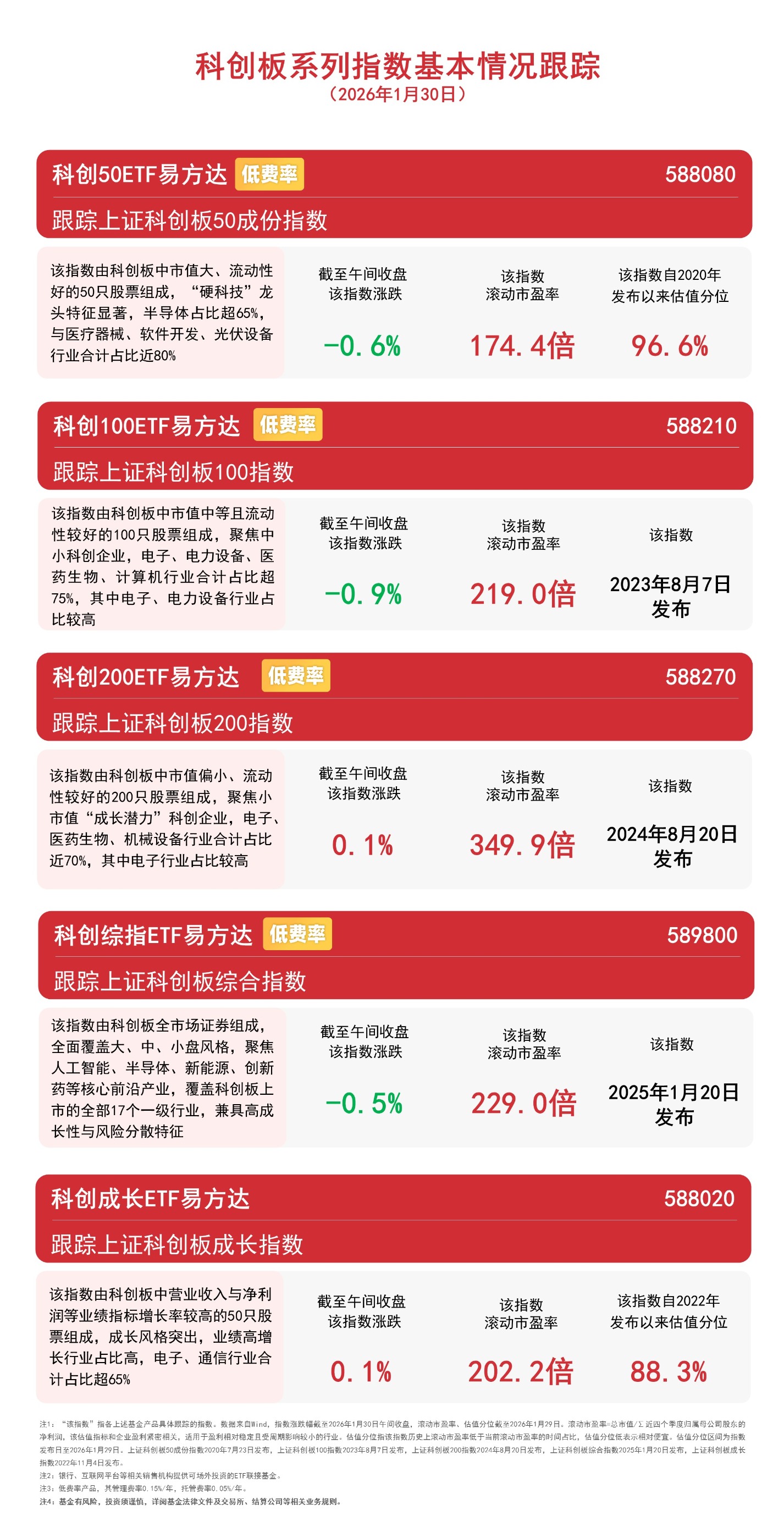
Group 1 - The article discusses the performance and characteristics of various ETFs tracking the STAR Market indices, highlighting their focus on high-growth sectors such as technology and healthcare [2][3][4][5]. - The STAR 50 ETF tracks the top 50 stocks by market capitalization and liquidity on the STAR Market, with over 65% of its composition in the semiconductor sector, and nearly 80% in hard technology sectors including medical devices and software [2]. - The STAR 100 ETF focuses on 100 mid-cap stocks, with over 75% in electronics, power equipment, and pharmaceutical industries, reflecting a strong emphasis on small and medium-sized innovative enterprises [3]. - The STAR 200 ETF targets 200 smaller-cap stocks, concentrating on growth potential, with significant representation from electronics, pharmaceuticals, and machinery sectors [4]. - The STAR Composite ETF covers the entire STAR Market, including all 17 primary industries, with a focus on cutting-edge sectors like artificial intelligence, semiconductors, and renewable energy [4]. - The STAR Growth ETF consists of 50 stocks with high growth rates in revenue and net profit, predominantly in the electronics and communications sectors, showcasing a strong growth style [5]. Group 2 - As of the latest data, the STAR 50 index has a rolling P/E ratio of 174.4 times, while the STAR 100 index has a rolling P/E ratio of 219.0 times, indicating high valuations in these segments [2][3]. - The STAR Composite index has a rolling P/E ratio of 229.0 times, reflecting its broad coverage of various sectors and the associated growth expectations [4]. - The STAR Growth index has a rolling P/E ratio of 202.2 times, emphasizing the high growth potential of the companies included [5].
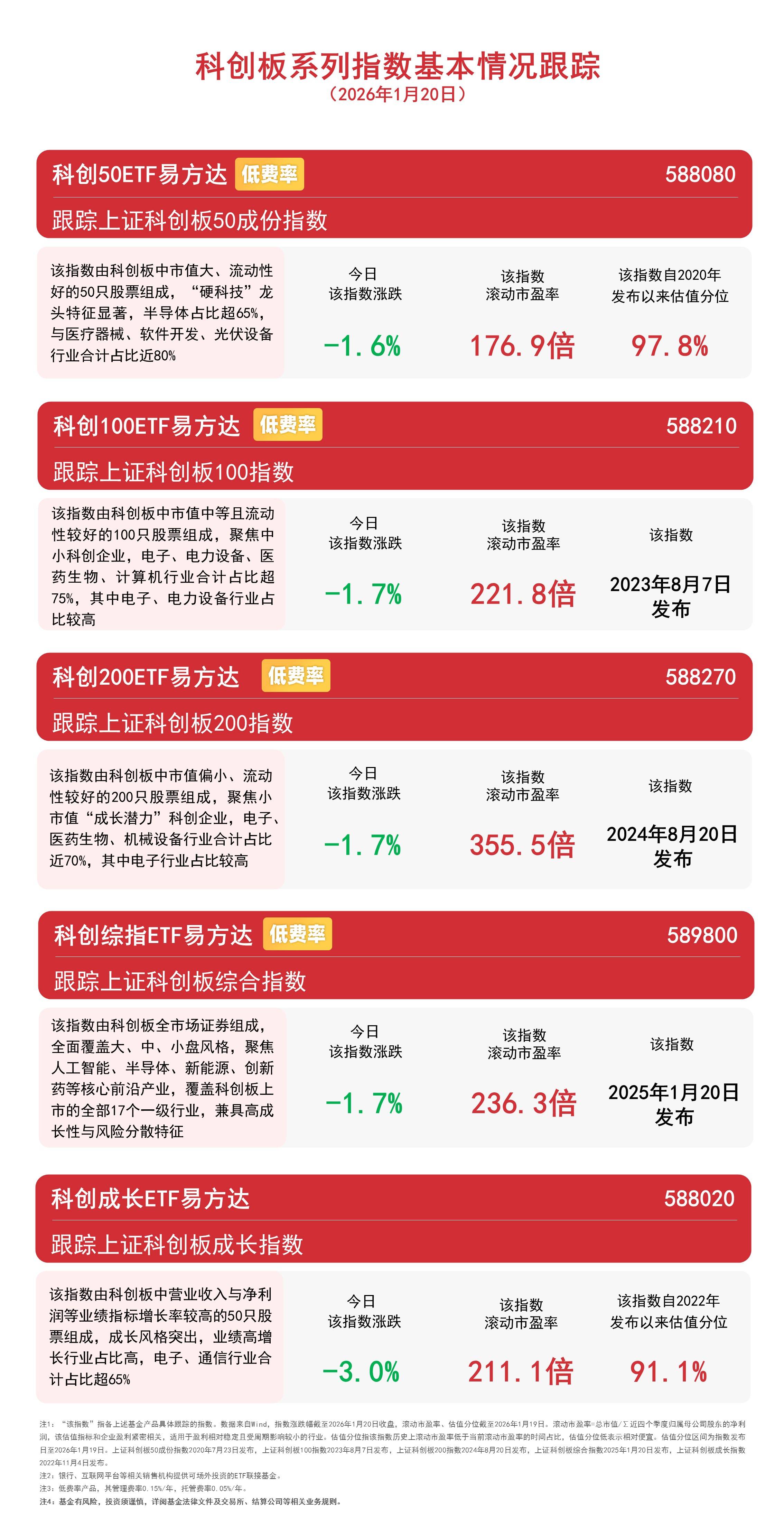
软件、商业航天板块下挫,指数调整时关注科创200ETF易方达(588270)等产品投资价值
Sou Hu Cai Jing· 2026-01-20 11:20
Group 1 - The STAR Market indices experienced declines, with the STAR 50 Index down by 1.6%, STAR 100 Index and STAR 200 Index both down by 1.7%, and the STAR Growth Index down by 3.0% [1] - Software and commercial aerospace concept stocks collectively fell, while certain semiconductor stocks showed strong performance, with notable gains including Zhongwei Semiconductor hitting the daily limit, Qizhong Technology rising over 16%, and Yingjixin increasing over 12% [1] Group 2 - The STAR 200 ETF, managed by E Fund, tracks the STAR 200 Index, which consists of 200 smaller-cap stocks from the STAR Market, focusing on growth potential in small-cap technology enterprises, with electronics, biomedicine, and machinery sectors accounting for nearly 70% of the index [5] - The STAR Comprehensive Index ETF, also managed by E Fund, tracks the STAR Comprehensive Index, which covers the entire market of the STAR Board, focusing on artificial intelligence, semiconductors, and new energy sectors [5]