索拉纳(SOL)

Search documents
12.9今日行情:为什么下跌?BTC、SOL、ETH、BNB、RDNT、STABLE、TRUMP、马到成功、bibi操作建议!
Sou Hu Cai Jing· 2025-12-09 07:59
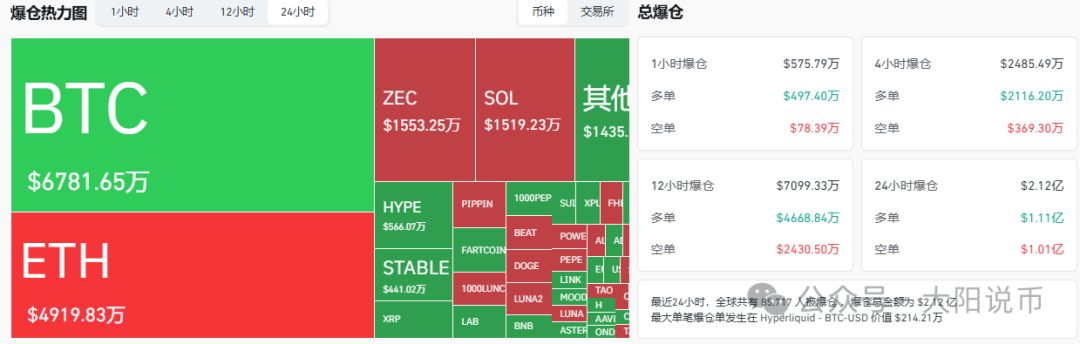
Summary of Key Points Core Viewpoint - In the past 24 hours, a total of 85,716 people experienced liquidation, with a total liquidation amount of $212 million. The largest single liquidation occurred on Hyperliquid for BTC-USD, valued at $2.1421 million [1]. Group 1: Liquidation Data - The total liquidation amount in the last 24 hours reached $212 million [1]. - The highest single liquidation was recorded at Hyperliquid for BTC-USD, amounting to $2.1421 million [1]. - The overall liquidation trend indicates a significant number of short-term investors are experiencing panic, leading to high turnover rates in trading [2][4]. Group 2: Market Sentiment and Analysis - The market sentiment remains unstable, with short-term players frequently buying and selling, primarily due to bearish outlooks [2]. - Despite the panic among short-term investors, early holders maintain a stable mindset, indicating a secure overall chip structure without widespread panic selling [4]. - The upcoming Federal Reserve meeting is highlighted as a major focus, with potential implications for market sentiment [4]. Group 3: Technical Analysis - Bitcoin's short-term support is noted around $88,100, with potential buying opportunities if it retraces to the $85,900-$85,200 range [6]. - Ethereum's support levels are identified at $2,955, $2,865, and $2,805, with resistance at $3,282 [9]. - Solana's key levels to watch are $140 for resistance and $125.8 and $124 for support [7]. Group 4: Investment Strategy - The strategy for December emphasizes patience in waiting for market consolidation and gradually building long positions to capture short-term profits [13]. - Caution is advised to avoid overexerting capital during market fluctuations, with a focus on maintaining sufficient liquidity for potential future bearish trends [13].

刘兴亮 | 极简区块链发展史
Sou Hu Cai Jing· 2025-10-14 10:49
Group 1: Economic Theories and Currency - Austrian economist Mises criticized excessive money issuance by governments and central banks as a form of indirect theft, leading to currency devaluation and loss of purchasing power for the public [1] - The issuance of currency should be independent of government control and tied to a free market system, with supply matching economic growth and export surpluses [1] - Historical context shows that limited supply of hard currency, like silver, maintained purchasing power, contrasting with government-issued paper money that can depreciate rapidly [3] Group 2: Blockchain and Cryptocurrency - Blockchain technology emerged alongside Bitcoin, created by Satoshi Nakamoto in 2008, serving as a public distributed ledger that solves the double-spending problem without a central authority [4][6] - Bitcoin's economic model, including a halving mechanism that limits total supply to 21 million coins, positions it as "digital gold," ensuring long-term value storage [12] - Ethereum introduced smart contracts and a decentralized computing environment, expanding blockchain capabilities beyond simple value transfer [14] Group 3: Development and Evolution of Blockchain - The development of cryptographic methods and consensus mechanisms, such as Byzantine Fault Tolerance, laid the groundwork for decentralized systems [7][8] - The introduction of Proof-of-Work (PoW) by Nakamoto created a competitive environment for maintaining the blockchain, deterring malicious activities [9][10] - Recent advancements in blockchain technology focus on scalability and efficiency, with many networks transitioning to Proof-of-Stake (PoS) to address energy consumption and performance issues [15][16] Group 4: Impact on Financial Systems - The rise of cryptocurrencies is disrupting traditional monetary systems and altering economic perceptions, aligning with Austrian economic ideals of a fully liberalized competitive market [16] - Various recognized cryptocurrencies, including Bitcoin, Ethereum, and others, are reshaping the landscape of digital finance and governance [16]

BTC, ETH, XRP, SOL Face Slow Bottoming Process After $16B Liquidation Shock
Yahoo Finance· 2025-10-11 06:57
Market Overview - The crypto market faced its largest liquidation event, resulting in leveraged bullish bets worth $16 billion being forced out across major cryptocurrencies like bitcoin, ether, and several altcoins, with some altcoins crashing between 20% to 40% [1] Recovery Process - The recovery following such a crash is expected to be gradual, testing the patience of bullish investors, as indicated by industry experts [2] - The initial phase involves the market "bleeding out," with liquidation orders flooding exchanges and pushing prices lower, leading to significant drops in altcoin values [2] - Market makers typically step back to manage risk during this phase, focusing on addressing price mismatches between spot and futures markets through arbitrage plays, which delays an immediate rebound [3] Data Stabilization - After a market crash, there is a phase where data feeds stabilize, allowing traders and market makers to rely on reliable information channels again, which may have experienced delays or outages during the crash [4] Absorption Phase - Once data feeds stabilize, market makers and large traders begin to absorb major sell orders to restore market equilibrium, capitalizing on liquidation orders that receive priority in order books [5] - Given the scale of forced liquidations, this absorption phase can take several days [5] Market Stabilization - The stabilization stage involves dealers and market makers closing out their long positions acquired at bargain prices while absorbing liquidation orders, aiming to profit from a potential market rebound [6] - As the market reaches equilibrium, dealers will start unwinding their positions, leading to a local maxima in prices for certain assets with tighter supply [6]
Crypto Markets Today: Major Tokens Slide, Altcoins Tumble More Than 10%
Yahoo Finance· 2025-09-22 12:00
Market Overview - The cryptocurrency market experienced significant losses early Monday, with major cryptocurrencies like bitcoin (BTC) and ether (ETH) contributing to a liquidation of leveraged bets worth $1.5 billion [1] - The decline followed a dovish Fed interest-rate cut, which was anticipated to lower the dollar index and promote risk-taking in crypto markets [1] Bitcoin Analysis - Recent signals indicate a downward trend for bitcoin, with BTCUSD falling out of its upward channel established since early September and dropping below key support levels and the 50-day moving average [2] - This combination of negative indicators suggests further declines are likely unless there is a fundamental shift in market sentiment [2] Derivatives Positioning - The top 20 tokens, excluding BTC and HYPE, have seen double-digit declines in futures open interest as overleveraged bets are liquidated [3] - Shorts are increasing in Binance-listed USDT futures, with open interest rising to 276K BTC, while funding rates for several altcoins are notably negative, indicating a bearish sentiment [3] - BTC front-month futures on the CME are trading at a $100 premium to the spot price, and a potential shift to a discount could signal increased selling pressure [3] Market Sentiment and Altcoins - The sell-off was exacerbated by a $1.6 billion liquidation cascade, with $500 million occurring in ether trading pairs [3] - Funding rates for ether have turned negative, indicating a shift in sentiment after a significant rally from $2,400 in July to $4,831 in late August [3] - Major cryptocurrencies like BTC, ETH, and SOL are at critical support levels, and a recovery could occur if traders are overly aggressive in short positions [3] - The average crypto token relative strength index (RSI) is at 28.4, suggesting heavily oversold conditions that may lead to a relief rally unless BTC and ETH break their support levels [3]
比特币(BTC)进入“机构锁仓时代”:牛市引擎还是市场隐患?
Sou Hu Cai Jing· 2025-06-25 12:17
Group 1 - The core viewpoint of the articles highlights the increasing trend of companies accumulating Bitcoin amidst geopolitical tensions and market volatility, indicating a shift towards institutional adoption of cryptocurrencies [2][3][5] - Strategy, a prominent company, purchased 10,100 Bitcoin for approximately $1.05 billion between June 9 and June 15, raising its total holdings to 592,100 Bitcoin, solidifying its position as the largest corporate holder of Bitcoin [3][4] - Other companies, including Metaplanet, Remixpoint, The Blockchain Group, BitMine, and Green Minerals AS, have also announced significant Bitcoin purchases, reflecting a broader trend of institutional investment in the cryptocurrency market [3][5] Group 2 - The stock performance of companies holding Bitcoin has shown a premium recognition in the market, with Strategy's stock rising nearly 26% this year, partly due to its Bitcoin valuation being included in major indices like Nasdaq 100 [4] - The accumulation of Bitcoin by companies is seen as a strategy to hedge against macroeconomic risks and inflation, with Bitcoin being perceived as a new reserve asset akin to gold [4][5] - Companies are leveraging Bitcoin holdings to enhance market visibility and attract liquidity, creating a positive feedback loop between Bitcoin purchases and stock price increases [4][5] Group 3 - Some companies view Bitcoin as a strategic pivot to transform their business models, particularly those with stagnant growth, aiming to position themselves as "Web3 companies" [5] - The trend of institutional players accumulating Bitcoin may lead to a potential "institutional lock-up" in the market, reducing selling pressure and enhancing confidence in Bitcoin's long-term value [5][6] - However, the concentration of Bitcoin holdings among institutions raises concerns about liquidity and risk, as any significant sell-off by a major holder could have a substantial impact on the market [6]

突发!伊朗加密币交易所被攻击,近亿美元资产被盗
证券时报· 2025-06-19 14:39
Group 1 - The military conflict between Iran and Israel has extended into the cryptocurrency sector [1] - Iranian cryptocurrency exchange Nobitex announced a service suspension due to a hacking incident, claiming that assets worth $90 million were destroyed [2][15] - Nobitex is the largest cryptocurrency exchange in Iran, playing a crucial role in the country's digital asset ecosystem [4] Group 2 - According to Chainalysis, the stolen assets from Nobitex are estimated to be at least $100 million, involving various cryptocurrencies including Bitcoin (BTC), Ethereum (ETH), Dogecoin (DOGE), Ripple (XRP), and Solana (SOL) [5] - Following the attack, Nobitex cut off all external access to its servers and stated that the situation is under control [6][7] - The exchange has promised that its reserve fund will fully cover the losses incurred from the hacking incident [8] Group 3 - The hacker group Gonjeshke Darande claimed responsibility for the attack, stating that it was a response to Nobitex's role in helping the Iranian government evade sanctions [14] - The group has a history of complex cyberattacks against Iran, including a significant attack in 2021 that caused widespread outages [13] - The Iranian Central Bank has imposed a curfew on domestic cryptocurrency exchanges, limiting their operating hours [12] Group 4 - The ongoing military conflict has led to a significant escalation in cyber warfare, with reports of large-scale cyberattacks on Iran's digital infrastructure by Israel [17][18] - The United Nations has expressed concern over the escalation of military conflict and urged both countries to de-escalate and achieve a ceasefire [20][21]

Tron以TRX作为抵押品的华尔街梦想会崩溃吗?
Sou Hu Cai Jing· 2025-06-19 04:04
Core Viewpoint - Tron is set to challenge Wall Street's perception of legitimate corporate assets through its strategic move to incorporate its native cryptocurrency TRX as a reserve asset, which could have broader implications beyond the company itself [1]. Group 1: Company Strategy and Developments - SRM Entertainment announced its rebranding to Tron Inc, adopting a treasury strategy centered around TRX, supported by a $100 million private investment that could rise to $210 million if warrants are fully exercised [1]. - The strategy aims to test TRX as a company reserve asset, marking a significant shift as Tron Inc would be the first U.S. company to use its blockchain's native token as a corporate reserve [5][6]. - Following the announcement, TRX experienced a 5% increase in value, indicating market interest in the new strategy [3]. Group 2: Market Context and Comparisons - More companies are integrating cryptocurrencies into their treasuries, inspired by firms like Strategy (formerly MicroStrategy), which has promoted aggressive Bitcoin acquisition strategies [3]. - However, the effectiveness of such treasury strategies is diminishing, as merely announcing a cryptocurrency treasury no longer guarantees a surge in stock prices [3]. - TRX's market capitalization reached $26.2 billion as of June 17, ranking it eighth among cryptocurrencies, but it lacks significant institutional demand and has lower trading volumes compared to Bitcoin and other treasury coins [6]. Group 3: Risks and Concerns - The plan to use TRX as a reserve asset introduces a feedback loop risk; if market confidence in Tron Inc wanes, TRX's price could drop, further impacting the perceived value of the company [5]. - Concerns have been raised regarding the potential for regulatory scrutiny, especially since the SEC has previously accused Tron and its founder of selling unregistered securities [14]. - The involvement of politically connected individuals, such as Eric Trump, in the new TRX financial company has raised questions about the independence and integrity of the venture [12][13].
集体飙涨!18万人爆仓
21世纪经济报道· 2025-03-03 02:22
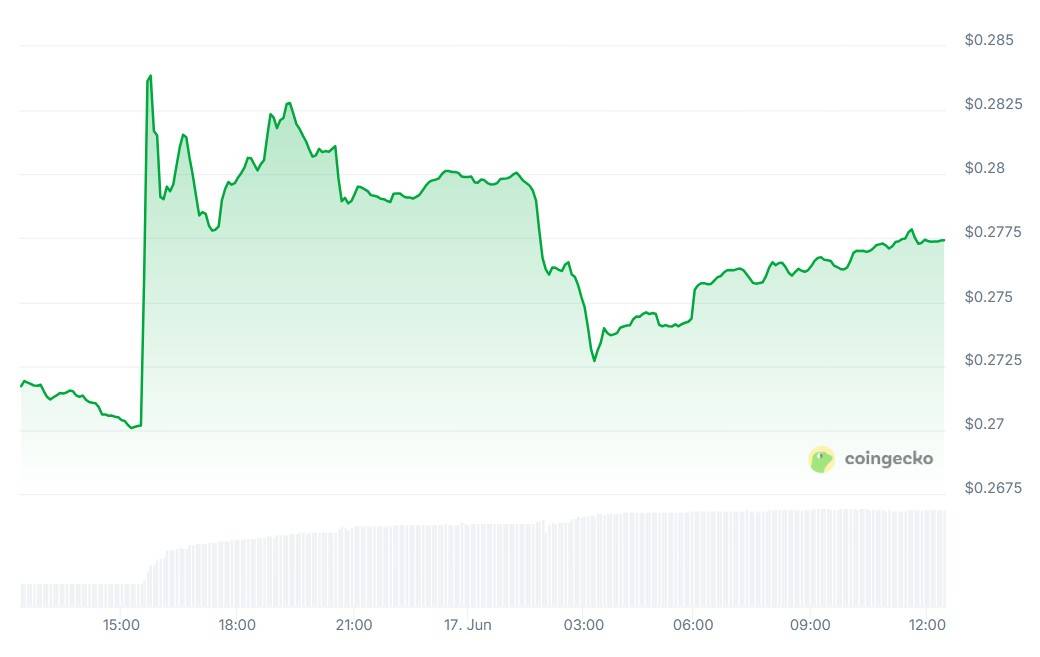
Market Overview - On March 3, cryptocurrencies experienced a sudden surge, with Bitcoin rising over 7.7% and Ethereum increasing by more than 11% [1][2] - Notable price movements included ADA soaring by 63.6% and XRP jumping by 28.1% [1][2] Liquidation Events - Over the past 24 hours, more than 180,000 traders were liquidated, with a total liquidation amount of approximately $828 million [2] - The liquidation breakdown showed significant losses across various time frames, with $830 million liquidated in 24 hours, including $280 million from long positions and $550 million from short positions [3] Regulatory Developments - President Trump announced that XRP, Solana (SOL), and Cardano (ADA) will be included in the U.S. cryptocurrency reserves [5][8] - A new working group was established to assess the feasibility of creating a national digital asset reserve and to develop a regulatory framework for the cryptocurrency industry [6][7] Market Sentiment and Reactions - The recent surge in cryptocurrency prices is seen as a response to the Biden administration's regulatory stance on the crypto industry [7] - Trump's upcoming cryptocurrency summit on March 7 aims to further solidify his support for the crypto sector [10] Historical Context - The cryptocurrency market faced a significant downturn prior to the recent surge, with Bitcoin dropping over 5% on February 26, reaching below $84,000, a nearly 20% decline from its January peak [13][16] - The market's volatility was exacerbated by a major hacking incident at Bybit, which resulted in the loss of over $1.5 billion in assets, triggering panic among investors [16][19]

特朗普重大宣布!这一品种暴涨超70%!
证券时报· 2025-03-03 00:34
Core Viewpoint - The article discusses the recent developments in the cryptocurrency market following President Trump's announcement to include XRP, Solana, and Cardano in the U.S. cryptocurrency reserves, leading to significant price increases for these cryptocurrencies and Bitcoin [1][3]. Group 1: Market Reactions - Following Trump's announcement, XRP surged over 30% to exceed $2.93, Solana rose over 24% to surpass $178, and Cardano increased nearly 72% in a single day [1]. - Bitcoin also experienced a notable increase, breaking the $94,000 mark with a nearly 10% rise [1]. Group 2: Market Volatility - The volatility in the cryptocurrency market resulted in over 170,000 liquidations within 24 hours, amounting to more than $800 million in liquidated positions [2]. - Specific liquidation amounts included $15.57 million in one hour, $63.21 million in four hours, and $750 million in twelve hours [2]. Group 3: Regulatory Developments - President Trump is set to host the first White House cryptocurrency summit on March 7, which aims to solidify his support for the cryptocurrency industry [3][4]. - The summit will include prominent figures from the cryptocurrency sector and aims to establish a clear regulatory framework to promote innovation and protect economic freedom [4]. - The current U.S. government shows signs of loosening regulations on the cryptocurrency industry, as evidenced by the SEC's decision to withdraw civil enforcement actions against Coinbase [6].