
网络安全软件

Search documents
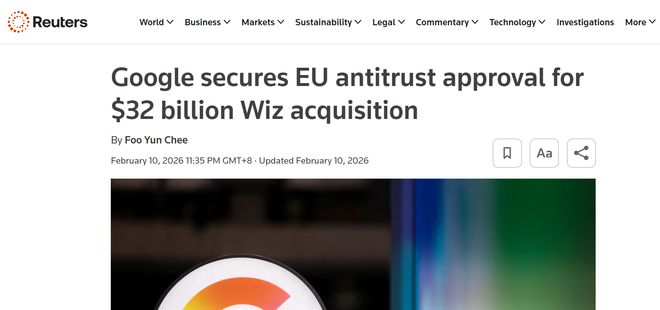
谷歌320亿美元收购Wiz获欧盟无条件批准,系其史上最大收购案
Huan Qiu Wang Zi Xun· 2026-02-12 03:31
Core Insights - Alphabet, Google's parent company, has received unconditional approval from the EU antitrust authority for its acquisition of cybersecurity company Wiz for $32 billion, marking the largest acquisition in Google's history [1][3] Group 1: Acquisition Details - The acquisition was officially announced in March of the previous year and aims to enhance Google's competitiveness in the cybersecurity and cloud computing sectors [3] - The EU antitrust authority confirmed that the transaction would not raise any competition concerns, as Google's market share in cloud infrastructure remains behind that of Amazon and Microsoft [3] Group 2: Market Impact - EU antitrust chief Teresa Ribeiro stated that customers in the market will still have reliable alternative service providers and sufficient options to switch providers, ensuring that the competitive landscape will not be adversely affected [3] - The European Commission conducted a thorough assessment of the transaction, concluding that the data acquired by Google through this acquisition does not involve commercial secrets and that other security software companies can also evaluate the relevant data, preventing market monopolization issues [3]

博通(AVGO.US)跌逾4% 偿债压力引发投资者担忧
Zhi Tong Cai Jing· 2026-01-14 15:49
Core Viewpoint - Broadcom (AVGO.US) shares fell over 4% to $338.72 amid concerns regarding its revenue from the Chinese market due to regulatory actions [1] Group 1: Regulatory Impact - Chinese authorities have reportedly instructed companies to cease using cybersecurity software developed by the US and Israel, which includes products from Broadcom's subsidiary VMware, potentially affecting Broadcom's revenue in China [1] Group 2: Financial Concerns - On January 13, Broadcom issued $4.5 billion in senior notes for debt restructuring, which has raised concerns among investors regarding increased financial leverage and debt repayment pressures [1]

美股异动 | 博通(AVGO.US)跌逾4% 偿债压力引发投资者担忧
智通财经网· 2026-01-14 15:48
Group 1 - Broadcom (AVGO.US) shares fell over 4% to $338.72 amid reports of Chinese authorities requesting companies to stop using cybersecurity software developed by the US and Israel, which may impact its revenue in the Chinese market [1] - The company issued $4.5 billion in senior notes on January 13 for debt restructuring, increasing financial leverage and raising investor concerns about debt repayment pressure [1]
黑莓上调年度营收预期下限,因网络安全软件需求强劲
Xin Lang Cai Jing· 2025-12-18 23:37
Core Viewpoint - BlackBerry has raised the lower end of its revenue forecast for fiscal year 2026 due to strong demand for its cybersecurity software as companies increase spending to combat increasingly complex cyber threats [1][2]. Group 1: Revenue Forecast - The company now expects fiscal year 2026 revenue to be between $531 million and $541 million, up from a previous forecast of $519 million to $541 million [1][2]. - For the fourth fiscal quarter, BlackBerry anticipates revenue between $138 million and $148 million, aligning with analyst expectations of $143.4 million [3]. Group 2: Financial Performance - For the third fiscal quarter ending November 30, BlackBerry reported revenue of $141.8 million, surpassing the average analyst estimate of $137.4 million [1][2]. - The QNX division, which develops embedded software for automotive systems, saw a 10% revenue increase in the third fiscal quarter, reaching $68.7 million [3]. Group 3: Market Trends - The rising digital threats and AI-driven vulnerabilities are driving demand for security solutions, benefiting companies like BlackBerry that have shifted from hardware to software and services [1][2]. - Currently, over 275 million vehicles globally are using QNX technology [2].
澳洲会计师公会发布《2025年商业科技应用调查》
Zheng Quan Ri Bao Wang· 2025-11-21 06:17
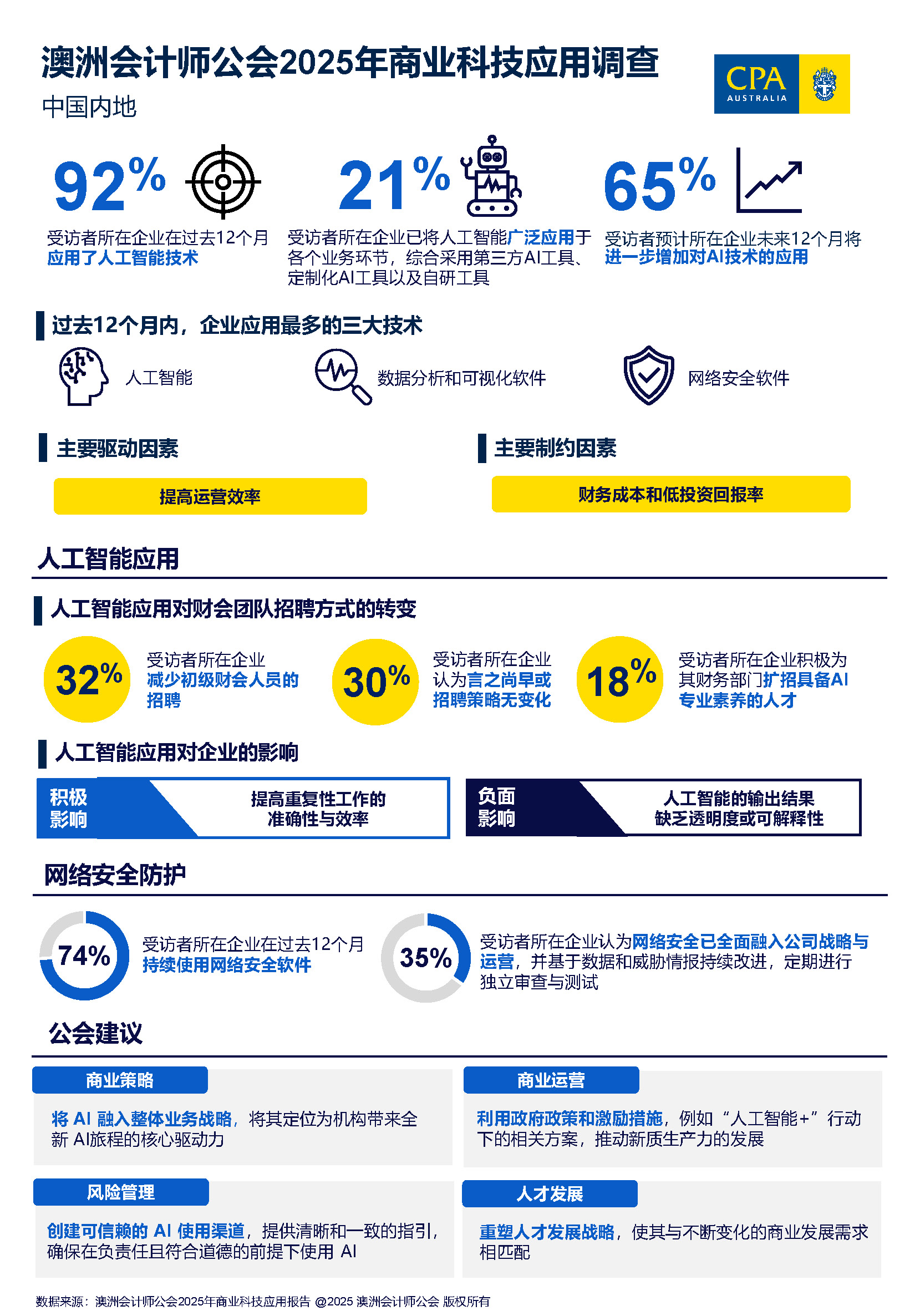
Core Insights - The rapid development of AI is significantly reshaping the core skill requirements in the accounting field, driving talent transformation [1] - Companies are increasingly focused on the practical value of AI projects, with a core emphasis on improving return on investment [1] Technology Adoption - AI, data analytics and visualization software, and cybersecurity software are the top three technologies adopted by mainland Chinese enterprises in the past 12 months [1] - 92% of respondents reported using AI tools like DeepSeek, a substantial increase from 72% in the previous year [1] AI Integration - 21% of respondents indicated that AI is widely integrated across various business functions, utilizing third-party, customized, and self-developed AI tools, up from 9% in the last survey [1] - 30% of enterprises moderately apply AI in several areas, primarily relying on third-party tools, while 40% occasionally use free or off-the-shelf AI tools [1] Future Outlook - 65% of respondents expect their companies to further increase AI technology applications in the next 12 months, a rise of 17 percentage points from the last survey [2] - The results indicate a strong growth momentum for AI in mainland China, reflecting ongoing confidence in its strategic value [2]
澳洲会计师公会调查:AI的快速发展正深刻重塑财会领域的核心技能要求
Jing Ji Guan Cha Wang· 2025-11-20 14:24
Core Insights - The latest survey by the Australian Accounting Association indicates a significant increase in AI application rates and maturity among mainland Chinese enterprises over the past year [1][2] Group 1: AI Application and Trends - 92% of respondents from mainland China reported using AI tools like DeepSeek, a substantial increase from 72% in the previous year [1] - 21% of respondents indicated that AI is widely integrated across various business functions, up from 9% in the last survey, marking the highest rate among all surveyed markets [1] - 65% of respondents expect their companies to further increase AI technology applications in the next 12 months, a rise of 17 percentage points from the last survey [2] Group 2: Challenges in AI Implementation - 40% of mainland enterprises identified cost and return uncertainty as a primary challenge, with 49% of small and medium-sized enterprises (SMEs) particularly concerned about low investment returns [2] - The lack of transparency and explainability in AI outputs, along with data security risks, poses significant challenges for both large and small enterprises [2] - Compliance and risk management pressures are heightened due to varying global AI governance rules, leading to increased data leakage risks [2] Group 3: Workforce and Talent Development - 32% of respondents noted a reduction in hiring entry-level accounting staff, while 18% reported actively recruiting talent with AI expertise for their finance departments [3] - Companies are advised to balance technology investments with long-term business strategies, especially for SMEs lacking digital capabilities [3] - Employers are encouraged to enhance existing employees' technological skills and create clear policies for ethical AI tool usage [4]
澳洲会计师公会调查:中国内地人工智能应用激增,财会人才需求加速转型
Guo Ji Jin Rong Bao· 2025-11-20 12:32
Core Insights - The application and maturity of artificial intelligence (AI) in mainland China have significantly increased over the past year, reshaping the core skill requirements in the accounting field and driving talent transformation [1][4] - Companies are increasingly focused on the return on investment (ROI) from AI projects, reflecting a more pragmatic approach to technology application [1][4] Group 1: AI Adoption and Trends - AI, data analytics, and cybersecurity software are the top three technologies adopted by mainland Chinese enterprises in the past year [4] - 92% of respondents from mainland China reported using AI tools like DeepSeek, a significant increase from 72% in the previous year [4] - 21% of respondents indicated that AI is widely integrated into various business processes, up from 9% in the last survey, making it the highest among all surveyed markets [4] - 65% of respondents expect their companies to further increase AI technology applications in the next 12 months, a rise of 17 percentage points from the previous survey [4] Group 2: Human Resource Strategies - 32% of respondents noted that their companies reduced hiring for junior accounting positions due to the proliferation of AI applications, while 18% are actively recruiting talent with AI expertise [5] - The demand for hybrid talent with both traditional accounting knowledge and technological skills is increasing, as companies seek to empower digital transformation [5] - Employers are encouraged to enhance or retrain existing employees' technological skills to adapt to the evolving workplace [5] Group 3: Investment and ROI Challenges - Approximately 40% of respondents indicated that the ROI from technology investments is low, particularly among small and medium-sized enterprises (SMEs) [7] - Companies are advised to clearly define their core business challenges before investing in new technologies and to consult with technology experts for tailored solutions [7] - SMEs should prioritize technology solutions that enhance core business functions and adopt phased investment strategies to ensure alignment with strategic goals [7] Group 4: Cybersecurity Concerns - 74% of respondents reported ongoing use of cybersecurity software, with 35% integrating cybersecurity into their overall business strategy [7][8] - The rise of generative AI and other public large language models has increased data breach risks, necessitating heightened employee awareness and responsible AI usage [8] - Companies are encouraged to regularly assess and update their cybersecurity measures to mitigate evolving threats, with options like security operation centers being viable solutions [8]
环球问策|微步在线薛锋:数字化时代网络安全≠软件防御,安全运营应回归本质
Huan Qiu Wang· 2025-08-27 04:25
Group 1 - The current cybersecurity landscape has significantly changed compared to ten years ago, with most enterprises having completed digital transformation and requiring a reassessment of cybersecurity importance [1][3] - Many companies still hold outdated views, believing that purchasing cybersecurity software guarantees safety, while real threats like phishing attacks demonstrate the inadequacy of this approach [3][4] - Companies face eight major challenges in security operations, including phishing attacks, vulnerability management, and credential misuse, necessitating a return to the essence of security operations and improvement of foundational capabilities [3][4] Group 2 - The cybersecurity industry is experiencing internal competition driven by low pricing strategies, as many digitalized enterprises fail to recognize the evolving nature of cybersecurity [4] - This low-price competition leads to a negative cycle where customers face unresolved cybersecurity issues after initial engagement, highlighting the need for proactive measures [4] - The company aims to differentiate itself by helping enterprises prevent cybersecurity incidents before they occur, advocating for a positive industry development rather than reactive measures post-incident [4]

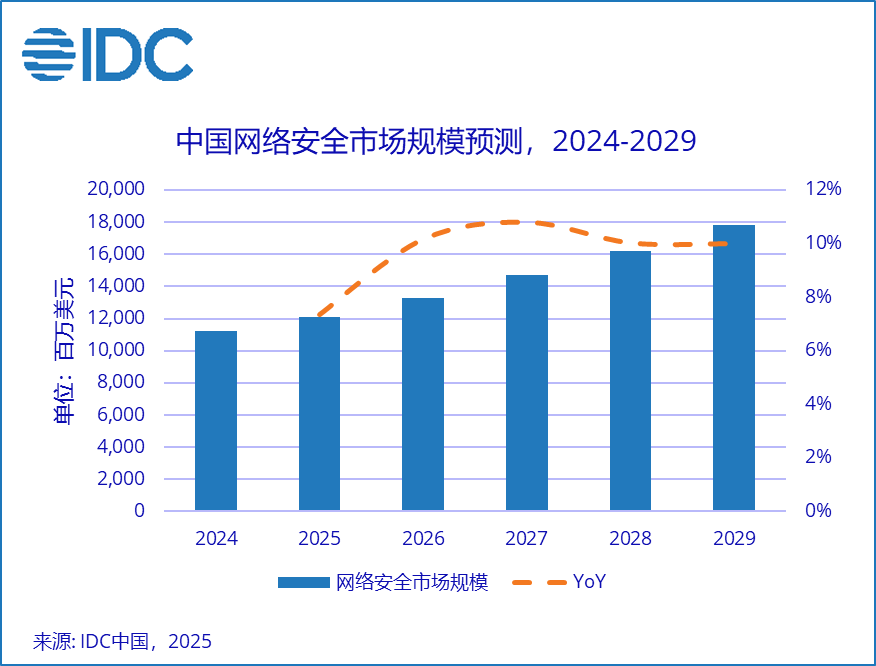
IDC:预计2029年中国网络安全市场规模达178亿美元 五年复合增长率9.7%
智通财经网· 2025-08-22 05:59
Core Insights - The global cybersecurity IT investment is projected to reach $244.4 billion in 2024 and is expected to grow to $416.2 billion by 2029, with a five-year compound annual growth rate (CAGR) of 11.2% [1] - The Chinese cybersecurity market is forecasted to grow from $11.2 billion in 2024 to $17.8 billion by 2029, with a CAGR of 9.7% [1] Cybersecurity Market Insights - The legislative framework of "Three Laws and One Regulation" is enhancing the maturity of China's cybersecurity market, with the cybersecurity software market experiencing the fastest growth at a CAGR of 13.7% [3] - The hardware market is benefiting from generative AI, while the unified threat management market is expected to capture nearly 70% of the security hardware investment [3] - The information and data security software market is the largest sub-market in cybersecurity software, with a CAGR of 18.1% [3] - Managed security services are seeing a demand increase due to regulatory compliance and heightened corporate security awareness, with a CAGR of 12.8% [3] Industry Spending Insights - The top three sectors for cybersecurity spending in 2024 are Government (25.4%), Financial Services (16.8%), and Telecommunications (15.4%), accounting for nearly 60% of total cybersecurity expenditure [4] Manufacturing Sector Insights - The High Tech and Electronics sector is experiencing rapid investment growth, with a projected CAGR of 12.5% due to increased digital technology penetration and the need for data security and intellectual property protection [5] Enterprise Size Insights - Very Large Businesses (1000+) dominate the cybersecurity market, accounting for nearly 70% of total investment, while Medium Businesses (100-499) are expected to see a CAGR of 11.1% as cybersecurity awareness increases [6] Future Outlook - The rapid development of generative AI and associated security risks is elevating the importance of cybersecurity for business continuity and core asset protection [7] - The continuous improvement of regulatory frameworks is enhancing compliance operability for enterprises, while companies are increasingly investing in advanced security technologies and talent development [7] - AI-driven intelligent security solutions are anticipated to expand application scenarios and drive steady growth in the cybersecurity software market [7]
美股异动|Palo Alto Networks涨超7% 第四财季收入及调整后每股盈利超预期
Ge Long Hui· 2025-08-19 13:50
Core Viewpoint - Palo Alto Networks reported strong fourth-quarter results, exceeding revenue and adjusted earnings per share expectations, leading to a stock price increase of over 7% [1] Financial Performance - Fourth-quarter revenue increased by 16% year-over-year to $2.54 billion, surpassing the expected $2.5 billion [1] - Net profit decreased by 31% year-over-year to approximately $254 million [1] - Adjusted earnings per share were $0.95, exceeding the forecast of $0.88 [1] Future Guidance - For the first quarter, the company provided optimistic guidance, expecting earnings per share between $0.88 and $0.90, above the analyst estimate of $0.85 [1] - For the entire fiscal year, the company anticipates adjusted earnings per share in the range of $3.75 to $3.85 and revenue between $10.48 billion and $10.53 billion, both exceeding expectations [1]
