美国国债期权

Search documents
市场预期逆转:美联储12月降息概率飙升至80%,债市多头押注创纪录
智通财经网· 2025-11-25 23:55
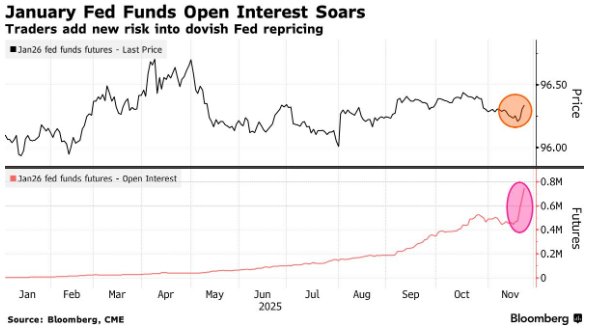
Core Viewpoint - Investors are significantly betting on the Federal Reserve's policymakers to cut interest rates again in the upcoming meeting next month, following a week where doubts about rate cuts have dissipated, laying the groundwork for a rise in U.S. Treasury bonds [1][3]. Market Sentiment - The shift in interest rate expectations began with the mixed September non-farm payroll data released last week, followed by comments from New York Fed President John Williams indicating potential room for rate cuts due to a weak labor market [3]. - The futures market reflects a dovish sentiment, with a recent survey from JPMorgan showing net long positions at their highest level in about 15 years [3]. Treasury Yield Movement - On Tuesday, the 10-year U.S. Treasury yield fell below 4% for the first time in a month, influenced by speculation regarding Kevin Hassett as a potential future Fed chair, which has heightened expectations for rate cuts over the next year [4]. Positioning in Futures Market - Since last Thursday, the total number of new positions in January federal funds futures has approached 275,000 contracts, indicating a significant increase in market positioning for a rate cut [5]. - The price of the January contract rose from a low of 96.18 to a high of 96.35, reflecting continued inflow of new long positions [5]. Divergence in Predictions - While most Wall Street strategists predict a rate cut in December, not all are as confident as traders. Morgan Stanley has removed its forecast for a rate cut, and JPMorgan leans towards maintaining rates next month, although the December decision remains close [6]. - Overall, the economic growth in the U.S. has been strong, but there are still downward risks in the labor market, and inflation remains above target levels [6]. Options Market Activity - In the SOFR options market, there has been a significant increase in open interest for contracts with a strike price of 96.25, primarily driven by a surge in bullish positions for December 2025 options [9][10]. - The premium for options used to hedge Treasury risks has remained near neutral levels, with a slight bias towards call options, indicating that traders are paying more to hedge against short- and medium-term contract price increases [13].

市场押注特朗普或将任命“鸽派”美联储主席 美债期权现看涨倾向
智通财经网· 2025-07-22 22:21
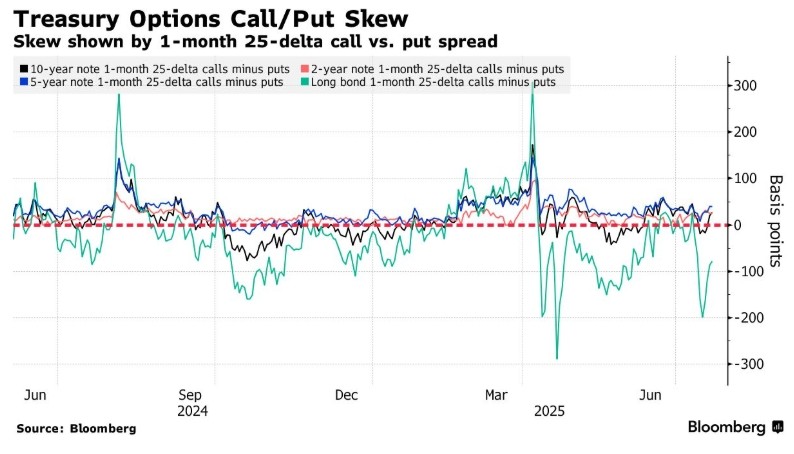
Core Viewpoint - The U.S. Treasury options market shows a bullish trend amid speculation that Trump may appoint a "dovish" successor to current Fed Chair Powell, leading to a shift in investor sentiment [1] Group 1: Market Reactions - The benchmark Treasury yield has retreated from previous highs, reflecting a change in investor sentiment as options trading indicates a bullish outlook [1] - Following reports of potential changes in Fed leadership, the 30-year Treasury yield peaked at 5.07% on July 16, the highest since May [1] - The White House clarified that Trump does not intend to replace Powell before his term ends in May next year, alleviating market concerns and prompting a rebound in long-term Treasuries [1] Group 2: Fed Policy and Investor Sentiment - Powell indicated that he would assess the impact of Trump's new tariff policies on the economy before considering rate cuts, adding uncertainty to the market [1] - Fed Governor Waller's rare suggestion for a rate cut in July has heightened attention on internal disagreements within the Fed [2] Group 3: Options Market Dynamics - The risk premium for 30-year Treasury put options has decreased as yields fell to around 4.9% by July 22, indicating reduced investor concern over significant declines [2] - A significant number of bullish bets on 10-year Treasury futures were observed, with approximately 54,000 September call options traded, totaling a premium of about $23 million [5] Group 4: Position Adjustments - A survey by JPMorgan revealed an increase in both long and short positions in U.S. Treasuries, with a decrease in neutral positions, indicating a more divided market stance [5] - According to CFTC data, asset managers reduced net long positions across most U.S. Treasury futures, particularly in the 5-year to ultra-long maturities, with a market value sensitivity of approximately $1.64 million per basis point [8] - Leveraged funds began to cover short positions in 10-year Treasuries, with a reduction in position value of about $5.6 million per basis point change in rates, suggesting a shift towards more neutral strategies [10]
美债市场“起义”:20年期拍卖翻车恐成“债券卫士”归来序曲
美股研究社· 2025-05-22 11:43
Core Viewpoint - Concerns over the expanding deficit threatening the U.S. safe-haven status are reflected in the weak demand for a $16 billion 20-year Treasury auction, leading to declines in U.S. stocks, bonds, and the dollar [3][4]. Group 1: Treasury Auction Results - The U.S. Treasury auctioned $16 billion of 20-year bonds with a winning yield of 5.047%, marking the second instance of yields surpassing 5% since the bond's introduction five years ago [3]. - The winning yield was 24 basis points higher than April's 4.810% and approximately 1.2 basis points above the pre-issue rate of 5.035%, indicating a significant tail risk [3]. - This auction is considered one of the worst performances for this maturity since its launch, reflecting deteriorating investor sentiment towards U.S. Treasuries [3]. Group 2: Market Reactions - The weak auction results exacerbated a multi-week sell-off in Treasuries, highlighting growing investor dissatisfaction with increasing U.S. debt levels [3][4]. - The S&P 500 index fell by 1.5%, while the 10-year Treasury yield reached 4.607%, the highest since February 13 [3]. - Analysts noted that the market's reaction to the auction signals a collective avoidance of U.S. debt by foreign buyers, with rising financing costs putting pressure on the stock market [4]. Group 3: Political and Economic Implications - The White House intensified pressure on Republicans to approve Trump's tax plan, which could add trillions to the already ballooning budget deficit [6]. - Concerns were raised that the current administration is unlikely to make meaningful cuts to the deficit, as highlighted by former Treasury Secretary Steven Mnuchin [6]. - The bond market is seen as a barometer for fiscal sustainability, with rising yields indicating that investors are increasingly wary of the government's fiscal policies [7]. Group 4: Debt and Deficit Statistics - The U.S. public debt-to-GDP ratio is approximately 100%, with interest payments projected to reach about $880 billion in 2024, exceeding defense spending [8]. - The amount of outstanding debt surged from under $14 trillion at the end of 2016 to nearly $30 trillion [8]. - The annual sales of U.S. government debt reached a record $2.6 trillion last year, indicating a significant increase in borrowing [8].