
自贸债

Search documents
自贸债:制度型开放的新引擎
Guo Ji Jin Rong Bao· 2026-01-26 11:37
Core Insights - The Free Trade Zone Bonds (referred to as "FTZ Bonds") have evolved over the past decade into a key innovation for China's financial openness, establishing a market ecosystem characterized by cross-border features and risk resilience [1][3] - The issuance of FTZ Bonds has created efficient channels for cross-border financing for the real economy and has accumulated valuable experiences for institutional openness [1][3] - Future developments should draw on experiences from mature markets like London and Hong Kong to further activate market potential and allow domestic and foreign capital to share in China's opportunities [1][3] Market Development - FTZ Bonds serve as a "two-way bridge" linking domestic and foreign capital markets, with a cumulative issuance of approximately 130 billion yuan by June 2025, attracting diverse issuers and investors [3] - The first issuance of the "Yulan Bond" in January 2026 marked a significant step in providing offshore financing paths for financial institutions in the FTZ, with a cumulative issuance exceeding 22 billion yuan and a year-on-year growth rate of over 40% [3][4] Strategic Focus - FTZ Bonds should focus on three core areas: supporting national strategies, empowering the real economy, and promoting the internationalization of the renminbi [4] - The market still has potential for growth, with limited participation channels for domestic investors and high costs for foreign investors due to issues like custody and settlement mechanisms [4] Legislative Framework - The introduction of the "Regulations on the Development of FTZ Offshore Bond Business" in December 2025 marks a new phase for the FTZ Bond market, providing clear institutional expectations and defining the boundaries of FTZ offshore bonds [5][6] - The regulations aim to enhance market governance through a combination of government oversight, regulatory collaboration, and industry self-discipline [5][6] Future Directions - The FTZ Bond market should continuously adapt to market needs and international experiences, focusing on functional orientation, flexible institutional frameworks, and optimizing key mechanisms [6][7] - Efforts should be made to lower participation costs for international investors and broaden participation channels for domestic investors, including integrating FTZ Bonds into liquidity asset measurements for commercial banks [9][10] Ecosystem Development - The development of a professional intermediary service system is essential for enhancing the efficiency of the entire service chain, including underwriting, legal, rating, and auditing services [10] - Risk management mechanisms must be strengthened, including monitoring cross-border capital flows and establishing clear rules for investor rights protection [11]
上海清算所董事长马贱阳:不断提升境内外双向投融资的便利化程度
Sou Hu Cai Jing· 2025-10-24 04:42
Core Viewpoint - Shanghai Clearing House is the largest OTC foreign exchange centralized clearing platform globally, with a projected foreign exchange clearing volume of 200 trillion yuan this year, exceeding that of the London Clearing House by over 20% [1] Group 1: Financial Infrastructure and Cross-Border Services - Shanghai Clearing House plays a unique role in enhancing Shanghai's cross-border financial service capabilities through internationality, security, and leadership [1] - The establishment of a cross-border connectivity network has significantly expanded the range and scale of cross-border trading and financing in Shanghai's financial market [1] - The "Yulan Bond" initiative has achieved international connectivity with the European Clearing Bank, with future plans to connect with Refinitiv and Hong Kong CMU for seamless integration of domestic and foreign markets [1] Group 2: Product Development and Innovation - The introduction of the "Yulan Bond" as a key cross-border financing product has supported over 200 billion yuan in issuance, facilitating Chinese enterprises' international expansion [2] - The "Two Ends Abroad" self-trade bond has successfully supported the issuance of the first offshore bond in the Shanghai Free Trade Zone [2] - The Panda Bond initiative has supported over 900 billion yuan in issuance, establishing Shanghai Clearing House as the largest Panda Bond issuance and custody platform in China [2] Group 3: Mechanism Innovation - The global first cross-border central counterparty clearing connectivity mechanism for derivatives has been launched to meet market demands for cross-border bond investment risk management [3] - The "Swap Connect" initiative has been introduced in collaboration with domestic and foreign financial infrastructures to support the rapid and stable development of the cross-border derivatives market [3] - Future efforts will focus on enhancing the convenience of cross-border investment and financing, strengthening Shanghai's capability in global financial resource allocation [3]
时隔2年,自贸债有望重启
21世纪经济报道· 2025-06-24 15:40
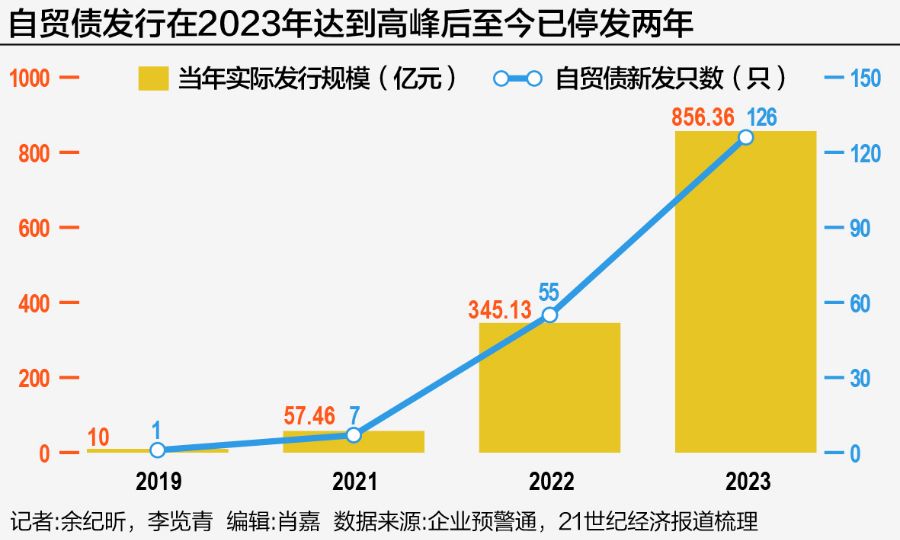
Core Viewpoint - The article discusses the potential revival of the Free Trade Zone (FTZ) bonds in China, highlighting the recent announcement by the People's Bank of China to develop offshore FTZ bonds, which aims to broaden financing channels for enterprises involved in the Belt and Road Initiative and enhance international investment participation [1][6]. Development Stages - The development of FTZ bonds can be divided into three stages: 1. **Policy Preparation Period**: Initiated in August 2013 with the establishment of the Shanghai FTZ and subsequent regulatory support [4]. 2. **Market Initial Stage**: Marked by the first issuance of FTZ bonds in December 2016, but with limited activity until 2019 [4]. 3. **Expansion Stage**: From 2019 onwards, there was a rapid increase in issuances, particularly by local government financing vehicles, culminating in a total issuance of 126 FTZ bonds worth 856.36 billion yuan in 2023, more than double the previous year's total [4][6]. Financing Dynamics - In 2023, the FTZ bonds exhibited a significant increase in issuance due to tighter regulations on traditional financing methods for local government financing vehicles, making FTZ bonds a more attractive option [6][7]. - The issuance of FTZ bonds was primarily dominated by local government financing vehicles, which accounted for 77% of the total issuers, while participation from private and foreign enterprises remained low [9][11]. Regulatory Challenges - The initial success of FTZ bonds faced regulatory challenges due to a mismatch between the intended purpose of attracting foreign investment and the reality of domestic banks being the primary investors [9][11]. - In May 2023, the People's Bank of China tightened regulations on FTZ bonds, leading to a halt in new issuances due to concerns over compliance and risk management [11][12]. Future Outlook - The revival of FTZ bonds is contingent upon establishing sustainable offshore funding sources, as the current reliance on domestic banks for funding undermines the original intent of attracting foreign capital [12][14]. - The new regulatory framework is expected to enforce stricter requirements, mandating that both issuers and investors must originate from offshore markets, which could reshape the market dynamics and enhance the internationalization of the renminbi [14][16].

自贸离岸债时隔两年有望重启,“两头在外”原则成亮点
2 1 Shi Ji Jing Ji Bao Dao· 2025-06-24 11:04
Core Viewpoint - The People's Bank of China announced the potential restart of the issuance of Free Trade Zone Bonds (FT Bonds), which aims to enhance financing channels for enterprises involved in the Belt and Road Initiative and those going global [1][2]. Development Stages - The development of FT Bonds can be divided into three stages: 1. Policy preparation period starting from August 2013 with the establishment of the Shanghai Free Trade Zone [2]. 2. Market initiation period beginning in May 2016 with the first issuance of FT Bonds, but no further issuances until 2019 [2]. 3. Expansion period from 2019 to 2023, where the issuance of FT Bonds surged, with 126 bonds issued in 2023 alone, totaling 85.636 billion yuan, more than double the total issuance in 2022 [2][5]. Financing Function - In 2023, FT Bonds demonstrated a significant "substitute financing function," with a notable increase in issuance due to tightened regulations on other financing methods for local government financing vehicles [5][6]. Regulatory Changes - The issuance of FT Bonds was halted in mid-2023 due to discrepancies between regulatory intentions and market realities, where a high concentration of issuers were local government financing vehicles, leading to increased credit risk [7][8]. Market Dynamics - The market for FT Bonds saw a shift in 2023, with the issuance primarily dominated by local government financing vehicles, which accounted for 77% of the total issuers, while participation from private and foreign enterprises remained low [7][8]. Future Outlook - The potential restart of FT Bonds will likely come with stricter requirements, focusing on ensuring that both issuers and investors are from offshore markets, thereby enhancing the "two ends abroad" model [10][11]. - The future development of FT Bonds is expected to be more internationalized, targeting high-credit-rated enterprises involved in the Belt and Road Initiative, with AAA-rated companies likely to dominate the market [12].
浙商证券廖博解读八项重磅金融举措:不仅应对短期挑战,更是长期战略部署
Zhong Guo Jing Ying Bao· 2025-06-24 05:52
Core Insights - The People's Bank of China announced eight significant financial measures aimed at stabilizing the financial market and enhancing the long-term reform of the financial system and international competitiveness [1][8] - The measures are designed to strengthen the financial defenses against potential external shocks while promoting financial openness through institutional innovation [1][4] Financial Market Development - Establishing an interbank market trading report library will improve transaction and investment efficiency for financial institutions and enhance regulatory precision [1][5] - The internationalization of the digital yuan is expected to advance significantly, with its advantages in speed and security facilitating cross-border payments [2][4] Digital Currency and Credit System - The development of the digital yuan is anticipated to reshape the cross-border payment system and open new pathways for its internationalization, particularly in supply chain finance and cross-border e-commerce [2][3] - The establishment of personal credit institutions aims to address information asymmetry in the rapidly growing consumer finance market, potentially boosting domestic consumption [2][3] Offshore Financial Services - The Shanghai Lingang New Area's offshore trade finance service reform and the development of free trade offshore bonds are expected to enhance the international influence of the renminbi [3][4] - The free trade offshore bonds, also known as "pearl bonds," are designed to maintain financial security and stability while increasing the attractiveness of renminbi-denominated bonds in international markets [3][4] Structural Monetary Policy Tools - Innovative structural monetary policy tools are focused on supporting foreign trade, technological innovation, and green finance, addressing financing challenges faced by enterprises [4][5] - Cross-border trade refinancing initiatives are set to improve the efficiency of cross-border settlements and provide new financing channels for both large and small enterprises [4][5] Foreign Exchange Market Enhancements - The promotion of renminbi foreign exchange futures trading will fill a significant gap in the foreign exchange market, providing more tools for managing exchange rate risks [5][6] - This initiative is expected to enhance the international competitiveness of China's financial market and support the stability and liquidity of the foreign exchange market [5][6] Investment Opportunities - The eight financial measures are expected to boost market confidence and create various investment opportunities, particularly in sectors like technology innovation and green industries [6][7] - The bond market is projected to see a decline in the ten-year government bond yield, enhancing the attractiveness of bond investments [6][7] Strategic Outlook - The combination of these policies represents a strategic deployment towards becoming a financial powerhouse, providing robust financial support for stable economic growth [8] - Investors and enterprises are encouraged to adopt a broader perspective to seize opportunities arising from these policy changes [8]

加力支持企业“走出去”与“一带一路”建设,陆家嘴金融沙龙聚焦跨境金融服务升级
Di Yi Cai Jing· 2025-05-15 14:13
Core Insights - The article emphasizes the need for comprehensive financial solutions for enterprises "going global," moving beyond traditional financing to include investment, risk management, and professional consulting services [1][2] - The "Action Plan" aims to address various pain points in cross-border financial services, such as difficulties in fund transfers, limited financing channels, and inadequate foreign exchange risk management capabilities [2][3] Group 1: Cross-Border Financial Services - The facilitation of cross-border financial services is a key indicator of an international financial center's competitiveness, with Shanghai making significant progress in this area [2][4] - The "Action Plan" includes 18 specific policy measures across five areas: payment and settlement, foreign exchange risk management, financing services, insurance protection, and comprehensive financial services [2][3] - Digital empowerment and pilot policies, such as supporting RMB cross-border trade refinancing and optimizing currency pool management, are highlighted as key innovations [3][4] Group 2: Support for "Going Global" Enterprises - The "Belt and Road" initiative provides a vast space for Chinese enterprises to expand internationally, with financial support being crucial for successful overseas operations [5][6] - Standard Chartered Bank has supported 720 "Belt and Road" projects over the past five years, amounting to over $130 billion, showcasing the importance of international banking networks in facilitating these initiatives [6] - Insurance plays a vital role in risk management for "going global" enterprises, with companies like Yongcheng Insurance focusing on providing comprehensive risk coverage and participating in the development of international reinsurance capabilities [6][7] Group 3: Collaborative Efforts and Future Directions - Enhancing cross-border financial service facilitation requires collaboration between financial institutions and government departments [4][7] - Shanghai's government is committed to optimizing cross-border financial services through mechanisms that include legal protections and risk monitoring [7]
