芝麻香油

Search documents
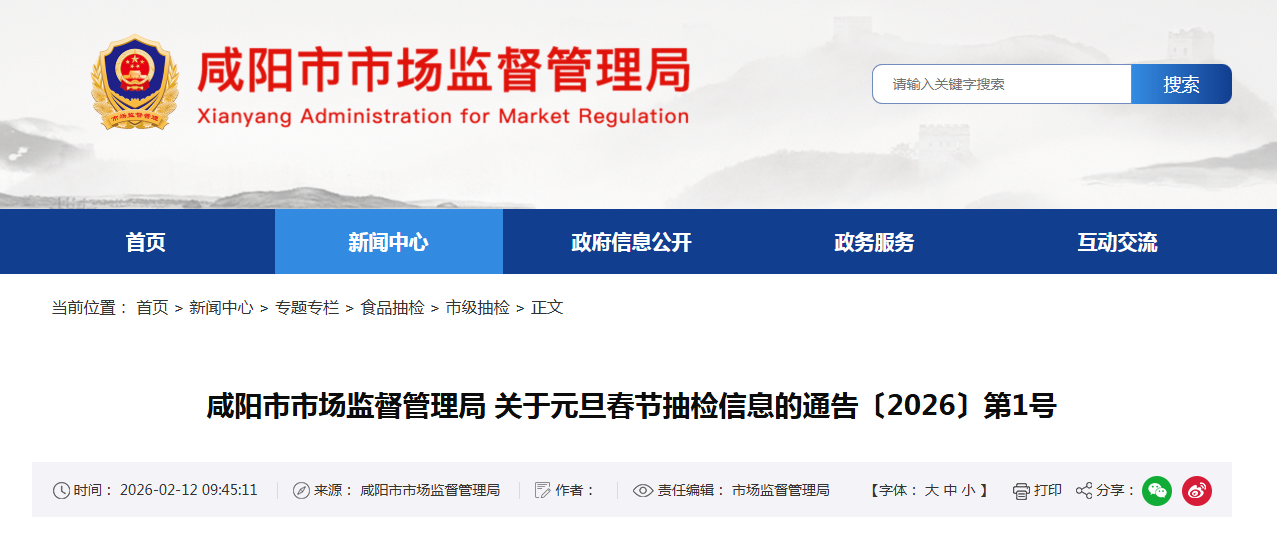
陕西省咸阳市市场监督管理局关于元旦春节抽检信息的通告〔2026〕第1号
Zhong Guo Zhi Liang Xin Wen Wang· 2026-02-14 09:02
Summary of Key Points Core Viewpoint - The Xi'an City Market Supervision Administration conducted a quality inspection of 112 batches of food products, revealing that one batch of longan sold at a convenience store exceeded the permissible limit of sulfur dioxide residues, prompting immediate action to recall the product and address the violation [3]. Group 1: Inspection Results - A total of 112 batches from 14 categories of food products were inspected, with one batch failing due to excessive use of food additives [3]. - The specific non-compliance was found in longan sold by a convenience store in Xi'an, with sulfur dioxide residue measured at 0.295 g/kg, exceeding the national standard limit of 0.05 g/kg [3]. Group 2: Actions Taken - The Xi'an City Market Supervision Administration has mandated relevant departments to take immediate action to manage the identified non-compliant products, including product recall and risk control measures [3]. - Consumers are encouraged to report any instances of the non-compliant products found in the market by calling the complaint hotline [3].

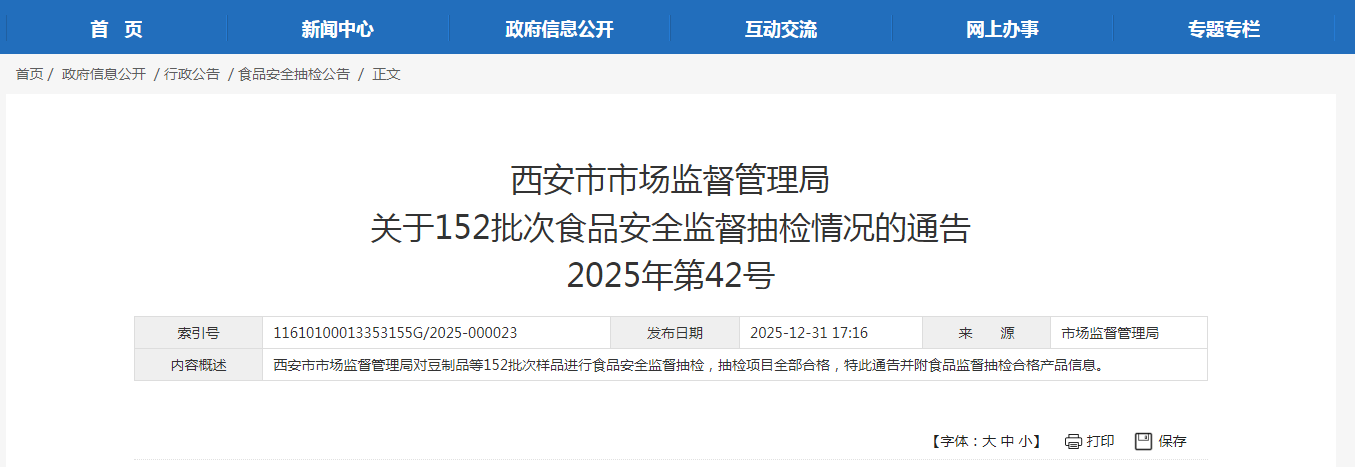
西安市市场监督管理局关于152批次食品安全监督抽检情况的通告(2025年第42号)
Zhong Guo Zhi Liang Xin Wen Wang· 2026-01-15 08:09
Summary - The Xi'an Market Supervision Administration conducted food safety supervision and spot checks on 152 batches of food products, including soybean products, grain processing products, meat products, dairy products, edible oils, and fats, all of which passed the safety standards [1]. Group 1: Food Safety Inspection Results - All 152 batches of food products tested were found to be compliant with national food safety standards [1]. - The inspection covered various categories of food, ensuring a comprehensive assessment of food safety in the region [1]. Group 2: Product Details - Specific products included sesame oil, red oil fermented bean curd, and various dairy products, all sourced from reputable companies [1][2]. - The inspection results indicate a focus on maintaining high-quality standards in food production and distribution within Xi'an [1][3].
千亿金龙鱼从巅峰到困境的跌宕之路
Xin Lang Cai Jing· 2025-12-15 05:59
Core Viewpoint - The company Jinlongyu, once valued at nearly 800 billion yuan, is currently facing significant challenges including declining performance, a trust crisis, and difficulties in strategic transformation [1][8]. Financial Performance - As of December 2025, Jinlongyu's stock price has plummeted by 78.08% from its peak, resulting in a market value loss exceeding 600 billion yuan [1][8]. - In 2024, the company's net profit attributable to shareholders fell by 12.14% to 2.502 billion yuan, while the net profit excluding non-recurring items dropped by 26.42% to 972 million yuan [1][8]. - The company's operating revenue for 2024 was 238.866 billion yuan, a decrease of 5.03%, marking two consecutive years of decline [1][8]. - Financial derivatives contributed significantly to profits, with 1.787 billion yuan from derivative operations accounting for 71.42% of net profit [1][8]. Market Dynamics - In the second quarter of 2025, Jinlongyu reported an operating revenue of 56.603 billion yuan, a quarter-on-quarter decrease of 4.19%, and a net profit of 0.774 billion yuan, down 21.11% [2][9]. - The company's raw material costs constitute 89.30% of operating costs, heavily influenced by international market prices, which are subject to geopolitical and exchange rate fluctuations [2][9]. Operational Efficiency - The company's production capacity utilization rates are low, with oilseed crushing at 47.35%, oil refining at 45.19%, and oil filling at 31.78% [3][10]. - Six out of ten fundraising projects have been delayed, including significant projects in Qingdao and Kunming, pushing completion dates to 2027 [3][10]. Trust Issues - Jinlongyu's public image has been damaged by legal issues, including a court ruling against its subsidiary for contract fraud, resulting in a compensation of 1.881 billion yuan, which is nearly 80% of its 2024 net profit [4][11]. - Consumer trust has declined, with 465 distributors exiting and online negative ratings rising to 7.3% [4][11]. Strategic Transformation - The company is attempting to diversify its product offerings, with its sesame oil achieving a market share of 29.1%, but this segment alone cannot offset overall revenue declines [5][12]. - Jinlongyu is exploring new business areas such as plant-based meat and central kitchens, but market feedback has been cautious due to low consumer awareness and acceptance [5][12]. Future Outlook - The challenges faced by Jinlongyu reflect structural changes in the consumer industry, where demand for staple goods remains stable but growth potential is limited [7][13]. - To overcome these challenges, the company needs to enhance supply chain resilience, innovate products, and rebuild consumer trust, particularly in food safety [7][13].
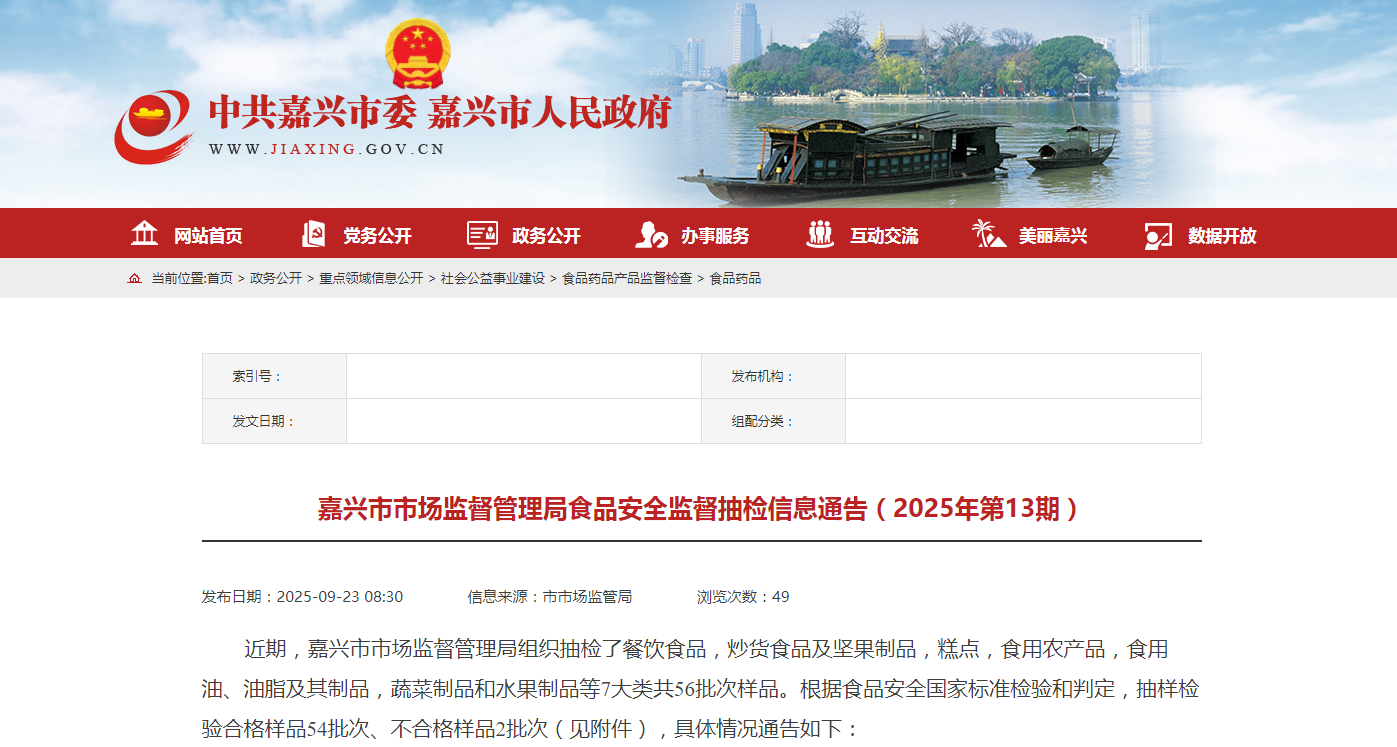
浙江省嘉兴市市场监督管理局食品安全监督抽检信息通告(2025年第13期)
Zhong Guo Zhi Liang Xin Wen Wang· 2025-10-13 05:08
Core Points - The Jiaxing Market Supervision Administration conducted a food safety inspection on 56 samples across seven categories, resulting in 54 passing and 2 failing samples [4][5][6] - The two non-compliant products included beef from a wholesale store containing Clenbuterol and old mountain yam from a vegetable wholesale department containing excessive levels of Miconazole and Miconazole manganese salt [4][5] - The local market supervision authorities have been instructed to take immediate action to control risks associated with the non-compliant products [4][6] Group 1: Inspection Results - A total of 56 samples were tested, with 54 passing and 2 failing the food safety standards [4] - The failing products were identified as follows: - Beef from Kaijie Beef Wholesale Department, which contained Clenbuterol at 11.4 µg/kg, exceeding the permissible limit [4] - Old mountain yam from Yiyuan Vegetable Wholesale Department, which contained Miconazole and Miconazole manganese salt at 0.495 mg/kg, above the acceptable level of 0.3 mg/kg [4][5] Group 2: Regulatory Actions - The Jiaxing Market Supervision Administration has mandated local market supervision departments to investigate and take legal action against the non-compliant products [4] - Immediate measures, such as product recalls, have been ordered to mitigate risks associated with the identified non-compliant products [4][6]
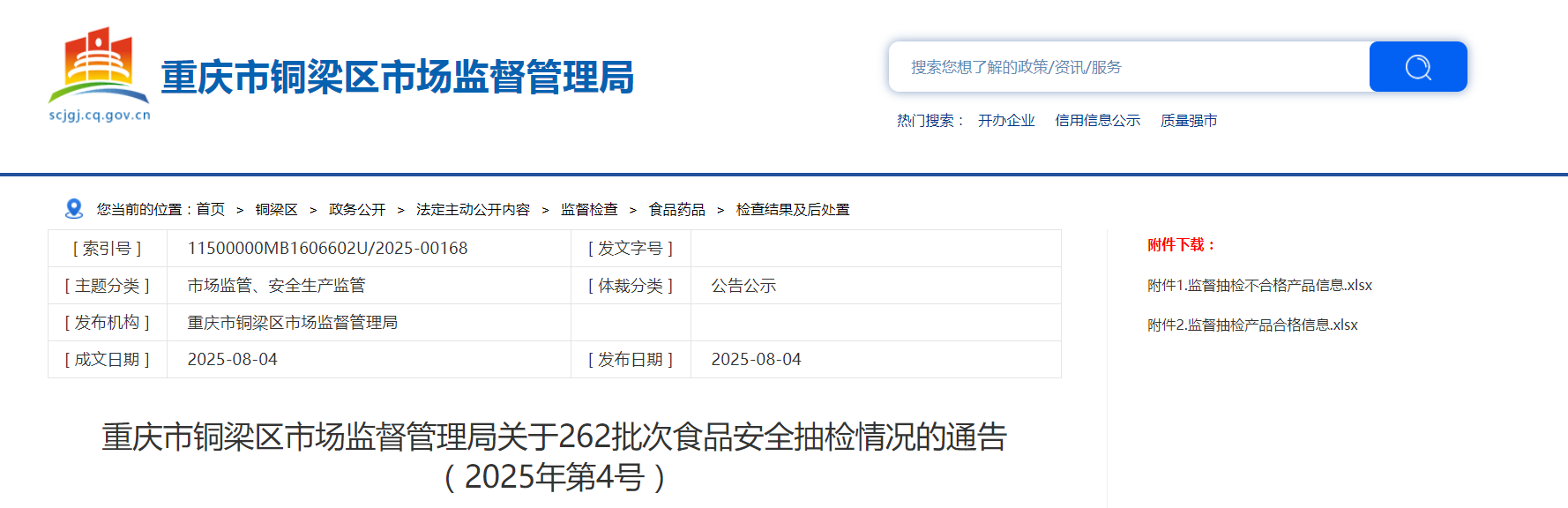
重庆市铜梁区市场监督管理局关于262批次食品安全抽检情况的通告(2025年第4号)
Zhong Guo Zhi Liang Xin Wen Wang· 2025-08-06 03:03
Core Points - The Chongqing Tongliang District Market Supervision Administration conducted a food safety inspection, testing 262 samples across various categories, with 254 passing and 8 failing the safety standards [1]. Group 1: Inspection Results - A total of 262 samples were tested, with 254 samples deemed compliant and 8 samples identified as non-compliant [1]. - The non-compliant products were subjected to legal actions as per the Food Safety Law of the People's Republic of China, including recall and removal from shelves [1]. Group 2: Non-compliant Products - Specific non-compliant products included items with pesticide residues exceeding the permissible limits, such as: - Imidacloprid at 0.244 mg/kg (limit ≤0.05 mg/kg) [1] - Cadmium at 0.493 mg/kg (limit ≤0.05 mg/kg) [1] - Enrofloxacin at 157 µg/kg (limit ≤100 µg/kg) [1] - The inspection revealed multiple instances of pesticide and heavy metal residues in various food products, indicating potential health risks [1].
“零添加”成调味乳品零食等营销卖点!海天、金龙鱼等回应
Nan Fang Du Shi Bao· 2025-03-29 10:42
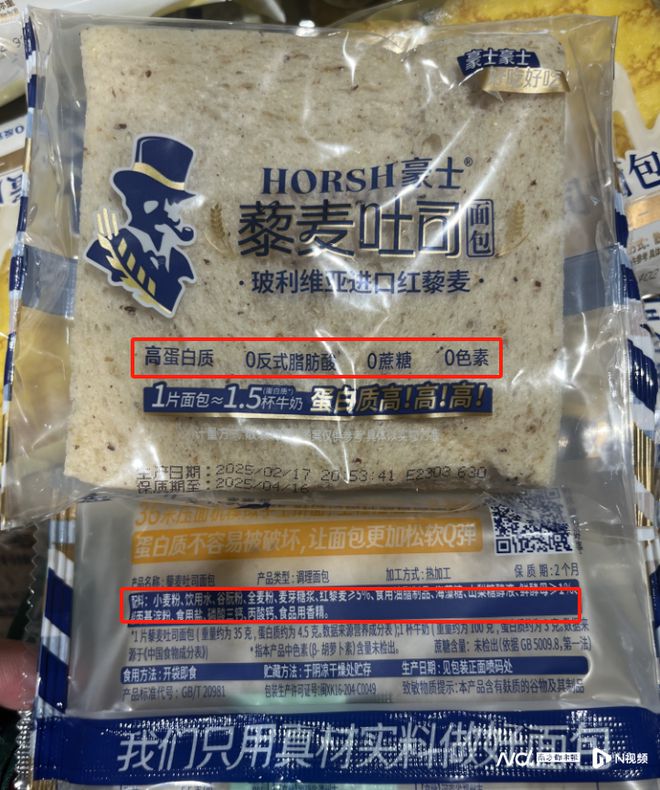
Core Viewpoint - The new food safety standards prohibit the use of terms like "zero added" and "not added" on pre-packaged foods, aiming to address misleading marketing practices in the industry. The implementation date is set for March 16, 2027, allowing companies a two-year transition period to comply [1][2][11]. Group 1: New Regulations - The newly released standards include 59 food safety national standards and amendments, specifically targeting misleading marketing language in pre-packaged food labeling [2][11]. - The revised GB 7718-2025 standard explicitly bans terms synonymous with "not added," such as "zero added" and "no added," to prevent consumer misunderstanding [2][13]. Group 2: Industry Response - Companies like Haidilao, Jinlongyu, and Qianhe have expressed support for the new regulations, indicating a commitment to comply and improve transparency in product labeling [11][12]. - The new regulations are expected to shift the industry focus from "label marketing" to "quality competition," encouraging companies to enhance product development and quality [11][12][14]. Group 3: Marketing Practices - Many brands, including Hao Shi and Wei Chuan, have been found to label products as "zero added" while containing other sugars or additives, highlighting the prevalence of misleading marketing in the industry [3][4][6]. - The dairy sector also sees widespread use of "zero added" claims, with brands like Nayuki and Mengniu promoting products as "zero sugar" or "zero fat," despite containing other forms of sugar [6][7]. Group 4: Consumer Misunderstanding - The marketing of "not added" products has created consumer misconceptions about the safety and quality of food products, leading to increased anxiety over the use of food additives [13][14]. - Experts argue that the new regulations will help consumers return to a more scientifically informed understanding of food safety, reducing the confusion caused by misleading claims [13][14].