
英伟达GB300机柜

Search documents
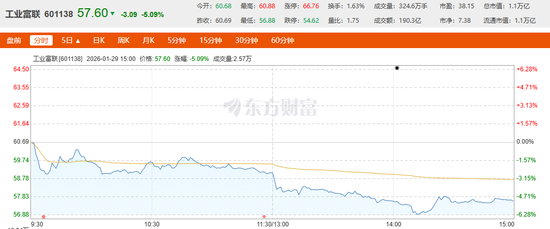
净利润增超50%,万亿AI大牛股,却遭机构“看空”!
Xin Lang Cai Jing· 2026-01-29 11:19
Core Viewpoint - Foxconn Industrial Internet Co., Ltd. (Industrial Fulian) announced a significant increase in its 2025 annual performance, with both annual and fourth-quarter operating results expected to grow substantially. However, due to a downward adjustment in industry valuation, China International Capital Corporation (CICC) lowered its target price by 18% [1][8]. Financial Performance - For Q4 2025, the company expects a net profit attributable to shareholders of 12.6 billion to 13.2 billion yuan, an increase of 4.5 billion to 5.1 billion yuan year-on-year, representing a growth of 56% to 63%. After excluding non-recurring gains and losses, the expected net profit is 12.4 billion to 13 billion yuan, with a year-on-year increase of 37 billion to 43 billion yuan, marking a growth of 43% to 50% [3][10]. - For the full year 2025, the company anticipates a net profit attributable to shareholders of 35.1 billion to 35.7 billion yuan, an increase of 11.9 billion to 12.5 billion yuan compared to 2024, reflecting a growth of 51% to 54%. After excluding non-recurring gains and losses, the expected net profit is 34 billion to 34.6 billion yuan, up 10.6 billion to 11.2 billion yuan year-on-year, indicating a growth of 45% to 48% [4][11]. Business Segments - The cloud computing sector is particularly strong, with server revenue from cloud service providers expected to grow over 1.8 times year-on-year in 2025. In Q4, this business is projected to grow over 30% quarter-on-quarter and over 2.5 times year-on-year. AI servers are identified as a core growth driver, with revenue expected to increase over 3 times year-on-year in 2025, and over 50% quarter-on-quarter in Q4 [5][11]. - In the communication and mobile network equipment sector, the company’s high-speed switch business continues to show robust growth. Revenue from switches above 800G is expected to increase by 13 times year-on-year in 2025, with Q4 showing a growth of over 4.5 times year-on-year. This growth is attributed to strong demand from the AI industry [12]. Market Position and Future Outlook - CICC provided an objective evaluation of Industrial Fulian's performance, indicating that the earnings forecast aligns with previous expectations. The upcoming release of NVIDIA's next-generation Rubin cabinet is expected to enhance the company's market position, with potential for increased shipment volumes and profit margins due to higher complexity and integration [6][12]. - CICC has cautiously adjusted the company's 2025 net profit forecast down by 2.7% to 35.5 billion yuan, while maintaining a 2026 net profit forecast of 75.8 billion yuan and introducing a 2027 forecast of 89.8 billion yuan. The current stock price corresponds to a price-to-earnings ratio of 15.9 times for 2026 and 13.4 times for 2027 [7][13].



AI主线怎么了?光模块龙头“易中天”大跌,后市怎么看?159363基金经理:AI算力仍是基本面最坚挺的方向
Sou Hu Cai Jing· 2025-09-04 10:01
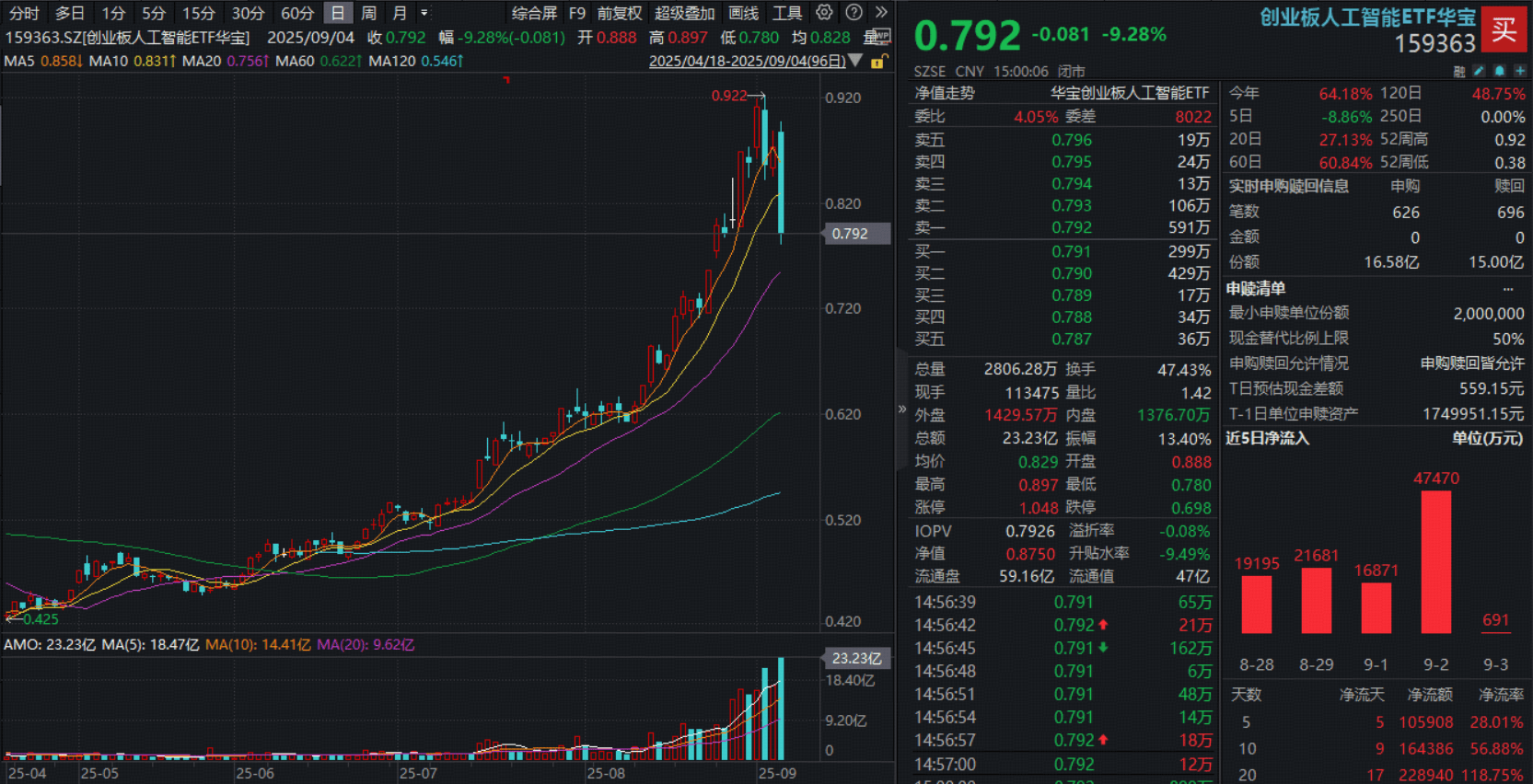
Core Viewpoint - The A-share market experienced significant volatility, particularly in technology stocks, with the artificial intelligence sector facing substantial declines, especially in optical module stocks [1][3]. Group 1: Market Performance - The A-share market saw a sharp decline, with the artificial intelligence index on the ChiNext board dropping over 9%, marking its largest single-day drop since April 8 [1]. - Leading optical module companies, including "Yizhongtian" (Xinyi Sheng, Zhongji Xuchuang, Tianfu Communication), all fell by more than 13% [1]. - The ChiNext artificial intelligence ETF (159363) also experienced a significant drop, closing down 9.28% and surpassing a trading volume of 2.3 billion yuan [1][3]. Group 2: Fund Manager Insights - Fund manager Cao Xuchen indicated that the rapid increase in the optical module sector led to a profit-taking effect, resulting in a sharp decline when new capital was insufficient to sustain price increases [3]. - The current market situation is characterized by short-term profit-taking and long-term capital gradually entering the market, suggesting that rapid adjustments may lead to quicker resolution of the downturn [3]. Group 3: Investment Recommendations - It is recommended to focus on the ChiNext artificial intelligence ETF (159363) and its associated funds, which have a portfolio allocation of approximately 70% in computing power and 30% in AI applications, aiming to capture AI market trends effectively [4]. - As of September 3, 2025, the ChiNext artificial intelligence ETF (159363) reached a new high in scale, exceeding 5.1 billion yuan, with an average daily trading volume of over 700 million yuan in the past month [4].
液冷技术趋势与产品量价
2025-09-03 14:46
Summary of Liquid Cooling Technology Trends and Product Pricing Industry Overview - The liquid cooling technology is becoming a necessary choice for high-power data center cooling, driven by strict policy requirements for data center PUE values, which must reach 1.3 for new data centers and below 1.25 for national projects [1][4] - Liquid cooling significantly reduces operational costs, as demonstrated by a client in Beijing who saved 57.5% in annual electricity consumption after upgrading [1][4] Key Points and Arguments 1. **Demand Drivers**: - The demand for liquid cooling technology arises from the need for high-power chip modules (e.g., AI chips, GPUs, ASICs) and high-performance memory and optical modules [3][4] - Domestic GPU manufacturers are increasing density and quantity to compensate for single-chip performance gaps, with companies like Huawei launching systems to compete with NVIDIA's NVL72 architecture [3][12] 2. **Liquid Cooling Solutions**: - Mainstream liquid cooling solutions include direct contact, immersion, and spray cooling, each with its advantages and disadvantages [7][8] - Direct contact cooling is cost-effective, costing approximately 3,000 to 4,000 RMB per kW, while immersion cooling is more efficient but at a higher cost [3][16] 3. **NVIDIA's Product Development**: - NVIDIA's roadmap shows a strong demand for liquid cooling, with power consumption of the Rubin series expected to reach 1,800 watts in 2026 and 3,600 watts in 2027 [1][4][5] - The GB300 liquid cooling system's value increased by approximately 23% compared to the GB200, reaching $85,000 [10] 4. **Market Trends**: - The expected shipment volume for the GB200 cabinet in 2025 is between 25,000 to 30,000 units, primarily to North American cloud providers [2][11] - Domestic liquid cooling manufacturers are gaining recognition and certification from major companies like NVIDIA, with firms like BYD actively participating in the market [21] 5. **Challenges and Innovations**: - The use of fluorinated liquids poses environmental and safety concerns, prompting companies like Intel to explore new mineral oil alternatives [17] - The cost of immersion systems is high due to the need for large quantities of specialized liquids, which limits widespread adoption [18] 6. **Comparative Analysis**: - Compared to NVIDIA, other major players like Intel and AMD are progressing more slowly in high-power, high-density cooling solutions, relying more on traditional air cooling methods [6] 7. **Future Outlook**: - Domestic manufacturers are expected to achieve greater breakthroughs in the future as brand recognition increases and they establish long-term partnerships with leading clients in North America [21] Additional Important Content - The liquid cooling technology is widely applied in memory modules, optical modules, ASIC chips, and switch chips, with increasing power consumption necessitating these solutions [15] - The market share of traditional cooling methods remains significant, accounting for 70% to 80% of the market, due to lower modification costs and higher power density [18][20]

Low CTE电子布专家交流
2025-11-04 01:56
Summary of Conference Call on Low CTE Materials Industry and Company Involved - The discussion revolves around the **Low CTE (Coefficient of Thermal Expansion) materials** used in the **electronics industry**, particularly in **Apple's iPhone 17 series** and other devices like **NVIDIA's GB300 cabinets** and **Switch Trade** [1][14][43]. Core Points and Arguments - **Adoption of Low CTE Materials**: Apple has begun using Low CTE materials in all versions of the iPhone 17, particularly in modules and optical stabilization components, with a higher usage ratio in the upgraded version [1][3][5]. - **Material Cost Increase**: The cost of materials for each phone has increased by approximately **20%**, with the cost per board rising from **45 CNY to 50 CNY or more** [1][11]. - **Monthly Procurement and Supply**: The company procures about **7,000-8,000 meters** of Low CTE materials monthly, with an expected increase to **30,000 meters** by Q4 2025 [1][12][22]. - **Market Share**: The company holds a **50% market share** in the narrowband Low CTE sector, with an anticipated monthly shipment of **100,000 meters** across the market [4][24]. - **Performance Metrics**: The production yield has decreased by **3 percentage points** to **95.7%** due to the adoption of Low CTE materials, affecting bendability tests [4][29]. - **Future Demand**: Demand for Low CTE materials is expected to grow significantly in **AI servers** and high-end consumer electronics, with a notable increase anticipated in **2026** [2][16]. Other Important but Possibly Overlooked Content - **Supplier Dynamics**: The primary suppliers for Low CTE materials include **Honghe, Zhongcai Technology, and Jushi**, with a preference for Taiwanese suppliers like Honghe [1][17]. - **Testing and Certification**: Apple completed the certification process for Low CTE materials in **2024**, with shipments expected to commence in the second half of **2025** [6][49]. - **Comparison with Traditional Materials**: Low CTE materials are superior in technical parameters and performance testing compared to traditional materials, which are currently used in older iPhone models [4][33]. - **Potential for Broader Applications**: While currently limited to iPhone 17, there is potential for broader application in future Apple products, including computers and wearables, depending on market acceptance and technological advancements [5][26][28]. - **Impact of Competitive Landscape**: High-end competitors like **Xiaomi and Huawei** are likely to follow Apple's lead if the new materials prove successful in the market [28]. This summary encapsulates the key insights from the conference call regarding the Low CTE materials, their application in Apple's products, and the broader implications for the electronics industry.
