蓝电

Search documents
蓝电科技控股权反转:国资退出,赛力斯重获100%股权
经济观察报· 2026-03-27 13:41
Group 1 - The core point of the article is the rapid change in the ownership structure of Chongqing Blue Electric Technology Co., Ltd. (Blue Electric Technology), where Sairisi regained 100% control just over a month after state-owned enterprises exited the shareholder sequence [2][3]. - On March 20, Blue Electric Technology completed a business change, with Qingfeng Technology and Yuan Investment Warehouse officially withdrawing, allowing Sairisi to regain control [2]. - Sairisi had previously signed a cooperation agreement with the Shapingba District Government on February 9, which involved the separation of existing assets related to Blue Electric, resulting in Sairisi losing control over the new company and the Blue brand's future development [2]. Group 2 - The Blue brand, launched by Sairisi in March 2023, aims to penetrate the mainstream new energy vehicle market priced between 100,000 to 150,000 yuan, enhancing self-development capabilities and reducing reliance on Huawei [4]. - The first model, Blue E5, features BYD's Fudi battery and Huawei's HiCar 3.0 system, but its market performance has not met expectations, with cumulative sales of 20,096 vehicles from January to November 2025, and an annual forecast of over 20,000 vehicles [4]. - The return of Blue Electric's ownership to Sairisi may indicate a strategic shift to continue leading this budget brand to cultivate new growth points, despite previous plans to divest [4]. Group 3 - Following the ownership change, Blue Electric Technology's management team was adjusted, with new members from Sairisi's core team taking over, indicating a consolidation of control [5]. - Sairisi reported significant revenue growth, achieving 110.534 billion yuan in revenue and a net profit of 5.312 billion yuan for the first three quarters of 2025, reflecting a year-on-year increase of 31.56% due to the success of the AITO brand [5].


赛力斯宣布剥离蓝电,问界或成公司“唯一”核心
Guo Ji Jin Rong Bao· 2026-02-10 13:16
Core Viewpoint - Company Cyres has chosen to divest its electric vehicle brand Blue Electric in favor of focusing on its AITO brand, which has shown significant sales growth and improved financial performance [1][8]. Group 1: Company Strategy - Cyres signed a cooperation agreement with the Shapingba District People's Government to divest Blue Electric's existing assets and establish a new company with diversified ownership [1][6]. - After the capital increase, Cyres will hold only 32% of the new company, losing control over Blue Electric, which will no longer be included in Cyres' consolidated financial statements [6][8]. - The new ownership structure will include 33.5% held by the Shapingba District government, 32% by Cyres and designated entities, 18.5% by other investors, and 16% by an employee stock ownership platform [6]. Group 2: Financial Performance - The AITO brand has achieved significant sales, with a cumulative delivery of over 420,000 units in 2025 and a single vehicle average price of 386,000 yuan, contributing over 92% of Cyres' revenue [8]. - Cyres reported a revenue of 110.53 billion yuan for the first three quarters of 2025, a year-on-year increase of 3.67%, and a net profit of 5.31 billion yuan, up 31.56% [8]. - The gross profit margin for AITO remains stable at 21%-24%, marking it as the only source of profit growth for the company [8]. Group 3: Industry Context - The Chinese electric vehicle market is experiencing intense competition, characterized by a "high-end breakthrough and low-end internal competition" dynamic, with traditional luxury brands accelerating their electric transformation [9]. - The decision to divest Blue Electric is seen as a proactive adjustment by Cyres in response to industry trends and its current development status, rather than a passive contraction [9]. - The ongoing price war in the low-end market has compressed profit margins, and the divestment aims to isolate Blue Electric's operational risks from the listed company, thereby improving overall financial health [9].
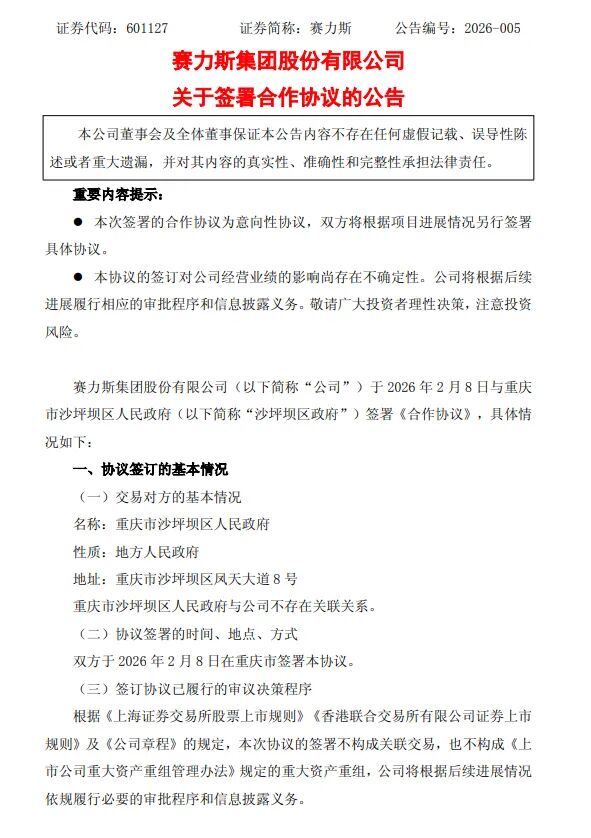
赛力斯剥离蓝电汽车资产 后者交由政府主导控股
Jing Ji Guan Cha Wang· 2026-02-09 12:56
Core Viewpoint - The announcement by Seres Group regarding the signing of a cooperation agreement with the Shapingba District Government indicates a strategic shift, focusing on asset optimization and long-term development by divesting the Blue Electric brand assets [2][3]. Group 1: Asset Divestiture - Seres Group will establish a new company by divesting its Blue Electric assets, with the Shapingba District Government and other investors contributing capital [2]. - Post-divestiture, Seres will hold approximately 32% of the new company, losing its controlling stake and influence over the Blue Electric brand's future [2][3]. - The collaboration aims to enhance the company's asset structure and aligns with its current development strategy [2]. Group 2: Blue Electric Brand Performance - The Blue Electric brand, launched in March 2023, aims to penetrate the mainstream electric vehicle market priced between 100,000 to 150,000 yuan [3]. - Despite initial expectations, Blue Electric's market performance has been underwhelming, with projected sales of over 20,000 units for the year 2025 [3]. - The decision to divest Blue Electric is seen as a rational move to allow Seres to concentrate on its more successful brand, AITO, which has significantly outperformed Blue Electric [3]. Group 3: AITO Brand Success - AITO brand has delivered over 420,000 vehicles by November 2025, accounting for 89% of Seres' total electric vehicle sales [4]. - The brand's high pricing strategy has positively impacted Seres' financial performance, with a reported revenue of 110.53 billion yuan and a net profit of 5.31 billion yuan for the first three quarters of 2025 [5]. - The divestiture of Blue Electric is expected to further improve Seres' financial metrics by eliminating the underperforming asset from its balance sheet [5]. Group 4: Future Developments - The Shapingba District Government will take the lead in the future development of the Blue Electric brand, although specific plans have not been disclosed [5]. - Seres is also expanding into robotics, having established a joint venture for this purpose, indicating a diversification strategy beyond electric vehicles [5][6].
市场分歧的背后,赛力斯已现“滞胀”迹象
Xin Lang Cai Jing· 2025-11-10 06:05
Core Viewpoint - The performance of Seres this year reflects a "stagflation" situation, indicating that its rigid costs may limit its growth potential [1]. Group 1: Company Overview - Seres has become the largest domestic vehicle listing company this year, surpassing Chery Automobile, but did not achieve the expected "opening red" upon its debut in the Hong Kong stock market [2]. - The company completed two significant expenditures this year: acquiring Longsheng New Energy Super Factory for over 8.1 billion yuan and purchasing a 10% stake in Yingwang Company for 11.5 billion yuan, which supports its future growth expectations [3]. Group 2: Sales and Financial Performance - For the first ten months of 2025, Seres' cumulative sales reached 356,000 units, a year-on-year increase of 1%, with the Wanjie series contributing 325,000 units, showing a decline of 0.6% [4]. - The revenue and profit structure for the first three quarters showed a revenue of 110.5 billion yuan with a gross margin of 29.4% and a net margin of 5.1%, indicating a significant improvement in profitability despite stagnant sales growth [4]. Group 3: Profitability and Cost Structure - Seres' gross margin has been increasing, recorded at 27.6%, 28.9%, and 29.4% for the first quarter, half-year, and first three quarters respectively, while the average vehicle price has also risen [4]. - The sales expense ratio has been increasing, with significant components being advertising and service fees, which may indicate a strategic focus on brand building despite rising costs [4][5]. Group 4: Market Position and Competitive Landscape - The pricing strategy for the new M7 model reflects a continued increase in prices, contrasting with the competitive landscape where other brands are lowering prices [5]. - Seres' production capacity is expected to reach one million units by 2027, which is crucial for achieving its sales targets, but the current high capacity utilization may limit pricing flexibility [5][6]. Group 5: Future Outlook - The company may face limitations in expanding its model categories due to the competitive environment and its reliance on the Huawei intelligent driving system, which could hinder its growth in the electric SUV segment [6]. - If Seres cannot achieve annual growth rates of around 40% in sales and revenue over the next two years, its profit structure may reach a marginal point, impacting its future valuation [6].
重庆将跑出港股年内最大汽车IPO
盐财经· 2025-10-19 10:19
Core Viewpoint - The article discusses the rapid progress of Seres in its Hong Kong IPO process, highlighting its potential to become the first "A+H" listed new energy vehicle company, driven primarily by its AITO brand, which has become a significant revenue contributor [4][5][8]. Group 1: IPO and Market Position - Seres has accelerated its Hong Kong listing process, with the board approving the global offering shortly after passing the Hong Kong Stock Exchange hearing [4]. - If successful, Seres is expected to surpass Chery Automobile, which currently holds a market capitalization of HKD 176.2 billion, making it the largest car IPO in Hong Kong this year [5]. - As of October 17, 2023, Seres has a market capitalization exceeding RMB 250 billion in the A-share market [5]. Group 2: AITO Brand Performance - The AITO brand has become the main performance driver for Seres, with sales projected to grow from 78,000 units in 2022 to 389,000 units by 2024 [8]. - In the first half of 2023, AITO's sales reached 152,000 units, solidifying its market presence [8]. - AITO has successfully covered the SUV market from RMB 200,000 to RMB 600,000, with four models launched: M5, M7, M8, and M9 [9]. Group 3: Revenue Structure - AITO's revenue contribution is expected to rise dramatically, with projections indicating it will account for over 90% of Seres' total revenue by 2024, up from 60% in 2022 [10][12]. - Other brands under Seres are being strategically reduced, with the Blue Electric brand showing weak sales of only 11,000 units in the first half of 2023 [11]. Group 4: Strategic Partnerships and Risks - Seres has a deep partnership with Huawei, which has significantly influenced its product development and market positioning [16][17]. - The company's reliance on Huawei is substantial, with procurement payments to Huawei expected to reach RMB 42 billion in 2024, constituting about 30% of total revenue [21][22]. - This dependency poses risks, as any disruption in the relationship could adversely affect Seres' business and financial performance [18][22]. Group 5: Future Growth and Diversification - Seres is diversifying its business model beyond vehicle sales, including a recent acquisition of Longsheng New Energy for RMB 8.164 billion to enhance its production capabilities [25]. - The company is also expanding its charging network, with over 12,000 charging stations established nationwide, contributing to a second growth curve [25]. - A partnership with ByteDance's Volcano Engine aims to integrate AI technologies into its offerings, enhancing its market differentiation [26]. Group 6: Valuation and Market Outlook - Analysts suggest that Seres' valuation could reach a PE ratio of 31 times by 2025, significantly higher than traditional automotive parts companies [26]. - The company's ability to maintain its sales momentum for the AITO brand will be crucial for its overall valuation and growth prospects [27].

华为发力具身智能!下一个“赛力斯”是谁?
Sou Hu Cai Jing· 2025-07-16 02:04
Core Insights - Huawei is making significant moves in the embodied intelligence sector, recently launching the Huawei Cloud Embodied Intelligence Industry Joint Innovation Center in Shenzhen, which has attracted nine well-known companies, including six listed firms, to establish subsidiaries in this field [1][10] - The Huawei Developer Conference 2025 introduced the CloudRobo embodied intelligence platform, aiming to transform all connected entities into embodied intelligent robots, marking a strategic shift in the AI landscape [3][4] - The Chinese government has recognized "embodied intelligence" as a key component of future industries, indicating its importance in national strategic planning [3][4] Industry Trends - The market for embodied intelligence is projected to grow significantly, with expectations to exceed 1 trillion yuan by 2026, driven by advancements in large model technologies [5][10] - Major companies like NVIDIA and Tesla are also investing in "large model + embodied intelligence" robotics, viewing intelligent robots as a second growth curve for their businesses [5][10] Huawei's Strategy - Huawei's approach mirrors its strategy in the automotive sector, focusing on providing a technological foundation and ecosystem collaboration rather than manufacturing end products [6][8] - The company aims to replicate the success of its automotive partnerships, such as with Seres, which transformed from a loss-making entity to one of China's top three car manufacturers with a market value exceeding 200 billion yuan [6][10] Regional Development - Shenzhen's Bao'an district is positioning itself as China's first "embodied intelligence port," fostering the growth of potential "unicorn" companies in this field [11][15] - The Huawei Cloud Embodied Intelligence Industry Joint Innovation Center is strategically located near significant tech hubs, enhancing collaboration and innovation within the industry [10][11] Collaborative Efforts - Huawei is engaging in partnerships with various companies to develop comprehensive solutions across different applications, including smart sorting, energy management, and intelligent healthcare [13][15] - The center has successfully attracted a diverse range of companies, from manufacturers to component developers, indicating a robust ecosystem for embodied intelligence [10][13]