
超大直径盾构机

Search documents
四个关键字看2025年工业和信息化发展!
中汽协会数据· 2026-01-26 09:13
Core Viewpoint - The article emphasizes the continuous stabilization of economic growth, focusing on the real economy and implementing a new round of key industry growth plans to support industrial provinces in driving steady industrial growth [2]. Group 1: Economic Growth and Industrial Performance - By 2025, the industrial added value above designated size is expected to grow by 5.9% year-on-year, with the manufacturing added value maintaining a stable share of GDP [3]. - The manufacturing sector is projected to retain its position as the world's largest for 16 consecutive years, with telecommunications business volume increasing by 9.1% year-on-year [4]. Group 2: High-Quality Development and Technological Advancement - The focus remains on high-quality development, advancing the intelligent, green, and integrated development of manufacturing [6]. - The added value of equipment manufacturing and high-tech manufacturing above designated size grew by 9.2% and 9.4% year-on-year, respectively, outpacing the overall industrial growth by 3.3 and 3.5 percentage points [6]. - Over 35,000 basic-level and 8,200 advanced-level smart factories have been established, with 15 leading smart factories nurtured [6]. Group 3: Innovation and Emerging Industries - The integration of technological and industrial innovation is being promoted, with breakthroughs in major equipment such as ultra-large diameter shield machines and heavy-duty gas turbines [10]. - The added value of integrated circuits and electronic special materials increased by 26.7% and 23.9% year-on-year, respectively, while industrial robot production rose by 28% [10]. - New energy vehicle sales reached 16.49 million units, reflecting a year-on-year growth of 28.2% [10]. Group 4: Business Environment and Competitive Landscape - Efforts to reform key areas and reduce enterprise burdens are underway, with actions to clear overdue payments to businesses and implement supportive policies [11]. - The competitive ecology in key industries such as new energy vehicles and photovoltaics is showing signs of improvement [11]. - Over 140,000 specialized and innovative small and medium-sized enterprises have been nurtured, with high-tech enterprises reaching 504,000 [11].


新华社:透视“十四五”收官之年工业和信息化发展成效
Xin Hua She· 2026-01-26 01:14
Core Insights - The industrial economy in China is showing steady growth, with a year-on-year increase of 5.9% in industrial added value for large-scale enterprises, and the manufacturing sector maintaining its position as the world's largest for 16 consecutive years [2][8] - The contribution of the industrial and information technology sectors to economic growth exceeds 40%, indicating their critical role in the national economy [2][7] Group 1: Industrial Growth and Achievements - The added value of equipment manufacturing and high-tech manufacturing increased by 9.2% and 9.4% year-on-year, respectively [9] - Over 35,000 basic-level, 8,200 advanced-level, 500 excellent-level, and 15 leading-level smart factories have been established [9] - More than 8,000 national green factories have been cultivated, contributing to energy and water consumption reduction in large-scale industrial units [9] Group 2: Innovation and New Technologies - Significant advancements in technology include over 300 key technology reserves from the first phase of 6G trials, and a year-on-year increase of 26.7% and 23.9% in the added value of integrated circuits and electronic materials, respectively [10] - The production of industrial robots increased by 28%, and new energy vehicle sales reached 16.49 million units, marking a year-on-year growth of 28.2% [10] - The application of artificial intelligence in manufacturing has expanded significantly, with the scale of intelligent computing power reaching 1590 EFLOPS [4] Group 3: Support for Small and Medium Enterprises - A total of 17,600 specialized and innovative "little giant" enterprises and over 140,000 specialized and innovative small and medium enterprises have been cultivated [3][13] - The added value of specialized and innovative "little giant" enterprises in large-scale industries is expected to grow by 6.9% year-on-year [3] Group 4: Future Directions and Policies - The focus for the upcoming year includes stabilizing growth, enhancing innovation, promoting integration, optimizing governance, and preventing risks, with a strong push for new industrialization [6] - The industrial and information technology sectors will continue to support the transformation and upgrading of traditional industries through initiatives like "5G + industrial internet" [5]
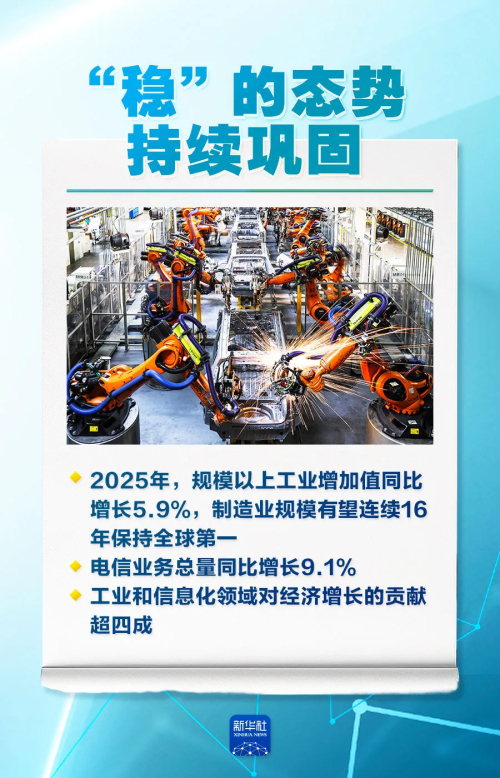
2025年中国工业经济顶压前行、向新向优
Ke Ji Ri Bao· 2026-01-22 01:55
Core Viewpoint - The industrial economy in China is expected to achieve effective qualitative improvements and reasonable quantitative growth by 2025, with major goals successfully completed [1] Group 1: Industrial Growth and Achievements - The added value of industrial enterprises above designated size is projected to grow by 5.9% year-on-year, with the manufacturing sector likely to maintain its position as the world's largest for 16 consecutive years [1] - The added value of equipment manufacturing and high-tech manufacturing industries increased by 9.2% and 9.4% year-on-year, respectively [1] - 5G and gigabit optical networks have been integrated into 91 out of 97 categories of the national economy, with industrial internet achieving full coverage across 41 industrial categories [1] - Over 140,000 specialized and innovative small and medium-sized enterprises have been cultivated, with 504,000 high-tech enterprises currently valid [1] Group 2: Economic Contribution and Development Strategies - The industrial and information sectors contribute over 40% to economic growth, acting as a stabilizing force [2] - The development of intelligent, green, and integrated manufacturing has led to the establishment of over 35,000 basic-level and 8,200 advanced-level smart factories, along with 500 excellent-level smart factories [2] - Significant advancements in technology and industry innovation have been made, with the added value of integrated circuits and electronic materials growing by 26.7% and 23.9% year-on-year, respectively [2] - The production of industrial robots increased by 28% year-on-year, and new energy vehicle sales rose by 28.2% [2] Group 3: Artificial Intelligence Industry Development - The artificial intelligence industry is expected to thrive in 2025, with over 6,000 AI companies projected and the core industry scale anticipated to exceed 1.2 trillion yuan [3] - The smart computing power scale reached 1,590 EFLOPS, and the market for AI glasses saw shipments exceeding 1.78 million units in the first three quarters of 2025 [3] - The establishment of a national AI industry investment fund with a scale of 60 billion yuan is underway [3] Group 4: Emerging and Future Industries - The cultivation of emerging and future industries has accelerated, with innovations like brain-computer interface technology expanding into various fields [4] - The government plans to implement actions to develop and strengthen emerging industries, including the creation of national demonstration bases for emerging industry development [4][5] - There will be a focus on supporting local governments to establish future industry pilot zones and increasing government investment fund allocations [5]
2025中国经济答卷丨“压舱石”作用凸显 工业经济锻造发展新动能
Xin Hua She· 2026-01-22 01:39
Core Viewpoint - By 2025, China's industrial added value is expected to grow by 5.9% year-on-year, with the manufacturing sector likely to maintain its position as the world's largest for 16 consecutive years, contributing over 40% to economic growth, thus playing a significant "ballast" role in the economy [1] Group 1: Industrial Economic Development - The overall industrial and information technology development in China in 2025 is characterized by four aspects: stability, progress, new momentum, and vitality [2] - The stability of the industrial economy is reinforced by the introduction of a new round of ten key industry growth support plans, effectively promoting steady growth [2] - The value added of major equipment manufacturing and high-tech manufacturing industries increased by 9.2% and 9.4% year-on-year, respectively, outpacing the overall industrial growth by 3.3 and 3.5 percentage points [2] - The production of industrial robots increased by 28% year-on-year, and investment in industries such as aerospace and aviation equipment manufacturing achieved double-digit growth [2] Group 2: Future Industrial Strategy - The Ministry of Industry and Information Technology plans to implement actions to develop and strengthen emerging industries, creating new momentum for economic growth [4] - The focus will be on the large-scale application of new technologies, products, and scenarios in manufacturing, as well as establishing national demonstration bases for emerging industry development [4] - The integration of artificial intelligence into over 70% of business scenarios in leading factories is a strategic move to enhance future manufacturing competitiveness [4] Group 3: Support for Small and Medium Enterprises - In 2025, the added value of small and medium-sized enterprises (SMEs) in the industrial sector is expected to grow by 6.9%, with the SME export index remaining in the expansion range for 21 consecutive months [6] - The Ministry of Industry and Information Technology will continue to improve the policy and regulatory framework to promote high-quality development of SMEs [6] - A three-year action plan will be implemented to cultivate specialized and innovative SMEs, enhancing the support mechanism for their growth [6]
2025年我国规模以上工业增加值同比增长5.9% 制造业规模有望连续16年保持全球第一
Yang Guang Wang· 2026-01-22 01:02
Core Insights - The Chinese government aims for a 5.9% year-on-year growth in industrial added value by 2025, with the manufacturing sector expected to maintain its position as the world's largest for 16 consecutive years [1][2] - The industrial and information technology sectors are projected to contribute over 40% to economic growth, reinforcing their role as a stabilizing force in the economy [1] Group 1: Industrial Growth - The added value of major equipment manufacturing and high-tech manufacturing is expected to grow by 9.2% and 9.4% year-on-year, respectively, outpacing overall industrial growth by 3.3 and 3.5 percentage points [1] - The government emphasizes the importance of supporting industrial provinces to drive stable industrial economic growth [1] Group 2: Emerging Industries - Significant breakthroughs in major equipment such as ultra-large diameter shield machines and heavy-duty gas turbines are noted, with artificial intelligence providing strong momentum for industrial growth [1] - The first phase of 6G technology trials has resulted in over 300 key technology reserves, indicating a focus on nurturing emerging pillar industries [1] Group 3: Future Industries and SMEs - The government plans to implement strategic major technology projects and support the establishment of future industry pilot zones, aiming to create a competitive environment for future industries nationwide [2] - The competitive ecosystem for key sectors like new energy vehicles and photovoltaics continues to improve, with 5G and gigabit optical networks integrated into 91 out of 97 national economic categories [2] - Over 140,000 specialized and innovative small and medium-sized enterprises (SMEs) have been cultivated, with high-tech enterprises reaching 504,000 [2] Group 4: Policy and Support for SMEs - A plan to promote SME development during the 14th Five-Year Plan period has been established, focusing on ensuring timely payments to SMEs and preventing new debts [2] - The government aims to revise SME classification standards to enhance the precision and effectiveness of policy support [2]
“压舱石”作用愈发凸显 创新动能持续壮大
Xin Lang Cai Jing· 2026-01-21 22:36
Core Viewpoint - The industrial economy in China is showing steady growth, with significant contributions to overall economic performance, and the government is committed to advancing new industrialization by 2025 [1][8]. Group 1: Industrial Growth and Performance - The industrial added value of large-scale enterprises increased by 5.9% year-on-year, with manufacturing value added maintaining the world's top position for 16 consecutive years [1]. - The added value of equipment manufacturing and high-tech manufacturing increased by 9.2% and 9.4% year-on-year, respectively [2]. - The telecommunications business volume grew by 9.1% year-on-year, indicating robust performance in the industrial and information sectors [1]. Group 2: Support for Small and Medium Enterprises - The government is implementing reforms to reduce burdens on enterprises and ensure the implementation of policies that benefit businesses, fostering a supportive environment for development [3]. - A total of 17,600 specialized and innovative "little giant" enterprises have been cultivated, along with over 140,000 specialized and innovative small and medium enterprises [3]. Group 3: Innovation and New Growth Drivers - Significant advancements in technology are highlighted, including breakthroughs in humanoid robots and major equipment like large-diameter shield machines [4]. - The added value of industries such as integrated circuits and electronic materials is projected to grow by 26.7% and 23.9% year-on-year, respectively, by 2025 [5]. - The scale of artificial intelligence computing power in China has reached 1,590 EFLOPS, with applications expanding across key industries [5]. Group 4: Digital Economy and Industrial Upgrading - The integration of the digital economy with the real economy is enhancing industrial transformation, with over 23,000 "5G + industrial internet" projects established [6]. - New business models such as "black light factories" and "smart ports" are emerging as key drivers for upgrading traditional industries [6]. Group 5: Future Industrial Strategy - The government aims to stabilize growth, strengthen innovation, promote integration, optimize governance, and prevent risks as part of the new industrialization strategy [8]. - Focus areas include enhancing the adaptability of consumer goods supply and demand, promoting green and low-carbon transitions, and developing new energy solutions [8].
去年工信领域对经济增长贡献超四成
Mei Ri Jing Ji Xin Wen· 2026-01-21 12:55
Core Insights - The Chinese industrial economy is expected to achieve qualitative improvements and reasonable quantitative growth by 2025, with a target industrial added value growth of 5.9% year-on-year [1] - The contribution of the industrial and information technology sector to economic growth is projected to exceed 40%, playing a stabilizing role in the economy [1] Industrial Growth - The added value of major equipment manufacturing and high-tech manufacturing industries is expected to grow by 9.2% and 9.4% year-on-year, respectively, surpassing the overall industrial growth rate by 3.3 and 3.5 percentage points [2] - The number of national green factories has exceeded 8,000, with energy and water consumption per unit of industrial added value continuously decreasing [2] Digital Transformation - By the end of 2025, the digital industry revenue is projected to reach approximately 38.3 trillion yuan, with profits of 3.1 trillion yuan, marking cumulative growth of about 39.5% and 48.4% compared to the end of the 13th Five-Year Plan [3] - The industrial internet has achieved coverage across 41 major industrial categories, with over 100 million industrial devices connected to key platforms [3] Innovation and Emerging Industries - Significant breakthroughs in key technologies have been made, including advancements in super-large diameter shield machines and heavy-duty gas turbines, with the production of industrial robots increasing by 28% year-on-year [2][4] - The construction of leading smart factories has resulted in an average production efficiency increase of 29% and a reduction in product defect rates by 47% [4] Small and Medium Enterprises - The added value of small and medium-sized enterprises in the industrial sector is expected to grow by 6.9% year-on-year, with a continuous expansion in the export index for 21 months [4] - By 2025, the cumulative number of specialized and innovative "little giant" enterprises is projected to reach 17,600, with over 140,000 specialized and innovative small and medium-sized enterprises [4] Service Optimization - Information communication services are being optimized, with online processing covering over 91% of various telecom services [5] - Digital services for the elderly have been upgraded, with over 3,092 websites and apps related to elderly life undergoing accessibility improvements [5]
透视“十四五”收官之年工业和信息化发展成效
Xin Hua She· 2026-01-21 12:26
Core Insights - The industrial sector is increasingly recognized as the "ballast" of the national economy, with significant growth and development highlighted in the "14th Five-Year Plan" completion year [1][2]. Industrial Growth - The total industrial output value above designated size increased by 5.9% year-on-year, with manufacturing value added maintaining the world's top position for 16 consecutive years [2]. - The telecommunications business volume grew by 9.1% year-on-year, contributing over 40% to economic growth from the industrial and information sectors [2]. Manufacturing and Innovation - The value added of equipment manufacturing and high-tech manufacturing increased by 9.2% and 9.4% year-on-year, respectively [3]. - Over 35,000 basic-level, 8,200 advanced-level, and 500 excellent-level smart factories have been established, alongside more than 8,000 national green factories [3]. Support for SMEs - The government has accelerated reforms in key areas, implemented actions to reduce enterprise burdens, and promoted the implementation of policies benefiting enterprises [4]. - A total of 17,600 "little giant" enterprises and over 140,000 specialized and innovative SMEs have been cultivated, with a target of 6.9% year-on-year growth in value added for SMEs by 2025 [4]. New Growth Drivers - Innovations such as humanoid robots and breakthroughs in major equipment like large-diameter shield machines are being emphasized [5]. - The value added in sectors like integrated circuits and electronic materials is projected to grow by 26.7% and 23.9% year-on-year, respectively [6]. Digital Economy Integration - The deep integration of the digital economy with the real economy is empowering industrial transformation and upgrading, with over 23,000 "5G + industrial internet" projects established [7]. Future Industrial Strategy - The focus for the upcoming year will be on stabilizing growth, enhancing innovation, promoting integration, optimizing governance, and preventing risks, with a strong push for new industrialization [8]. - The government aims to enhance the adaptability of consumer goods supply and demand, optimize product supply, and promote intelligent, green, and integrated development in the consumer goods industry [8].
“压舱石”作用愈发凸显 创新动能持续壮大——透视“十四五”收官之年工业和信息化发展成效
Xin Hua Wang· 2026-01-21 12:25
Core Viewpoint - The industrial sector is a cornerstone of the national economy, with significant growth and development expected by 2025, emphasizing new industrialization and technological innovation [2][8]. Group 1: Industrial Growth and Performance - The industrial added value of large-scale enterprises increased by 5.9% year-on-year, with manufacturing value added maintaining the world's top position for 16 consecutive years [2]. - The added value of equipment manufacturing and high-tech manufacturing grew by 9.2% and 9.4% respectively [2]. - The contribution of the industrial and information sector to economic growth exceeded 40% [2]. Group 2: Support for SMEs - The government has accelerated reforms in key areas, implemented actions to reduce enterprise burdens, and cleared overdue payments to support small and medium-sized enterprises (SMEs) [3]. - A total of 17,600 "little giant" enterprises and over 140,000 specialized and innovative SMEs have been cultivated [3]. - The added value of industrial SMEs is expected to grow by 6.9% year-on-year by 2025 [3]. Group 3: Technological Innovation - Significant advancements in new technologies include a 26.7% increase in the added value of the integrated circuit industry and a 23.9% increase in electronic materials [5]. - The scale of artificial intelligence computing power reached 1,590 EFLOPS, with applications in key industries such as steel, electricity, and telecommunications [5]. - Over 330 humanoid robot products have been launched domestically, showcasing the growth of innovative capabilities [5]. Group 4: Digital Economy Integration - The integration of the digital economy with the real economy is enhancing industrial transformation, with over 23,000 "5G + industrial internet" projects established [6]. - New business models such as "dark factories," "unmanned mines," and "smart ports" are emerging as key drivers for upgrading traditional industries [6]. Group 5: Future Industrial Strategy - The focus for the upcoming year will be on stabilizing growth, enhancing innovation, promoting integration, optimizing governance, and preventing risks [8]. - The government aims to enhance the adaptability of consumer goods supply and demand to release consumption potential [8]. - Efforts will be made to promote green and low-carbon transitions, focusing on developing key energy-saving and environmental protection equipment [8].
稳、进、新、活 2025年工业和信息化发展呈现四大特点
Zhong Guo Xin Wen Wang· 2026-01-21 06:40
Core Viewpoint - The development of the industrial and information technology sectors in 2025 is characterized by four main features: stability, progress, innovation, and vitality, reflecting a commitment to high-quality development and the achievement of key economic goals. Group 1: Stability - The industrial economy has maintained a stable growth trajectory, with the added value of industrial enterprises above designated size increasing by 5.9% year-on-year, and the manufacturing sector's contribution to GDP remaining stable [1] - The telecommunications business volume grew by 9.1% year-on-year, contributing over 40% to overall economic growth, reinforcing its role as an economic stabilizer [1] Group 2: Progress - The pace of high-quality development has accelerated, with the added value of equipment manufacturing and high-tech manufacturing increasing by 9.2% and 9.4% year-on-year, respectively, outpacing overall industrial growth by 3.3 and 3.5 percentage points [2] - The establishment of over 35,000 basic-level and 8,200 advanced-level smart factories has been achieved, alongside the cultivation of 15 leading smart factories, indicating solid progress in the digital transformation of manufacturing [2] Group 3: Innovation - Significant advancements in technology and industry innovation have been made, with breakthroughs in major equipment such as ultra-large diameter shield machines and heavy-duty gas turbines, and over 300 key technologies developed in the first phase of 6G testing [3] - The added value of integrated circuits and electronic materials increased by 26.7% and 23.9% year-on-year, respectively, while the production of industrial robots rose by 28%, and new energy vehicle sales reached 16.49 million, up 28.2% [3] Group 4: Vitality - Reforms in key areas have been accelerated, with actions taken to reduce corporate burdens and clear overdue payments, creating a more vibrant business environment [4] - The cultivation of specialized and innovative small and medium-sized enterprises has seen over 140,000 such firms established, with high-tech enterprises reaching 504,000, indicating a robust growth in the industrial sector [4]