
车用电力

Search documents
(经济观察)中国CPI“篮子”更新映射消费新风向
Zhong Guo Xin Wen Wang· 2026-02-11 11:49
Core Viewpoint - The update of China's Consumer Price Index (CPI) "basket" reflects new consumption trends and changes among Chinese residents, aiming to provide a more accurate representation of price movements in the consumer market [1][2]. Group 1: CPI and PPI Update - The CPI and Producer Price Index (PPI) undergo a base period rotation every five years, with the latest data based on 2025 as the new base year [1]. - The National Bureau of Statistics has released the first data following this base period rotation, indicating a new "price coordinate system" is in place [1]. Group 2: Changes in Consumption Patterns - The CPI basket has been updated to include new categories reflecting changes in consumer preferences, such as electric vehicle charging, home security devices, and internet medical services [2]. - The updated CPI basket now includes 268 basic classifications across eight major categories, maintaining the overall number while adjusting specific classifications to better capture new economic trends [2]. Group 3: Weight Adjustments - The weight adjustments in the CPI reflect the proportion of spending on various categories, with food, housing, and transportation being the largest components [3]. - The weight for services has increased while the weight for consumer goods has decreased, aligning with the trend of consumers shifting from purchasing goods to services [3]. - The impact of the base period rotation on the CPI and PPI monthly year-on-year indices is estimated to be minimal, averaging about 0.06 and 0.08 percentage points respectively [3]. Group 4: Recent CPI Data - In January, the CPI year-on-year growth rate fell to 0.2%, influenced by the timing of the Spring Festival, while the core CPI, excluding food and energy, rose by 0.8%, indicating a continued recovery in consumer demand [3].
最新公布!CPI统计口径调整,新增洗碗机、医美服务等新消费分类
证券时报· 2026-02-11 09:02
Core Viewpoint - The article discusses the release of the Consumer Price Index (CPI) and Producer Price Index (PPI) data for January, marking the first data release based on the new 2025 benchmark, indicating a slight overall impact from the benchmark rotation on the indices [1][3]. Group 1: CPI Analysis - In January, the CPI increased by 0.2% month-on-month and year-on-year, with core CPI (excluding food and energy) showing a moderate increase [1][8]. - The CPI's year-on-year growth was affected by the Spring Festival's timing and international oil price fluctuations, with food prices decreasing by 0.7%, impacting the CPI by approximately 0.11 percentage points [8]. - The core CPI rose by 0.8% year-on-year, indicating a continued recovery in consumer demand, with a month-on-month increase of 0.3%, the highest in six months [8]. Group 2: PPI Analysis - The PPI rose by 0.4% month-on-month, marking the fourth consecutive month of increase, while the year-on-year decline narrowed to 1.4% [10]. - The increase in PPI is attributed to the ongoing construction of a unified national market, which has led to price increases in certain industries, such as cement and lithium-ion battery manufacturing [10][11]. - Input factors, including international metal prices, have influenced domestic prices, with significant increases in the prices of silver, copper, and aluminum [11]. Group 3: Benchmark Rotation Changes - The benchmark rotation introduced new categories reflecting modern consumption trends, such as home security devices and internet medical services, expanding the coverage of new economic sectors [3][4]. - The number of CPI survey points increased to approximately 120,000, covering around 620,000 specifications, which is a significant expansion compared to the previous benchmark [3]. - The new weightings in the CPI are more aligned with current consumer spending patterns, with an increase in the service category's weight and a decrease in consumer goods [5][6].


最新公布!CPI统计口径调整,新增洗碗机、医美服务等新消费分类
券商中国· 2026-02-11 06:18
Core Viewpoint - The article discusses the release of the Consumer Price Index (CPI) and Producer Price Index (PPI) data by the National Bureau of Statistics, marking the first data release based on the new 2025 benchmark, indicating a slight impact on the indices due to the benchmark rotation [1][3]. CPI Summary - In January, the CPI increased by 0.2% month-on-month and year-on-year, with core CPI (excluding food and energy) showing a moderate increase [2][6]. - The CPI's year-on-year growth was affected by the Spring Festival's timing and international oil price fluctuations, with food prices decreasing by 0.7%, impacting the CPI by approximately 0.11 percentage points [6][7]. - The core CPI rose by 0.8% year-on-year, indicating a continued recovery in consumer demand [7]. PPI Summary - The PPI rose by 0.4% month-on-month, marking the fourth consecutive month of increase, while the year-on-year decline narrowed to 1.4% [2][8]. - The increase in PPI is attributed to the ongoing construction of a unified national market, which has led to price increases in certain industries, such as cement and lithium-ion battery manufacturing [8][9]. - Input factors have caused price divergence in the non-ferrous metals and petroleum-related industries, with international metal prices driving domestic price increases [9]. Benchmark Rotation Changes - The benchmark rotation introduced new categories and adjusted weights to better reflect current consumption patterns, with the CPI's service weight increasing and consumer goods weight decreasing [3][5]. - New categories include housing security equipment, elderly products, dishwashers, and internet medical services, expanding the coverage of new economic sectors [3][4]. - The number of survey points for CPI has increased to approximately 120,000, covering around 620,000 specifications, enhancing the data collection process [3][4].

为什么开展价格指数基期轮换?涉及哪些内容?国家统计局权威解读→
Yang Shi Xin Wen· 2026-02-11 02:00
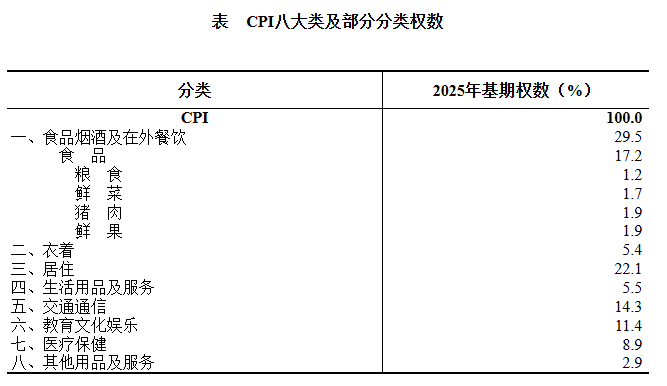
Core Viewpoint - The National Bureau of Statistics of China released the Consumer Price Index (CPI) and Producer Price Index (PPI) data based on the 2025 benchmark, marking the first data release after the benchmark rotation [1] Group 1: Purpose of Benchmark Rotation - Benchmark rotation is a fundamental task in compiling price indices, aimed at adapting to changes in the structure of goods and services in production, circulation, and consumption [2] - The CPI reflects the price level changes of goods and services consumed by residents over a certain period, requiring adjustments to the "fixed basket" of goods to accurately represent current consumption patterns [2] Group 2: Changes in CPI Survey - The CPI benchmark rotation involves revising the survey classification directory, survey points, representative specifications, classification weights, and price comparison benchmarks [3] - The current benchmark includes new categories such as housing security equipment, elderly products, dishwashers, and internet medical services, reflecting new consumption trends [3][4] Group 3: Survey Coverage and Data Collection - Approximately 120,000 survey points and about 620,000 representative specifications were included in the current benchmark, expanding the coverage compared to the previous benchmark [4] - The data collection methods have been optimized, with increased use of big data applications such as online transaction prices and electronic data from enterprises [4] Group 4: CPI Weight Calculation - CPI weights are derived from household expenditure surveys and are adjusted to ensure they accurately reflect the consumption structure [5] - The weights for the eight major categories in the 2025 benchmark are: Food, Alcohol, and Dining Out (29.5%), Clothing (5.4%), Housing (22.1%), Household Goods and Services (5.5%), Transportation and Communication (14.3%), Education, Culture, and Entertainment (11.4%), Healthcare (8.9%), and Other Goods and Services (2.9%) [5][7] Group 5: Impact of Benchmark Rotation - The benchmark rotation will affect the CPI and PPI data, with an average impact of approximately 0.06 and 0.08 percentage points on the monthly year-on-year indices for CPI and PPI, respectively [9]
国家统计局城市司负责人就CPI等价格指数基期轮换有关情况接受中国信息报专访
Guo Jia Tong Ji Ju· 2026-02-11 01:39
Core Viewpoint - The National Bureau of Statistics released the Consumer Price Index (CPI) and Producer Price Index (PPI) data based on the 2025 benchmark, marking the first data release after the benchmark rotation [1] Group 1: Purpose of Benchmark Rotation - Benchmark rotation is a fundamental task in compiling price indices, aligning with international practices to adapt to changes in the structure of goods and services transactions in production, circulation, and consumption [2] - The CPI reflects the price level changes of goods and services consumed by residents over a certain period, requiring timely adjustments to the "fixed basket" of goods to accurately represent market price changes [2] Group 2: Changes in CPI Survey - The CPI benchmark rotation involves revising the survey classification directory, survey points, representative specifications, classification weights, and price comparison benchmarks [3] - The current CPI survey classification directory has been adjusted based on comprehensive market research, adding new categories such as housing security equipment, elderly products, and internet medical services, while maintaining 8 major categories and 268 basic classifications [3][4] Group 3: Survey Points and Data Collection - Approximately 120,000 survey points and about 620,000 representative specifications were selected for the current benchmark, expanding the coverage compared to the previous benchmark [4] - New retail formats and data collection methods, including online transaction prices and big data applications, have been incorporated to better reflect new consumption patterns [4] Group 4: CPI Weight Calculation - CPI weights are determined based on household expenditure surveys and other macro data, ensuring they accurately reflect the consumption structure [5] - The weights for the eight major categories in the 2025 benchmark are as follows: Food, Alcohol, and Dining Out (29.5%), Clothing (5.4%), Housing (22.1%), Household Goods and Services (5.5%), Transportation and Communication (14.3%), Education, Culture, and Entertainment (11.4%), Medical Care (8.9%), and Other Goods and Services (2.9%) [6][7] Group 5: Impact of Benchmark Rotation - The benchmark rotation will influence the CPI and PPI indices due to changes in survey classifications, survey points, and weights, with an estimated average impact of approximately 0.06 and 0.08 percentage points on the monthly year-on-year indices for CPI and PPI, respectively [9]
本次CPI基期轮换涉及到哪些内容?国家统计局回应
Guo Jia Tong Ji Ju· 2026-02-11 01:36
Group 1 - The National Bureau of Statistics released the first data on the Consumer Price Index (CPI) and Producer Price Index (PPI) based on the 2025 benchmark, marking the first data release after the benchmark rotation [1] - The benchmark rotation involves adjustments to the survey classification directory, survey points (enterprises), representative specifications, classification weights, and price comparison benchmarks [1] Group 2 - The CPI benchmark rotation includes revisions to the survey classification directory, which now reflects new consumer trends by adding categories such as housing security equipment, elderly products, dishwashers, automotive electricity, photography services, internet medical services, and medical beauty services [2] - The category "Food, Tobacco, and Alcohol" has been renamed to "Food, Tobacco, Alcohol, and Dining Out," and "Tourism" has been renamed to "Travel Agency and Other Tourism Services" to better reflect changes in consumer spending [2] - A new travel service price index has been introduced, covering categories like airplane tickets, train tickets, accommodation, vehicle rentals, and travel agency services [2] Group 3 - Approximately 120,000 survey points and about 620,000 representative specifications were selected for the CPI survey, expanding the coverage compared to the previous benchmark [3] - New retail formats such as membership-based supermarkets and instant retail platforms have been included as survey points, along with representative specifications like smart drones [3] - The data collection methods for CPI have been optimized, with increased use of big data applications such as online transaction prices, enterprise electronic data, and administrative records [3] Group 4 - The CPI weight calculation follows principles of objectivity, authenticity, and scientific unity, using internationally comparable methods [3] - After the weight calculation, the new benchmark specifications' prices will be used to recalculate the index for 2025, serving as the new comparison benchmark [3]