CPI基期轮换

Search documents
透视2026物价新局:基期轮换、体感差异与回升之路|宏观经济
清华金融评论· 2026-02-14 07:49
Core Viewpoint - The article discusses the recent release of January CPI and PPI data by the National Bureau of Statistics, highlighting the importance of the five-year base period rotation and the transparency of data publication, which reflects changes in consumer spending patterns and impacts residents' perceptions of prices [5][6]. Group 1: CPI and PPI Data Analysis - In January 2026, the CPI increased by 0.2% year-on-year, a decrease of 0.6 percentage points from the previous month, primarily due to the timing of the Spring Festival [15]. - The PPI in January 2026 was -1.4%, an increase of 0.5 percentage points from the previous month, driven by rising international prices of non-ferrous metals due to investment in emerging industries like artificial intelligence [16]. - The article emphasizes the need for a combined analysis of January and February CPI data due to the Spring Festival's impact on price fluctuations [15]. Group 2: Changes in CPI Weighting - The CPI's weighting system underwent a significant adjustment, with the new base period starting in 2025, reflecting changes in consumer behavior and the introduction of new categories such as internet medical services and elderly products [8][11]. - The weight of food and beverages, clothing, housing, and other categories has been adjusted, with food and beverage weights decreasing while service weights have increased, indicating a shift in consumer spending patterns [8][20]. - The average impact of the base period rotation on monthly CPI year-on-year indices is estimated to be approximately 0.06 percentage points [8]. Group 3: Economic Implications and Policy Recommendations - The article highlights the ongoing issue of low prices in the Chinese economy, with the GDP deflator index negative for 11 consecutive quarters and PPI negative for 40 months, necessitating stronger measures to promote reasonable price recovery [20]. - Current macroeconomic policies are aimed at boosting domestic demand and supporting price recovery through fiscal measures and adjustments in monetary policy [21]. - Long-term price recovery will depend on effectively addressing supply-demand imbalances, including wage growth mechanisms and optimizing income distribution [22].

时报观察|CPI“新标尺”捕捉中国消费升级“新脉搏”
证券时报· 2026-02-13 00:26
Core Viewpoint - The article discusses the upcoming adjustment of the Consumer Price Index (CPI) in China, which will begin in 2026, reflecting a shift in consumption structure from "survival-type" to "development-type" and providing a more accurate measure for macroeconomic decision-making and public perception of living standards [1][2]. Group 1: CPI Adjustment and Its Implications - The CPI adjustment will be based on a new benchmark year of 2025, occurring every five years, which aligns with international statistical practices and aims to better reflect actual changes in consumption patterns [1]. - The core purpose of the CPI benchmark rotation is to ensure that the "fixed basket" of goods and services used for measurement accurately represents the consumption structure, including new categories such as electric vehicle power and medical beauty services [1]. - The adjustment will also include new retail formats and platforms, such as membership-based supermarkets and instant retail platforms, expanding the coverage of new economic sectors [1]. Group 2: Changes in Weighting and Consumer Behavior - The National Bureau of Statistics has revealed the new weights for major CPI components, enhancing data transparency and aiding public and professional understanding of data changes [2]. - In this adjustment, the weight of consumer goods has decreased, particularly for traditional necessities like food and tobacco, while the weight of services has increased, including the introduction of an index for travel service prices [2]. - These changes reflect a genuine restoration of residents' spending structures and capture the "new pulse" of consumption upgrades in China, indicating a significant transformation in consumer behavior [2].

CPI“新标尺”捕捉中国消费升级“新脉搏”
Xin Lang Cai Jing· 2026-02-12 18:30
Group 1 - The core viewpoint of the news is the upcoming adjustment of the Consumer Price Index (CPI) in China, which will start in 2026 with 2025 as the base year, reflecting the shift in consumption structure from "survival" to "development" [1][2] - The adjustment aims to ensure that the "fixed basket" used for CPI calculations accurately represents the actual changes in consumption patterns, incorporating new categories such as electric vehicle power and medical beauty services [1] - The introduction of new retail formats and platforms, such as membership-based supermarkets and flash sales, indicates a broader coverage of new economic sectors in the CPI survey [1] Group 2 - The National Bureau of Statistics has improved the transparency of CPI data by publishing the weights of major components after the base year adjustment, aiding public and professional understanding of data changes [2] - The optimization of the weight structure reflects new consumption characteristics, with a decrease in the weight of traditional necessities like food and beverages, while the weight of services has increased, including a new index for travel services [2] - The CPI base year adjustment captures the transformation of consumer spending patterns and the pulse of consumption upgrades in China, providing a more accurate measure of price levels and supporting high-quality development and improved public welfare [2]

1月份CPI同比上涨0.2% 物价低位温和回升
Jin Rong Shi Bao· 2026-02-12 02:05
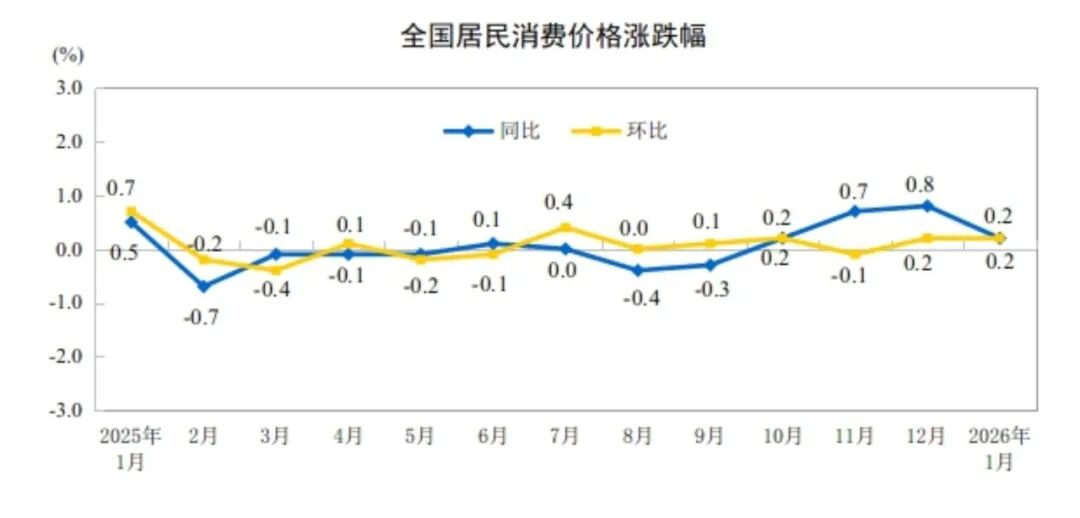
Group 1 - In January, the Consumer Price Index (CPI) increased by 0.2% month-on-month and year-on-year, while the core CPI, excluding food and energy, rose by 0.8% year-on-year, indicating a continued recovery in consumer demand [1][2] - The Producer Price Index (PPI) rose by 0.4% month-on-month but decreased by 1.4% year-on-year, reflecting a gradual stabilization in prices after four consecutive months of month-on-month increases [1][2] - The decline in year-on-year CPI growth was attributed to the high base effect from the previous year's Spring Festival and a significant drop in energy prices, which fell by 5.0% in January [2] Group 2 - The increase in core CPI, which rose by 0.3% month-on-month, is the highest in the past six months, suggesting that consumer demand is recovering despite the overall CPI decline [2] - The PPI's month-on-month increase was driven by the ongoing construction of a unified national market and rising demand in certain sectors, such as artificial intelligence and digital technology, which boosted prices for electronic semiconductor materials and storage devices [2] - The CPI base period rotation is set for 2025, with adjustments to the fixed basket of goods to better reflect current consumer spending patterns, enhancing the accuracy of the price index [3]
居民消费需求持续恢复 1月CPI同比上涨0.2%
Zhong Guo Zheng Quan Bao· 2026-02-11 20:23
Group 1 - In January, the Consumer Price Index (CPI) increased by 0.2% month-on-month and year-on-year, while the core CPI, excluding food and energy, rose by 0.8% year-on-year [1][2] - The Producer Price Index (PPI) rose by 0.4% month-on-month, marking the fourth consecutive month of increase, with a year-on-year decline of 1.4%, although the decline has narrowed compared to the previous month [1][3] - The increase in consumer demand is attributed to the ongoing construction of a unified national market and rising demand in certain industries, leading to price increases in sectors such as cement manufacturing and lithium-ion battery production [3] Group 2 - The January CPI was influenced by a "Spring Festival misalignment," which affected the year-on-year comparison, as January 2025 was a month with significant price increases due to the holiday [2] - Food prices decreased by 0.7% year-on-year, contributing to a 0.11 percentage point decline in the CPI, while service prices increased by 0.1%, contributing a 0.05 percentage point increase [1][2] - The energy prices saw a significant drop of 5.0% in January, with gasoline prices falling by 11.4% year-on-year, which had a larger downward impact on the CPI compared to the previous month [2] Group 3 - The core CPI continues to show a moderate upward trend, with a month-on-month increase of 0.3%, the highest in the past six months [2] - The PPI's year-on-year decline is narrowing due to improvements in supply-demand structures in key industries, with non-metallic mineral products and black metal smelting showing reduced price declines [3] - The new CPI and PPI data, based on a 2025 benchmark, reflect changes in consumer behavior and include new categories such as housing security equipment and internet medical services [4][5]
(经济观察)中国CPI“篮子”更新映射消费新风向
Zhong Guo Xin Wen Wang· 2026-02-11 11:49
Core Viewpoint - The update of China's Consumer Price Index (CPI) "basket" reflects new consumption trends and changes among Chinese residents, aiming to provide a more accurate representation of price movements in the consumer market [1][2]. Group 1: CPI and PPI Update - The CPI and Producer Price Index (PPI) undergo a base period rotation every five years, with the latest data based on 2025 as the new base year [1]. - The National Bureau of Statistics has released the first data following this base period rotation, indicating a new "price coordinate system" is in place [1]. Group 2: Changes in Consumption Patterns - The CPI basket has been updated to include new categories reflecting changes in consumer preferences, such as electric vehicle charging, home security devices, and internet medical services [2]. - The updated CPI basket now includes 268 basic classifications across eight major categories, maintaining the overall number while adjusting specific classifications to better capture new economic trends [2]. Group 3: Weight Adjustments - The weight adjustments in the CPI reflect the proportion of spending on various categories, with food, housing, and transportation being the largest components [3]. - The weight for services has increased while the weight for consumer goods has decreased, aligning with the trend of consumers shifting from purchasing goods to services [3]. - The impact of the base period rotation on the CPI and PPI monthly year-on-year indices is estimated to be minimal, averaging about 0.06 and 0.08 percentage points respectively [3]. Group 4: Recent CPI Data - In January, the CPI year-on-year growth rate fell to 0.2%, influenced by the timing of the Spring Festival, while the core CPI, excluding food and energy, rose by 0.8%, indicating a continued recovery in consumer demand [3].
1月CPI、PPI环比均上涨!
Jin Rong Shi Bao· 2026-02-11 11:46
Group 1: Consumer Price Index (CPI) Insights - In January, the CPI increased by 0.2% month-on-month and year-on-year, with the core CPI (excluding food and energy) rising by 0.8% year-on-year, indicating a continued recovery in consumer demand [1][3] - The CPI's month-on-month increase was driven by a 0.2% rise in both urban and rural areas, with non-food prices also increasing by 0.2% [3] - The core CPI's month-on-month increase of 0.3% is the highest in six months, influenced by rising prices for air tickets and travel agency fees, which increased by 5.7% and 2.0% respectively [3] Group 2: Producer Price Index (PPI) Insights - The PPI increased by 0.4% month-on-month in January but decreased by 1.4% year-on-year, marking the second consecutive month of narrowing decline [1][5] - Key factors for the PPI increase include the ongoing construction of a unified national market and rising demand in certain sectors, such as artificial intelligence and digital technologies, which led to price increases in electronic semiconductor materials and external storage devices by 5.9% and 4.0% respectively [5] - The month-on-month increase in industrial purchase prices was 0.5%, with a year-on-year decline of 1.4%, indicating a narrowing of the decline by 0.7 percentage points compared to the previous month [6] Group 3: CPI and PPI Base Period Rotation - The January CPI and PPI data represent the first release after the base period rotation, which is conducted every five years to ensure the price index reflects current consumer behavior [8][9] - The rotation includes adjustments to the "fixed basket" of goods and services, incorporating new categories such as electric vehicle power and internet medical services to better represent current consumption patterns [9][11] - The average impact of the base period rotation on the month-on-month CPI and PPI indices is approximately 0.06 and 0.08 percentage points, respectively, indicating a relatively minor effect [11]
1月核心CPI温和上涨 节前重要民生商品量足价稳
Bei Jing Shang Bao· 2026-02-11 11:01
Group 1 - In January, the national consumer price index (CPI) increased by 0.2% year-on-year, with core CPI (excluding food and energy) rising by 0.8% [1][3] - The CPI increase was influenced by the Spring Festival timing and a significant drop in energy prices due to international oil price fluctuations [1][3] - The new base year for CPI and producer price index (PPI) is set to 2025, with the impact of this base year change on CPI and PPI monthly year-on-year indices averaging approximately 0.06 and 0.08 percentage points, respectively [1][8] Group 2 - Food prices decreased by 0.7%, contributing to a 0.11 percentage point decline in the year-on-year CPI, while non-food prices increased by 0.4% [4][5] - Core CPI showed a moderate increase, with a 0.3% month-on-month rise, marking the highest level in six months, driven by rising prices in travel and household services [5] - The PPI decreased by 1.4% year-on-year but increased by 0.4% month-on-month, marking four consecutive months of month-on-month increases [6][7] Group 3 - The new base year CPI classification includes adjustments to better reflect changes in consumer spending, with new categories added such as home security devices and internet medical services [8][9] - The overall weight changes in the CPI categories are minimal compared to the 2020 base year, with an increase in service weights and a decrease in consumer goods weights [9]

CPI进行新一轮基期轮换,有哪些新变化?
Xin Hua Wang· 2026-02-11 09:23
Core Viewpoint - The National Bureau of Statistics of China has released the first data of the national Consumer Price Index (CPI) and Producer Price Index (PPI) based on the 2025 benchmark, marking the first data release after the benchmark rotation [1] Group 1: Purpose of Benchmark Rotation - The benchmark rotation is an essential foundational work for compiling price indices and follows international practices. In China, CPI and PPI undergo a benchmark rotation every five years, with the new indices starting from 2026 [2] - The CPI reflects the price level changes of goods and services consumed by residents over a certain period. The "fixed basket" of goods and services used for CPI calculation needs to be adjusted to reflect changes in consumer behavior and preferences [2] Group 2: Changes in CPI Survey - The benchmark rotation involves adjustments to the survey classification directory, survey points, representative specifications, classification weights, and price comparison benchmarks [3] - The current CPI survey includes 8 major categories and 268 basic classifications, with new additions such as housing security equipment, elderly products, dishwashers, and internet medical services to reflect new consumption trends [3] Group 3: Survey Coverage and Data Collection - The current benchmark includes approximately 120,000 survey points and around 620,000 representative specifications, expanding the coverage compared to the previous benchmark [4] - New retail formats and platforms, such as membership supermarkets and instant retail platforms, have been included in the survey points, and the use of big data for price collection has increased [4] Group 4: CPI Weight Calculation - CPI weights represent the proportion of expenditure on each category of goods or services in the "fixed basket" relative to the total expenditure. The weights for the 2025 benchmark are: Food, Tobacco, and Alcohol (29.5%), Clothing (5.4%), Housing (22.1%), and others [5] - Compared to the 2020 benchmark, the overall changes in CPI weights are minimal, with service weights increasing and consumer goods weights decreasing, aligning with economic development trends [5] Group 5: Impact of Benchmark Rotation - The benchmark rotation will affect the CPI and PPI data due to changes in survey categories, points, and weights, but the overall impact on the monthly year-on-year indices is relatively small, averaging about 0.06 and 0.08 percentage points for CPI and PPI, respectively [7]
最新公布!CPI统计口径调整,新增洗碗机、医美服务等新消费分类
证券时报· 2026-02-11 09:02
Core Viewpoint - The article discusses the release of the Consumer Price Index (CPI) and Producer Price Index (PPI) data for January, marking the first data release based on the new 2025 benchmark, indicating a slight overall impact from the benchmark rotation on the indices [1][3]. Group 1: CPI Analysis - In January, the CPI increased by 0.2% month-on-month and year-on-year, with core CPI (excluding food and energy) showing a moderate increase [1][8]. - The CPI's year-on-year growth was affected by the Spring Festival's timing and international oil price fluctuations, with food prices decreasing by 0.7%, impacting the CPI by approximately 0.11 percentage points [8]. - The core CPI rose by 0.8% year-on-year, indicating a continued recovery in consumer demand, with a month-on-month increase of 0.3%, the highest in six months [8]. Group 2: PPI Analysis - The PPI rose by 0.4% month-on-month, marking the fourth consecutive month of increase, while the year-on-year decline narrowed to 1.4% [10]. - The increase in PPI is attributed to the ongoing construction of a unified national market, which has led to price increases in certain industries, such as cement and lithium-ion battery manufacturing [10][11]. - Input factors, including international metal prices, have influenced domestic prices, with significant increases in the prices of silver, copper, and aluminum [11]. Group 3: Benchmark Rotation Changes - The benchmark rotation introduced new categories reflecting modern consumption trends, such as home security devices and internet medical services, expanding the coverage of new economic sectors [3][4]. - The number of CPI survey points increased to approximately 120,000, covering around 620,000 specifications, which is a significant expansion compared to the previous benchmark [3]. - The new weightings in the CPI are more aligned with current consumer spending patterns, with an increase in the service category's weight and a decrease in consumer goods [5][6].