
价格指数基期轮换

Search documents
基期轮换:确保CPI数据更准确反映消费新变化
Sou Hu Cai Jing· 2026-02-12 04:29
Group 1 - The core idea of the news is the upcoming price index base period rotation in China, which is a fundamental statistical practice to ensure that the Consumer Price Index (CPI) accurately reflects current consumer behavior and economic conditions [2][3]. - The base period rotation will update the reference point for price comparisons from 2020 to 2025, allowing for a more accurate representation of the changes in consumer spending patterns [2][3]. - The CPI is designed to reflect the price level changes of a representative basket of goods and services consumed by residents over a certain period [2]. Group 2 - The rotation will involve adjustments to the CPI survey classification directory, survey points, representative specifications, classification weights, and price comparison base periods [4]. - New categories reflecting current consumption trends will be added, such as housing security equipment, elderly products, dishwashers, electric vehicle charging, photography services, internet medical services, and medical beauty services [4]. - The name of the "Food, Tobacco, and Alcohol" category will be changed to "Food, Tobacco, Alcohol, and Dining Out," and "Tourism" will be renamed to "Travel Agency and Other Tourism Services" to better reflect consumer spending [4]. Group 3 - The national CPI survey will cover approximately 120,000 points and about 620,000 specifications, expanding the coverage compared to the previous base period [6]. - New retail formats, such as membership-based supermarkets and flash sales platforms, will be included in the survey points, along with new representative specifications like smart drones [6]. - The data collection methods for CPI will be optimized, with an increased use of big data applications, including online transaction prices and administrative records [6]. Group 4 - The CPI weights, which represent the expenditure share of each category in the fixed basket, will see minor overall changes compared to the 2020 base period, with service weights increasing and consumer goods weights decreasing [7]. - Specific categories such as Food, Tobacco, and Alcohol; Transportation and Communication; Education, Culture, and Entertainment; Medical Care; and Other Goods and Services will see an increase in their weights [7]. Group 5 - The base period rotation will impact various policies linked to the CPI, such as price subsidy mechanisms for low-income groups when CPI growth exceeds certain thresholds [8]. - A more accurate CPI will also provide a reference for adjustments in interest rates, minimum pensions, and other livelihood policies [8].

1月CPI、PPI数据出炉
Di Yi Cai Jing Zi Xun· 2026-02-11 16:30
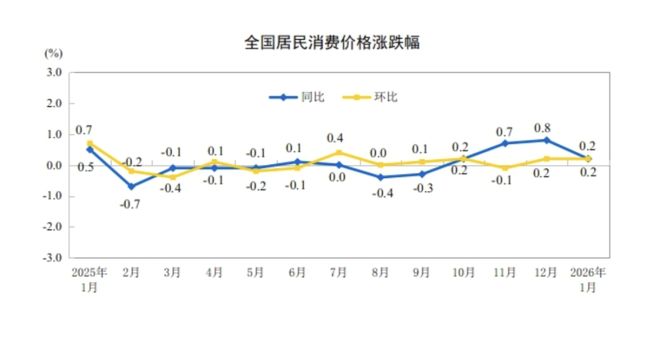
Group 1: Consumer Price Index (CPI) Data - In January 2026, the national consumer price index (CPI) increased by 0.2% year-on-year, with urban areas rising by 0.2% and rural areas by 0.1% [1] - Food prices decreased by 0.7%, while non-food prices increased by 0.4%; consumer goods prices rose by 0.3%, and service prices increased by 0.1% [1] - Month-on-month, the CPI also rose by 0.2%, with urban and rural areas both increasing by 0.2% [1] Group 2: Producer Price Index (PPI) Data - In January 2026, the national industrial producer price index (PPI) decreased by 1.4% year-on-year, with the decline narrowing by 0.5 percentage points compared to the previous month [2] - Month-on-month, the PPI increased by 0.4%, with the growth rate expanding by 0.2 percentage points from the previous month [2] - The purchase price index for industrial producers also saw a year-on-year decline of 1.4%, with a narrowing of the decline by 0.7 percentage points compared to the previous month [2] Group 3: Price Index Base Period Rotation - The rotation of the price index base period is a fundamental task for compiling price indices, aimed at adapting to changes in the structure of goods and services in production, circulation, and consumption [5] - The CPI and PPI undergo base period rotation every five years, with the new base period starting in 2026 based on 2025 data [5] - The base period rotation involves adjusting the "fixed basket" of goods and services to reflect the latest changes in consumer structure, enhancing the representativeness of the price index [5] Group 4: Impact of Base Period Rotation - The base period rotation will affect the classification, survey points, representative specifications, and weights used in calculating the CPI and PPI, but the overall impact on the total index is relatively small [7] - The estimated average impact of the base period rotation on the year-on-year indices for CPI and PPI is approximately 0.06 and 0.08 percentage points, respectively [7]
为什么开展价格指数基期轮换?涉及哪些内容?国家统计局权威解读→
Yang Shi Xin Wen· 2026-02-11 02:00
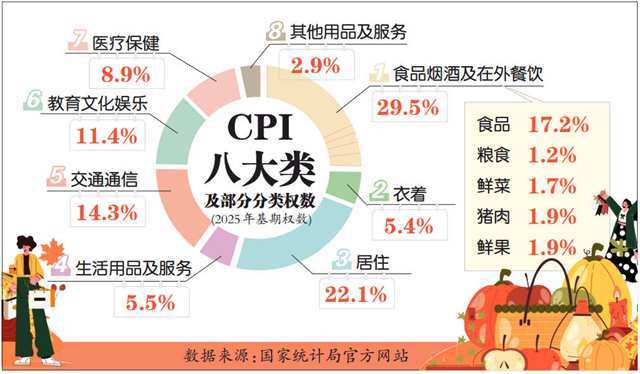
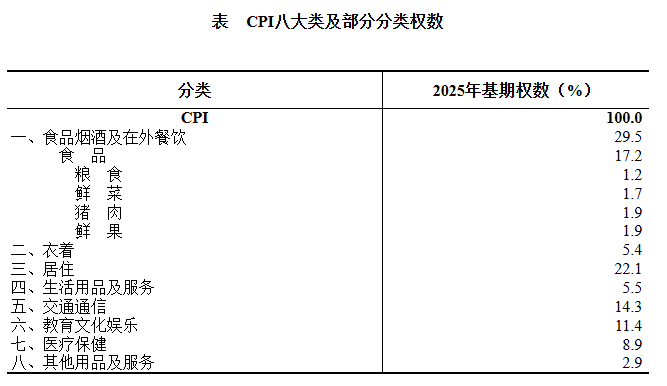
Core Viewpoint - The National Bureau of Statistics of China released the Consumer Price Index (CPI) and Producer Price Index (PPI) data based on the 2025 benchmark, marking the first data release after the benchmark rotation [1] Group 1: Purpose of Benchmark Rotation - Benchmark rotation is a fundamental task in compiling price indices, aimed at adapting to changes in the structure of goods and services in production, circulation, and consumption [2] - The CPI reflects the price level changes of goods and services consumed by residents over a certain period, requiring adjustments to the "fixed basket" of goods to accurately represent current consumption patterns [2] Group 2: Changes in CPI Survey - The CPI benchmark rotation involves revising the survey classification directory, survey points, representative specifications, classification weights, and price comparison benchmarks [3] - The current benchmark includes new categories such as housing security equipment, elderly products, dishwashers, and internet medical services, reflecting new consumption trends [3][4] Group 3: Survey Coverage and Data Collection - Approximately 120,000 survey points and about 620,000 representative specifications were included in the current benchmark, expanding the coverage compared to the previous benchmark [4] - The data collection methods have been optimized, with increased use of big data applications such as online transaction prices and electronic data from enterprises [4] Group 4: CPI Weight Calculation - CPI weights are derived from household expenditure surveys and are adjusted to ensure they accurately reflect the consumption structure [5] - The weights for the eight major categories in the 2025 benchmark are: Food, Alcohol, and Dining Out (29.5%), Clothing (5.4%), Housing (22.1%), Household Goods and Services (5.5%), Transportation and Communication (14.3%), Education, Culture, and Entertainment (11.4%), Healthcare (8.9%), and Other Goods and Services (2.9%) [5][7] Group 5: Impact of Benchmark Rotation - The benchmark rotation will affect the CPI and PPI data, with an average impact of approximately 0.06 and 0.08 percentage points on the monthly year-on-year indices for CPI and PPI, respectively [9]
1月CPI、PPI数据出炉
第一财经· 2026-02-11 01:58
Group 1 - The core viewpoint of the article highlights the recent trends in consumer and industrial prices in China, indicating a slight increase in consumer prices and a decrease in industrial producer prices [1][2]. Group 2 - In January 2026, the national consumer price index (CPI) increased by 0.2% year-on-year, with urban areas rising by 0.2% and rural areas by 0.1%. Food prices decreased by 0.7%, while non-food prices increased by 0.4% [1]. - The month-on-month CPI also rose by 0.2%, with urban and rural areas both showing a 0.2% increase. Food prices remained stable, while non-food prices increased by 0.2% [1]. Group 3 - In January 2026, the industrial producer price index (PPI) decreased by 1.4% year-on-year, with the decline narrowing by 0.5 percentage points compared to the previous month. Month-on-month, the PPI increased by 0.4%, with the increase expanding by 0.2 percentage points from the previous month [2]. - The industrial purchase price index also saw a year-on-year decrease of 1.4%, with the decline narrowing by 0.7 percentage points compared to the previous month, while month-on-month it increased by 0.5% [2]. Group 4 - The article discusses the importance of price index base period rotation, which is a fundamental aspect of price index compilation. This practice is aimed at adapting to changes in the structure of goods and services transactions in production, circulation, and consumption [6]. - The CPI base period rotation occurs every five years, with the new index starting from 2025. This adjustment is necessary to reflect the latest changes in consumer structure and improve the representativeness of the price index [6][7]. Group 5 - The impact of the base period rotation on CPI and PPI data is relatively small, with estimated average effects of approximately 0.06 and 0.08 percentage points, respectively [8].

为什么开展价格指数基期轮换?涉及哪些内容?国家统计局权威解读
Yang Shi Xin Wen· 2026-02-11 01:55
Core Viewpoint - The National Bureau of Statistics of China released the Consumer Price Index (CPI) and Producer Price Index (PPI) data based on the 2025 benchmark, marking the first data release after the benchmark rotation [1] Group 1: Purpose of Benchmark Rotation - Benchmark rotation is a fundamental task in compiling price indices, aimed at adapting to changes in the structure of goods and services in production, circulation, and consumption [2] - The CPI reflects the price level changes of goods and services consumed by residents over a certain period, necessitating adjustments to the "fixed basket" of goods to accurately represent current consumption patterns [2] Group 2: Changes in CPI Survey - The CPI benchmark rotation involves revising the survey classification directory, survey points, representative specifications, classification weights, and price comparison benchmarks [3] - The current CPI survey includes 8 major categories and 268 basic classifications, with new categories added to reflect emerging consumption trends, such as electric vehicle charging and internet medical services [3][4] Group 3: Survey Coverage and Data Collection - Approximately 120,000 survey points and around 620,000 representative specifications were included in the current CPI survey, expanding the coverage compared to the previous benchmark [4] - New retail formats and products, such as membership supermarkets and smart drones, were incorporated into the survey, and data collection methods were optimized to include big data applications [4] Group 4: CPI Weight Calculation - CPI weights are determined based on household expenditure surveys and other macro data, ensuring they accurately reflect the consumption structure [5] - The weights for the 2025 benchmark are as follows: Food, Alcohol, and Dining Out (29.5%), Clothing (5.4%), Housing (22.1%), and others, with some categories showing slight increases or decreases compared to the previous benchmark [5][7] Group 5: Impact of Benchmark Rotation - The benchmark rotation will affect the CPI and PPI indices, with an average impact of approximately 0.06 and 0.08 percentage points on the monthly year-on-year indices, respectively [9]
国家统计局城市司负责人就CPI等价格指数基期轮换有关情况接受专访
Xin Hua Wang· 2026-02-11 01:52
Core Viewpoint - The National Bureau of Statistics released the Consumer Price Index (CPI) and Producer Price Index (PPI) data based on the 2025 benchmark, marking the first data release after the benchmark rotation [1] Group 1: Purpose of Benchmark Rotation - Benchmark rotation is a fundamental task in compiling price indices, aimed at adapting to changes in the structure of goods and services in production, circulation, and consumption [2] - The CPI reflects the price level changes of a representative basket of goods and services consumed by residents, which needs to be updated to accurately represent current consumption patterns [2] Group 2: Changes in CPI Survey - The CPI benchmark rotation involves revising the survey classification directory, survey points, representative specifications, classification weights, and price comparison benchmarks [3] - New categories reflecting current consumption trends, such as housing security equipment and internet medical services, have been added to the CPI survey [3][4] Group 3: Survey Coverage and Data Collection - Approximately 120,000 survey points and about 620,000 representative specifications were included in the current benchmark, expanding the coverage compared to the previous benchmark [4] - The data collection methods have been optimized, with increased use of big data applications, including online transaction prices and administrative records [4] Group 4: CPI Weight Calculation - CPI weights are determined based on household expenditure surveys and other macroeconomic data, ensuring they accurately reflect the consumption structure [5] - The weights for the 2025 benchmark are as follows: Food, Beverages, and Dining Out (29.5%), Housing (22.1%), and Transportation and Communication (14.3%) among others [6] Group 5: Changes in Weights Compared to Previous Benchmark - Overall, the changes in CPI weights are minimal compared to the 2020 benchmark, with service weights increasing and consumer goods weights decreasing [7] - Specific categories such as Food, Beverages, and Dining Out have seen a rise in weight for dining out, while the weight for food has decreased [7] Group 6: Impact of Benchmark Rotation on CPI and PPI - The benchmark rotation will have a minor impact on the monthly year-on-year indices of CPI and PPI, estimated at approximately 0.06 and 0.08 percentage points respectively [9]
国家统计局城市司负责人就CPI等价格指数基期轮换有关情况接受中国信息报专访
Guo Jia Tong Ji Ju· 2026-02-11 01:39
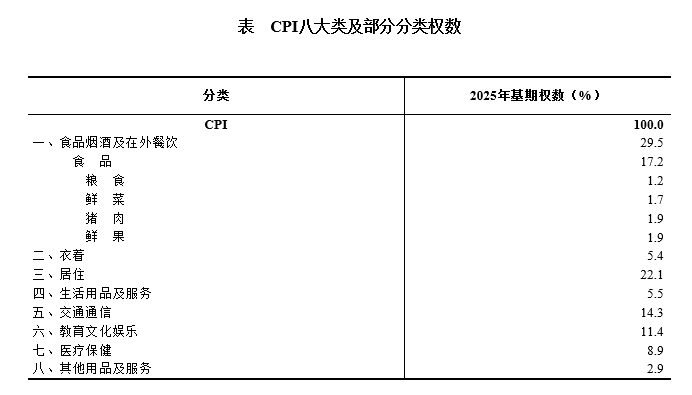
Core Viewpoint - The National Bureau of Statistics released the Consumer Price Index (CPI) and Producer Price Index (PPI) data based on the 2025 benchmark, marking the first data release after the benchmark rotation [1] Group 1: Purpose of Benchmark Rotation - Benchmark rotation is a fundamental task in compiling price indices, aligning with international practices to adapt to changes in the structure of goods and services transactions in production, circulation, and consumption [2] - The CPI reflects the price level changes of goods and services consumed by residents over a certain period, requiring timely adjustments to the "fixed basket" of goods to accurately represent market price changes [2] Group 2: Changes in CPI Survey - The CPI benchmark rotation involves revising the survey classification directory, survey points, representative specifications, classification weights, and price comparison benchmarks [3] - The current CPI survey classification directory has been adjusted based on comprehensive market research, adding new categories such as housing security equipment, elderly products, and internet medical services, while maintaining 8 major categories and 268 basic classifications [3][4] Group 3: Survey Points and Data Collection - Approximately 120,000 survey points and about 620,000 representative specifications were selected for the current benchmark, expanding the coverage compared to the previous benchmark [4] - New retail formats and data collection methods, including online transaction prices and big data applications, have been incorporated to better reflect new consumption patterns [4] Group 4: CPI Weight Calculation - CPI weights are determined based on household expenditure surveys and other macro data, ensuring they accurately reflect the consumption structure [5] - The weights for the eight major categories in the 2025 benchmark are as follows: Food, Alcohol, and Dining Out (29.5%), Clothing (5.4%), Housing (22.1%), Household Goods and Services (5.5%), Transportation and Communication (14.3%), Education, Culture, and Entertainment (11.4%), Medical Care (8.9%), and Other Goods and Services (2.9%) [6][7] Group 5: Impact of Benchmark Rotation - The benchmark rotation will influence the CPI and PPI indices due to changes in survey classifications, survey points, and weights, with an estimated average impact of approximately 0.06 and 0.08 percentage points on the monthly year-on-year indices for CPI and PPI, respectively [9]
为什么要开展价格指数基期轮换?国家统计局回应
Guo Jia Tong Ji Ju· 2026-02-11 01:33
Group 1 - The National Bureau of Statistics released the Consumer Price Index (CPI) and Producer Price Index (PPI) data based on 2025 as the new base year, marking the first data release after the base year rotation [1] - The base year rotation is an essential foundational work for compiling price indices, aligning with international practices to adapt to changes in the structure of transactions in production, circulation, and consumption [1] - CPI and PPI undergo base year rotation every five years in China, with the new indices starting from 2026 based on the 2025 base year [1] Group 2 - CPI reflects the price level changes of goods and services consumed by residents over a certain period, using a representative "fixed basket" of goods and services to observe overall price changes [2] - The consumer structure is evolving with economic development, necessitating timely adjustments to the CPI's "fixed basket" to accurately reflect current consumption patterns, such as the inclusion of electric power for new energy vehicles [2] - The CPI base year rotation involves adjusting the "fixed basket" and the price comparison base year to enhance the representativeness of the price index and more accurately reflect market price changes [2]