
钙钛矿晶硅叠层组件

Search documents
马斯克领跑太空光伏
Di Yi Cai Jing Zi Xun· 2026-02-13 14:20
Core Insights - The recent surge in the space photovoltaic sector, driven by Elon Musk's comments on the potential of solar energy for AI, has led to significant market fluctuations, with the Wind Space Photovoltaic Index rising nearly 40% in January before experiencing an over 8% decline from its peak due to clarifications from multiple companies [2][3] - The concept of space photovoltaics, while not new, is gaining traction as advancements in launch technology and cost reductions from companies like SpaceX make large-scale deployment more feasible [4][6] - Industry experts express skepticism about the immediate commercial viability of space photovoltaics, emphasizing that ground-based solar power will remain the primary energy source for the foreseeable future [2][5] Industry Trends - The potential market for space photovoltaics is vast, with estimates suggesting that launching 10,000 satellites annually could create a market worth 200 billion yuan for solar wings, and long-term projections estimate the market could reach 5.6 trillion yuan [3] - The rapid increase in SpaceX's launch frequency, from 31 launches in 2021 to a projected 167 in 2025, is expected to significantly lower launch costs, thereby facilitating the growth of the space photovoltaic sector [4] - Despite the optimism surrounding space photovoltaics, the industry remains cautious, with challenges such as high certification times for aerospace clients and the need for standardized supply chains and quality control systems [5][6] Technological Developments - The industry is focusing on developing new technologies such as P-type ultra-thin HJT batteries and perovskite-silicon tandem batteries, which are seen as potential solutions for the challenges faced in space photovoltaic applications [7] - Perovskite tandem batteries have shown laboratory efficiencies exceeding 35% and are significantly cheaper than traditional gallium arsenide batteries, making them a promising candidate for future space applications [7][8] - The integration of solar technology with aerospace initiatives is viewed as essential for Chinese companies to leverage their existing advantages in the photovoltaic supply chain and to participate in the global space race [9]



马斯克领跑太空光伏
第一财经· 2026-02-13 14:17
Core Viewpoint - The article discusses the impact of Elon Musk's vision for space photovoltaics on the Chinese solar industry, highlighting both the potential market opportunities and the challenges of commercialization in the near term [3][5]. Group 1: Market Dynamics - The Space Photovoltaic Index surged nearly 40% in January, driven by Musk's comments at the Davos Forum, but has since corrected by over 8% due to clarifications from several companies [3]. - If 10,000 satellites are launched annually, it could create a market space of 200 billion yuan for solar wings, with long-term projections estimating the space photovoltaic market could reach 5.6 trillion yuan [5][6]. Group 2: Technological Challenges - The high cost of launches and limited capacity have historically constrained the scalability of space photovoltaics, but advancements by SpaceX are expected to significantly reduce these costs [6]. - The unique environmental conditions in space present different operational challenges compared to ground-based solar systems, necessitating extensive testing and validation before large-scale deployment [7]. Group 3: Industry Participation - Chinese solar companies are encouraged to leverage their existing advantages in ground solar to collaborate with aerospace firms, aiming to capture early opportunities in the space photovoltaic sector [9][11]. - The article emphasizes the need for Chinese companies to accelerate the integration of solar and aerospace technologies, participate in international standard-setting, and innovate in global market solutions [11]. Group 4: Future Prospects - The development of new technologies such as P-type ultra-thin HJT batteries and perovskite-silicon tandem cells is seen as crucial for reducing costs and improving efficiency in space photovoltaics [10]. - The article suggests that while space photovoltaics are still in the early stages of commercialization, the industry is beginning to move faster in response to Musk's initiatives, with some companies already planning small-scale tests in space [9][10].

电力设备及新能源周报20260118:钙钛矿晶硅叠层组件再创世界纪录,国网“十五五”计划投资同比大增-20260118
Minsheng Securities· 2026-01-18 08:11
Investment Rating - The report maintains a "Recommended" rating for several key companies in the power equipment and new energy sectors, including Ningde Times, Kodali, and others [5][6]. Core Insights - The power equipment and new energy sector saw a weekly increase of 0.79%, outperforming the Shanghai Composite Index, with the energy storage index showing the highest growth at 1.81% [1]. - The National Energy Administration projects a total electricity consumption of 10,368.2 billion kWh by 2025, representing a year-on-year growth of 5.0% [4][56]. - TCL Zhonghuan's strategic investment in a new energy company aims to enhance vertical integration in the photovoltaic industry, reducing costs and improving efficiency [3][37]. Summary by Sections 1. New Energy Vehicles - Hive Energy showcased three core technological breakthroughs at its sixth Battery Day, focusing on semi-solid technology, Dragon Scale 3.0 technology, and ion oscillation fast charging technology, all aimed at enhancing safety and performance [2][13][21]. 2. New Energy Generation - TCL Zhonghuan's acquisition of a new energy company is expected to optimize resources and enhance business synergy, facilitating a shift from low-level competition to value co-creation in the photovoltaic sector [3][37]. 3. Power Equipment and Industrial Control - The National Grid's "14th Five-Year Plan" anticipates a fixed asset investment of 4 trillion yuan, a 40% increase from the previous plan, to support the development of a new power system [4][56]. - The report highlights significant growth in electricity consumption across various sectors, with the service industry and residential electricity usage contributing 50% to the overall growth [4][56]. 4. Commercial Aerospace - Trina Solar set a new world record with a 886W per 3.1 m² perovskite/silicon tandem module, reinforcing its leadership in high-efficiency energy technology [5]. 5. Weekly Sector Performance - The energy storage index led the sector with a 1.81% increase, while the nuclear power index experienced the largest decline at 6.39% [1].






多晶硅巨头最新研判:将恢复盈利
Shang Hai Zheng Quan Bao· 2025-08-31 12:16
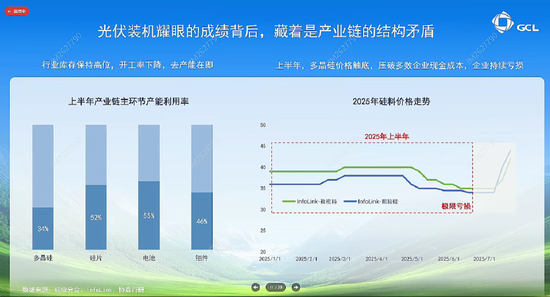
Core Viewpoint - GCL-Poly Energy is expected to return to profitability by the end of August to September, driven by industry consolidation and improved pricing dynamics in the polysilicon market [1][2] Group 1: Financial Performance - GCL-Poly's polysilicon revenue for the first half of the year was 5.665 billion yuan, a year-on-year decrease of 35.4%, with a loss of 1.968 billion yuan in the polysilicon segment [2] - The company achieved a market share of 24.32% in granular silicon production, with cash production costs dropping to 25.31 yuan per kilogram, a 6.5% decrease from the first quarter [5] - The company's asset-liability ratio has decreased to 38.45%, with significant reductions in sales, administrative, and financing costs [7] Group 2: Market Outlook - The polysilicon price is expected to stabilize between 60,000 yuan and 80,000 yuan per ton, with inventory levels gradually decreasing [1] - The average transaction price for n-type granular silicon has increased by 2.17% week-on-week, reaching 4.70 million yuan per ton [4] Group 3: Future Developments - GCL-Poly's subsidiary, GCL-Poly Photovoltaics, plans to file for an IPO in Hong Kong either this year or next, with ongoing preparations by intermediaries [1][8] - The company aims to achieve a production efficiency of 26% for its perovskite-silicon tandem cells by 2026, with a sales target of over 100 MW [8][9] - The expected shipment scale for the perovskite industry is projected to reach 100 MW, GW level, and 3-5 GW from 2026 to 2028 [8][9]

“光伏新势力”,最新发声
Shang Hai Zheng Quan Bao· 2025-06-14 04:46
Core Viewpoint - The mass production breakthrough of perovskite batteries is a landmark event signaling the arrival of a new era in photovoltaic technology [1][3]. Industry Insights - Leading figures in the photovoltaic industry, such as Zhu Gongshan and Gao Jifan, express strong optimism about perovskite technology, indicating it will unlock a low-carbon future and mark a new historical stage in the industry [3][4]. - The transition to mass production of perovskite tandem batteries is currently in the stages of production line construction and process breakthroughs, with an estimated timeline of 2-3 years for market validation [1][5]. Technological Advancements - Perovskite tandem components are theoretically 50% more efficient and 20% cheaper than traditional silicon components, with a carbon footprint reduction of over 50% [3]. - The expected revenue increase from a 1GW component cycle is estimated to be at least 2 billion yuan [3]. Market Dynamics - The global photovoltaic installation target set for 2030 by COP28 could lead to significant market expansion if perovskite tandem components are widely adopted [3]. - Companies like GCL-Poly and Trina Solar are investing heavily in perovskite technology, with Trina Solar aiming to lead in patent applications and innovations in this field [4][6]. Production and Sales Goals - GCL-Poly plans to complete equipment debugging for its 500MW production line by October, targeting a production efficiency of 26% by year-end, with sales projections of around 100MW for the following year [7]. - Renshou Energy is also focusing on the commercialization of perovskite tandem components, with expectations for mass production timelines aligning closely with those of silicon-perovskite tandem components [8][9]. Competitive Landscape - The industry is witnessing a shift from traditional silicon technologies to perovskite solutions, with companies like Renshou Energy and Guangyin Technology making significant strides in developing all-perovskite tandem components [9][10]. - Concerns about technology diffusion and competitive advantages are present, but companies believe that ongoing innovation will maintain their market positions [10][11].