
铜矿石和精矿

Search documents
海关:智利1月铜出口量为177,235吨
Wen Hua Cai Jing· 2026-02-06 00:42
智利1月铜矿石和精矿出口量为1,556,029吨,当月对中国出口铜矿石和精矿906,158吨。 智利海关公布的数据显示,智利1月铜出口量为177,235吨,当月对中国出口铜27,113吨。 (文华综合) 156 5309 0867 liumingkang@smm.cn 作为全球最大的铜消费国,中国产业链面临三大挑战:上游资源对外依存度攀升、中游加工环节产能过剩、下游需求受高铜价抑制。为助力行业应对变局, 上海有色网携手铜产业链企业联合编制《2026中国铜产业链分布图》中英双语版,点击此链接即可免费领取铜产业链分布图: https://s.wcd.im/v/470opZ19l/。 SMM联合制作联系人 刘明康 ...


中国12月钢铁出口创新高、稀土同比大增32%,全年大豆、铁矿石、原油进口齐破纪录
Hua Er Jie Jian Wen· 2026-01-14 07:58
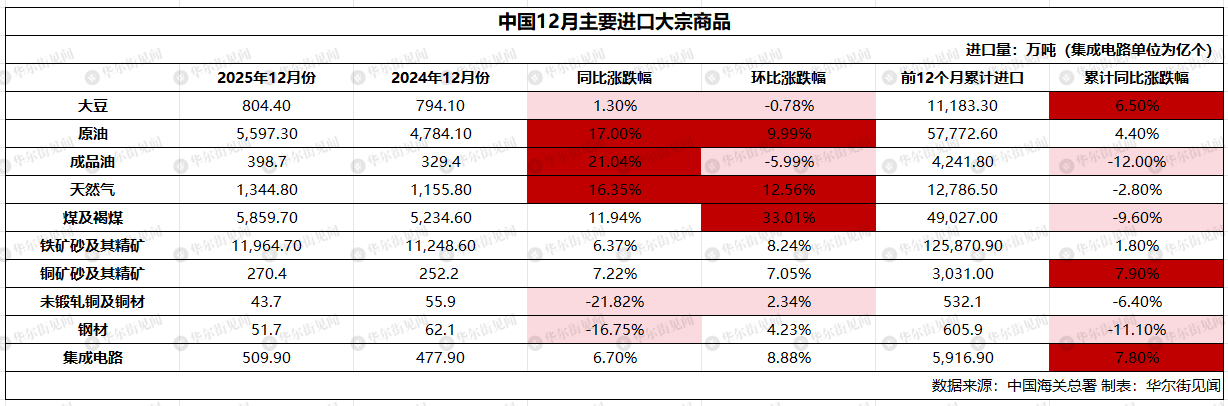
Core Insights - In 2025, China's soybean imports reached a record high of 111.8 million tons, marking the third consecutive year of growth, with a 6.5% increase from 2024 [1][3] - Iron ore imports also hit a historical peak, growing by 1.8% to 1.26 billion tons, continuing a three-year growth trend [6] - Coal imports saw the largest decline in a decade, dropping by 9.6% to 49 million tons [6][13] - December exports of rare earths surged by 32% year-on-year to 4,392 tons, while steel product exports exceeded the previous peak in 2015, reaching 11.3 million tons [2][1] Import and Export Data - December soybean imports were 8 million tons, a 1.3% increase year-on-year, while the total for the year was 111.83 million tons [3][13] - December iron ore imports were 11.96 million tons, a 6.37% increase from the previous year [9] - December crude oil imports reached 55.97 million tons, a 17% increase year-on-year, with an annual total of 57.77 million tons [4][12] - December natural gas imports rose by 16.35% to 1.34 million tons, but the total for the year fell by 2.8% to 12.79 million tons [7][13] Market Analysis - The increase in crude oil imports is attributed to stronger refining activity and robust stockpiling demand, with processing volumes expected to reach 15.38 million barrels per day in 2025 [5] - The decline in coal imports is linked to rising domestic production and the rapid adoption of clean energy, which is reducing coal demand [7] - The surge in rare earth exports indicates a solid demand foundation, despite a 20% month-on-month decline in December due to pre-holiday stockpiling by overseas buyers [2]
海关:智利12月铜出口量为146,401吨
Wen Hua Cai Jing· 2026-01-13 01:33
Core Insights - Chile's copper exports in December reached 146,401 tons, with 42,984 tons exported to China [2] - The total export volume of copper ore and concentrate from Chile in December was 1,170,302 tons, with 751,238 tons sent to China [2] Industry Challenges - China's copper industry faces three main challenges: increasing reliance on foreign resources in the upstream sector, overcapacity in the midstream processing segment, and suppressed downstream demand due to high copper prices [2] - To assist the industry in navigating these changes, a bilingual version of the "2026 China Copper Industry Chain Distribution Map" has been compiled in collaboration with copper industry chain enterprises [2]
智利海关:智利11月铜出口量为124422吨
Wen Hua Cai Jing· 2025-12-03 07:10
Group 1 - Chile's copper exports in November reached 124,422 tons, with 29,112 tons exported to China [1] - In November, Chile's total copper ore and concentrate exports amounted to 1,054,487 tons, with 716,614 tons sent to China [1] Group 2 - China's copper industry faces three major challenges: increasing reliance on foreign resources, excess capacity in the midstream processing sector, and suppressed downstream demand due to high copper prices [2] - To assist the industry in navigating these challenges, Shanghai Nonferrous Metals Network has collaborated with copper industry enterprises to compile the "2026 China Copper Industry Chain Distribution Map" in both Chinese and English [2]
美国对铜征50%重税!中国难逃冲击
Jin Tou Wang· 2025-07-11 10:54
Group 1 - The US has decided to impose a 50% tariff on copper imports, significantly impacting global copper trade dynamics [1] - China, as the largest copper consumer, relies heavily on imports, with 94% of its copper needs met through foreign sources [1] - The tariff is expected to primarily affect Chile, Canada, and Mexico, which are major suppliers to the US [1] Group 2 - Copper is viewed as a leading economic indicator, with price fluctuations potentially signaling economic growth or recession [2] - China's refined copper imports have remained stable, with a 7.4% year-on-year increase in copper ore and concentrate imports in the first five months of the year [2] - China's refined copper production has increased significantly, reaching 1.36 million tons last year, a 4.1% increase from the previous year [2]