阿迪达斯羽绒服

Search documents
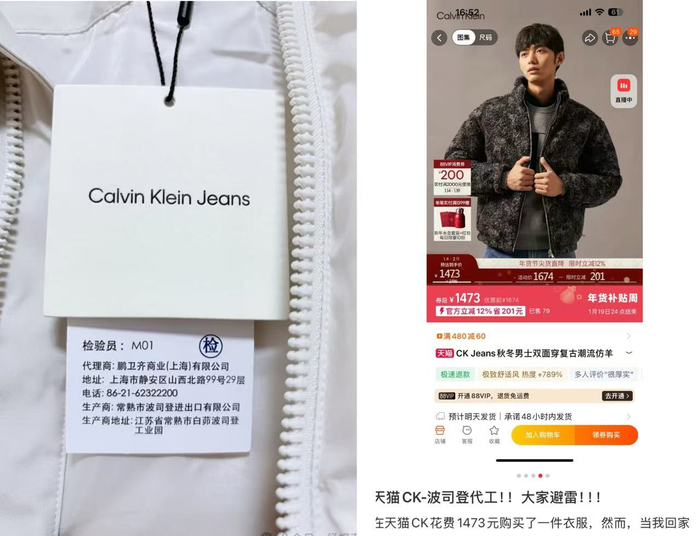
购买的CK羽绒服由波司登代工?门店回应
Xin Lang Cai Jing· 2026-01-19 12:00
Core Viewpoint - Recent social media posts revealed that Calvin Klein Jeans' white down jacket is manufactured by Bosideng, indicating a trend of international brands utilizing local manufacturers for production [1][4]. Group 1: Brand and Manufacturing - Calvin Klein has confirmed that some of its down jackets are produced by Bosideng, a Chinese manufacturer [1]. - The production label indicates that the agent is Pengweiqi Commercial (Shanghai) Co., Ltd., and the manufacturing site is located in Jiangsu Province, China [1]. - Calvin Klein operates in various countries and utilizes different manufacturers based on product specifications and production batches [4]. Group 2: Market and Financial Data - The price range for Calvin Klein's down jackets on Tmall is between 1,300 to 3,000 yuan [4]. - PVH Group, Calvin Klein's parent company, reported total revenues from 2019 to 2024 as follows: $9.4 billion, $6.799 billion, $9.155 billion, $9.024 billion, $9.218 billion, and $8.653 billion [6]. - In the third quarter of 2025, PVH Group's revenue increased by 2% year-on-year to $2.294 billion [7]. Group 3: Industry Trends - The practice of outsourcing production to local manufacturers is common in the modern manufacturing industry, as seen with both Calvin Klein and Adidas utilizing local firms for their products [7]. - Consumers are encouraged to focus on product specifications such as down fill power, fill weight, fabric technology, and craftsmanship rather than solely on brand names [9].

找雪中飞代工羽绒服,阿迪达斯做错了吗?
3 6 Ke· 2025-11-03 12:51
Core Viewpoint - Adidas faces backlash from consumers over high-priced down jackets produced by a third-party manufacturer, Snow Flying, which offers similar products at lower prices, raising questions about brand premium and consumer awareness [1][2][5] Financial Performance - Adidas reported third-quarter revenue of €6.6 billion, a 3% year-on-year increase, and operating profit of €736 million, up 23% [1][6] - In the Greater China region, third-quarter revenue reached €947 million, marking a 10% year-on-year growth and achieving ten consecutive quarters of growth [1][8] - The company has raised its annual performance forecast despite the ongoing controversy [8][12] Market Position and Competition - Adidas has seen a resurgence in the Chinese market after a decline due to the Xinjiang cotton controversy, but faces strong competition from local brands like Anta and Li Ning, which have surpassed Adidas in revenue and market share [1][6][15] - Adidas's market share in China has dropped from 15% in 2021 to 8.7% in 2024, while local brands continue to grow [15][16] Consumer Sentiment and Brand Strategy - Consumer complaints about product quality and service have surged, with over 25,000 complaints on platforms like Black Cat Complaints, primarily focused on quality issues [4][5] - The shift in consumer focus towards value for money over brand prestige is evident, with a significant increase in consumers prioritizing product pricing [16] - Adidas has adapted its strategy by positioning itself as a fashion brand and engaging popular celebrities for endorsements, which has helped regain consumer interest [9][11] Industry Trends - The use of third-party manufacturing is common in the industry, allowing brands like Adidas to reduce costs, but it can negatively impact brand image if consumers feel misled about product origins [5][12] - The overall sportswear market in China is projected to grow from ¥542.5 billion in 2024 to ¥598.9 billion by the end of 2025, indicating a competitive landscape for all brands [12][16]

羽绒服代工风波中,阿迪达斯创单季最强业绩,中国市场十连增
Nan Fang Du Shi Bao· 2025-11-01 10:24
Core Insights - Adidas is experiencing a significant recovery after reporting its first loss in 30 years in 2023, with a projected return to profitability in 2024 and double-digit sales growth across all business lines and markets in the first half of 2025 [2][4] Financial Performance - In Q3, Adidas reported a revenue increase of 12% year-on-year to €6.6 billion, achieving the highest quarterly revenue in its history [2] - The gross margin reached 51.8%, and operating profit increased by 23% to €736 million, raising the operating profit margin for the first nine months to 10.1%, exceeding the CEO's initial target [4] - Adidas has raised its full-year guidance for 2025, expecting brand revenue to grow by double digits and operating profit to reach €2 billion, up from a previous estimate of €1.7 billion to €1.8 billion [4] Product Line Performance - Revenue from footwear increased by 11% to €3.75 billion, with the ADIZERO series running shoes seeing over 30% growth [5] - Apparel revenue grew by 16% to €2.38 billion, while accessories saw a modest increase of 1% [5] Regional Performance - Sales in Europe grew by 12% to €2.33 billion, North America by 8% to €1.3 billion, and Greater China by 10% to €947 million [7] - Greater China has shown consistent quality growth for ten consecutive quarters, with Q3 revenue reaching €974 million, a 10% year-on-year increase [7] Strategic Initiatives - Adidas is focusing on sports marketing and professional endorsements to rebuild its reputation in vertical markets like running and football [5] - The company is implementing a "China for China" strategy, emphasizing local consumer engagement and innovation, with China being defined as a growth engine and innovation testing ground [7][9] Market Challenges - Adidas has faced increased costs due to higher tariffs on goods from Vietnam and Indonesia, impacting its pricing strategy in the U.S. market [7] - Recent consumer feedback highlighted concerns over the quality of Adidas products compared to local competitors, leading to discussions about pricing and product sourcing [11]

买阿迪达斯羽绒服的人,被上了一课?
3 6 Ke· 2025-10-31 13:46
Core Insights - The controversy surrounding Adidas's down jackets being produced by the OEM Snow Flying has highlighted the brand's reliance on outsourcing production to third-party manufacturers, allowing it to focus on high-value activities like design and marketing [3][6][9] Group 1: Outsourcing and Production Strategy - Adidas has almost entirely outsourced its production, with very few products manufactured in-house, primarily high-end items produced in Germany [6][9] - The company has historically closed its own factories in China, relying on a network of OEMs concentrated in regions like Guangdong and Fujian for manufacturing [6][7] - The global production strategy includes expanding capacity in countries like Vietnam and Indonesia to optimize costs and mitigate risks [7][9] Group 2: Market Dynamics and Consumer Sentiment - The price difference between Adidas and Snow Flying products has led consumers to question the value of purchasing branded items when cheaper alternatives are available [4][9] - There is a growing consumer awareness regarding the origins of products, with many now scrutinizing manufacturing labels for transparency [19] Group 3: Financial Performance and Business Model - The outsourcing model has allowed Adidas to operate with a lighter asset base, significantly reducing fixed asset investments and risks [14] - In 2024, Adidas's revenue in Greater China grew by 10%, with a gross margin of 51.7% in Q2 2025, showcasing the financial benefits of the light asset model compared to traditional heavy asset models [14][15] Group 4: Challenges and Quality Control - The shift to outsourcing has raised concerns about quality control, with reports of product defects linked to manufacturing in regions like Vietnam and Cambodia [15][17] - The relationship between brands and OEMs is complex, balancing the need for production capacity with the risk of OEMs producing competing products [17]

买阿迪达斯羽绒服的人,被上了一课?
36氪· 2025-10-31 13:36
Core Viewpoint - The article discusses the outsourcing model of major brands like Adidas, highlighting how they rely on third-party manufacturers for production while focusing on design, research, and marketing to maximize profits [3][10]. Group 1: Outsourcing Model - Adidas has outsourced its production to factories like Xuezhongfei and Bosideng, indicating that the brand has minimal in-house manufacturing capabilities [7][10]. - The outsourcing strategy allows Adidas to maintain a "light asset" operation, reducing fixed asset investments and risks while enabling quick adjustments to production based on market changes [17][19]. - The concentration of shoe manufacturing in regions like Guangdong and Fujian is due to the complete industrial chain and mature supply chain [8]. Group 2: Global Production Strategy - Adidas has expanded its production capacity overseas, particularly in Vietnam and Indonesia, to optimize costs and mitigate risks associated with supply chain disruptions [8][10]. - The company has shifted its production base from China to Southeast Asia since 2013, with Cambodia becoming the largest manufacturing country for Adidas apparel by 2021 [14][16]. - Recent adjustments have seen an increase in products manufactured in China, reflecting a strategic shift to regain consumer trust in the Chinese market [16][18]. Group 3: Quality Control and Consumer Awareness - The reliance on third-party manufacturers poses challenges in quality control, with past incidents of product quality issues reported [19][21]. - Consumers are becoming more aware of the production origins of their purchases, leading to a demand for transparency in the supply chain [22][23]. - The article emphasizes the importance of product labeling, as consumers can identify manufacturers through tags, which can influence purchasing decisions [22][23].

买阿迪达斯羽绒服的人,被上了一课
盐财经· 2025-10-28 09:42
Core Viewpoint - The article discusses the outsourcing model of Adidas, highlighting consumer reactions to the revelation that their products are manufactured by third-party factories like Xuezhongfei, which has sparked discussions about brand transparency and consumer awareness [4][12][23]. Group 1: Adidas Outsourcing Model - Adidas has largely outsourced its production to third-party factories, focusing on design, research, and marketing to maximize profits [4][8]. - The company has no significant production lines of its own, with only a small percentage of high-end products manufactured in Germany [8][12]. - The outsourcing model allows Adidas to maintain a "light asset" operation, reducing fixed asset investments and risks while enabling quick adjustments to production based on market changes [18][20]. Group 2: Consumer Reactions and Market Dynamics - Consumers have expressed dissatisfaction upon discovering that Adidas products are made by Xuezhongfei, leading to discussions about the price differences between branded and unbranded products [6][24]. - The price comparison shows that Adidas's down jacket, priced at 867.71 yuan with 70% down content, is significantly more expensive than a similar product from Xuezhongfei, which costs 569 yuan with 85% down content [6][8]. - The article notes a shift in consumer awareness, with a growing demand for transparency regarding product origins and manufacturing processes [23][24]. Group 3: Global Production Strategy - Adidas's production strategy has evolved, with a significant shift of manufacturing bases from China to Southeast Asia, particularly Cambodia and Vietnam, driven by cost considerations and supply chain optimization [16][20]. - In 2021, Cambodia became the largest manufacturing country for Adidas apparel, accounting for 21% of total production, while China's share dropped to 20% [16]. - Recent strategic adjustments have seen an increase in locally produced goods in China, with 95% of products sold in the Chinese market being "Made in China" [17]. Group 4: Quality Control and Challenges - The outsourcing model presents challenges in quality control, with reports of product quality issues arising from factories in Vietnam and Cambodia [20][22]. - The relationship between brands and their manufacturing partners is complex, balancing the need for production capacity with the risk of competition from the manufacturers themselves [22]. - The article emphasizes the importance of maintaining brand image and consumer trust, suggesting that brands should enhance supply chain transparency to meet evolving consumer expectations [23].

从运动鞋到羽绒服,阿迪达斯几乎没有自己的生产线
阿尔法工场研究院· 2025-10-28 00:06
Core Viewpoint - The article discusses the outsourcing model of Adidas, highlighting consumer reactions to the revelation that their products are manufactured by third-party factories like Xuezhongfei, leading to discussions about brand transparency and consumer awareness [4][5][8]. Group 1: Adidas Outsourcing Model - Adidas has largely outsourced its production to third-party factories, focusing on design, research, and marketing to maximize profits [4][8]. - The company has no significant production lines of its own, with most of its manufacturing done by factories in regions like Guangdong and Fujian, China [8][9]. - The outsourcing strategy allows Adidas to maintain flexibility in production and cost management, enabling quick adjustments to market changes [15][16]. Group 2: Consumer Reactions and Market Dynamics - Consumers expressed dissatisfaction upon discovering that high-priced Adidas products were made by Xuezhongfei, prompting discussions about the value of brand versus actual product quality [5][19]. - A comparison of prices revealed that similar products from Xuezhongfei were significantly cheaper, raising questions about the pricing strategies of major brands like Adidas [5][19]. - The article notes a shift in consumer awareness, with buyers increasingly interested in the actual manufacturing details rather than just the brand name [18][19]. Group 3: Strategic Adjustments and Market Performance - Adidas has been adjusting its production strategy, with a notable increase in locally produced items in China, reflecting a shift back towards domestic manufacturing [12][14]. - The company aims to regain consumer trust through deeper localization and responsiveness to market demands, as evidenced by its plans to establish a new headquarters in Shanghai [14]. - Recent financial performance indicates a positive trend, with Adidas's revenue in the Greater China region growing by 10% year-on-year in 2024, showcasing the effectiveness of its strategic adjustments [15].
东鹏饮料前三季收入168亿;阿迪回应雪中飞代工;万辰集团前三季净利增917%|品牌周报
3 6 Ke· 2025-10-27 02:36
Group 1: Dongpeng Beverage - Dongpeng Beverage reported a revenue of 61 billion yuan in Q3, a year-on-year increase of 30.4%, and a net profit of 13.9 billion yuan, up 41.9% [1] - For the first three quarters, the total revenue reached 168.4 billion yuan, growing by 34%, with a net profit of 37.6 billion yuan, an increase of 38.9% [1] - The company anticipates achieving an annual revenue of 158.4 billion yuan in 2024, representing a 40.6% growth, and a net profit of 33.3 billion yuan [1] - Energy drinks generated 4.2 billion yuan in revenue, a 15% increase, while electrolyte drinks saw a significant 84% growth, reaching 1.35 billion yuan [1] Group 2: Coca-Cola - Coca-Cola's Q3 revenue reached 12.455 billion USD, a 5% increase, surpassing market expectations [3] - The net profit for the quarter was 3.683 billion USD, reflecting a 29% growth [3] - Global single-serve sales increased by 1%, with flagship Coca-Cola brand sales growing by 1% driven by markets in Europe, the Middle East, Africa, and Asia-Pacific [3] - The company reaffirmed its 2025 earnings guidance, expecting an 8% growth in comparable currency-neutral earnings per share [4] Group 3: Deckers Brands - Deckers Brands reported a net sales increase of 9.1% in Q2, reaching 1.431 billion USD [4] - HOKA brand sales grew by 11.1% to 630 million USD, while UGG brand sales increased by 10.1% to 760 million USD [5] - The company expects full-year net sales to be around 5.35 billion USD, slightly below analyst expectations [5] Group 4: Adidas - Adidas reported a 12% revenue growth in Q3, reaching 6.63 billion euros, driven by double-digit growth across markets and product categories [7] - The gross margin improved by 0.5 percentage points to 51.8%, with operating profit significantly increasing to 736 million euros [7] - The company raised its full-year operating profit forecast to approximately 2 billion euros [7] Group 5: Wanchen Group - Wanchen Group announced a revenue of 36.562 billion yuan for the first three quarters, a 77.37% year-on-year increase, with a net profit of 855 million yuan, up 917.04% [16] - The growth was attributed to the continuous development of the bulk snack business [16] Group 6: Baima Tea - Baima Tea's IPO was oversubscribed nearly 1900 times, with subscription amounts reaching at least 853 billion yuan [17] Group 7: Wumart Group - Wumart Group's founder expressed optimism about the development of the hard discount model, aiming to adjust AI new retail to 100 stores by year-end [18] Group 8: Jinzhai Food - Jinzhai Food reported a Q3 revenue of 685 million yuan, a 6.55% increase, but a net profit decline of 14.77% [19] Group 9: Sushi Industry - Japan's largest conveyor sushi manufacturer plans to invest approximately 300 million yen to expand its factory, increasing production capacity by 20% [20]


东鹏饮料前三季收入利润超2024全年;阿迪回应雪中飞代工;万辰集团前三季净利大增917%丨品牌周报
36氪未来消费· 2025-10-26 06:06
Group 1: Dongpeng Beverage - Dongpeng Beverage's Q3 revenue reached 6.1 billion yuan, a year-on-year increase of 30.4%, with net profit at 1.39 billion yuan, up 41.9% [2] - For the first three quarters, revenue totaled 16.84 billion yuan, growing 34% year-on-year, while net profit was 3.76 billion yuan, an increase of 38.9% [2] - The company has surpassed its total revenue and net profit for the entire year of 2024 within the first three quarters [3] - Energy drinks generated 4.2 billion yuan in revenue, a 15% increase, while electrolyte drinks saw revenue of 1.35 billion yuan, growing 84% [3] - Dongpeng's sales model primarily relies on regional distributors, complemented by various sales channels, with over 3,200 distributors and coverage of over 4.2 million active retail points [3] Group 2: Coca-Cola - Coca-Cola's Q3 revenue reached 12.455 billion USD, a 5% increase, exceeding market expectations [4] - The company's net profit for Q3 was 3.683 billion USD, reflecting a 29% growth [4] - Global unit case volume increased by 1%, with flagship Coca-Cola brand sales growing by 1% driven by markets in Europe, the Middle East, Africa, and Asia-Pacific [4] - The company reaffirmed its 2025 earnings guidance, expecting comparable currency-neutral EPS growth of about 8% [5] Group 3: Deckers Brands - Deckers Brands reported a 9.1% increase in net sales for Q2, reaching 1.431 billion USD [6] - HOKA brand net sales grew by 11.1% to 630 million USD, while UGG brand sales increased by 10.1% to 760 million USD [6] - The company provided a full-year financial outlook, expecting net sales of approximately 5.35 billion USD, below analyst expectations [6] Group 4: Adidas - Adidas reported a 12% increase in brand revenue for Q3, reaching 6.63 billion euros [8] - The company's gross margin improved by 0.5 percentage points to 51.8%, with operating profit rising significantly to 736 million euros [8] - Based on Q3 performance, Adidas raised its full-year operating profit forecast to around 2 billion euros [8] Group 5: Wanchen Group - Wanchen Group announced a 77.37% year-on-year increase in revenue for the first three quarters, totaling 36.562 billion yuan [18] - The net profit for the same period was 855 million yuan, a staggering 917.04% increase [18] Group 6: Bama Tea - Bama Tea's IPO was oversubscribed nearly 1900 times, with subscription amounts reaching at least 85.3 billion yuan [19] Group 7: Wumart Group - Wumart Group's founder expressed optimism about the development of hard discount models in retail, with plans to expand AI new retail to 100 stores by year-end [20] Group 8: Jin Zai Foods - Jin Zai Foods reported a 6.55% increase in Q3 revenue, totaling 685 million yuan, but net profit declined by 14.77% [21]

买阿迪达斯羽绒服的人,被上了一课
创业邦· 2025-10-25 10:14
Core Viewpoint - The article discusses the reliance of major global brands like Adidas on contract manufacturing, highlighting the cost advantages and strategic shifts in production locations, particularly in response to market dynamics and consumer awareness [6][9][13]. Group 1: Adidas' Manufacturing Strategy - Adidas has largely separated its brand from manufacturing, relying on third-party factories for production, with only a small percentage of high-end products made in-house [9][10]. - The company has shifted its production base from China to Southeast Asia, particularly Cambodia and Vietnam, due to cost considerations and supply chain optimization [16][19]. - Recent trends indicate a potential return to increased production in China, with 95% of products sold in China being locally manufactured as of October 2023 [19][20]. Group 2: Contract Manufacturing Dynamics - The contract manufacturing model allows Adidas to operate with lower fixed asset investments and risks, focusing on design, research, and marketing [20][21]. - The article notes that while this model provides flexibility in production, it also poses challenges in quality control, with past issues of product quality arising from overseas manufacturing [22][24]. - The relationship between brands and contract manufacturers is complex, balancing the need for production capacity with the risk of competition from manufacturers [24][25]. Group 3: Consumer Awareness and Market Response - There is a growing consumer awareness regarding the origins of products, leading to increased scrutiny of manufacturing practices and transparency in supply chains [25]. - The article suggests that brands should embrace this shift by enhancing supply chain transparency and focusing on the actual value of products rather than solely on brand prestige [25]. - The case of Snow Zhongfei, a contract manufacturer for Adidas, illustrates the impact of consumer knowledge on purchasing decisions, as consumers are now more aware of price differences between branded products and their manufacturers [25].