5G专利

Search documents
OPPO向奥迪许可5G专利,可用于车联网
Guan Cha Zhe Wang· 2025-12-10 10:24
Group 1 - OPPO has signed a global patent licensing agreement with Audi, allowing the use of its essential cellular communication patents, including 5G, to enhance Audi's connected vehicle user experience [1] - This agreement marks OPPO's third bilateral patent licensing deal with major automotive manufacturers, following partnerships with Volkswagen and another well-known domestic car company [1] - The collaboration reflects a shared vision between wireless technology leaders and the automotive industry to promote seamless connectivity and cross-industry cooperation [1] Group 2 - As of January 2025, OPPO ranks eighth in the global patent landscape for 5G, with a total of 11,700 patent applications and over 65,000 granted patents [2][3] - The company is increasing its investment in core technology areas such as 5G/6G, artificial intelligence, charging, imaging, and video [3]


世界首个!我国专利数量超500万件 国际专利申请量连续6年位居全球第一
Xin Hua She· 2025-12-10 01:26
Core Insights - During the "14th Five-Year Plan" period, China's intellectual property has shifted from "quantitative accumulation" to "qualitative improvement," with a focus on high-value patents that drive innovation and development [1] - China has become the first country in the world to possess over 5 million valid domestic invention patents, and has ranked first globally in PCT international patent applications for six consecutive years [1] Group 1: Patent Development - High-value invention patents are becoming key elements for achieving high-quality development, with the number of high-value invention patents per 10,000 people reaching 15.3, surpassing the target of 12 set for the "14th Five-Year Plan" [1] - The technology transfer rate from universities and research institutions is steadily increasing, while the industrialization rate of enterprise invention patents has risen from 44.9% in 2020 to 53.3% in 2024 [1] Group 2: Future Goals - Looking ahead to the "15th Five-Year Plan," China aims to rapidly break through key core technologies in important fields, with an increasing number of leading areas in technological innovation and industrial innovation [1] - The integration of innovation-driven development is becoming more pronounced, highlighting the importance of high-value patents in enhancing both industry upgrades and improving people's livelihoods [1]
特朗普签字,每日数十亿美元流向美国,美前财长:中国是唯一赢家
Sou Hu Cai Jing· 2025-08-11 21:55
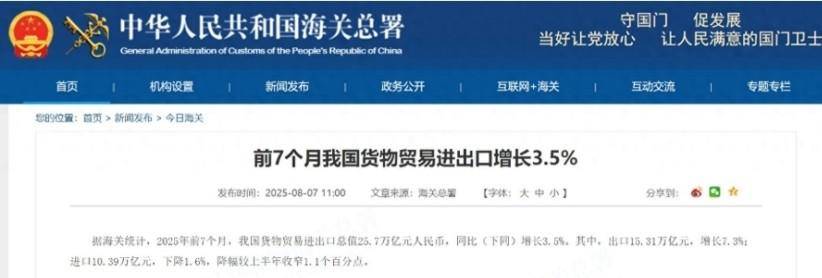
Core Viewpoint - The article argues that the ultimate winner of the tariff war is China, despite the U.S. government's claims of success in generating revenue through tariffs [3][15]. Group 1: Economic Impact on the U.S. - The high tariffs imposed by the Trump administration have led to skyrocketing prices for raw materials like steel and semiconductors, forcing U.S. factories to cut production and resulting in a decline in product quality [7]. - U.S. allies are shifting their trade partnerships towards China, with Brazil signing a multi-billion dollar soybean deal with China and India accelerating trade with Russia [7]. - Retail giants like Walmart and Best Buy are facing increased costs, contributing to a rise in inflation to 2.9%, which is straining consumers' finances [7]. Group 2: China's Economic Resilience - China's total import and export volume reached 25.7 trillion yuan in the first seven months of 2025, marking a 3.5% increase, with exports to Belt and Road Initiative countries soaring by 8.7% [11]. - Many U.S. companies are relocating their production lines to China to avoid tariffs, benefiting from China's robust textile industry infrastructure [11]. - Chinese e-commerce platforms like Taobao and Dunhuang.com are gaining international traction as affected businesses and consumers turn to them [11]. Group 3: Global Reactions and Trends - India and Brazil have strongly opposed Trump's tariff policies, with India's government prioritizing farmers' interests and Brazil filing a complaint with the WTO [13]. - The U.S. manufacturing PMI has dropped to 48%, while China's remains above 50%, indicating a stark contrast in economic health [15]. - The article concludes that unilateralism and protectionism will backfire in the changing global economic landscape, with China emerging as the biggest winner due to its flexible economic strategies and strong industrial chain [15].
美国税改72小时倒计时,中方亮出关键棋子!72岁崔天凯重出江湖
Sou Hu Cai Jing· 2025-07-05 13:29
Group 1 - The U.S. Senate has passed the largest tax reform bill in 30 years with a narrow margin, reflecting deep internal divisions and strategic intentions to attract overseas capital, reshape U.S. manufacturing, and create a "tax haven" to draw global industry capital [1] - The Chinese Ministry of Commerce has issued strong statements in response, indicating a commitment to defend national interests and development rights, signaling the start of a significant economic confrontation [3] - The return of veteran diplomat Cui Tiankai to the diplomatic front represents China's strategic response to the evolving economic landscape, emphasizing the need for both a firm stance and strategic intelligence in negotiations [5] Group 2 - China has initiated a tax countermeasure strategy, including a reduction of corporate income tax to 15% in Hainan Free Trade Port and increased R&D expense deductions for specialized enterprises, aiming to attract global high-end resources [7] - The ongoing economic conflict is characterized by a combination of tax policies, industrial strategies, and technological restrictions, with the Biden administration's initiatives posing significant challenges to China's new energy sector [5] - The future of this economic battle hinges not on the extent of tax cuts but on which country can create a more sustainable value ecosystem for global enterprises, with China positioning itself as a provider of fertile ground for global innovators [9]