60/40组合

Search documents
AI热潮掩盖了华尔街“老登交易”的大年:多元化回报创多年新高
美股IPO· 2025-12-20 04:18
Core Insights - The traditional stock-bond balanced portfolio has recorded double-digit gains this year, marking its best performance since 2019, yet funds continue to flow into concentrated large-cap tech stocks and thematic trades [1][2] - Despite the strong performance of diversified strategies in 2025, investor focus remains on AI-driven narratives, leading to a neglect of balanced investment strategies [3][4] Diversification Strategy Performance - In 2025, diversified investment strategies achieved their strongest performance in years, but this success has largely gone unnoticed amid the AI hype [3][7] - BCA Research's chief strategist Marko Papic emphasizes that the key to success in 2025 lies in global diversification rather than solely focusing on stocks [4] Fund Flows and Market Trends - According to JPMorgan data, balanced and multi-asset fund categories, including public risk parity funds and 60/40 portfolios, have experienced capital outflows for 13 consecutive quarters until a mild rebound this fall [5] - Funds are increasingly moving towards concentrated large-cap tech exposures and thematic trades, as well as direct hedging tools like gold [6] Market Rotation and Stock Performance - This year has seen a market rotation, with value-oriented stock ETFs attracting over $56 billion in inflows, marking the second-largest annual inflow since 2000 [9] - International stocks have rebounded due to favorable fiscal reforms and a weaker dollar, with small-cap stocks outperforming large-cap stocks in the fourth quarter [10] Future Outlook - Some strategists believe this shift will continue into 2026, with expectations of expanding U.S. corporate earnings and strong performance from small-cap and international stocks [11] - JPMorgan's David Lebovitz is leaning towards emerging market bonds and UK government bonds while maintaining selective exposure to U.S. stocks and AI stocks [12] Cautionary Signals - There are indications of potential bubbles, with Bank of America noting a strong buying impulse in 2025, the second strongest in nearly a century [13] - Manulife John Hancock Investments' Emily Roland warns of increasing disconnection between market performance and fundamentals, suggesting that this year has been a dream year for short-term investors [14]



AI热潮掩盖了华尔街“老登交易”的大年:多元化回报创多年新高
Hua Er Jie Jian Wen· 2025-12-20 03:55
Core Insights - The year 2025 has seen a strong performance of diversified investment strategies, with inflation data supporting their value as U.S. inflation came in below expectations, leading to a rare simultaneous rise in both stocks and bonds [1][3] - Despite the success of diversified strategies, funds continue to flow towards concentrated large-cap tech stocks and thematic trades, raising concerns about the risks of abandoning diversification at a potentially critical time [1][2] Group 1: Performance of Diversified Strategies - Diversified investment strategies achieved their strongest performance in years, with traditional balanced portfolios recording double-digit gains, marking the best performance since 2019 [1][3] - A global allocation fund under Cambria Investments, holding 29 ETFs, reported its best annual performance since inception, outperforming the S&P 500 index [1] Group 2: Investor Behavior and Trends - Investors have been moving away from balanced strategies, with funds flowing out of balanced and multi-asset fund categories for 13 consecutive quarters until a mild rebound this fall [3][4] - The shift in funds is towards concentrated large-cap tech stocks, thematic trades from core energy to quantum computing, and direct hedging tools like gold [3][4] Group 3: Market Dynamics and Future Outlook - The market has seen a rotation, with value stock ETFs attracting over $56 billion in inflows this year, the second-largest annual inflow since 2000, while Cambria's global value ETF surged approximately 50% [5] - Small-cap stocks have outperformed large-cap stocks in the fourth quarter, and some strategists expect this trend to continue into 2026 [5] - J.P. Morgan's David Lebovitz is leaning towards emerging market bonds and UK government bonds while maintaining selective exposure to U.S. stocks and AI stocks [6] Group 4: Cautionary Signals - Signs of a bubble are emerging, with Bank of America noting a strong buying impulse in 2025, and concerns about the disconnect between market performance and fundamentals are growing [7] - Despite abandoning the classic 60/40 allocation, many investors have not given up on multi-asset approaches, seeking opportunities in alternative assets such as private credit, infrastructure investments, and hedge funds [8]
不信股债组合,这届年轻人正在“重塑华尔街”
智通财经网· 2025-06-23 13:42
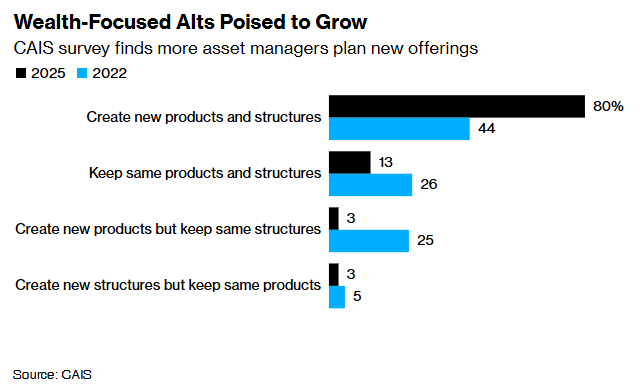
Group 1: Investment Trends - A new generation of wealthy investors, primarily millennials and Gen Z, is skeptical about traditional markets and is increasingly investing in alternative assets such as pre-IPO unicorns, real estate, cryptocurrencies, and collectibles [1][8] - Since 2020, the number of retail clients holding alternative assets at Bank of America has doubled, with approximately 93% of surveyed investors planning to increase their allocation to alternative assets in the future [1][4] - The traditional 60/40 portfolio strategy has lost its appeal due to simultaneous declines in stocks and bonds, prompting a shift towards alternative investments [2][5] Group 2: Market Dynamics - Alternative asset supply is rapidly increasing, with 80% of alternative asset managers planning to launch retail-friendly products, nearly double from three years ago [4] - Financial institutions are adapting their offerings, with firms like Blackstone and Apollo Global Management repackaging elite investment strategies into ETFs and semi-liquid funds for broader distribution [1][4] - The demand for alternative assets is reshaping how Wall Street markets wealth creation products, moving from institutional-only products to those accessible to high-net-worth individuals [1][4] Group 3: Investor Behavior - Many investors are moving away from public markets, driven by a distrust of traditional investment systems, which they perceive as fragile and manipulated [8][9] - The cultural phenomenon of "fear of missing out" (FOMO) is influencing younger investors to seek early-stage investments in technology companies [5][6] - There is a notable divergence in investment preferences among younger investors, with some pursuing high-risk opportunities while others maintain significant cash holdings due to default settings in their investment accounts [9] Group 4: Future Outlook - The interplay between investor preferences and product supply is expected to drive a cyclical growth in alternative asset allocations, indicating a potential wave of change in wealth management practices [9] - The trend towards retailization of alternative assets is partly due to traditional buyers being "capital constrained," with individual investors currently allocating only 7% of their investments to alternative assets compared to 20% for large institutions [8][9]