
AI7

Search documents
特斯拉的物理AI芯片路线图
Xin Lang Cai Jing· 2026-01-22 00:02
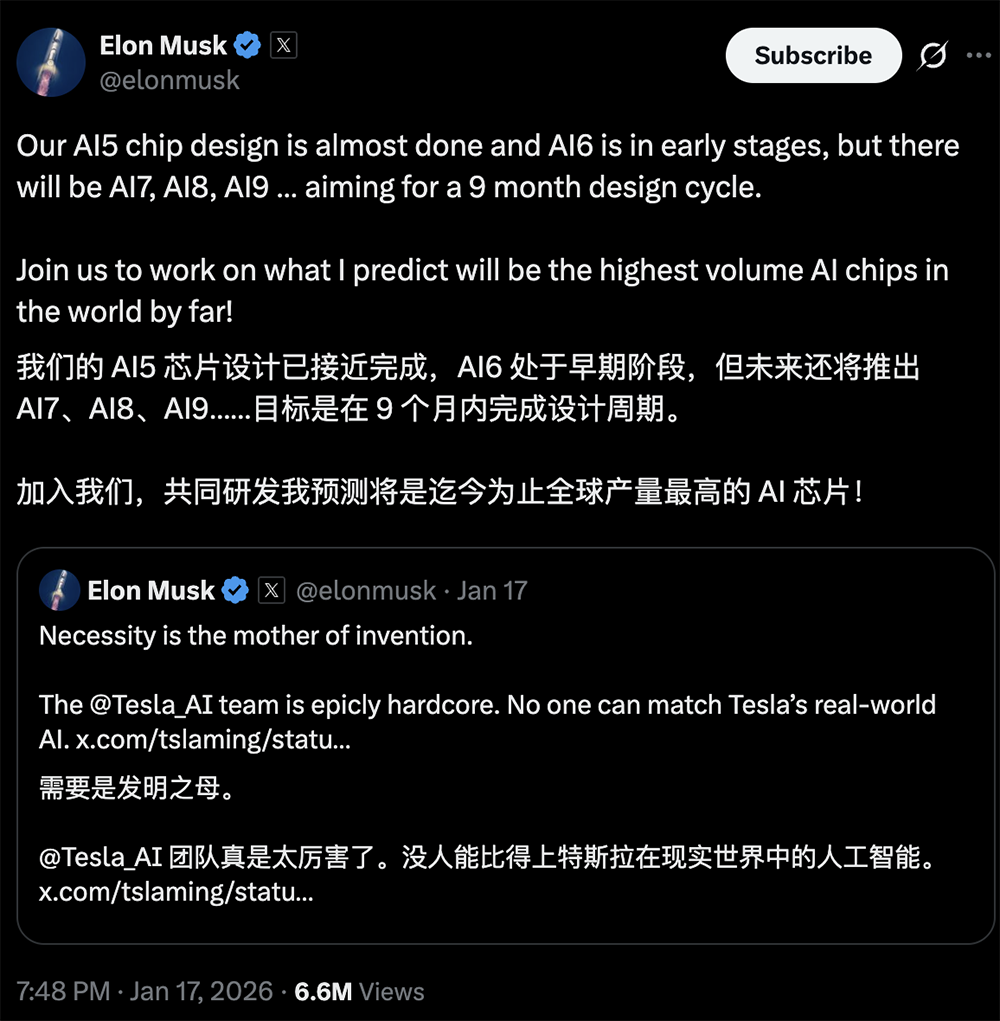
Core Insights - Tesla is shifting its focus towards AI chips, moving from hardware support to a core element that determines product capability limits [1][12] - Elon Musk revealed Tesla's latest AI chip roadmap, with AI5 design nearing completion and AI6 in early stages, aiming to compress chip design cycles to 9 months per generation [1][12] Group 1: AI Chip Development - The goals for Tesla's vehicle chips from HW3/AI3 and HW4/AI4 to the upcoming AI5 focus on providing higher computing power and larger memory for Full Self-Driving (FSD) and allowing redundancy for future complex end-to-end models [3][13] - The AI4 era features a 7nm process with approximately 216 TOPS supporting current FSD V12, which is insufficient for long-term goals of full autonomy and embodied intelligence [3][13] - AI5 is expected to utilize both Samsung's 2nm and TSMC's 3nm processes, with Musk claiming a "50 times performance improvement," combining a 10 times increase in raw computing power and a 9 times increase in memory capacity compared to AI4 [3][13] Group 2: Application and Integration - AI5 targets two core businesses: FSD and the Optimus humanoid robot, with a unified algorithm and hardware platform for both vehicles and robots, creating a unique advantage in embodied intelligence [4][14] - The architecture allows Tesla to view smart cars as "mobile robots" and robots as "walking cars," facilitating collaborative evolution at the foundational level [4][14] - Following AI5, AI6 will expand to support both edge inference and cloud training, with HW series chips deployed in vehicles and Dojo series chips for data center training, indicating a dual technical pathway [4][14] Group 3: Dojo Project and Space Computing - The initial goal of the Dojo project was to provide customized, efficient computing infrastructure for Tesla's autonomous driving training, with the first D1 chip based on a 7nm process [5][15] - AI6 and AI7 are envisioned as versatile AI computing chips that can support both edge inference and data center training, even adapting to space environments [5][15] - Space computing is a significant application for AI7, leveraging collaboration with SpaceX to deploy high-performance computing systems in orbit, taking advantage of potential benefits in latency, coverage, and infrastructure costs [6][16] Group 4: Engineering Solutions and Future Goals - Space computing presents challenges such as radiation, heat dissipation, and energy consumption, requiring higher reliability and power control for chips [7][17] - Musk mentioned AI8 and AI9, with an ambitious goal of shortening chip design cycles to 9 months per generation, aiming to align hardware upgrades with the rapid evolution of AI algorithms [7][17] - Tesla proposes an engineering solution to extend the usable life of older AI3 chips by processing 16-bit data with 8-bit low precision chips, balancing user scale and long-term product lifecycle [7][17] Summary - Tesla's AI chip roadmap indicates aggressive growth in computing power, with a 50 times performance increase from AI4 to AI5, significantly outpacing industry averages [11][21] - The application scope is expanding from vehicle inference to robots, data centers, and space computing, with a significantly compressed iteration cycle to match the rapid evolution of AI models [11][21]


马斯克高调“复活”特斯拉Dojo3芯片项目 再度剑指“太空AI”
Jin Rong Jie· 2026-01-21 04:30
Core Viewpoint - Tesla is restarting its previously shelved supercomputer project Dojo 3, marking a significant shift in its chip strategy, with a new focus on "space AI computing" rather than just terrestrial autonomous driving model training [1] Group 1: Project Details - Dojo 3 was fully halted five months ago in August 2025, and its core mission is now expanded to include AI computing in space [1] - The decision to restart Dojo is based on the successful progress of AI5 chip design [1] Group 2: Recruitment and Vision - Elon Musk has issued a recruitment call for engineers interested in developing the world's highest output chips, asking candidates to summarize key technical challenges they have solved [1] - Musk's vision includes deploying AI computing centers in space, which he believes will be more cost-effective than operating similar systems on Earth within the next four to five years, due to "free" solar energy and relatively easy cooling technologies [1]
特斯拉芯片路线图发布
半导体行业观察· 2026-01-19 01:54
Core Viewpoint - Tesla aims to accelerate its AI chip development cycle to compete with AMD and NVIDIA, targeting a nine-month design cycle for its AI processors, starting with AI5 and progressing to AI9 [1][2]. Group 1: AI Chip Development - Tesla's AI chips are primarily designed for automotive applications, which require high redundancy and safety certifications, making rapid development challenging compared to data center processors [1]. - The development cycle can potentially be shortened if future chips (AI6, AI7, AI8, AI9) are based on incremental iterations rather than entirely new designs, reusing existing architectures and frameworks [2]. Group 2: Technological Innovations - Tesla has developed a "Mixed-Precision Bridge" technology that allows low-cost, low-power 8-bit hardware to perform high-precision 32-bit calculations without losing accuracy [4]. - This technology enables Tesla's AI systems to maintain high precision in spatial calculations, crucial for tasks like recognizing traffic signs and balancing in humanoid robots [5][6]. Group 3: Memory and Data Management - Tesla's approach includes optimizing key-value (KV) caches to reduce memory usage by over 50%, allowing for the storage of more historical data without exhausting RAM [11]. - The use of a "read-only" safety lock ensures that once data is generated, it cannot be overwritten, preventing potential errors in AI decision-making [12]. Group 4: Computational Efficiency - The architecture integrates native sparse acceleration technology, allowing the chip to focus only on non-zero values, significantly improving throughput and reducing energy consumption [15]. - Tesla's AI5 chip is expected to achieve performance levels 40 times greater than current hardware while effectively managing memory bandwidth [18]. Group 5: Strategic Implications - The advancements in Tesla's chip technology aim to reduce dependency on NVIDIA's CUDA ecosystem, enhancing strategic independence and potentially creating a distributed inference cloud comparable to AWS [20]. - The mixed-precision architecture lays the groundwork for deploying advanced AI capabilities in smaller, low-power devices, facilitating edge computing without relying on cloud servers [20].
马斯克:特斯拉已审核芯片AI5进度,非常棒!AI6和AI7也会紧随其后推出;AI8的惊艳程度将超出想象
Sou Hu Cai Jing· 2025-11-03 07:52
Core Insights - Tesla's AI team has made significant progress on the AI5 chip, with Elon Musk expressing satisfaction on social media [1] - Upcoming chips AI6 and AI7 are expected to follow AI5, with AI8 anticipated to exceed expectations [1] Performance Metrics - The AI5 chip boasts a computing power of 2000-2500 TOPS and a power consumption of only 150-200W, which is approximately 20% higher than HW4, but with a performance increase of up to 40 times [3]

X @Elon Musk
Elon Musk· 2025-11-02 05:12
Just finished a long AI5 design review with the Tesla California and Texas chip engineers. It’s going to be great.And AI6 and AI7 will follow in fast succession.AI8 will be out of this world. ...