Air Force 1

Search documents
NIKE, Inc. (NKE): A Bull Case Theory
Yahoo Finance· 2026-01-20 15:11
Group 1 - The bullish thesis on NIKE, Inc. emphasizes its strong market position and potential for recovery under new leadership [1][2] - NIKE commands an 85% share in basketball footwear and 65% of NBA players wear its products, showcasing its dominance in the apparel and footwear market [2] - Strategic missteps under former CEO John Donahue led to a 70% decline in shares, but the company is now executing a turnaround strategy under CEO Elliott Hill [3][4] Group 2 - The "Win Now" turnaround focuses on sport-centric culture, reorganization by sport, and innovation driven by athlete insights [4] - Early signs of recovery include a trend back to 60% wholesale revenue, 20% growth in the running segment for Q1 2026, and normalizing inventory levels [4] - The new product cycle could generate $4 EPS in FY28, suggesting a potential upside to $100 per share, with a conservative scenario pointing to $80 per share [5] Group 3 - Key catalysts for growth include new product success, recovery in China revenue, and improvements in margins [6] - NIKE presents a compelling long-term investment opportunity due to its strong fundamentals, durable competitive advantage, and cultural relevance [6] - The stock has appreciated approximately 3.7% since a previous bullish thesis, indicating positive market sentiment [7]

Where Will Nike Be in 5 Years?
Yahoo Finance· 2026-01-10 21:01
Core Viewpoint - Nike has experienced a significant decline in stock price, dropping 55% since January 2021, and currently trades 63% below its peak, raising questions about its future performance over the next five years [1]. Group 1: Strategic Changes and Challenges - The COVID-19 pandemic has altered Nike's strategic priorities, shifting consumer behavior towards online shopping and away from physical retail [2]. - Previous leadership focused on core franchise products, which may have lost their appeal due to excessive supply, while also aggressively pursuing direct-to-consumer sales and reducing third-party retail partnerships [3]. - As the economic environment and consumer behavior normalized, Nike struggled to maintain momentum, leading to pressure on sales and profits [4]. Group 2: Leadership and Turnaround Strategy - CEO Elliott Hill, who took over in October 2024, has initiated a "Win Now" strategy that focuses on product innovation, improving relationships with wholesale accounts, and strengthening the brand [4]. - Hill described the company's current phase as being in the "middle innings" of a turnaround, acknowledging the challenges and uncertainties ahead for potential investors [5][7]. Group 3: Financial Outlook - Analyst estimates project Nike's revenue to reach $46.7 billion in fiscal 2026, reflecting a 0.9% year-over-year increase, while earnings per share are expected to decline by 28% [8].
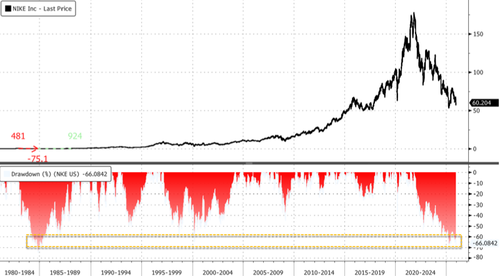
Amid Nike's Worst Drawdown Since late 70s, UBS Flags Emerging Bullish Signals
ZeroHedge· 2025-12-26 18:00
Core Viewpoint - Nike is experiencing a challenging market environment, but recent survey data indicates potential for a turnaround, particularly under new CEO Elliott Hill's leadership [1][5][6]. Group 1: Market Context - Apple CEO Tim Cook's purchase of 50,000 Class B shares at a weighted average price of $58.97 highlights interest in Nike despite its four-year bear market [1]. - Recent earnings data show softer demand in China and mixed trends in North America, contributing to Nike's stock struggles [1]. Group 2: Survey Insights - UBS Evidence Lab's global sportswear survey indicates that Nike's brand is improving year-over-year and remains strong, suggesting a potential turnaround [3][5]. - Key elements of Nike's strategy, such as re-entering the wholesale channel, are showing positive results, with increased consumer accessibility to Nike products [6]. - The percentage of consumers who view Nike as "good for doing sports" has returned to its 2019 peak level, reflecting a successful refocus on sports under Elliott Hill [6]. Group 3: Brand Strength and Consumer Sentiment - Nike holds the highest Net Promoter Score (NPS) globally, with scores rising across all studied regions, indicating strong brand loyalty [13]. - The brand ranks highly in attributes such as "high-quality products," "good for doing sports," and "prestigious brand," reinforcing its competitive positioning [13]. - Global purchase intentions for Nike footwear and apparel are increasing year-over-year, suggesting positive consumer sentiment [13]. Group 4: Challenges and Valuation - There is a slight erosion in global aided awareness among the 16-24 age demographic, which may impact brand perception [8]. - The Converse brand's survey results are underwhelming, indicating challenges within Nike's broader portfolio [8]. - UBS has set a price target of $62 based on a valuation of 29 times the estimated FY28 EPS of $2.15, reflecting cautious optimism about Nike's future performance [8].


The Zacks Analyst Blog NIKE, Steven Madden, Wolverine World Wide and Adidas'
ZACKS· 2025-12-17 10:36
Core Viewpoint - NIKE Inc. is expected to report a decline in both revenue and earnings for the second quarter of fiscal 2026, reflecting ongoing challenges in the market and strategic transitions [2][3][18]. Financial Performance - The Zacks Consensus Estimate for NIKE's fiscal second-quarter revenues is $12.2 billion, indicating a 1.7% decline year-over-year [3]. - The estimated earnings per share for the same quarter is 37 cents, representing a significant decline of 52.6% from the previous year [3]. - In the last reported quarter, NIKE achieved an earnings surprise of 81.5%, beating the consensus estimate by an average of 53.7% over the trailing four quarters [4]. Strategic Initiatives - NIKE's "Win Now" strategy aims to restore brand energy and position the company for sustainable growth after a period of underperformance [6][17]. - The company is focusing on disciplined execution, supply-chain optimization, and strategic pricing to enhance margin recovery [10][17]. Regional Performance - North America remains NIKE's strongest region, with projected revenues of $5.2 billion for the second quarter, reflecting a modest growth of 0.5% year-over-year [8]. - In EMEA, revenues are expected to rise by 1.7%, while Greater China is projected to see a decline of 12.7% in revenues, amounting to $1.5 billion [9][11]. Margin and Cost Pressures - NIKE anticipates a gross margin decline of 300-375 basis points, influenced by higher tariffs and increased promotional activity [12][13]. - SG&A expenses are expected to rise in the high-single digits due to increased demand creation investments [12][13]. Stock Performance and Valuation - NIKE shares have decreased by 6.2% over the past three months, underperforming the industry and the S&P 500 [14][15]. - The current P/E ratio of 31.47X exceeds the industry average of 28.06X and the S&P 500's average of 23.35X, indicating a potentially pricey valuation [16]. Long-term Outlook - NIKE's strategic initiatives are designed to strengthen its competitive position and drive long-term growth, despite facing near-term challenges [17][19]. - The company is navigating a difficult demand environment, particularly in lifestyle categories and Greater China, which may impact short-term performance [18][20].
Nike's 'Win Now' Strategy Shows Early Wins, But Q2 Earnings Expected To Slip - Nike (NYSE:NKE)
Benzinga· 2025-12-17 08:30
Core Viewpoint - Nike Inc. is facing a challenging financial landscape as it prepares to report second-quarter fiscal 2026 earnings, with CEO Elliott Hill indicating that the path to recovery will not be straightforward [1] Group 1: 'Win Now' Strategy - Nike's 'Win Now' strategy, focusing on Running, North America, and Wholesale, has shown early success, with the Running category increasing over 20% in the first quarter due to revamped franchises like the Pegasus and Vomero [2] - The spring wholesale order book is up, indicating that retail partners are regaining confidence in the brand [2] Group 2: Revenue and Supply Challenges - Management has intentionally reduced the supply of classic franchises such as the Air Force 1 and Dunk to maintain brand health, which has negatively impacted immediate revenue [3] - Organic digital traffic has slowed by double digits as promotional activities have been limited [3] Group 3: Financial Headwinds - For the second quarter, management expects revenue to decline in the low single digits and gross margins to contract significantly by 300 to 375 basis points [4] - Tariffs are projected to cost the company $1.5 billion annually, compounded by a 10% revenue decline in Greater China last quarter [4] Group 4: Analyst Sentiment - Analysts at Raymond James express caution, noting that a stock re-rating is unlikely until there is a clearer inflection in revenue and EBIT% [5] - Stifel maintains a 'Hold' rating, highlighting that shares are trading at a premium of approximately 25 times FY27 earnings, suggesting that the market has already priced in a recovery that has not yet fully materialized [6] Group 5: Stock Performance - NKE shares fell 0.97% to $67.12, but have increased by 8.43% over the last six months; however, the stock has declined by 11.3% year-to-date [7] - The stock exhibits a weaker price trend over the medium and long term but shows a strong trend in the short term, with a poor quality ranking [7]

NIKE Pre-Q2 Earnings: Buy Now or Wait Out Near-Term Volatility?
ZACKS· 2025-12-16 17:51
Core Viewpoint - NIKE Inc. is expected to report a decline in both revenue and earnings for the second quarter of fiscal 2026, with revenues projected at $12.2 billion, a 1.7% decrease year-over-year, and earnings per share estimated at 37 cents, reflecting a 52.6% decline from the previous year [1][2][10] Financial Performance - The Zacks Consensus Estimate indicates a revenue drop to $12.2 billion and earnings of 37 cents per share for the fiscal second quarter, marking a significant decline from the prior year [2][10] - In the last reported quarter, NIKE achieved an earnings surprise of 81.5%, exceeding consensus estimates by an average of 53.7% over the last four quarters [3] Earnings Expectations - NIKE has an Earnings ESP of -3.79% and a Zacks Rank of 3, suggesting that the likelihood of an earnings beat is low for this quarter [4] - The company is facing challenges in the Sportswear segment due to the deliberate phase-out of aging franchises, which is expected to create revenue softness [11] Regional Performance - North America remains NIKE's strongest region, with projected revenues of $5.2 billion for the second quarter, indicating a modest 0.5% year-over-year growth [7] - In EMEA, revenues are expected to rise by 1.7% as inventory levels normalize and the focus shifts to profitability [8] - Greater China is projected to see a significant revenue decline of 12.7% year-over-year, with revenues estimated at $1.5 billion, reflecting ongoing structural weaknesses [12] Margin and Cost Management - NIKE anticipates a gross margin decline of 300-375 basis points, influenced by higher tariffs and increased promotional activity [13] - SG&A expenses are expected to rise in the high-single digits due to increased demand creation investments [14] Stock Performance and Valuation - NIKE shares have declined by 6.2% over the past three months, underperforming the industry and the S&P 500 [15] - The current stock price of $67.78 reflects a 29.6% increase from its 52-week low but is 17.8% below its 52-week high, with a forward P/E ratio of 31.47, higher than industry and S&P averages [19] Strategic Initiatives - NIKE's "Win Now" strategy aims to restore brand energy and position the company for sustainable growth, focusing on operational resets and improved wholesale partnerships [5][21] - The company is adapting to market dynamics through innovation-led product launches and enhanced consumer engagement [21][23] Challenges Ahead - The company faces near-term challenges, including weak demand in lifestyle categories, elevated SG&A costs, and the impact of new U.S. tariffs [24] - Management's cautious outlook highlights the difficulty in balancing short-term financial pressures with long-term strategic goals [22][24]
Running Strong, Sportswear Soft: Can NIKE Balance Its Portfolio?
ZACKS· 2025-12-10 17:45
Core Insights - NIKE Inc's first-quarter fiscal 2026 results indicate progress in rebuilding momentum, particularly in the running category, which grew over 20% due to redesigned franchises resonating with consumers [1][8] - However, the overall performance remains uneven, with significant softness in the Sportswear segment and a 30% decline in classic footwear in North America [2][3] Performance Summary - The running category was a standout performer, driven by franchises like Vomero, Structure, and Pegasus, supported by the company's "Sport Offense" strategy [1] - North America saw a 4% growth, bolstered by stronger wholesale trends, helping stabilize the top line despite a cautious consumer backdrop [1] - In contrast, Sportswear continues to struggle, particularly in Greater China, where revenues fell 10% and NIKE Digital dropped 27% due to marketplace headwinds [2][3] Competitive Landscape - Key competitors include adidas AG and lululemon athletica inc., both of which are showing signs of recovery and growth in various segments [4][5][6] - adidas is regaining momentum with strong demand for lifestyle franchises and improved performance in running and football, while lululemon benefits from strong brand equity and international expansion [5][6] Valuation and Estimates - NIKE shares have declined 14.7% over the past three months, slightly worse than the industry's decline of 13.7% [7] - The company trades at a forward price-to-earnings ratio of 29.58X, higher than the industry's average of 26.33X [9] - The Zacks Consensus Estimate indicates a year-over-year earnings decline of 23.6% for fiscal 2026, but a growth of 50.9% is expected for fiscal 2027 [10]
Jordan, Converse & More: Can NIKE's Brand Trio Fire on All Cylinders?
ZACKS· 2025-11-10 18:17
Core Insights - NIKE Inc. is implementing a "Sport Offense" strategy to unify its brands NIKE, Jordan, and Converse, aiming for sharper focus, faster innovation, and stronger consumer connections [1][8] - The strategy is inspired by the success in running, where double-digit growth was achieved through athlete-centric innovation [1] Brand Performance - Jordan Brand remains a cultural powerhouse, while NIKE is stabilizing core franchises like Air Force 1 and Air Jordan 1 [2] - Converse is undergoing a reset under new leadership to regain profitable growth through sharper positioning and refreshed designs [2] - The combination of these three brands creates a unique ecosystem that blends performance, lifestyle, and streetwear across various price points, which is NIKE's competitive edge [2] Market Challenges - NIKE faces hurdles such as softness in sportswear, lagging sales in China, and weaker digital traffic [3] - The company must prove that its brand trio can sustain momentum across markets, with management indicating that growth may not be linear [3] Competitive Landscape - Key competitors include adidas AG and lululemon athletica inc. [4] - adidas is recovering by focusing on brand strength and profitability, seeing renewed momentum from classic lifestyle products and core performance categories [5] - lululemon is outperforming in the premium activewear space, driven by innovation in performance fabrics and strong brand loyalty [6] Financial Performance - NIKE shares have declined by 19.3% year to date, compared to the industry's decline of 20.7% [7] - The forward price-to-earnings ratio for NIKE is 30.26X, higher than the industry average of 25.91X [9] - The Zacks Consensus Estimate indicates a year-over-year earnings decline of 23.6% for fiscal 2026, followed by a projected growth of 50.5% for fiscal 2027 [10]
营收超预期、库存连降,耐克CEO贺雁峰最新答卷:以“运动”为锚,曙光已见
Cai Jing Wang· 2025-10-10 06:38
Core Insights - Nike's Q1 FY2026 financial report indicates signs of recovery with revenue of $11.7 billion, a slight increase of 1% year-over-year, surpassing market analysts' expectations [2] - The dealer business generated $6.8 billion in revenue, significantly exceeding the $4.5 billion from direct sales, becoming a key driver of growth [2] - Global inventory decreased by 2% to $8.1 billion, with a notable 11% reduction in Greater China, reflecting effective inventory management [2] Strategic Actions - Under CEO Elliott Hill's leadership, Nike has focused on "sports" as the core strategy, implementing the "Win Now" plan through organizational restructuring, product innovation, market ecosystem restoration, brand value redefinition, and localized execution [3] - Organizational restructuring aimed to refocus Nike on "sports" by breaking down business units into sport-specific segments, allowing for targeted efforts in running, basketball, and soccer [4] - The team has successfully rebuilt relationships with wholesale partners, recovering lost market shelf space and driving the dealer business back to growth, with dealer revenue accounting for over 58% of total revenue [5][6] Inventory Management - Effective inventory management has been a critical component of the "Win Now" plan, with global inventory assets decreasing to $8.1 billion and significant improvements in inventory turnover efficiency [6] - The reduction in inventory levels for previously over-reliant classic series like Air Force 1 and Dunk has created space for seasonal product replenishment and new product launches [6] Brand Value Rebuilding - Nike is focusing on brand value reconstruction by emphasizing key sports moments and increasing innovation investments, leading to a gradual recovery in brand visibility since mid-2024 [7] - Recent marketing initiatives, including collaborations with top athletes and immersive experiences, have reinforced Nike's commitment to its core "sports" identity [7] Future Growth Strategy - Despite the positive Q1 FY2026 results, Nike acknowledges the complexity of recovery across different business areas, emphasizing that progress will not be linear [9] - The "Win Now" plan will continue to drive strategic focus, product innovation, and channel optimization to support comprehensive recovery across all categories and regions [10] Product Innovation - Nike is intensifying investments in core categories such as running, basketball, and soccer, with new product launches aimed at enhancing competitive advantage [11][12] - The company is also targeting women's and children's markets with innovative products and collaborations, expanding its reach in these segments [14][15] Financial Outlook - Capital markets are showing optimism regarding Nike's long-term profitability, with RBC upgrading its rating to "outperform" and raising the target price to $90, anticipating significant revenue contributions from the 2026 World Cup [16] - The resilience of Nike's supply chain, with production expanded to multiple countries, positions the company to better withstand market fluctuations and policy risks [16] Conclusion - Over the past year, Nike has laid a solid foundation for transformation, with a focus on the "Win Now" plan, core category innovation, and leveraging upcoming events like the World Cup to drive sustainable growth [17]
Is NIKE Stock's Move Below 200-Day SMA a Warning or Opportunity?
ZACKS· 2025-10-08 16:31
Core Viewpoint - NIKE Inc. (NKE) has experienced a decline in stock performance, falling below key technical indicators, indicating bearish sentiment and a shift in investor confidence [1][2][9]. Stock Performance - NKE shares have lost 6.3% over the past three months, underperforming the Zacks Shoes and Retail Apparel industry's decline of 2.5% and the broader Zacks Consumer Discretionary sector's fall of 1.8% [6]. - The stock closed at $68.91 on October 8, 2025, below its 200-day simple moving average (SMA) of $69.13, and has also traded below its 50-day SMA since September 5, 2025 [1][2][10]. - Compared to competitors, NKE's performance is weaker, with Wolverine World Wide and Steven Madden seeing gains of 29% and 30.2%, respectively, while NKE outperformed adidas AG, which declined by 12.8% [7]. Strategic Transition - NIKE's ongoing transition, driven by the "Win Now" strategy, aims to shift focus from aging products to innovation-led performance items, which has created a revenue headwind as the company clears old inventory [11][12]. - The first-quarter fiscal 2026 results highlighted revenue declines in critical markets like North America and Greater China, attributed to promotional activities and local competition [12]. - Despite challenges, NIKE's fundamentals remain strong, with growth in performance categories like Running and Global Football indicating potential for future consumer engagement [21]. Financial Metrics - NIKE's current forward 12-month price-to-earnings (P/E) ratio stands at 34.64X, significantly higher than the industry average of 29.76X and the S&P 500's average of 23.65X, raising concerns about valuation [15][17]. - The Zacks Consensus Estimate for fiscal 2026 indicates a 0.2% year-over-year revenue growth, but a 23.2% decline in EPS, while fiscal 2027 estimates suggest 5.7% revenue growth and 56.4% EPS growth [23]. Investor Sentiment - The stock's current trading position below both the 50 and 200-day SMAs reflects cautious investor sentiment, with a delicate balance between optimism for long-term growth and skepticism regarding near-term execution risks [24][25]. - Given the elevated valuation and lack of near-term growth visibility, it may be prudent for investors to wait for signs of revenue stabilization and margin recovery before making new investments [25].