Apple Glasses

Search documents
华为、字节、Meta同台竞技,AI眼镜势必记住2026这一年
3 6 Ke· 2026-02-26 11:06
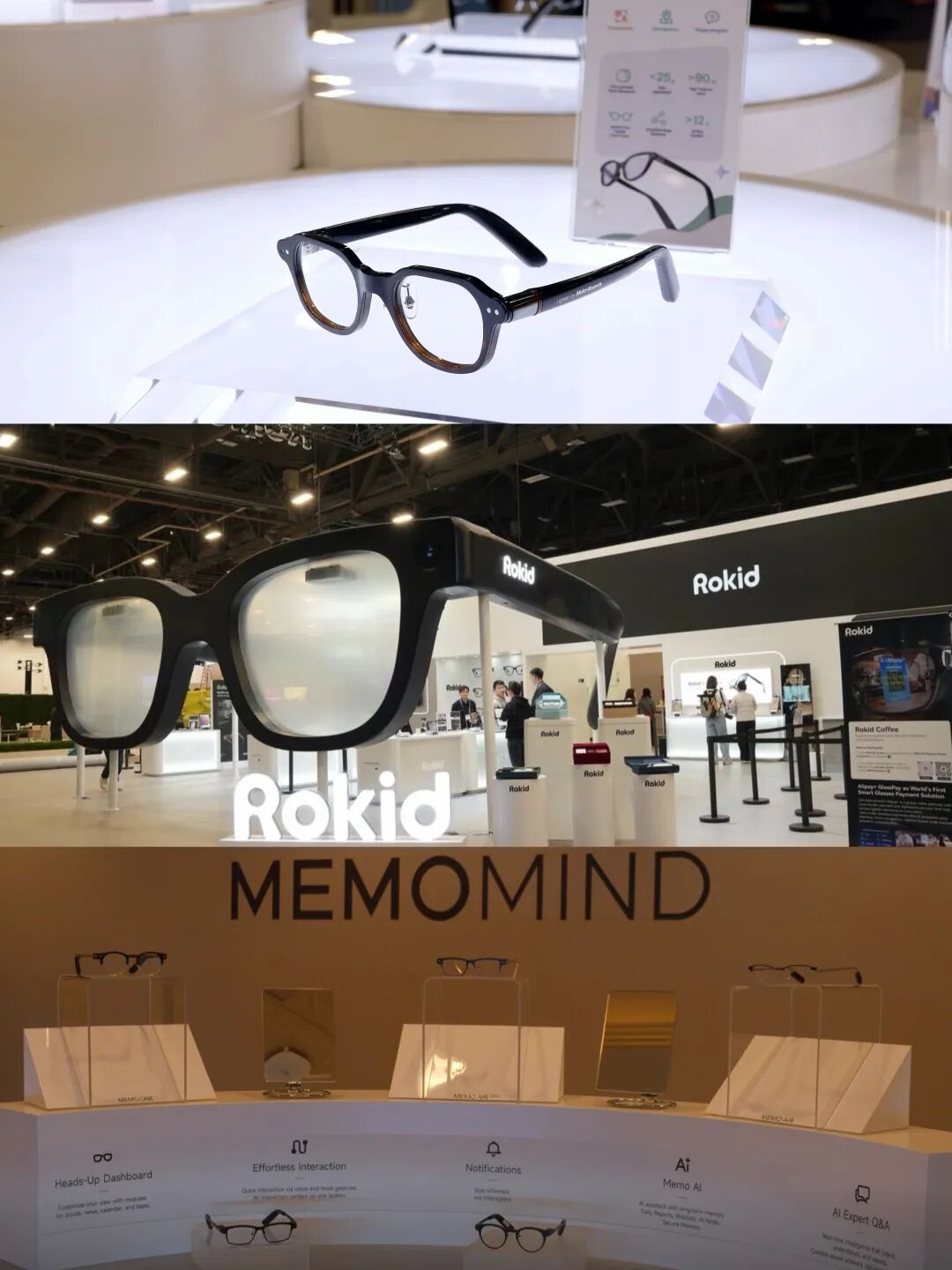
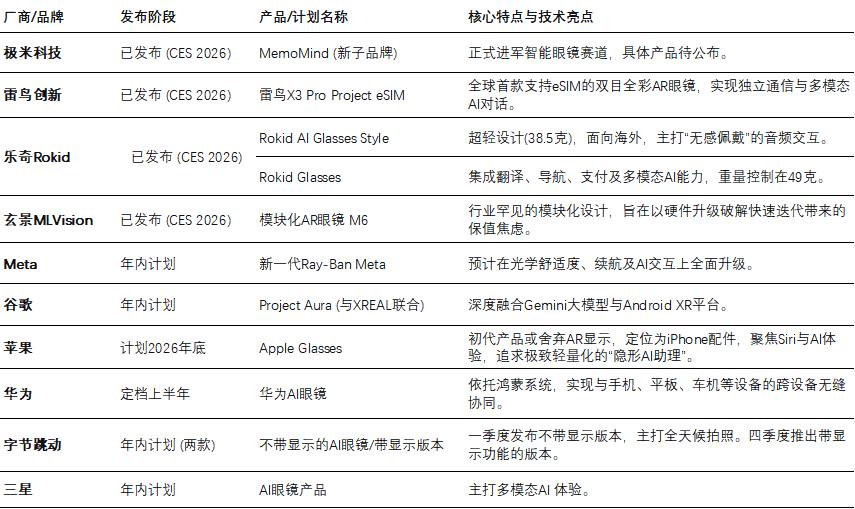
Core Insights - The AI glasses market in 2026 is characterized by intense competition, with numerous companies, including major tech giants and startups, launching new products and strategies, marking a shift from niche gadgets to essential tools for various applications [1][2][4] Group 1: Market Dynamics - The AI glasses market is witnessing a "full-scale war" with major players like Meta, Google, Apple, and domestic companies like Huawei and ByteDance all actively participating [1][2] - The CES 2026 event served as a platform for companies to showcase their innovations, with significant product announcements from various manufacturers [2][4] - The trend of "lightweight" and "independence" is evident, as companies prioritize user comfort and reduce reliance on smartphones through features like eSIM and independent processing capabilities [9][10] Group 2: Product Launches and Innovations - Key product launches include: - XGIMI's MemoMind brand entering the smart glasses market [8] - Thunderbird's X3 Pro Project eSIM, the first dual-lens AR glasses with independent connectivity [8] - Rokid's ultra-light AI glasses weighing only 38.5 grams, emphasizing comfort and audio interaction [8] - Modular AR glasses M6 from Xuanjing, designed for hardware upgrades [3][8] - Meta plans to enhance its Ray-Ban Meta glasses, aiming for improved optical comfort and AI interaction [4][8] - Google's three-step strategy includes launching audio smart glasses and collaborating on Project Aura with XREAL [4][8] - Apple is expected to release Apple Glasses by the end of 2026, focusing on a lightweight design and AI integration [4][8] Group 3: Industry Trends and Drivers - The industry is driven by three main factors: cost reduction in the supply chain, advancements in AI interaction, and growing market demand [10][11] - The rapid decrease in component costs, particularly in chips and optical displays, has made AI glasses more affordable for consumers, with prices now in the 2000-3000 yuan range [11] - The introduction of national subsidies for smart glasses is expected to boost market penetration and consumer adoption [14][15] Group 4: Future Competition Landscape - The competition is shifting from hardware specifications to user experience, ecosystem integration, and technological innovation [16][17] - Companies are focusing on creating compelling reasons for daily use, with examples like Rokid's integration of AI glasses into automotive systems and educational tools [17][18] - The future of the industry will depend on ecosystem development, with companies like Google and Huawei aiming to create comprehensive platforms that integrate AI capabilities and user data [20][21]





库克预告苹果将有前所未见的创新,你期待吗?
Sou Hu Cai Jing· 2026-01-31 14:17
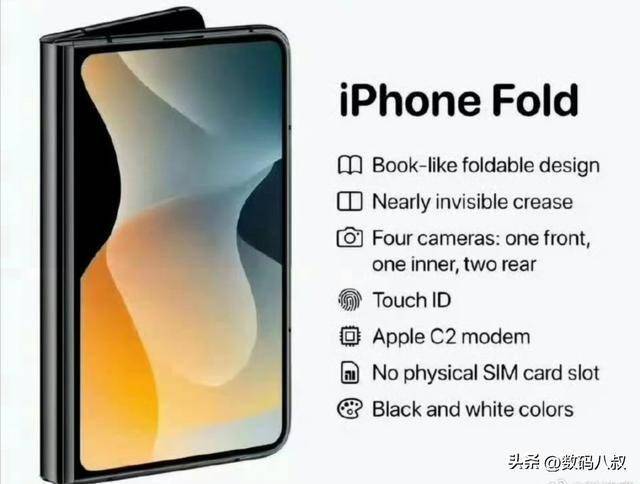
Group 1 - Apple recently launched the new AirTag, maintaining its price at 249 yuan for a single unit and 849 yuan for a four-pack [1] - CEO Tim Cook announced during a conference call that Apple will unveil greater surprises and innovations later this year, with rumors suggesting over 20 new products are set to be released [3] - The recently introduced second-generation AirTag is considered just a precursor to the upcoming innovations [3] Group 2 - There are strong indications that Apple will release its first foldable iPhone in the second half of the year, featuring specifications aligned with the iPhone 18 Pro and iPhone 18 Pro Max, and will debut the new A20 Pro chip [5][7] - The A20 Pro chip will utilize TSMC's latest packaging technology and be manufactured using a 2nm process, enhancing overall performance and efficiency while reducing power consumption [7] - The foldable iPhone is expected to have an outer screen size of 5.5 inches and an inner screen size of 7.8 inches, with advanced features such as a "near-zero crease" effect and self-healing coating technology [9] Group 3 - Samsung Display (SDC) is set to be the exclusive screen supplier for Apple's first foldable phone, planning to ship 11 million units of the iPhone Fold's inner and outer screens, which is over 30% higher than previous expectations [11] - Apple is also reportedly developing its first smart glasses, Apple Glasses, which are expected to be unveiled this year and released next year, designed to work in conjunction with the iPhone and centered around AI Siri [13]
库克放话「前所未见创新」,苹果2026新品矩阵要炸场
Sou Hu Cai Jing· 2026-01-31 14:17
Core Insights - Apple CEO Tim Cook signaled unprecedented innovation for the year, stating that the company's best products are yet to come, raising expectations for new releases in the tech community [1] - The new product lineup is set to deeply integrate into users' daily lives, utilizing breakthrough technologies to reshape hardware experiences and ecosystem connectivity [3] Product Innovations - Apple is preparing over 20 new products this year, spanning mobile phones, PCs, wearables, and smart home devices, featuring both iterative upgrades and entirely new cross-category launches [3] - The foldable iPhone, referred to as iPhone Fold, is a key innovation, expected to debut in the fall with proprietary folding technology and durable panel solutions, aiming to redefine the design paradigm of foldable devices [5] - The PC product line will see significant upgrades, with the new MacBook Pro featuring M6 series chips for enhanced computing power and energy efficiency, optimized for professional creative and AI computing scenarios [7] - A budget version of the MacBook will also be introduced, equipped with the A18 Pro chip, expanding the Mac product range [7] Wearables and Smart Ecosystem - The development of Apple Glasses is accelerating, featuring a lightweight design that integrates AR interaction, audio-visual capabilities, and photography, enhancing the connectivity within the iPhone and Watch ecosystem [8] - The new generation of Apple Watch will upgrade health monitoring algorithms and sensors, adding features for chronic disease tracking and exercise data analysis [8] - New smart home devices, including a central hub and security cameras, will incorporate advanced Siri and Face ID technologies, creating a comprehensive smart home control system [8] Strategic Direction - Apple's focus on self-developed chips and innovative form factors, along with a shift from single-device experiences to a holistic ecosystem, indicates a strategic push for defining the next generation of smart terminals [10] - The anticipated breakthroughs in foldable phones and AI+AR integrated wearables suggest that 2026 will be a pivotal year in Apple's innovation cycle [10]
库克暗示苹果“前所未见”的创新,今年见
Sou Hu Cai Jing· 2026-01-31 12:38
Group 1 - Apple reported its fiscal Q1 2026 earnings, with CEO Tim Cook indicating that the company will unveil significant surprises and innovations later this year [1][3] - There are rumors that Apple will launch over 20 new products this year, with the recently introduced second-generation AirTag being just a preview [3] - Cook emphasized that the best products from Apple are yet to come, expressing confidence in the opportunities ahead for the company [3] Group 2 - Apple is expected to release its first foldable smartphone, the iPhone Fold, in the fall, which will differ in size and form factor from competitors [3] - The company is also developing its first smart glasses, Apple Glasses, which are anticipated to be unveiled this year and shipped next year [3] - The MacBook Pro is set to receive a significant upgrade with the introduction of the M6 chip [3]

库克暗示苹果今年将有“前所未见”的创新
Sou Hu Cai Jing· 2026-01-30 15:33
Core Viewpoint - Apple announced its Q1 FY2026 financial results and CEO Tim Cook hinted at significant upcoming innovations and surprises later this year [1][3]. Product Innovations - Apple is rumored to launch over 20 new products this year, with the recently unveiled second-generation AirTag being just a preview [3]. - Tim Cook stated that the company's best products are yet to come, expressing confidence in the upcoming innovations that will enhance user experiences [3]. - Reports suggest that Apple is expected to release its first foldable smartphone, the iPhone Fold, in the fall, which will differ in size and form factor from competitors [4]. - Additionally, Apple is developing its first smart glasses, Apple Glasses, which are anticipated to be revealed this year and shipped next year, along with a significant upgrade to the MacBook Pro featuring the M6 chip [5].

20亿美元收Q.ai,苹果想让你「无声」地控制 AI
3 6 Ke· 2026-01-30 08:11
Core Insights - Apple is accelerating its efforts in AI, recently completing a nearly $2 billion acquisition of Israeli AI startup Q.ai, marking its second-largest deal since acquiring Beats in 2014 [1][2][5] - Q.ai's technology focuses on analyzing facial micro-expressions and muscle movements to interpret "silent speech," allowing users to communicate intentions without vocalizing [2][8] - This technology is expected to be integrated into future Apple products like AirPods, iPhones, and rumored AI glasses, enhancing private and seamless human-computer interaction [3][5] Group 1: Acquisition Details - The acquisition of Q.ai is a strategic move for Apple to address its lag in generative AI compared to competitors like OpenAI and Google [6][7] - Q.ai's technology aims to solve current voice assistant limitations related to privacy and situational constraints, enabling discreet command input in various environments [8][9] - The founders of Q.ai have a notable background, with co-founder Aviad Maizels previously founding PrimeSense, which developed technology for Apple's Face ID [4] Group 2: Future Product Integration - Q.ai's technology aligns with Apple's future product roadmap, including the anticipated Apple Glasses, expected to launch by late 2026, which will utilize AI and camera integration for enhanced user interaction [16][20] - AirPods are evolving into more than just audio devices, with future versions expected to incorporate features like real-time translation and gesture control, complementing Q.ai's silent speech technology [19][20] - Apple is also rumored to be developing a wearable AI device, "Apple Pin," designed for continuous environmental awareness and interaction with Siri [21][22] Group 3: Industry Trends - The acquisition highlights a trend in AI competition shifting from pure model capabilities to an integrated experience of models, hardware, and interaction [23] - Major tech companies are expected to invest in new interactive hardware, with the focus on creating seamless and natural user experiences [23] - Apple's strategy aims to redefine how devices communicate with users, moving towards an ambient computing era where AI understands subtle user expressions [23][24]
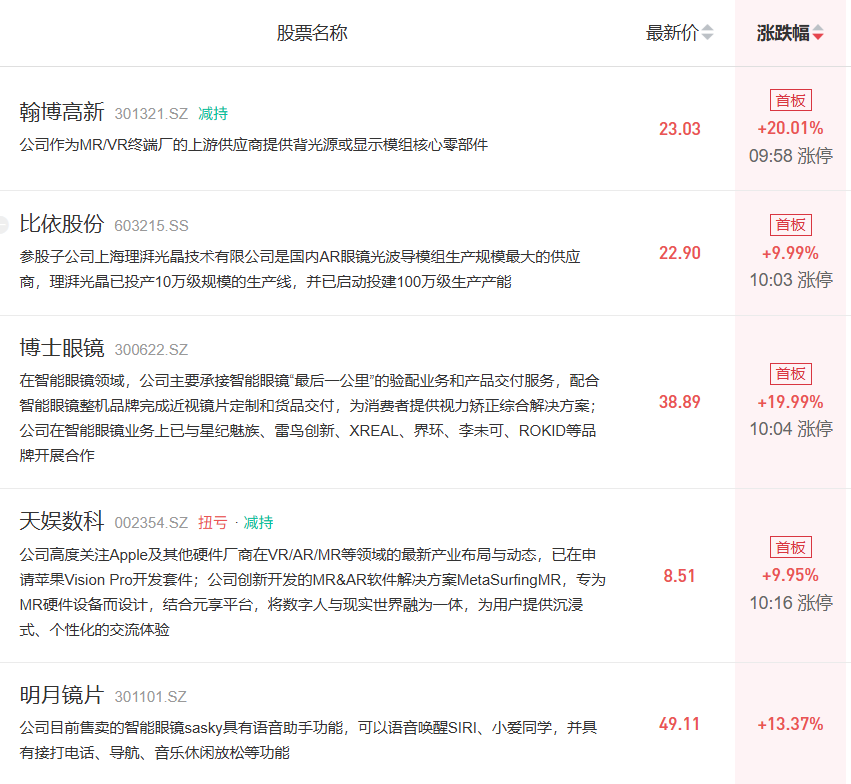
【大涨解读】智能眼镜:Meta计划推动AI眼镜翻倍产能,全球其他巨头也加速布局,有望加速推动其成为AI时代的操作系统入口
Xuan Gu Bao· 2026-01-14 02:37
Market Overview - On January 14, the AI glasses sector experienced a collective surge, with companies like Hanbo High-tech, Biyi Co., and Doctor Glasses hitting the daily limit up, while other firms such as Mingyue Lens and Rainbow Technology also saw significant gains [1] Company Highlights - Hanbo High-tech (301321.SZ) saw its stock price rise to 23.03, an increase of 20.01%, as it provides core components for MR/R terminal manufacturers [2] - Biyi Co. (603215.SS) reached a price of 22.90, up by 9.99%, with its subsidiary being the largest domestic producer of AR glasses waveguide modules, having launched a production line with a capacity of 100,000 units [2] - Doctor Glasses (300622.SZ) reported a stock price of 38.89, increasing by 19.99%, focusing on the last-mile fitting services for smart glasses and collaborating with various brands [2] - Mingyue Lens (301101.SZ) offers smart glasses with voice assistant features, achieving a price of 49.11, up by 13.37% [2] Industry Events - On January 13, Bloomberg reported that Meta suggested EssilorLuxottica SA increase its annual production capacity to 20 million units or more by the end of 2026, with discussions for further expansion to 30 million units if demand remains strong [3] - Major tech companies like Apple, Google, and ByteDance are accelerating their investments in the AI glasses market, with Apple planning to unveil Apple Glasses at WWDC 2026 and ByteDance expected to release its first AI glasses in Q1 2026 [3] Institutional Insights - The AI glasses market is projected to become a high-volume product, with global sales expected to reach 90 million units by 2030, reflecting a compound annual growth rate (CAGR) of 97.42% over six years [4] - The core innovation in AI glasses is driven by generative AI, transforming them from expensive accessories to interactive smart devices, with prices dropping to the consumer-friendly range of around 1,500 yuan [5] - The industry is entering a rapid growth phase, addressing previous issues of high pricing and limited functionality, with over 80% penetration of features like AI dialogue and AR navigation [5]



国泰海通|轻工:CES 2026新品百花齐放,产业趋势明确
国泰海通证券研究· 2026-01-13 13:20
Core Viewpoint - The smart glasses industry is expected to enter a rapid growth phase, with related companies poised to benefit from an upward cycle in market conditions [2]. Group 1: Industry Trends - CES 2026 showcased a variety of new smart glasses from leading Chinese brands such as Thunderbird Innovation, XREAL, Rokid, and others, highlighting a clear industry trend [2]. - Key product highlights include differentiated designs for competitive advantage, innovative multi-core solutions for better performance and power balance, and a focus on niche markets to meet specific needs [2]. - The integration of AI technology is deepening, with products like Looki L1 claiming to automatically record life events and store data locally [2]. Group 2: Future Product Launches - Google plans to launch Project Aura in December 2025 in collaboration with Xreal and is reviving its independent AI glasses project, aiming for a 2026 release [3]. - Apple is concentrating resources on the development of Apple Glasses, expected to be announced at WWDC 2026, which will rely on the iPhone and focus on AI and audio [3]. - Meta is delaying the release of its mixed reality glasses, code-named "Phoenix," to optimize product experience after significant losses in its Reality Labs division [3]. - ByteDance is set to release its first AI glasses in Q1 2026 [3]. Group 3: Market Projections - Global smart glasses sales are projected to reach 1.52 million units in 2024, with a significant increase to 3.5 million units in 2025, representing a 230% year-on-year growth [4]. - The growth is primarily driven by the continued sales of RayBan Meta and the introduction of multiple new AI smart glasses from major manufacturers [4]. - By 2029, global sales are expected to reach 60 million units, with a CAGR of 109% from 2025 to 2029, indicating a substantial market share for China [4].

弃Vision Pro转战AI眼镜?Apple Glasses预计今年发布
Shen Zhen Shang Bao· 2026-01-13 13:18
Group 1 - Apple has reportedly paused maintenance for the Vision Pro in the industrial sector and reduced the production of headsets significantly, indicating a shift in strategy from initial strong promotion to reduced investment due to underwhelming market performance [1] - IDC forecasts that Apple will ship 390,000 units of Vision Pro in 2024, with a drastic drop to 45,000 units in the last quarter of 2025 [1] - Sensor Tower's report reveals that Apple has cut digital advertising spending for Vision Pro by over 95% in key markets like the US and UK over the past year [1] Group 2 - In response to the disappointment with Vision Pro, Apple is shifting focus to the more lightweight AI smart glasses, with the first product, Apple Glasses, expected to launch this year [2] - Apple has entered a multi-year partnership with Google to utilize Google's Gemini model and cloud technology for its next-generation AI models, aiming to enhance its AI capabilities, including a more personalized Siri [2] - IDC predicts that global shipments of smart glasses will exceed 23.687 million units by 2026, with the Chinese market alone expected to surpass 4.915 million units, indicating a move towards scaled growth in the smart glasses market [2]
轻量化“内卷”与eSIM加持下,智能眼镜迎来新纪元?
Guo Ji Jin Rong Bao· 2026-01-08 13:24
Core Insights - The smart glasses industry is expected to transition from a niche market to a mainstream one by 2025, with significant growth in market size and product penetration [1] - Global smart glasses sales are projected to surge by 350.82% year-on-year to 13.448 million units in 2025, with the Chinese market seeing a 159.76% increase to 3.286 million units [2] - The introduction of eSIM technology is anticipated to enhance the functionality of smart glasses, allowing them to operate independently from smartphones [7][8] Market Trends - The CES 2026 showcased smart glasses as a focal point, with 38 exhibition booths dedicated to this category, highlighting the growing interest and competition in the market [4] - Lightweight design has become a core competitive factor, with several companies unveiling ultra-light models, such as Rokid's 38.5g AI glasses and MoJie's 25g AR glasses [5][6] - The integration of eSIM technology is seen as a pivotal development, enabling smart glasses to function as independent communication devices, similar to smartwatches [8] Industry Challenges - The smart glasses industry faces challenges in achieving product differentiation, maintaining lightweight designs, and effectively utilizing AI technology to establish themselves as independent smart devices [3][10] - The competition is expected to shift from a chaotic phase to a more structured one, focusing on quality, technology, and ecosystem capabilities [9] - Key challenges include balancing power consumption, size, and functionality, as well as establishing a robust application ecosystem that creates indispensable use cases for smart glasses [10]