
Apple Watch Ultra 3

Search documents
X @HTX
HTX· 2026-04-06 04:12
🥳 Are you ready?HTX Carnival: $100,000 Prize Pool!🔹Participate by holding $HTX, trading spot, or creating a spot grid bot🔹Users who subscribe to $HTX Flexible Earn could enjoy 4% APY!Register to win generous rewards such as Apple Watch Ultra 3 and AirPods. Who will win?Join NOW: https://t.co/KsNzdf8BaD ...
Apple Expands Wearables Portfolio With New AirPods Max: What's Ahead?
ZACKS· 2026-03-18 16:51
Core Insights - Apple is expanding its Wearables, Home and Accessories portfolio with the launch of AirPods Max 2, amidst increasing competition from Samsung, Alphabet, and Garmin [1][4][9] - In Q1 fiscal 2026, Apple’s Wearables, Home and Accessories sales were $11.49 billion, a decrease of 2.2% year-over-year, accounting for 8% of net sales, and missing the Zacks Consensus Estimate by 5.72% [1][9] Product Features - AirPods Max 2 introduces features such as Adaptive Audio, Conversation Awareness, Voice Isolation, and Live Translation, with Active Noise Cancellation (ANC) being 1.5 times more effective than the previous generation [2][9] - The device is expected to appeal to podcasters, musicians, and content creators due to its studio-quality audio recording and camera remote capabilities [2] Market Performance - Apple’s Wearables, Home and Accessories segment has seen strong adoption of Apple Watch Ultra 3 and Apple Watch Series 11, contributing to a record installed base, with over half of Apple Watch purchasers being new customers [3] - Despite the strong performance in the watch segment, Apple faces stiff competition from Alphabet and Garmin in the wearables market [4] Competitor Analysis - Alphabet's Google Services generated $342.72 billion in 2025, up 12.4% from 2024, benefiting from growth in AI infrastructure, Google Cloud, and Search [5] - Garmin's Fitness segment generated $765.8 million in sales in Q4 2025, up 42% year-over-year, driven by demand for advanced wearables [6] Stock Performance and Valuation - Apple shares have declined 6.5% year-to-date, underperforming the broader Zacks Computer and Technology sector, which dropped 3% [7] - The stock is trading at a forward price/earnings ratio of 28.83X, compared to the sector's 24.18X, indicating a premium valuation [11] - The Zacks Consensus Estimate for fiscal 2026 earnings is $8.41 per share, suggesting a year-over-year growth of 12.7% [12]



Bank of America reveals S&P 500 ‘cheat sheet’
Yahoo Finance· 2026-03-17 23:37
Core Viewpoint - Investors are increasingly cautious about S&P 500 index funds due to geopolitical tensions and rising oil prices, prompting a shift towards sector-specific investments, particularly in energy stocks [2][4][8]. Group 1: S&P 500 Analysis - The S&P 500 index fund, represented by SPDR S&P 500 ETF (SPY), has gained nearly 70% over the past five years, indicating strong long-term performance despite short-term volatility [1]. - A recent analysis by Bank of America shows that the S&P 500 is trading at a higher price ratio to WTI oil than at any other time in history, except during the COVID-19 pandemic and the dot-com bubble [3]. - Analysts believe the S&P 500 has priced in a de-escalation of the conflict with Iran but has not accounted for sustained higher oil prices [4]. Group 2: Sector Recommendations - Bank of America recommends investing in S&P 500 Energy stocks instead of S&P 500 index funds, reflecting a bullish outlook on the energy sector amid rising oil prices [4][8]. - The analysis suggests selling discretionary stocks due to unaccounted short-term equity gains and highlights that the Consumer Staples sector has priced in risks from lower demand due to reduced immigration [5]. - The top five ranked industries identified as attractive opportunities include Passenger Airlines, Metals & Mining, Personal Care Products, and Air Freight and Logistics [7]. Group 3: Economic Implications - The shift in investment strategy away from S&P 500 index funds is seen as prudent, especially in light of concerns regarding the AI bubble and its potential impact on the market [9][10]. - Surging energy prices are expected to negatively affect the tech industry, drawing parallels to historical market behaviors during the dot-com bubble [11].

计算机行业观点:IPHONE20周年展望-20260315
SINOLINK SECURITIES· 2026-03-15 07:50
Investment Rating - The report does not explicitly state an investment rating for the industry Core Insights - The 3D printing technology aligns with ESG demands in the consumer electronics industry, enhancing efficiency and supporting high-end upgrades through material utilization and process simplification [2] - The transition from subtractive to additive manufacturing represents a significant efficiency revolution, allowing companies to reduce their environmental footprint while maintaining product performance and aesthetics [10] - The 3D printing process significantly reduces the need for traditional pollution-intensive surface treatments, thus lowering environmental impact [12] Summary by Sections 1. Why Does the Consumer Electronics Industry Need 3D Printing? - The consumer electronics sector faces dual challenges of carbon reduction and resource efficiency, with 3D printing offering a solution through high material utilization rates and the ability to use recycled materials [10] - Traditional CNC processes have a material utilization rate of only 30%-70%, while 3D printing can achieve over 95% [10] - Companies like Apple are utilizing 100% recycled titanium powder in their products, significantly reducing material usage and supporting sustainability goals [10] 2. What Are the Subsequent Steps in 3D Printing? - Post-processing steps such as polishing and grinding are crucial for achieving the quality standards required in consumer electronics [21] - These processes address surface defects inherent in 3D printed parts, ensuring they meet aesthetic and functional requirements [21] - The choice of post-processing techniques varies based on material type and product application, impacting the final product's quality and market acceptance [24] 3. What Recent Signals Indicate Acceleration in the Industry Chain? - The upstream sector is experiencing significant expansion, with advancements in titanium powder production methods leading to cost reductions and increased demand for 3D printing [31] - The introduction of new technologies in the midstream equipment sector is enhancing production efficiency, enabling the manufacturing of complex components [50] - The consumer electronics sector is poised for large-scale adoption of 3D printing, driven by the need for lightweight and durable components in products like foldable smartphones [60] 4. Related Companies - Key companies mentioned include Huazhu High-Tech, Dazhu Laser, Yujing Co., Lens Technology, Feiwo Technology, Yuhuan CNC, Hassen Co., Huichuangda, Yinbang Co., and Bolite [5]
陆家嘴财经早餐2026年3月9日星期一
Wind万得· 2026-03-08 22:50
Group 1 - The Chinese Foreign Minister Wang Yi emphasized that this year is a "big year" for China-US relations, calling for a suitable environment for high-level exchanges and risk management [3] - The Iranian situation remains a focal point for the market, with significant developments expected from the upcoming meetings of the National People's Congress and the Chinese People's Political Consultative Conference [5] - The recent surge in oil prices, with US crude oil reaching $111 per barrel, is attributed to the near halt of shipping in the Strait of Hormuz, prompting production cuts from Middle Eastern oil-producing countries [4][21] Group 2 - The Chinese National Bureau of Statistics is set to release February CPI and PPI data, with expectations of a significant year-on-year increase in CPI due to the Spring Festival effect [7] - The Shenzhen Stock Exchange is actively preparing for reforms in the ChiNext board to enhance IPO and refinancing inclusivity while improving the quality of listed companies [8] - The recent popularity of multi-asset FOF products has led to a significant increase in public fund issuance, exceeding 220 billion yuan this year, marking a nearly 30% year-on-year growth [9] Group 3 - OpenClaw, an open-source AI intelligent agent, has gained significant attention in the A-share market, with several listed companies responding to its technological adaptations [9][15] - The recent price fluctuations in the oil market are expected to have a substantial impact on various sectors, with analysts predicting a potential rise in oil prices to historical highs if the geopolitical situation does not stabilize [21][22] - The South Korean government is considering implementing a price control system for oil, marking a significant policy shift in response to rising energy prices due to the Middle Eastern conflict [21]

2月9日晚8点锁定京东年货节 潮流数码新年货清单终极放价
Sou Hu Wang· 2026-02-09 03:43
Group 1 - The core theme of the news is the launch of JD's New Year sales event, featuring significant discounts on various digital products to meet consumer demand for new year upgrades [1][13] - The event includes a wide range of products such as projectors, smart wearables, smart home devices, AI glasses, and gaming equipment, with discounts reaching up to 50% [1][13] - Promotions include cash subsidies, interest-free installment plans, and additional gifts with purchases, enhancing the appeal of the offers [1][13] Group 2 - The XGIMI Z6X projector is highlighted as an ideal choice for creating a home theater experience, priced at 1399 yuan, with added benefits like a 2-year warranty and free gifts [3] - Huawei WATCH GT 6 is available for 1222.3 yuan after a 15% subsidy, while Xiaomi Watch 6 is at a historical low of 539 yuan, both offering health and technology features [5] - Smart glasses are gaining popularity among younger consumers, with Xiaomi AI glasses priced at 1849 yuan and Thunderbird viewing glasses at 1099 yuan, both benefiting from subsidies and installment options [7] - For gamers, the Sony PS5 is available for 3149 yuan after a 10% subsidy, along with the Microsoft Xbox controller at 299 yuan, enhancing the gaming experience [9] - Smart home security products like Huawei Smart Lock 2 Pro are offered at 2549.15 yuan with a 15% subsidy, and the Huawei Smart Camera 5i 4K is priced at 189 yuan, providing enhanced home safety [11] - The overall event aims to lower the entry barrier for high-quality digital living, catering to various consumer needs for home upgrades and gifts [13]


Wall Street Lunch: The Biggest Restaurant Chain Hits The States (undefined:MXUGF)
Seeking Alpha· 2026-01-26 20:05
Company Overview - Mixue Ice Cream & Tea, founded in 1997, has become the world's largest restaurant chain by number of locations, surpassing McDonald's and Starbucks [2][3] - The company started as a small ice cream stall targeting students and budget-conscious consumers, and has since expanded its menu to include bubble tea, fruit tea, milk tea, and coffee [3] Expansion Strategy - Mixue has aggressively expanded overseas, particularly in Southeast Asia, operating thousands of locations in countries such as Indonesia, Vietnam, Thailand, Malaysia, and the Philippines [4] - Current growth plans focus on not only opening more shops but also strengthening its supply chain, including new production facilities in Hainan and Henan, and an international supply chain platform in Southeast Asia to support franchisees [4][5] U.S. Market Entry - The company made its North American debut with its first store in Los Angeles in December, followed by two locations in New York [5]



苹果发布新AirTag:连接范围更广 查找更便捷
Xin Lang Cai Jing· 2026-01-26 14:22
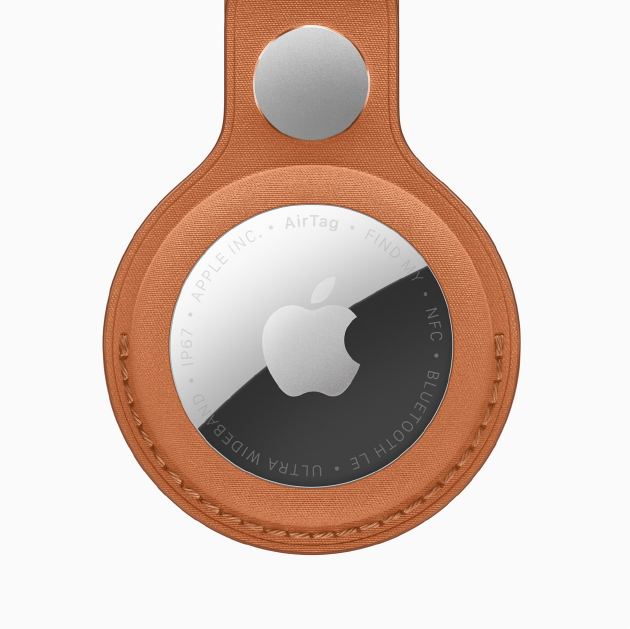
Core Viewpoint - Apple has officially launched an upgraded version of AirTag, enhancing its tracking capabilities and expanding Bluetooth range and speaker volume, allowing users to efficiently track important items through the "Find My" app [1][3]. Product Features - The new AirTag features a second-generation ultra-wideband technology chip, significantly improving location accuracy and expanding the tracking range by up to 50% compared to the previous model [3]. - The speaker volume has been increased by 50%, enabling users to hear the AirTag from twice the distance, making it easier to locate hidden items [5]. - The "Find My" network supports the new AirTag, allowing users to locate their devices and share location information securely with trusted third parties, such as airlines [5][6]. Collaboration and Impact - Apple has partnered with over 50 airlines to enable secure sharing of item location information, which has led to a 26% reduction in delayed luggage and a 90% decrease in lost or unreturnable luggage [6]. - The sharing feature is strictly controlled, ensuring that only authorized personnel can access location data, which is encrypted for privacy [6][7]. Environmental Responsibility - The new AirTag aligns with Apple's 2030 carbon neutrality goals, utilizing 85% recycled plastic for its shell and 100% recycled rare earth elements for its magnets [7]. - The packaging is made from 100% fiber-based materials, promoting recyclability [7]. Pricing and Availability - The new AirTag is priced at 249 RMB for a single unit and 849 RMB for a four-pack, with availability through official channels and retail stores [8]. - Customers purchasing through the official website can enjoy free personalization services [8].
IDC:2025年前三季度全球腕戴设备市场同比增长10%
智通财经网· 2025-12-17 05:51
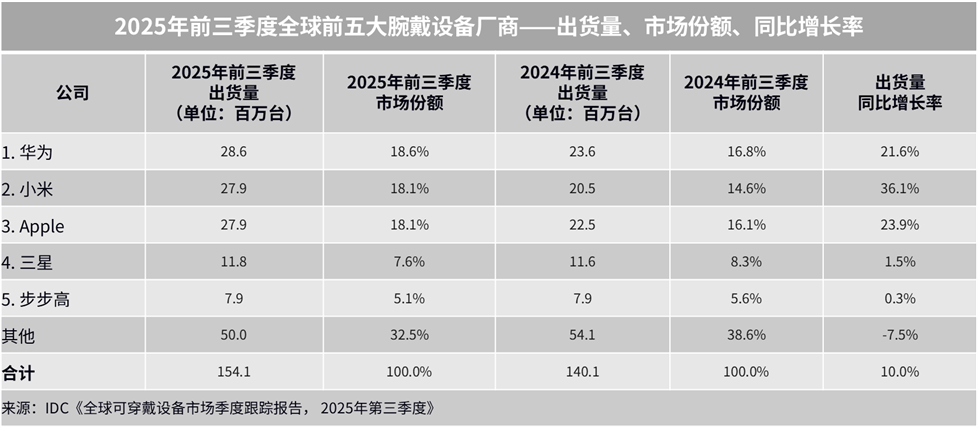
Core Insights - The global wearable device market is projected to ship 150 million units in the first three quarters of 2025, reflecting a year-on-year growth of 10.0% [1] - The Chinese market alone is expected to ship 58.43 million units, marking a significant year-on-year increase of 27.6% [1][9] - Major manufacturers are actively launching new products, which is driving growth in both global and developed markets [1] Global Market Performance - The global smartwatch market is expected to ship 120 million units in the first three quarters of 2025, with a year-on-year growth of 7.3% [1] - The global wristband market is projected to ship 32.86 million units, showing a year-on-year increase of 21.3% [1] - The top five manufacturers in the global wrist-worn device market include Huawei, Xiaomi, Apple, Samsung, and BBK, with Huawei leading at 28.6 million units shipped [3] Company-Specific Insights - **Huawei**: Achieved the highest global shipment volume of 28.6 million units, with a year-on-year growth of 21.6%. The new Watch GT 6 series features significant upgrades and is expanding its overseas market presence [3][4] - **Xiaomi**: Recorded a shipment of 27.9 million units, marking a 36.1% year-on-year increase. The growth is driven by its entry-level products like the Mi Band 10 and Redmi Watch series [4] - **Apple**: Launched three new models in Q3 2025, including the Apple Watch S11, which supports 5G. Apple maintains a strong position in the mid-to-high-end market [5] - **Samsung**: Released the Galaxy Watch 8 series, successfully reversing a decline in shipments earlier in the year [6] - **BBK**: Maintained a strong position in the children's smartwatch market in China, leveraging its brand and product diversity [7] Chinese Market Performance - The Chinese wrist-worn device market is expected to ship 58.4 million units in the first three quarters of 2025, with a year-on-year growth of 27.6% [9] - The top five manufacturers in China include Huawei, Xiaomi, BBK, Apple, and Honor, with Huawei leading at 20.8 million units shipped [9] Future Market Predictions - The Chinese wrist-worn device market is projected to ship 79.58 million units in 2026, with a growth rate of 5.1% [11] - The adult smartwatch segment is expected to grow by 8.2%, while the children's smartwatch market is anticipated to recover in 2026 [11] - The wristband market is expected to continue its growth trajectory, driven by high cost-performance ratios and diverse product offerings [11] Industry Trends - The wearable market is entering a "value competition" phase, with manufacturers focusing on health function upgrades, AI applications, and 5G technology [12] - There is a growing demand across different age groups and a penetration into lower-tier markets, which may unlock long-term growth potential for the industry [12]

华创证券:3C、消费、高端制造等多轮驱动 3D打印发展空间广阔
智通财经网· 2025-12-16 02:03
Core Insights - 3D printing additive technology addresses pain points in traditional manufacturing processes, with significant growth potential driven by 3C, consumer, and industrial sectors [1] - The domestic supply chain for 3D printing equipment and components is rapidly catching up, with consumer-grade products leading in the domestic market [1] Group 1: Industry Overview - 3D printing offers advantages such as reduced product development cycles, efficient formation of complex structures, and higher material utilization compared to traditional manufacturing [1] - According to data from Zhongshan Industrial Research Institute, the distribution of downstream applications in China's 3D printing market shows aerospace accounting for the largest share at 16.7%, followed by medical (15.5%), automotive (14.5%), consumer electronics (11.9%), and academic research (11.2%) [1] - The global 3D printing market is projected to reach $21.9 billion by 2024 and $115 billion by 2034 according to Wohler Associates [1] Group 2: Consumer Electronics - Apple's entry into the 3D printing space is expected to lead the development in the 3C sector, with the introduction of 3D printing processes in products like the iPhone Air and Apple Watch Ultra [2] - The use of titanium in 3D printing is gaining traction due to its lightweight and high-strength properties, with significant advancements in foldable screen technology [2] Group 3: Consumer Market - The application of 3D printing is expanding from industrial to consumer markets, including entertainment and education, with open-source models and community sharing lowering the learning curve [3] - The global consumer-grade 3D printing market is expected to grow from $4.1 billion in 2024 to $16.9 billion by 2029 according to Zhaosheng Consulting [3] Group 4: High-end Manufacturing - 3D printing is enabling breakthroughs in commercial aerospace and nuclear fusion industries by overcoming traditional manufacturing limitations [4] - Major organizations like NASA and SpaceX are utilizing additive manufacturing for critical components in rocket technology [4] Group 5: Supply Chain - Domestic manufacturers of 3D printing equipment and components are rapidly improving their performance, with companies like Plater and Huazhu High-Tech closing the gap with international leaders [5] - In the consumer market, Chinese suppliers dominate the global consumer-grade 3D printer shipment market, accounting for nearly 95% of the total shipments [5]