
Atlas 浏览器

Search documents
Sora关停背后:为啥它没跑成“视频版ChatGPT”?
AI前线· 2026-03-25 04:22
Core Viewpoint - OpenAI's video generation AI, Sora, has been shut down, leading to mixed reactions on social media, with some users lamenting its realistic output while others criticize its copyright and content risks [2][3][8]. Group 1: Sora's Shutdown and Reactions - Sora's closure has garnered over 11 million views on social media, indicating significant public interest [2]. - User comments reflect a divide, with some appreciating Sora's capabilities and others expressing relief at its shutdown due to concerns over copyright and misinformation [3][8]. - The anticipated partnership with Disney, which involved a $1 billion investment and the use of over 200 IPs for Sora, has been jeopardized by the app's closure [13][14]. Group 2: Reasons for Sora's Failure - Sora struggled to achieve the same success as ChatGPT, primarily due to challenges in usage frequency, cost structure, and product form [15][17]. - Despite initial success, with over 1 million downloads in five days, Sora's usage declined significantly, with a 45% drop in downloads by January 2026 [23]. - The cost of video generation is substantially higher than text generation, with estimates suggesting that generating one minute of AI video requires over ten times the computational resources of generating a thousand-word text [26][29]. Group 3: OpenAI's Strategic Shift - OpenAI's decision to shut down Sora may be linked to its preparations for an IPO, with a current valuation of approximately $730 billion and a focus on core products that generate sustainable revenue [32][33]. - The company plans to consolidate its offerings, integrating ChatGPT, Codex, and Atlas into a single desktop application, indicating a shift towards a more streamlined product strategy [36][37]. - The closure of Sora signals OpenAI's intent to prioritize high-frequency, revenue-generating products over experimental ones that incur high costs [35][37].


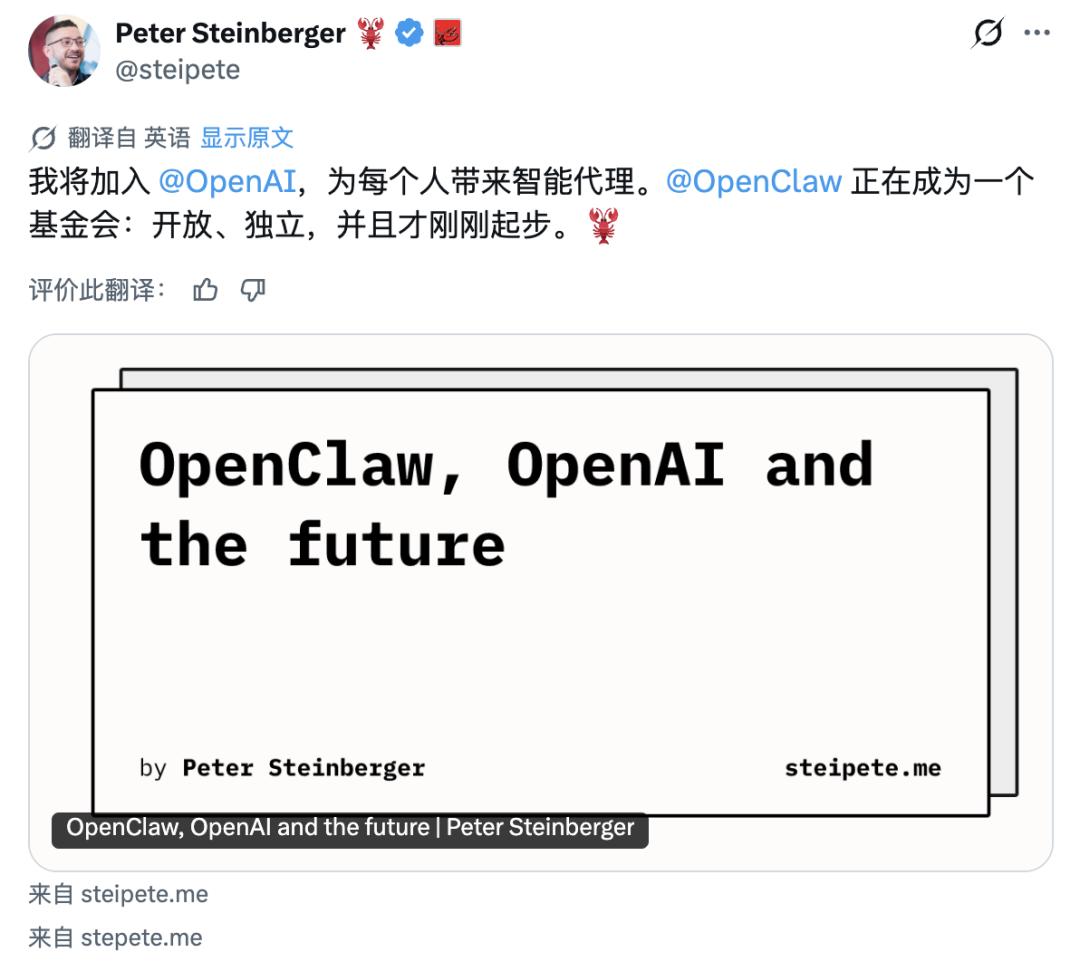
突发,OpenClaw之父宣布加入OpenAI,小扎抢人失败
3 6 Ke· 2026-02-16 01:26
Core Insights - Peter Steinberger, the developer of OpenClaw, announced his decision to join OpenAI, aiming to make intelligent agents accessible to everyone while transitioning OpenClaw to operate as a foundation that remains open-source and independent [1][10]. Group 1: OpenAI's Acquisition Strategy - OpenAI's interest in acquiring Peter Steinberger and his team was driven by the desire to enhance their personal intelligent agent initiatives and other product developments, with discussions about establishing a foundation to manage the OpenClaw project [5]. - The competition for AI talent is intense, with Meta also vying for Steinberger, highlighting the urgency and significance of personal intelligent agents in the current AI landscape [7][9]. Group 2: OpenClaw's Unique Value Proposition - OpenClaw has gained popularity due to its ability to allow users to create powerful AI agents that can control computers and perform complex tasks, distinguishing it from other agents that focus on specific tasks [16]. - Unlike existing products like Anthropic's Claude Code and OpenAI's Codex, which are primarily coding assistants, OpenClaw enables users to access various AI models and grant agents complete access to their computers, making it highly desirable for tech-savvy users [19][20]. Group 3: OpenAI's Challenges with Agent Products - OpenAI's initial predictions regarding the success of their ChatGPT Agent have not materialized, with user engagement dropping significantly from a peak of 4 million weekly active users to below 1 million [22]. - The decline in user engagement is attributed to a lack of understanding of the product's capabilities and the AI model's performance in executing tasks on users' computers, which is central to the agent's value proposition [24][26]. - OpenAI is considering a shift in strategy to develop more specialized agent products to clarify their functionalities and improve reliability, potentially drawing inspiration from the open-source community [24][26].
十月AI行业深度复盘
2025-11-16 15:36
Summary of Key Points from the Conference Call Industry Overview - The conference call focuses on the AI industry, particularly the performance of four major tech giants: Microsoft, Google, Meta, and Amazon, as well as developments in the global AI supply chain and domestic market trends [1][2][8]. Financial Performance of Major Tech Companies - **Overall Performance**: The four tech giants reported a total revenue of $411.4 billion, a year-on-year increase of 16%, and a net profit of $86.6 billion, up 6%. Operating cash flow reached $159 billion, reflecting a robust cash generation capability, up 37.6% [1][8]. - **Microsoft**: Reported quarterly revenue of $77 billion, a growth of 18%, and a net profit of $27.7 billion, up 12%. Intelligent cloud revenue was $30.9 billion, increasing by 28% [1][11]. - **Google**: Achieved quarterly revenue of $102.3 billion, exceeding expectations, with an operating profit of $31.2 billion, up 9%, and a net profit of $35 billion, up 33% [1][11]. - **Meta**: Third-quarter revenue was $51 billion, a 26% increase, but net profit fell 83% due to a one-time non-cash tax item [1][14]. - **Amazon**: Reported total revenue of $180.2 billion, a 13% increase, but operating profit of $17.4 billion fell short of expectations [1][14]. AI Commercialization and Developments - **Google's AI Commercialization**: Google demonstrated significant advancements in AI commercialization, with a token consumption rate of 7 billion per minute and monthly active users of related applications reaching 650 million, a 300% increase [1][13]. - **Anthropic and OpenAI**: Anthropic raised its 2025 revenue forecast to $4.7 billion, a 26% increase, with API and related services as major revenue sources. OpenAI launched new products and aims to create a flow entry point with ChatGPT [2][5][15][16]. Capital Expenditure Trends - **CSP Capital Expenditure**: The capital expenditure of the four major cloud service providers (CSPs) showed strong growth, with Microsoft at $34.9 billion (up 75%), Google at $24 billion (up 83%), Meta at $19.4 billion (up 111%), and Amazon at $35.1 billion (up 55%). Total capital expenditure is expected to exceed $360 billion in 2025, a nearly 60% year-on-year increase [4][8]. Domestic Market Outlook - The domestic AI industry is expected to replicate the current development status of the U.S. by 2026, with major players like ByteDance and Alibaba likely to expand into international markets [2][6][21]. Future Trends and Investment Opportunities - The AI sector is anticipated to enter a competitive arms race, with companies striving to become the dominant players in future operating systems. Key developments will focus on enhancing model accuracy and user engagement [18][19]. - Investment opportunities are seen in large models and cloud computing firms like Alibaba, with a strong emphasis on domestic computing power and increasing government support [22][23]. Conclusion - The overall sentiment is optimistic regarding the growth potential of the AI industry, with significant advancements in technology and commercialization strategies being observed among leading companies. The domestic market is poised for substantial growth, mirroring international trends and expanding into new markets.




通信行业周观点:AIDC多项合作推进,OCS产业加速落地-20251028
Changjiang Securities· 2025-10-27 23:30
Investment Rating - The report maintains a "Positive" investment rating for the communication industry [10]. Core Insights - The communication sector saw an increase of 11.43% in the 43rd week of 2025, ranking first among major industries in the Yangtze River region. Year-to-date, the sector has risen by 67.97%, also ranking first [2][5]. - Anthropic and Google are collaborating to deploy up to 1 million TPUs, with an expected investment of several hundred billion dollars, aiming for a launch of over 1 GW computing cluster by 2026 [6]. - The introduction of OCS switch cabinets in Google's Ironwood super node architecture indicates a rapid advancement in the OCS industry, supported by significant orders for yttrium vanadate from Tengjing Technology [6][8]. - NVIDIA is considering providing guarantees for loans to OpenAI to support its data center expansion, with a total funding support of up to $100 billion planned for the construction of at least 10 GW AI computing clusters [7][8]. Summary by Sections Market Performance - In the 43rd week of 2025, the communication sector increased by 11.43%, leading the Yangtze River region's major industries. Since the beginning of the year, the sector has risen by 67.97% [2][5]. Key Collaborations and Developments - Anthropic's partnership with Google aims to deploy 1 million TPUs to meet the growing demand for AI model training and inference, with a project investment expected to reach hundreds of billions of dollars [6]. - The OCS industry is accelerating, as evidenced by Tengjing Technology's significant order for yttrium vanadate, which is crucial for the OCS technology [6]. AI and Computing Expansion - NVIDIA's potential loan guarantees for OpenAI are part of a broader strategy to support the expansion of AI computing capabilities, with OpenAI also launching the Atlas browser featuring integrated ChatGPT functionalities [7][8]. Investment Recommendations - The report recommends several companies across various segments, including: - Telecom Operators: China Mobile, China Telecom, China Unicom - Optical Modules: Zhongji Xuchuang, Xinyi Sheng, Tianfu Communication - Liquid Cooling: Yingweike - Hollow Core Fiber: Fenghuo Communication, Hengtong Optic-Electric - Domestic Computing: Runze Technology, Guanghuan New Network - AI Applications: Boshi Jie, Heertai, Tuobang Co., Yiyuan Communication - Satellite Applications: Huace Navigation, Haige Communication [8].






怎么看OpenAi的AI浏览器Atlas?
2025-10-22 14:56
Summary of OpenAI's AI Browser Atlas Conference Call Company and Industry - The conference call discusses OpenAI and its newly released AI browser, Atlas, which integrates advanced AI technologies to enhance user experience and functionality [1][2][4]. Core Points and Arguments - **Integration of ChatGPT**: Atlas browser features built-in ChatGPT, allowing seamless user interaction without frequent model switching, thus avoiding performance lags [2][4]. - **Agent Mode**: The browser employs an Agent mode that personalizes user interactions by remembering browsing history and operational details, enhancing contextual assistance [2][4]. - **Data Precision**: OpenAI collaborates with well-known service providers to ensure data accuracy, moving beyond simple OCR technology for page information extraction [2][5]. - **User Base**: Atlas has over 1 million daily active users, with more than 70% being professional consumers who create their own services using OpenAI's tools [8][10]. - **Security Features**: The browser automatically identifies and blocks phishing links, malicious tracking, and unwanted downloads, enhancing user privacy and security [6][10]. - **Developer Support**: OpenAI provides SDKs, Agent Keys, and Codex to lower technical barriers for developers, fostering an open ecosystem for service integration [7][10]. - **Membership Model**: OpenAI's strategy includes a membership system for advanced services, which has successfully attracted existing paid users and new customers seeking enhanced features [10][11]. Additional Important Content - **Future Operating System Entry**: OpenAI aims to position Atlas as a potential entry point for future operating systems, leveraging its advanced model capabilities and strong developer ecosystem [11][12]. - **Challenges for PC Browsers**: The transition of PC browsers to primary entry points faces challenges due to user preferences for mobile devices and potential conflicts with mobile manufacturers [14][15]. - **Cost Management**: Atlas's development requires high standards across various dimensions, including model capabilities and ecosystem partnerships, to ensure user experience despite higher costs [12][13]. - **Multimodal Recognition**: OpenAI addresses the high computational costs associated with multimodal recognition through model optimization and intelligent resource allocation [18][19]. - **Potential Killer Applications**: OpenAI's strengths in large models and developer integration position it well for creating killer applications, particularly through Agent-based solutions and hardware devices [20].