Atlas 900 A3 SuperPoD

Search documents
国产算力大涨,V4给英伟达新一轮DS冲击?
3 6 Ke· 2026-02-27 11:32
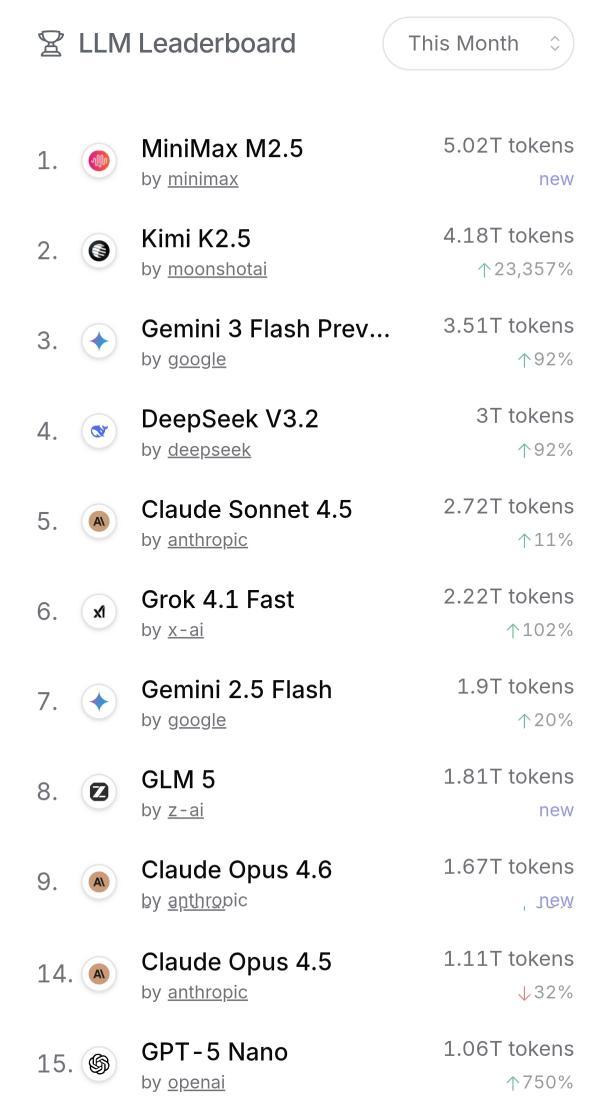
Group 1 - The core point of the article is that Chinese large models have surpassed American models in token usage, marking a significant milestone in the AI industry [1][2][13] - From February 9 to 15, 2023, the token call volume for Chinese models reached 41.2 trillion, surpassing the U.S. models at 29.4 trillion, and further increased to 51.6 trillion in the following week, a 127% rise [1] - The newly released MiniMax M2.5 achieved a token call volume of 45.5 trillion, becoming the monthly champion on OpenRouter [1][2] Group 2 - The rise of domestic computing power is breaking the monopoly of Nvidia, with significant investments in production capacity from local wafer manufacturers [3] - HW Ascend is accelerating its product launches, with the Ascend 950PR and 950DT expected in Q1 and Q4 of 2026, respectively, enhancing the capabilities of the Atlas 900 A3 SuperPoD [3] - The integration of domestic models, computing power, and China's electricity supply forms a competitive advantage that is difficult to replicate [3][4] Group 3 - The essence of AI is power consumption, which is fundamentally linked to chip computation and electricity supply [4] - China's leading position in power infrastructure and clean energy supports the growth of computing power, which in turn drives the iteration of large models [4] - The collaboration between HW Ascend and domestic manufacturers enhances the competitive edge of the domestic ecosystem [5] Group 4 - HW Ascend's public testing of the CodeArts AI development tool lowers the entry barrier for AI development, increasing participation in the ecosystem [7] - HW Ascend is actively defining global AI standards by joining the Linux Foundation's AAIF, positioning its chip architecture within global technology norms [7] - Nvidia's recent financial report showed strong revenue but resulted in a significant stock drop, attributed to market concerns over its growth sustainability and competition from emerging players [8][12] Group 5 - The "halo effect" in the AI industry is driven by strong demand for AI infrastructure and the rapid evolution of AI applications, impacting the software sector [10] - Key investment opportunities are identified in four areas: AIDC cloud services, domestic computing power, core segments of the global AI computing industry, and the "optical-electrical-material" triangle in AI infrastructure [10][12] - The "optical-electrical-material" triangle represents a high-demand segment, with increasing requirements for optical communication and power supply as AI computing needs grow [10][12] Group 6 - The overall trend indicates that the global AI industry landscape is being restructured, with China emerging as a significant player rather than merely a follower [13] - The era of domestic large models and computing power is just beginning, highlighting the importance of these developments in the global AI context [13]


阿里自研高端AI芯片正式上线,科创芯片设计ETF易方达(589030)最新单日净流入近8300万元
Xin Lang Cai Jing· 2026-01-29 03:10
Group 1 - The core viewpoint of the news highlights the active trading and significant inflow of funds into the E Fund Sci-Tech Chip Design ETF (589030), with a turnover of 10.97% and a transaction volume of 46.7362 million yuan as of January 29, 2026 [1] - As of January 28, the latest scale and share of the E Fund Sci-Tech Chip Design ETF reached a new high since its establishment, with a net inflow of 82.7062 million yuan [1] - Over the past five trading days, there have been net inflows on four days, totaling 141 million yuan, indicating strong investor interest [1] Group 2 - Alibaba has launched its self-developed high-end AI chip "Zhenwu 810E," marking a significant step in its vertical integration strategy, with the chip featuring 96G HBM2e memory and already deployed in multiple clusters for over 400 clients, including State Grid and the Chinese Academy of Sciences [1] - The emergence of super node server clusters is accelerating the penetration of domestic AI infrastructure, with the Huawei Atlas 900 A3 SuperPoD cluster achieving 1.7 times the total performance of NVL72 and a memory capacity 3.6 times greater, with over 300 sets deployed by September 2025 [2] - The newly released Atlas 950 and 960 SuperCluster have achieved scales of over 500,000 and 1 million cards respectively, indicating a systemic leap in domestic AI computing capabilities [2]
智融·创变·未来——媒体融合技术展探访见闻
Zhong Guo Jin Rong Xin Xi Wang· 2025-10-13 11:53
Core Insights - The 2025 Media Integration Development Conference in Ordos showcased the latest breakthroughs and applications in media integration technology, emphasizing its role as a platform for innovation and industry foresight [1] Group 1: Media Integration Technology - The "Media Integration Technology Exhibition" highlighted cutting-edge technologies and their applications, featuring top institutions and companies such as China Unicom, Huawei, and Baidu, which collectively illustrate the profound transformation in the media landscape [1] - The exhibition demonstrated that media integration technology has expanded beyond information dissemination to core aspects of social management and services, showcasing its potential to enhance community governance [2] Group 2: Innovative Solutions - China Unicom's "Grassroots Smart Governance Platform" exemplifies how technology can empower community governance, integrating services, publicity, and education into a digital platform for grassroots party-building efforts [2] - The Xinhua Finance Professional Terminal, developed by China Economic Information Service and China Electronic Cloud, represents a new paradigm in financial information services, utilizing a comprehensive AI architecture to address practical challenges in business scenarios [2] Group 3: Advanced Technologies in Media Production - The National Key Laboratory for Media Integration Production Technology showcased advanced technologies such as big data and AI, with tools like "Xinhua Miaobi" providing intelligent writing support for public officials [3] - Huawei's OceanStor Pacific 9928 storage solution and Atlas 900 A3 SuperPoD computing power are designed to enhance the entire media production process, facilitating the integration of hardware and intelligent applications [4] Group 4: Industry Ecosystem - The exhibition revealed a collaborative media integration ecosystem, with companies like Yonyou and Zhongke Wenge providing robust information support and decision-making services, respectively, indicating a shift towards a more integrated and synergistic media industry [5] - The event underscored that media integration is a crucial path for the high-quality development of the media industry, reflecting how technology is reshaping media forms and expanding their functions [5]



昇腾AI:引领超节点+集群时代:AI算力卖水人系列(8)
Guohai Securities· 2025-09-28 13:35
Investment Rating - The report maintains a "Recommended" rating for the computer industry [1] Core Insights - The report addresses key issues such as the parameters of Huawei's next-generation Ascend processors, supernodes, and cluster solutions compared to NVIDIA, the core components of the Huawei Ascend ecosystem, and the changes in demand within the AI computing industry, highlighting how Huawei's Ascend benefits from the localization of AI chips [5][7] - Huawei's Ascend AI chips are positioned as the first globally to cover all scenarios, with the CloudMatrix 384 cluster solution based on the Ascend 910C processor. As of September 18, 2025, over 300 units of the Atlas 900 A3 SuperPoD supernode have been deployed [5][24] - The report emphasizes the growth potential of the AI computing industry, driven by increasing demand from cloud service providers (CSPs), sovereign nations, and AI inference, alongside the push for domestic chip production due to escalating U.S. sanctions [7][9] Summary by Sections Section 1: Ascend Chips - The Ascend processors are based on Huawei's Da Vinci architecture, optimized for matrix operations, and are the foundation for Ascend computing products, offering high computing power, energy efficiency, and flexibility [15] - The report outlines a roadmap for the Ascend processors, with annual releases expected to double computing power each year [5][17] Section 2: AI Computing Infrastructure - Huawei's AI computing solutions, including the Atlas series, provide a comprehensive infrastructure for AI applications across various scenarios, covering the entire process of deep learning inference and training [18] - The report highlights the deployment of the Atlas 900 A3 SuperPoD, which integrates 384 Ascend 910C NPUs and 192 Kunpeng CPUs, achieving a computing capacity of 300 PFLOPS [24][26] Section 3: Market Demand and Trends - The report notes that NVIDIA anticipates global AI capital expenditures to reach $3-4 trillion over the next five years, with significant growth expected in AI inference markets [7] - The localization of AI chips in China is accelerating, with domestic brands accounting for approximately 30% of the market share as of 2024 [7] Section 4: Competitive Positioning - Huawei's Ascend aims to become the second choice globally for AI computing power, competing directly with NVIDIA through its comprehensive software and hardware ecosystem [5][9] - The report identifies key players in the AI chip and server markets, including companies like Haiguang Information, Cambricon, and major server manufacturers [10]
【招商电子】国产算力芯片链深度跟踪:华为披露AI芯片3年规划,国内自主可控加速发展
招商电子· 2025-09-19 15:21
Core Viewpoint - Huawei's Full Connect 2025 Conference showcased the Lingqu Unified Interconnection Protocol, announcing the launch of Ascend 950/960/970 and Kunpeng 950/960 over the next three years, highlighting the gradual enhancement of domestic AI computing chip capabilities amid US-China tensions [9][58]. Group 1: AI Computing Chip Development - The Ascend NPU roadmap includes the release of Ascend 950 (PR and DT versions) in 2026, followed by 960 in 2027 and 970 in 2028, with significant performance improvements [15][20]. - The Kunpeng CPU will see the launch of Kunpeng 950 in late 2026 and Kunpeng 960 in early 2028, supporting advanced computing needs [20][34]. - Domestic chip manufacturers like Haiguang and Cambricon are projecting substantial revenue growth, with Haiguang targeting a CAGR of 44% over three years [3][58]. Group 2: Advanced Manufacturing and Semiconductor Industry - The domestic lithography machine industry is focusing on complete machines and related components, with expectations for advanced process expansion by 2026 [3][59]. - The domestic semiconductor industry is expected to benefit from the acceleration of independent and controllable demands, particularly in advanced logic and storage production lines [3][62]. Group 3: Storage and Edge Computing - The demand for inference and edge computing storage is increasing, with significant growth expected in AI PCs, smartphones, and wearable devices by 2026 [4][58]. - Domestic manufacturers are enhancing their enterprise storage product lines, with companies like Jiangbolong and Baiwei Storage launching new enterprise-level solutions [4][58]. Group 4: Investment Recommendations - Investment opportunities are suggested in AI computing chips, high-end chip manufacturing, packaging, storage, and related equipment and materials [5].
半导体设备ETF(159516)涨超1.5%,行业技术突破或将催动发展
Mei Ri Jing Ji Xin Wen· 2025-08-13 02:55
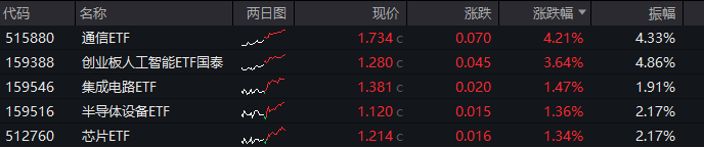
Group 1 - The core viewpoint of the article highlights the introduction of the AI computing cluster solution Cloud Matrix 384 at the WAIC2025 conference, which utilizes a fully interconnected topology for efficient collaboration [1] - The Atlas 900 A3 SuperPoD features a super-node architecture with ultra-large bandwidth of 392GB/s, ultra-low latency of less than 1 microsecond, and exceptional performance of 300 PFLOPs, enhancing the training performance of models like LLaMA3 by over 2.5 times compared to traditional clusters [1] - The Ascend 910C outperforms NVIDIA's GB200 NVL72 in system-level BF16 computing power (300 PFLOPS), HBM capacity (49.2TB), and bandwidth (1229TB/s) [1] Group 2 - The semiconductor equipment ETF (159516) tracks the semiconductor materials and equipment index (931743), focusing on the materials and equipment sectors within the semiconductor industry, covering companies involved in manufacturing, processing, and testing [1] - The index constituents are primarily companies with significant technological advantages and core competitiveness in semiconductor materials and equipment, aiming to reflect the overall performance and industry development trends of listed companies in this segment [1] - Investors without stock accounts can consider the Guotai Zhongzheng Semiconductor Materials and Equipment Theme ETF Initiated Link A (019632) and Link C (019633) [1]
你相信“光”吗?“光模块ETF”哪里找?通信ETF(515880)中光模块占比超40%
Mei Ri Jing Ji Xin Wen· 2025-07-30 01:33
Group 1: Market Trends - AI computing hardware sector showed significant gains on July 29, driven by increased capital expenditure from overseas cloud vendors and a release of performance results [1] - Google's Q2 earnings report revealed an increase in annual capital expenditure to $85 billion, primarily for AI servers and data center construction, with cloud computing revenue reaching $13.6 billion, a 32% year-over-year increase [2] - The ongoing trade negotiations between China and the U.S. in Stockholm may lead to a reduction in trade conflicts, which could benefit domestic optical module companies [3] Group 2: Domestic Developments - At the recent World Artificial Intelligence Conference, companies like Huawei and ZTE showcased advancements in AI computing infrastructure, indicating steady improvements in domestic capabilities [2] - Huawei presented its Ascend 384 super node machine, while ZTE displayed a super node server designed for large-scale model training and inference [2] Group 3: Investment Opportunities - Investors are encouraged to consider communication ETFs (515880) and the ChiNext AI ETF (159388) for potential investment opportunities in the optical module sector [1][7] - Public funds have shown an increase in holdings in the communication sector, with a rise in the top ten holdings' proportion to 3.61%, marking a shift from underweight to overweight [3]
Where is Nvidia? Chinese rivals take the limelight at major AI event in Shanghai
CNBC· 2025-07-28 08:53
Core Insights - Huawei showcased its Ascend chips and AI system at the World AI Conference in Shanghai, highlighting its competitive position in the AI chip market [1][4] - Nvidia, despite previous hopes of re-entering the Chinese market with its H20 chips, did not participate in the conference, indicating potential challenges in its relationship with China [2][3] Group 1: Huawei's Developments - Huawei presented its new computing system, the "Atlas 900 A3 SuperPoD," which connects 384 Ascend chips for AI model training [4] - The Ascend chips, while individually less powerful than Nvidia's Blackwell chips, compensate by utilizing five times more chips in their system compared to Nvidia's GB200 [4] Group 2: Competitive Landscape - Nvidia's absence at the conference contrasts with Huawei's prominent display, emphasizing the latter's growing influence in the Chinese AI market [2][3] - Other Chinese companies, such as Moore Threads and Yunsilicon, also participated in the AI expo, indicating a competitive environment in the semiconductor industry [5]