Blackwell B300芯片

Search documents
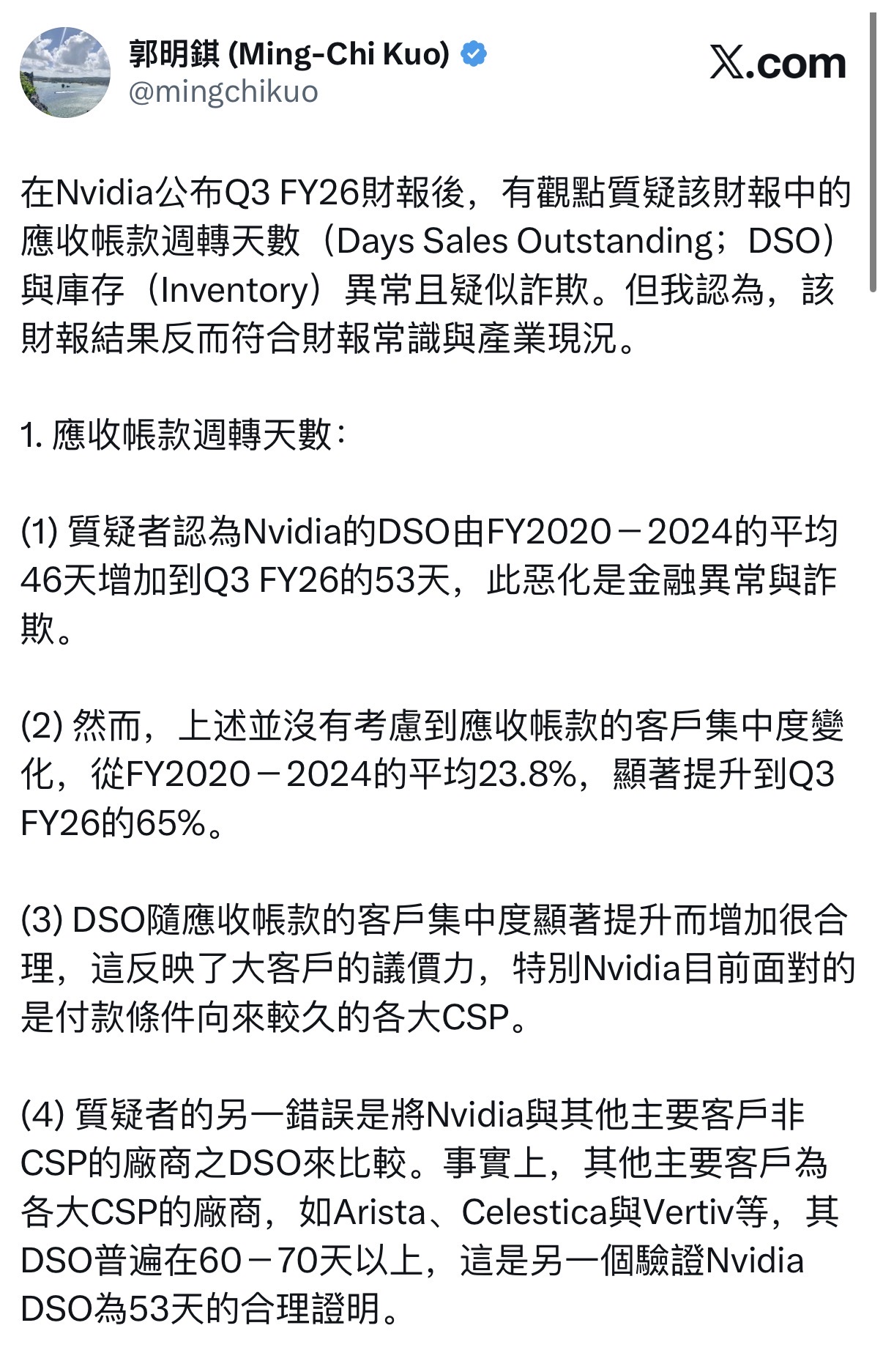
英伟达出击回应空头质疑,郭明錤力挺财报合规
Jin Shi Shu Ju· 2025-11-25 10:11
Core Viewpoint - Nvidia has become a focal point in discussions regarding the value of AI and related stocks due to a series of stock sell-offs and accounting fraud allegations, prompting the company to respond to market skepticism with a detailed memo addressing twelve key concerns raised by investors [1][2]. Group 1: Nvidia's Response to Investor Concerns - Nvidia's investor relations team sent a seven-page memo to Wall Street analysts addressing various doubts, including a response to Michael Burry's criticism regarding stock-based compensation dilution and stock buybacks, clarifying that the total amount spent on share repurchases since 2018 is $91 billion, not the $112.5 billion claimed by Burry [2]. - The memo also refuted allegations comparing Nvidia's situation to historical accounting fraud cases, asserting that the company's core business fundamentals are strong and its financial reporting is transparent, emphasizing that it does not use special purpose entities to hide debt or inflate profits [2]. - Nvidia addressed concerns about the economic value of its hardware, stating that customers set GPU depreciation periods based on actual usage, with older models like the A100 still generating significant profits, contrary to claims that their economic lifespan is only 2 to 3 years [2]. Group 2: Analyst Insights on Financial Metrics - Analyst Ming-Chi Kuo stated that Nvidia's financial results align with industry norms, countering claims of anomalies in accounts receivable turnover days (Days Sales Outstanding, DSO) and inventory levels [3]. - Kuo explained that the increase in DSO from an average of 46 days (2020-2024) to 53 days in Q3 2026 is reasonable due to a significant rise in customer concentration from 23.8% to 65%, reflecting the bargaining power of major customers [4]. - Regarding inventory, Kuo clarified that the reported 32% increase in inventory for Q3 2026 is consistent with industry trends and that the majority of the inventory consists of work-in-progress items, indicating preparations for strong demand for the new Blackwell B300 chip [6].


大幅上调英伟达目标价,这家大行的理由:台积电产能分配远超预期,OpenAI“闭环交易”
美股IPO· 2025-10-16 08:08
Core Viewpoint - HSBC upgraded Nvidia's rating to "Buy" and raised the target price from $200 to $320, indicating a potential upside of 78% based on two key signals [3][4]. Group 1: Capacity Allocation and Revenue Projections - Nvidia's allocation for TSMC's CoWoS advanced packaging capacity is expected to increase from 480,000 wafers to 700,000 wafers in fiscal year 2027, representing a year-on-year growth of 140% [4][5]. - The adjustment in capacity allocation is projected to drive Nvidia's data center revenue to $351 billion for fiscal year 2027, which is 36% higher than the market consensus of $258 billion [3][4]. - In an optimistic scenario, if capacity reaches 800,000 wafers, data center revenue could potentially reach $390 billion, corresponding to an earnings per share of $9.68, which is 11% higher than the baseline scenario [5]. Group 2: AI Market and Revenue Opportunities - The report highlights a significant "closed-loop transaction" involving Nvidia's investment of up to $100 billion in OpenAI, which has signed a $300 billion five-year partnership with Oracle to deploy Stargate capacity, with Oracle purchasing GPUs from Nvidia [6][7]. - The estimated revenue opportunity from the Stargate and OpenAI commitments is projected to be between $251 billion and $400 billion, nearly double Nvidia's current fiscal year 2027 forecast [6][7]. - Different chip generations have varying power consumption, leading to different revenue projections based on chip type, with potential revenues ranging from $2.51 billion to $400 billion depending on the chip used [7].
这颗明星芯片,大缺货?
半导体芯闻· 2025-09-03 10:50
Core Viewpoint - Nvidia clarifies rumors regarding the shortage of its H100 and H200 AI chips, stating that it has sufficient inventory to meet all orders [2][3] Group 1: Supply Chain and Inventory - Nvidia emphasizes that it can fulfill all orders for H100 and H200 chips despite market rumors of shortages [2] - The company denies that restarting production of the H20 chip will affect the supply of H100, H200, or the next-generation Blackwell chips [2] Group 2: Market Reactions and Stock Performance - On September 2, Nvidia's stock fell by 1.95% to $170.78, with an intraday drop of 4%, influenced by shortage rumors and broader market pressures [2] - The uncertainty surrounding tariffs imposed by the Trump administration and rising U.S. bond yields are contributing factors to the stock's performance [2] Group 3: Strategic Developments in China - Nvidia is halting production of the H20 chip designed for Chinese companies and is developing a new product tailored for AI data centers, which will be a lower-performance version due to U.S. government requirements [5][6] - The company is in discussions with the Trump administration regarding the approval of this new chip for sale to China [5] Group 4: Geopolitical Considerations - There are divisions within the U.S. government regarding the sale of AI chips to China, with concerns about national security and maintaining a competitive edge in AI technology [6][7] - Nvidia's CEO expresses surprise at the security concerns raised by Chinese officials, asserting that there are no backdoor functions in their chips [7][8] Group 5: Future Outlook - Nvidia is expected to release its quarterly earnings report soon, which is anticipated to significantly impact the market [8]