
CCL(覆铜板)

Search documents
建筑建材-一线反馈及近况梳理
2026-03-16 02:20
Summary of Key Points from Conference Call Records Industry Overview - **Industry**: Electronic Fabric and Cleanroom Engineering - **Key Companies**: 亚翔集成 (Axon Integrated), 台积电 (TSMC), 美光科技 (Micron Technology), 巨石集团 (Jushi Group), 国际复材 (International Composites), 泰山玻纤 (Taishan Fiberglass), 日东纺 (Nitto Denko) Core Insights and Arguments Electronic Fabric Market - **Price Trends**: The average price of ordinary electronic fabric reached 5.7 RMB/m in March 2026, with expectations to approach 7 RMB/m in the first half of the year [1][5] - **Supply Constraints**: A significant supply gap of 10% exists due to the shift of weaving machine capacity towards high-end products, limiting new capacity investments due to high precious metal costs [1][4] - **High-End Fabric Localization**: The domestic production of high-end fabrics is accelerating, with a 20% price advantage over Japanese products, indicating potential for price increases [1][7] - **AI Hardware Impact**: The upgrade of AI hardware, particularly the Rubin platform, is driving demand for high-end fabrics, leading to non-linear price increases for copper foil and fillers [1][10] Market Dynamics - **Supply-Demand Imbalance**: The ordinary electronic fabric market is experiencing tight supply due to no new supply in the past two and a half years, while demand continues to recover, leading to monthly price increases since December 2025 [3][4] - **Key Influencing Factors**: The price trajectory is influenced by limited weaving machine supply, high precious metal costs, and low industry inventory levels [4][5] - **Future Price Outlook**: The price of ordinary electronic fabric is expected to continue rising in the first half of 2026, with historical price comparisons indicating a potential peak between 6.6 RMB/m and 9 RMB/m [5][6] High-End Special Electronic Fabric - **Supply Gap**: The high-end special electronic fabric market is projected to face a supply gap of 10%-15% in 2026, particularly for second-generation fabrics and LCTE [7][8] - **Price Adjustments**: Price adjustments for high-end fabrics are less frequent than for ordinary fabrics, but there is a strong expectation for price increases based on market research [7][8] Cleanroom Engineering Market - **Market Opportunities**: The cleanroom market is expected to see significant growth due to TSMC's new factory plans in North America, with projected capital expenditures reaching 125 billion USD from 2026 to 2030 [20][21] - **New Projects**: Micron's announcement of a new Fab in Singapore is expected to create additional orders for cleanroom engineering companies [15] Company Performance - **亚翔集成 (Axon Integrated)**: The company reported strong performance in its 2025 financials, particularly in its Singapore project, with a net profit margin of 28%, exceeding market expectations [14][17] - **Future Projections**: The company is expected to maintain a stable revenue stream of 18-20 billion RMB annually from its Singapore operations, with a focus on high-margin projects [17][20] Additional Important Insights - **Market Trends**: The electronic fabric industry is witnessing a shift from high-end technology to ordinary fabric sectors, with expectations for alternating focus between high-end and ordinary electronic fabrics throughout 2026 [2][12] - **Investment Considerations**: The stock price movements are often ahead of fundamental changes, with price increase expectations being a key driver for stock performance [6][12] - **Labor Market Dynamics**: Personnel expansion is a critical leading indicator for cleanroom engineering companies, as it precedes project bidding and revenue recognition [25]
南亚新材20260312
2026-03-13 04:46
Summary of Conference Call for Nanya Technology Corporation Industry Overview - The CCL (Copper Clad Laminate) segment shows significant profit elasticity, with each 10% price increase contributing an additional 1-3 percentage points to gross/net profit after accounting for costs [2][3]. - The price increase cycle is expected to continue until the first half of 2026, with substantial price hikes observed in copper foil and standard electronic fabrics [2][3]. Key Insights and Arguments - Nanya has a first-mover advantage in the overseas N customer M-series product line, with sample submission progress ahead of competitors by one quarter [2][4]. - Domestic H customer market share for the 950PR model has declined due to competition from Huazheng and others, but the 950DT model remains strong, with overseas growth as a core driver [2][4]. - The traditional FR-4 business has seen unit prices approach 120 RMB, benefiting from multiple rounds of price increases, indicating a high certainty of performance recovery by 2026 [2][5]. - The market capitalization of Nanya has surpassed 30 billion RMB, with a critical observation window for growth expected in April-May 2026, focusing on the supply chain integration and volume ramp-up for N customers [2][6]. Additional Important Points - From a qualitative perspective, despite rising upstream raw material prices starting in 2025, the cost transmission in the CCL segment has been smooth, supported by high industry operating rates and strong demand in the PCB market [3]. - Quantitatively, domestic CCL manufacturers can achieve a gross margin and net profit elasticity increment of about 1-3 percentage points with each 10% price increase, indicating significant profitability in the current inflationary environment [3]. - Nanya's traditional CCL business is expected to continue contributing to performance elasticity due to the clear price increase theme in the CCL industry through the first half of 2026 [5]. - The core investment logic for Nanya revolves around the expected performance recovery of traditional business in 2026 and rapid advancements in high-end 400G materials, with strong recognition of its technical capabilities within the industry [6].

CCL涨价行情下如何选标的
2026-02-10 03:24
Summary of Conference Call Records Industry Overview - The CCL (Copper Clad Laminate) sector has experienced multiple price increases since 2025, with a notable adjustment of over 25% in December 2025. A leading Japanese company announced a 30% price hike for all products starting March 2026, which is expected to significantly boost the performance of related companies like Huazheng New Materials [1][4][5]. Key Points and Arguments - **Strong Demand and Profitability**: The demand for AI is driving significant orders in the PCB and seal segments, leading to strong industry demand. Companies are managing cost pressures by reducing expenses to maintain profit margins, with those holding low-cost inventories poised to benefit directly [1][5]. - **Revenue Growth Projections**: The company anticipates a revenue growth of approximately 50% in 2026, primarily driven by price increases and capacity expansion. The price increase in Q4 2025 was about 25%, with further upward potential in Q1 2026. Gross margins are expected to reach 17%-18%, with net margins also improving [1][11]. - **High-Frequency Products**: The revenue share of high-frequency and high-speed products has increased from 14% in 2025 to around 30% in 2026, significantly enhancing the company's profit margins. AI client business gross margins can reach 40%, far exceeding the overall gross margin levels [1][8]. - **AI Business Growth**: Huazheng New Materials is making significant inroads in the AI sector, with optimistic expectations for terminal market share. The increasing share of high-margin AI business is expected to enhance overall profitability and potentially alter the valuation framework [1][9]. - **Long-Term Outlook**: The company is optimistic about 2027, with an expected addition of 600,000 units/month capacity, which will significantly boost revenue. Profit margins are projected to recover to 8%-10%, with revenue growth around 25% [1][12]. Valuation Insights - **Current Valuation**: Huazheng New Materials has a PE ratio of approximately 23, which is lower than peers. Given its high growth trajectory, there is potential for its valuation to align with that of South Asia, with a mid-term potential for threefold growth [2][13]. - **Peer Comparisons**: Other companies in the sector, such as Shengyi Technology, also show high certainty and growth potential. Shengyi is expected to see its PE ratio drop from around 30 to the low 20s by 2027, indicating a potential 50% upside [2][14]. Market Concerns - **Sustainability of Price Increases**: Key concerns regarding the sustainability of CCL price increases include the high levels of raw materials (like copper), further price hikes in upstream electronic fabric segments, and whether companies can maintain profit margins [7]. Emerging Business Performance - **New Business Ventures**: While new business areas like CDF films and mobile glass back panels have been previously overhyped, their current contribution to revenue and profit margins is relatively small. However, there are signs of breakthroughs that could enhance the overall valuation framework [10]. This summary encapsulates the critical insights from the conference call, highlighting the CCL industry's dynamics, company performance expectations, and market valuation perspectives.

AI驱动高端产品规模量产 PCB公司2025年业绩强势预增
Shang Hai Zheng Quan Bao· 2026-01-23 18:12
Core Viewpoint - The PCB industry is experiencing significant growth driven by the demand for high-end products, particularly due to advancements in AI data centers and related technologies, leading to a positive outlook for 2025 earnings across various companies in the sector [1][2]. Group 1: Company Performance - Approximately 80% of the 20 PCB companies that have released earnings forecasts for 2025 expect profit growth, with companies like Jin'an Guoji and Shenghong Technology projecting net profit increases exceeding 250% [1]. - Shenghong Technology anticipates a net profit of 4.16 billion to 4.56 billion yuan for 2025, representing a year-on-year growth of 260.35% to 295.00% [3]. - Founder Technology expects a net profit of 430 million to 510 million yuan for 2025, an increase of 67.06% to 98.14% compared to the previous year [3]. - Benchuan Intelligent forecasts a net profit of 30.4 million to 45.6 million yuan for 2025, reflecting a growth of 28.06% to 92.08% year-on-year [4]. Group 2: Market Trends - The demand for high-end PCB products, such as multilayer boards and HDI boards, is increasing due to the rising requirements for signal transmission rates and data loss in AI and high-performance computing [2]. - China is expected to maintain its position as the largest PCB production region, accounting for over 50% of global output in the coming years [2]. Group 3: Material and Equipment Upgrades - The continuous production of high-end products is driving the upstream materials and equipment sectors towards high-end upgrades, creating a robust market demand for high-end supporting products [5]. - Jin'an Guoji projects a net profit of 280 million to 360 million yuan for 2025, with a growth of 655.53% to 871.40% year-on-year, driven by improved market conditions for copper-clad laminates [6]. - Dafu Technology expects a net profit of 97 million to 125 million yuan for 2025, recovering from a loss of 245 million yuan in the previous year [6]. - The demand for high-end manufacturing equipment is surging, with companies like Dazhu CNC projecting a net profit of 785 million to 885 million yuan for 2025, an increase of 160.64% to 193.84% year-on-year [7]. Group 4: Emerging Technologies - Companies are expanding their focus on emerging markets such as AI power servers and robotics, with Benchuan Intelligent actively pursuing these opportunities [4]. - The demand for precision tools and polishing materials is also rising, with Ding Tai Gao Ke expecting a net profit of 410 million to 460 million yuan for 2025, reflecting a year-on-year growth of 80.72% to 102.76% [8].




白银、金刚石钻针板块大涨,高盛认为这些行业进入超级周期!
Mei Ri Jing Ji Xin Wen· 2026-01-22 10:39
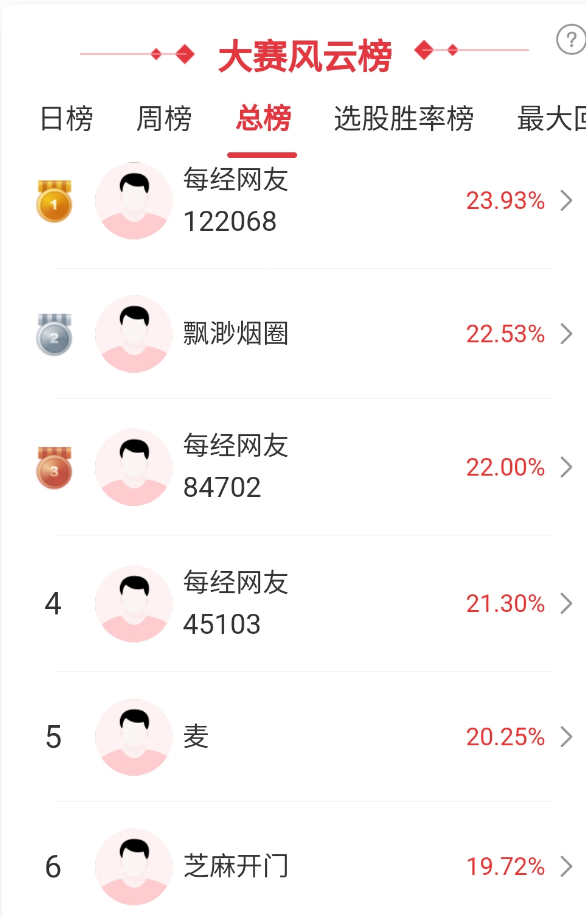
Market Overview - The Shanghai Composite Index continued to fluctuate, with sectors such as silver, diamond drill bits, and gas turbines showing performance. The total trading volume in the Shanghai, Shenzhen, and Beijing markets reached 27,166 billion yuan, an increase of 926 billion yuan compared to Wednesday, marking the 14th consecutive trading day exceeding 25 trillion yuan [1]. Competition Insights - The 82nd session of the "Digging Gold" competition, organized by the Daily Economic News App, started on January 19, with several participants entering the competition within the first four days. The registration period runs from January 17 to January 30, and the competition lasts from January 19 to January 30. Participants are given a simulated capital of 500,000 yuan for stock trading [1][3]. Prize Structure - The pre-tax cash rewards for each competition session are as follows: 688 yuan for the 1st place, 188 yuan for the 2nd to 4th places, and 88 yuan for the 5th to 10th places, with the remaining profitable participants sharing a total of 500 yuan. The monthly leaderboard winner receives 888 yuan for 1st place, with decreasing amounts for subsequent ranks [3]. Market Sentiment - Some experienced participants believe the current market trend is a slow bull market, emphasizing individual stocks over the overall market [4]. Sector Opportunities - Participants are optimistic about opportunities in the M9 materials industry chain, including resin and diamond drill bits, which are expected to benefit from the new generation of AI chips from Nvidia. A Goldman Sachs report indicates that AI infrastructure is driving the PCB and CCL industries into a super cycle, with the global AI server CCL market projected to surge from 1.5 billion dollars in 2024 to 18.7 billion dollars by 2027 [5]. Additional Benefits - Participants who successfully register for the "Digging Gold" competition will receive a six-day free reading access to the "Fire Line Quick Review," a product developed by the team that includes the latest market events, investment logic, and company analysis. Top 10 performers in each weekly competition will also receive an additional ten-day access to the "Fire Line Quick Review" [5].

黄仁勋提出AI不会简单地取代人类工作,且将创造更高价值的就业
Huan Qiu Wang· 2026-01-22 01:04
Group 1 - Nvidia's CEO Jensen Huang stated that artificial intelligence has initiated the largest infrastructure build in human history, with total investments expected to reach trillions of dollars, requiring more energy, land, and skilled workers [1] - Huang believes that AI will not simply replace human jobs but will create higher-value employment through task automation [1] - JPMorgan's CEO Jamie Dimon mentioned that the introduction of AI may lead to fewer employees in the financial institution within five years, emphasizing the need for collaboration between government and businesses to retrain workers and facilitate a gradual transition [1] Group 2 - Dimon suggested that local governments should implement support programs for wages, retraining, relocation, and early retirement [3] - Goldman Sachs reported that AI infrastructure development is driving the PCB (Printed Circuit Board) and CCL (Copper Clad Laminate) industries into a super cycle, with projections indicating that the AI server PCB and CCL markets will grow by 113% and 142% respectively by 2026 [3]



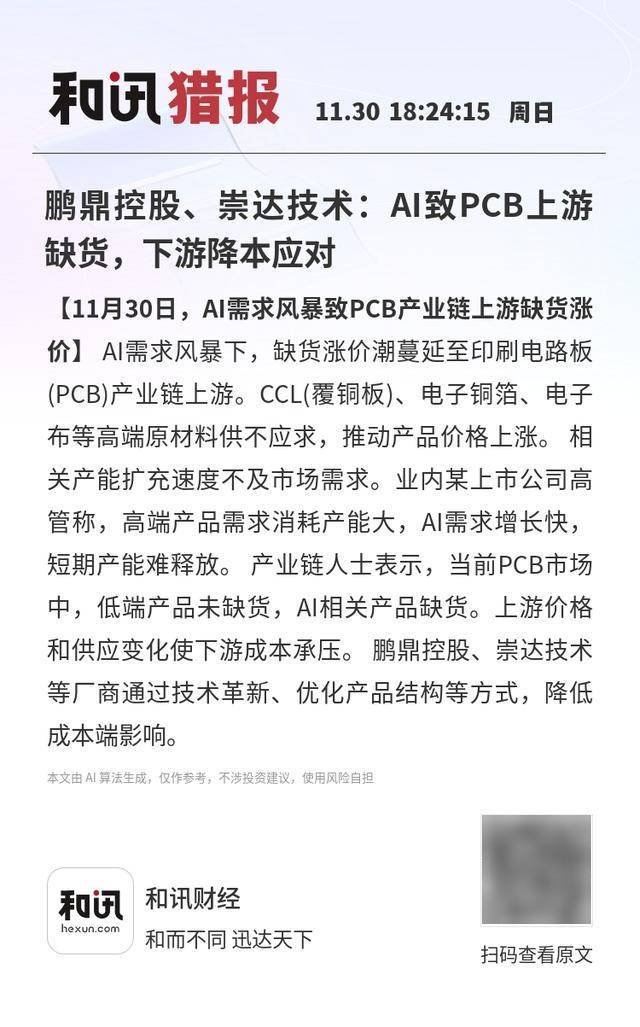
鹏鼎控股、崇达技术:AI致PCB上游缺货,下游降本应对
Sou Hu Cai Jing· 2025-11-30 13:11
Core Viewpoint - The AI demand surge is causing shortages and price increases in the upstream supply chain of the printed circuit board (PCB) industry, particularly affecting high-end raw materials like CCL (copper-clad laminate), electronic copper foil, and electronic fabric [1][2]. Group 1: Industry Impact - The demand for high-end products is consuming production capacity rapidly, and the growth in AI demand is outpacing the speed of capacity expansion in the industry [1][2]. - Currently, there is no shortage of low-end products in the PCB market, but AI-related products are experiencing shortages [1][2]. Group 2: Company Responses - Companies such as Pengding Holdings and Chongda Technology are implementing technological innovations and optimizing product structures to mitigate the impact of rising costs from upstream price and supply changes [1][2].


持续迭代!PCB行业受益AI高速增长
Lai Mi Yan Jiu Yuan· 2025-09-12 07:00
Investment Rating - The report indicates a positive investment outlook for the PCB industry, driven by the rapid growth in AI demand and technological advancements [5][20]. Core Insights - The PCB industry is undergoing a structural upgrade, with AI computing power demand being a core variable reshaping the market landscape. The global PCB market is expected to exceed $78.6 billion by 2025, with AI servers, smart electric vehicles, and high-speed communication devices as the main growth pillars [5][20]. - The report highlights that the compound annual growth rate (CAGR) for AI server PCBs is projected to reach 32.5%, significantly higher than the industry average, driven by advancements in GPU architectures [5][6]. - The introduction of advanced packaging technologies like CoWoP is expected to enhance PCB value and performance, indicating a shift towards more complex and high-density designs [16][17]. Summary by Sections Industry Overview - PCB is a fundamental component in electronic devices, categorized by layers, structure, and technical characteristics. The industry is seeing a shift towards high-density interconnect (HDI) boards and multi-layer boards due to the increasing complexity of electronic systems [4][5]. Market Dynamics - The global PCB market is projected to grow from approximately $73.6 billion in 2024 to $78.6 billion in 2025, with a CAGR of 5.2%. High-end PCBs are expected to be the main growth drivers, with AI-related PCBs currently valued at $5.6 billion [8][19]. - The report notes that the value of AI server PCBs has increased from $500 to over $2,500 due to the rising demand for high-end applications [8]. Technological Advancements - The report discusses the increasing requirements for PCBs in AI applications, including the need for higher layer counts and advanced materials to ensure signal integrity and performance [6][10]. - The introduction of glass substrates as a potential alternative to traditional organic substrates is highlighted, with advantages in surface flatness and thermal stability [18]. Competitive Landscape - The report identifies a concentrated market for high-end PCBs, with leading companies benefiting from technological barriers and scale advantages. In contrast, the mid-to-low-end PCB market remains highly competitive [19]. - Domestic companies are positioned favorably in the AI PCB sector, with ongoing capacity shortages and opportunities to penetrate overseas supply chains [19]. Investment Trends - The report notes that the PCB industry is experiencing a shift towards high-end development driven by technological innovations in electronics and communication sectors, with significant investment activities noted in upstream materials and equipment [20][21].
电子行业观点报告:CCL迎涨价潮,持续关注AIPCB上游材料机会-20250822
Shanghai Securities· 2025-08-22 11:11
Investment Rating - The industry investment rating is "Overweight (Maintain)" [2] Core Viewpoints - CCL is experiencing a price increase trend, with major manufacturers like Jiantao and Hongruixing announcing price hikes for various products [5] - CCL is a core raw material for PCBs, accounting for 30% of PCB total costs, with raw material costs making up 60% of the total PCB cost [5][10] - The demand for PCBs is driven by the rapid growth of AI technology, leading to a strong demand for AI servers and an upward trend in PCB market conditions [5] - The supply of upstream materials for AIPCB is facing shortages, particularly in high-performance materials such as Low Dk electronic cloth and HVLP copper foil [5] - The report suggests focusing on companies like Honghe Technology, Tongguan Copper Foil, and Defu Technology, which are key players in the upstream materials for AIPCB [6] Summary by Sections Price Trends - Major manufacturers have announced price increases for CCL products, with Jiantao raising prices by 10 yuan per sheet and other manufacturers following suit due to rising copper prices [5] Cost Structure - CCL's cost structure shows that upstream raw materials account for approximately 90% of its costs, with copper foil, resin, and fiberglass being the primary components [5][12] Market Demand - The rapid development of AI technology is significantly boosting the demand for PCBs, particularly for high-performance materials required for AI server upgrades [5] Supply Constraints - The report highlights a tightening supply of high-end materials in the PCB industry, including Low Dk electronic cloth and HVLP copper foil, which are critical for meeting the growing demand [5] Investment Recommendations - The report recommends monitoring companies such as Honghe Technology, Tongguan Copper Foil, and Defu Technology for potential investment opportunities in the AIPCB upstream materials sector [6]




芯片soc、铜连接、掩膜板、被动元器件投资机会
2025-08-18 15:10
Summary of Key Points from Conference Call Records Industry Overview - The semiconductor industry, particularly the chip SoC sector, is experiencing strong downstream demand with stable prices and healthy inventory levels. [1][3] - The passive components sector, specifically supercapacitors, is benefiting from increased demand due to advancements in AI technology, particularly with Nvidia's GV300. [11] Company-Specific Insights Jinchen Co., Ltd. - Jinchen Co., Ltd. reported Q2 revenue of 1.8 billion, a year-on-year increase of 10% and a quarter-on-quarter increase of nearly 20%. Net profit exceeded 300 million, with a year-on-year growth of 30% and a quarter-on-quarter growth of 60%. The gross margin reached 37.2%. [1][4] - Approximately 70% of Jinchen's products are exported, leading to a relatively relaxed competitive environment. The company is launching new products, including 6nm chips and WiFi router chips, which are expected to enhance profitability. [5] Ruikeda - Ruikeda's high-voltage connector business is benefiting from the electrification of vehicles, with profits and revenues stabilizing and recovering. The company has entered the optical communication field through a joint venture, with optimistic prospects for AEC orders starting in the second half of the year. [6][7] Cambrian - Cambrian is accelerating domestic substitution in the AI chip market, planning to raise 3.985 billion for the development of large model chip platforms. The company reported Q1 revenue of 1.1 billion, a year-on-year increase of 42 times, and expects 2025 revenue to reach 6-8 billion. [17][18][19] Market Dynamics Optical Film Industry - The optical film market is significant, accounting for approximately 12%-13% of semiconductor materials, with a total market size exceeding 20 billion. However, the domestic substitution rate is low, with less than 5% in the semiconductor sector. [8][9] Supercapacitor Market - The global supercapacitor industry is projected to grow at a compound annual growth rate of 25%, with the Chinese market expected to exceed 40 billion by 2030. Domestic companies like Jianghai and Yuanli are positioned to benefit from this growth. [11][12] Investment Trends - Domestic companies are increasing investments in the optical film sector, with Hefei Jingmei Semiconductor planning a total investment of 12 billion. Other companies like Guanshi Technology and Luwei Optoelectronics are also ramping up investments. [9][10] - The CCL (Copper Clad Laminate) industry is seeing a surge in demand, with companies like Shengyi Technology reporting significant revenue and profit growth. [13][15] Conclusion - The semiconductor and related industries are poised for growth, driven by technological advancements and increasing domestic substitution. Companies like Jinchen, Ruikeda, and Cambrian are well-positioned to capitalize on these trends, while the optical film and supercapacitor markets present significant investment opportunities. [1][2][3][4][5][6][7][8][9][10][11][12][13][14][15][16][17][18][19]

