
ChatGPT Pro

Search documents
X @Cointelegraph
Cointelegraph· 2026-02-12 23:01
🔥 NEW: OpenAI introduced GPT-5.3-Codex-Spark, a real-time coding model rolling out in research preview for ChatGPT Pro users. https://t.co/x9Sne6La9N ...
“AI税”背后的价值观分野
Xin Lang Cai Jing· 2026-02-06 00:22
Group 1 - The article highlights the contrasting approaches to AI development between the US and China, emphasizing that while the US focuses on subscription models and monetization, China prioritizes accessibility and affordability of AI applications [1][2] - In the US, the concept of "AI tax" is introduced, where users incur significant costs for AI services, with estimates suggesting that a typical American family could spend between $720 to $1,000 annually on AI subscriptions [1] - In contrast, China's AI applications are becoming increasingly affordable, with costs dropping to levels comparable to utilities, allowing broader access, especially in lower-tier cities [2] Group 2 - The article discusses the philosophical differences in AI utilization, where the US views AI as a tool for capital gain, while China sees it as a quasi-public good aimed at benefiting the majority [3] - China's approach to AI development emphasizes improving overall societal efficiency, particularly benefiting low-income groups more than high-income ones, reflecting a commitment to inclusive growth [3] - The narrative suggests that China's historical focus on equitable development continues to shape its AI strategy, prioritizing the needs of its people over strict investment-return calculations [3]
外媒热议中美AI路径分野:一个精英获益,一个普通人得利
Guan Cha Zhe Wang· 2026-02-04 02:46
Core Insights - The article discusses the shift in the US-China AI competition from "parameter height" to "livelihood depth," emphasizing the concept of "AI Tax" and how China's AI applications are becoming a global influence due to their infrastructure-like characteristics [1][3]. Group 1: AI Tax and Subscription Models - The term "AI Tax" is introduced, highlighting the financial burden of AI subscriptions in the US, where major companies charge around $20 per month for AI services [4][6]. - In contrast, Chinese AI services, such as Alibaba's Qwen and Ant Group's Ant AQ, are offered for free, showcasing a significant disparity in accessibility [6][7]. - The average annual AI expenditure for a typical American middle-class family can exceed 720-1000 USD, while the equivalent in China is projected to be nearly zero by 2026 [8]. Group 2: Healthcare Sector Disparities - The article notes that the US healthcare expenditure reached 5.3 trillion USD in 2024, with a per capita spending of 15,474 USD, which constitutes 18% of GDP [9]. - Despite the introduction of AI, the US healthcare system remains expensive and inaccessible, with many Americans concerned about unexpected medical costs [10][12]. - In China, AI applications like Ant A-fu are transforming healthcare access, allowing users to consult AI for health inquiries without the need for expensive consultations [13][14]. Group 3: AI Accessibility and Social Impact - The article emphasizes that China's approach to AI mirrors its historical focus on improving societal efficiency, akin to the development of high-speed rail and mobile payments [19][20]. - The accessibility of AI in China is seen as a means to empower lower-income groups, contrasting with the US model that prioritizes high-end, subscription-based services [19][21]. - The competition between the US and China in AI is framed as a battle between protecting technological "premium rights" and ensuring widespread "accessibility" of technology [20][21].


8300亿美金独角兽不得不试水“广告”,AI讲不出新故事?
Sou Hu Cai Jing· 2026-01-18 05:24
Group 1 - OpenAI aims for a valuation of $830 billion in its upcoming funding round, necessitating the identification of real market buyers for its substantial computing costs before the arrival of AGI [1][19] - The company has begun testing advertisements in a restrained manner, leveraging AI for minor innovations, as this is seen as a last resort for monetization [2][8] - Ads are presented at the bottom of ChatGPT responses, only triggered when highly relevant to user queries, allowing for a seamless user experience [4][6] Group 2 - The advertising strategy is primarily targeted at free users in the U.S. and subscribers of the new ChatGPT Go, while premium users will continue to enjoy an ad-free experience [7] - ChatGPT subscription revenue constitutes 60% of OpenAI's income, with active users expected to grow from nearly 900 million to 2.6 billion by 2030 [8][9] - OpenAI's user base is segmented into a "four-tier pyramid," with strategies to monetize the remaining 95% of users who do not currently pay for subscriptions [10][11] Group 3 - The ChatGPT Go subscription at $8 per month targets users who find the $20 subscription too expensive, offering enhanced features while retaining ads [11] - The $20 ChatGPT Plus version is positioned as a premium offering, emphasizing a pure experience without ads, thus enhancing its perceived value [12] - The $200 ChatGPT Pro tier provides advanced features and is aimed at high-end users, while free users are covered by ads [13] Group 4 - OpenAI's revenue structure now includes subscription services, traditional B2B API business, and the new advertising model, forming a three-tier income system [15] - The company anticipates that advertising revenue could exceed $10 billion by 2027, with a target of $110 billion from non-paying users by 2030 [17] - OpenAI is transitioning from a simple AI tool to a comprehensive platform, collaborating with major retailers to enhance its market position [18] Group 5 - OpenAI's rapid cash burn rate is concerning, with projected losses of $8 billion in the first half of 2025 and potential quarterly losses exceeding $12 billion [20] - The company plans to invest approximately $115 billion in computing and data center infrastructure from 2025 to 2029, with long-term investments projected between $1 trillion and $1.4 trillion [21] - The shift towards advertising may not be merely a necessity but could become a significant pillar of OpenAI's revenue model, similar to the paths taken by Google and Meta [28][29]

刚刚!ChatGPT 突然官宣加广告!“SVIP” 才无广告
程序员的那些事· 2026-01-17 07:16
Core Viewpoint - OpenAI is introducing an advertising feature in the free version and the $8 per month ChatGPT Go subscription, aiming to subsidize significant computing costs while expanding revenue sources [3][5]. Group 1: Advertising Implementation - The advertising will be displayed at the bottom of conversations, clearly marked as "sponsored" and distinct from responses, ensuring relevance to the ongoing topic [5]. - Strict guidelines are in place to prevent ads from appearing in conversations involving users under 18, as well as sensitive topics like health and politics [5]. - Users will have the option to disable personalized ads and block specific content, with a commitment that conversation data will not be sold to advertisers [5]. Group 2: Subscription Models - The ChatGPT Plus ($20/month) and Pro ($200/month) subscriptions will remain ad-free permanently, catering to users who prefer an uninterrupted experience [5]. - The ChatGPT Go subscription, which has been rolled out globally, offers enhanced features such as a tenfold increase in message limits and support for file uploads compared to the free version [5]. Group 3: Business Strategy - OpenAI emphasizes that the introduction of ads is a last resort to balance accessibility and commercialization, with a focus on maintaining user trust over revenue generation [5].

OpenAI的国际化困局
Xin Lang Cai Jing· 2026-01-05 12:18
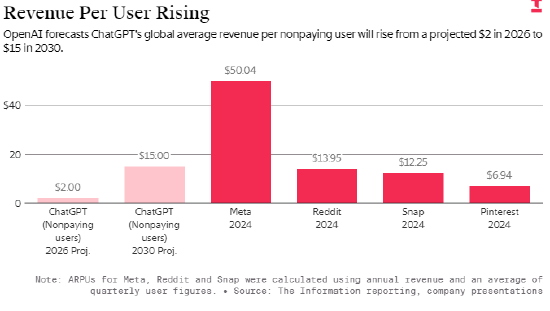
Core Insights - OpenAI projects that by the beginning of the next decade, nearly one-third of the global population will be ChatGPT users, which is approximately three times its current user base of nearly 900 million weekly active users. This large user base could support a substantial advertising and e-commerce business [3][13] - The source of new users is as critical as the number of new users for ChatGPT, with about 90% of its users currently coming from regions outside the United States and Canada, posing a challenge for OpenAI's advertising business [3][14] Revenue Projections - OpenAI expects to generate $112 billion in revenue from the free version of ChatGPT over the next five years, primarily from advertising sales and commissions from online purchases made through the app [4][14] - If advertising and shopping features are successfully implemented, OpenAI anticipates generating $46 billion in revenue from free users in 2030 alone [4][14] User Demographics - The user base of ChatGPT is heavily concentrated outside the United States and Canada, with only about 12% of users from these regions as of Q3 2025 [5][17] - Countries like India and Brazil are significant markets for ChatGPT, but the average revenue per user (ARPU) in these regions is likely lower than in the U.S., Japan, and France, which could hinder advertising revenue growth [8][18] Subscription and Revenue Growth - Currently, only about 5% of ChatGPT's nearly 900 million weekly active users are subscribed to paid plans, with monthly fees of approximately $20 for ChatGPT Pro and $200 for ChatGPT Plus [8][18] - OpenAI plans to introduce a more affordable subscription option, ChatGPT Go, priced at around $5 per month, in countries like India [8][18] - The company aims to increase the average revenue per user from $2 in 2026 to $15 by the end of 2030 [8][18] Cost Considerations - OpenAI anticipates incurring significant costs in running AI models, with projected cumulative costs reaching nearly $150 billion by 2030 [9][19] - The company is relying on revenue from the free version of ChatGPT to help offset these high operational costs [9][19] Competitive Landscape - OpenAI is focused on ensuring the continuous growth of ChatGPT's user base amid intense market competition, having initiated an emergency response mechanism to optimize the platform [10][20] - New features, such as incorporating more visual content in responses, have been launched to enhance user engagement [10][20]
半世纪难题48小时破解!陶哲轩组队把AI数学玩成打怪游戏了
量子位· 2025-12-13 04:34
Core Viewpoint - The collaboration between mathematicians and AI has led to the resolution of the long-standing Erdős 1026 problem, which had remained unsolved for 50 years, in just 48 hours [1][2][3]. Group 1: Problem Overview - The Erdős 1026 problem was proposed in 1975 and involves determining the minimum possible value of a function related to a game theory scenario involving two players, Alice and Bob [8][10][12]. - The problem's complexity was highlighted by the introduction of a maximum constant c(n) that represents the minimum proportion of coins Bob can guarantee to take, regardless of how Alice distributes them [10][13]. Group 2: AI's Role in the Solution - AI tools played a crucial role in solving the problem quickly, with traditional methods potentially taking weeks or months to reach a conclusion [3][5]. - The use of AI models, such as Harmonic and AlphaEvolve, allowed mathematicians to automate the construction and proof of key inequalities, transforming the original problem into a computational geometry challenge [16][18][22]. Group 3: Collaborative Efforts - The solution involved multiple mathematicians working together, with contributions from Boris Alexeev, Koishi Chan, and Lawrence Wu, showcasing the effectiveness of human-AI collaboration [17][28][32]. - The collaborative approach of combining human insight with AI capabilities is emerging as a new trend in mathematical problem-solving [46]. Group 4: Historical Context and Future Implications - The Erdős problems, proposed by the renowned mathematician Paul Erdős, have been a significant part of mathematical research, with many remaining unsolved [39][41]. - The increasing success of AI in solving these problems suggests a shift in how mathematical research may be conducted in the future, with AI becoming a standard tool for researchers [41][42].

X @Sam Altman
Sam Altman· 2025-10-30 20:43
Product Update - OpenAI introduces credits for Codex on ChatGPT Plus and Pro, offering more flexible usage beyond subscription limits [1] - This credit system is expected for compute-intensive features, maintaining low subscription prices for most users [1] - Codex rate limits have been reset for all users [2] Strategy - The company aims to keep subscription prices low for most users while allowing others to increase usage through credits [1]
How to Use Sora by OpenAI: A Step-by-Step Guide
CNET· 2025-10-25 12:01
If you're like me, you've probably been seeing a lot of videos like these. Sometimes making you question if what you're seeing is even real. With Sora.I can be in places like this. We're like this. Let's break down how you can.Two. But first little disclaimer. I.So to get the Sora app on iOS, you can find it in the App Store. Go ahead and type in Sora or Sora by open AI. And go ahead and install it Unfortunately, at the time of the recording of this video, Sora is not available on Android devices.You can, h ...

X @Sam Altman
Sam Altman· 2025-09-30 17:09
I did not expect such fun dynamics to emerge from being able to "put yourself and your friends in videos" but I encourage you to check it out!ChatGPT Pro subscribers can generate with Sora 2 Pro.Longer post coming in a minute. ...