
Claude聊天机器人

Search documents
AI冲击之下,新一轮“次贷危机”来了?
美股IPO· 2026-02-28 08:04
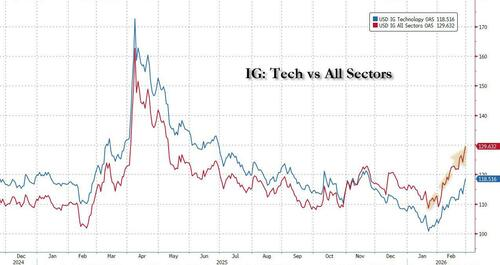
Core Viewpoint - The impact of AI is causing turmoil in the credit bond market, with risks reminiscent of the subprime mortgage crisis emerging, particularly affecting the software industry and leading to significant declines in leveraged loan indices and CLO assets [1][3][5] Group 1: Market Dynamics - Concerns over AI disruption are rapidly spreading to the global credit bond market, leading to asset sell-offs in leveraged loans and CLOs, raising investor awareness of systemic credit cycle risks [3][5] - The Bloomberg index indicates that the yield premium on comparable global debt has widened by nearly 4 basis points, marking the largest increase since November of the previous year [3] - Investment-grade bonds, once considered safe havens, are showing signs of pressure, with the spread of tech investment-grade bonds rapidly expanding [7][10] Group 2: Sector-Specific Impacts - The software and services sector has seen a significant decline in leveraged loans, contributing to a 1.34% drop in the Bloomberg U.S. leveraged loan index, the largest monthly decline since September 2022 [5][18] - Approximately 14% of the investment-grade index is now comprised of AI-related companies, with related debt ballooning to $1.2 trillion, surpassing the U.S. banking sector [7][9] - The high-yield bond market is under pressure, with U.S. junk bond funds experiencing continuous outflows in recent weeks [10][12] Group 3: Systemic Risk Concerns - UBS warns that the interconnectedness between private credit and leveraged loan markets poses a systemic contagion risk, particularly as borrowers frequently engage in dual financing [13][15] - The top 20 direct lending institutions dominate private credit asset management and hold significant positions in leveraged loans and high-yield bonds, indicating a potential rapid spread of default risks if the software sector is hit hard [15][17] - The refinancing risks in the software sector are escalating, with approximately $51 billion of software debt rated B- or below maturing by 2028, and another $50 billion by 2029 [19][20] Group 4: CLO and Asset Management - The underlying asset risks of leveraged loans are directly impacting structured products, with CLO managers urgently reassessing their exposure to AI-related industries [20] - Morgan Stanley estimates that between $40 billion and $150 billion of CLO assets are at risk due to their association with industries vulnerable to AI disruption [20]


AI冲击之下,新一轮“次贷危机”来了?
华尔街见闻· 2026-02-28 04:47
Group 1 - Concerns about the disruption caused by artificial intelligence (AI) are rapidly spreading to the global credit bond market, leading to asset sell-offs across various segments, including leveraged loans and collateralized loan obligations (CLOs) [1] - The yield premium on comparable global debt has recently widened by nearly 4 basis points, marking the largest increase since early November last year, indicating pressure on the investment-grade bond market [2] - High-yield bond funds in the U.S. have experienced continuous outflows in recent weeks, reflecting investor anxiety over default risks in the software industry [3][12] Group 2 - The private credit market is highly interconnected with the public market, suggesting that any shock to core industries like technology could quickly spread default risks throughout the broader credit bond sector [4] - The Bloomberg U.S. Leveraged Loan Index saw an average price drop of 1.34% in February, the largest monthly decline since September 2022, primarily due to loans in the software and services sector [6] - Morgan Stanley has warned that CLO asset pools, ranging from $40 billion to $150 billion, are facing disruption risks related to AI [7][28] Group 3 - The investment-grade bond market, once considered a safe haven, is showing signs of strain, with technology-related companies now accounting for 14% of the investment-grade index, and their debt ballooning to $1.2 trillion [8] - The recent failures of companies like Market Financial Solutions and First Brands Group have heightened concerns about loose underwriting standards in the credit bond market [15] - UBS has raised alarms about systemic contagion risks from private credit markets, as borrowers often finance through both private and syndicated loan markets, leading to significant overlap in issuer and industry exposure [17] Group 4 - The leveraged loan market is experiencing significant pressure due to concerns over traditional business models being disrupted by AI, resulting in a sharp decline in new loan issuance to the lowest level since May of last year [25] - Approximately $51 billion of software debt rated B- or below is set to mature by 2028, with another $50 billion maturing in 2029, posing serious refinancing challenges [26] - The interconnectedness of private credit and leveraged loans means that rising default rates in software and related sectors could quickly impact public markets, leading to wider spreads and liquidity issues [20][30]

AI冲击之下,新一轮“次贷危机”来了?
Hua Er Jie Jian Wen· 2026-02-28 03:32
Core Insights - Concerns over the disruption caused by artificial intelligence (AI) are rapidly spreading to the global credit bond market, leading to asset sell-offs and heightened investor vigilance regarding systemic credit cycles [1] - The yield premium on comparable global debt has widened by nearly 4 basis points, marking the largest increase since early November last year [1] - The investment-grade bond market, traditionally seen as a safe haven, is showing signs of pressure, particularly in the technology sector, where spreads have widened significantly [1][4] Group 1: Market Performance - In February, the Bloomberg U.S. leveraged loan index saw an average price drop of 1.34%, the largest monthly decline since September 2022, primarily due to software and services loans [3] - The technology sector now accounts for 14% of the investment-grade index, with related debt ballooning to $1.2 trillion, surpassing the U.S. banking sector as the largest segment [4] - Asian investment-grade dollar bonds have also experienced the largest weekly yield premium increase since November last year, indicating synchronized tightening with the U.S. market [6] Group 2: Credit Risk and Defaults - High-yield bonds and leveraged loans are under pressure, with significant sell-offs occurring in the junk bond market as investor concerns about default risks in the software industry escalate [7] - The leveraged loan market is showing weakness, with declines exceeding broader indices in the U.S. and Europe, exacerbated by recent bankruptcies in the sector [8] - UBS warns of systemic contagion risks from private credit bonds, as borrowers frequently engage in dual financing in both private and syndicated loan markets, leading to high overlap in issuer and industry exposure [10] Group 3: Future Outlook and Challenges - The refinancing risk in the software sector is increasing, with approximately $51 billion of software debt rated B- or below maturing by 2028, and another $50 billion by 2029 [16] - The CLO asset pools are facing significant risks due to their exposure to industries highly correlated with AI disruption, with estimates of $40 billion to $150 billion in CLO loans at risk [17] - The interconnectedness of private credit markets and public markets raises concerns about liquidity and credit spreads, particularly if default rates rise in key sectors like software [12][14]
Anthropic回应被美政府封杀:未收到通知 将诉诸法院
Feng Huang Wang· 2026-02-28 02:43
Core Viewpoint - Anthropic, an AI startup, has not received any direct communication from the U.S. Department of Defense or the White House regarding negotiation progress and plans to challenge its designation as a supply chain risk in court [1] Group 1: Company Actions and Responses - Anthropic has expressed deep concern over being classified as a supply chain risk, stating that this action has historically only been applied to U.S. adversaries and has never been publicly applied to any American company [1] - The Pentagon previously aimed to use Anthropic's Claude chatbot without restrictions, but Anthropic has maintained that Claude should not be used for mass surveillance against Americans or for fully autonomous weapon operations [1] Group 2: Government Actions - President Trump instructed U.S. government agencies to stop using Anthropic's technology, leading the Pentagon to classify Anthropic as a supply chain risk company [1] - The Pentagon issued a notice to Anthropic, demanding the relaxation of restrictions before a deadline, which Anthropic rejected [1]

小摩警告:美国CLO中多达1500亿美元杠杆贷款面临AI风险
智通财经网· 2026-02-28 01:52
Group 1 - Morgan Stanley estimates that approximately $40 billion to $150 billion of leveraged loans packaged into U.S. collateralized loan obligations (CLOs) may be impacted by the AI boom, particularly in industries most associated with AI risks [1] - The report highlights that CLOs provide investors exposure to floating-rate debt rather than fixed-rate corporate bonds, and CLO managers are currently screening their portfolios to identify loans most susceptible to AI impacts [1] - The report also mentions that while concerns about the software industry are valid, it is crucial to consider the broader implications of AI disruption on CLO credit risk, which remains difficult to quantify [1] Group 2 - Concerns regarding refinancing risks are emphasized, with approximately $51 billion of software-related debt rated B- or lower maturing in 2028, and another $50 billion maturing in 2029 [2] - The report indicates that the private credit market's ability to refinance syndicated loan assets is limited, contrasting with past trends where public markets commonly transferred transactions to private markets [2] - There are worries that a weakening labor market or anxiety surrounding AI could trigger broader sell-offs, leading to price risks, although the economists expect a more gradual diffusion of AI in the economy [2]

AI冲击之下“铁索连环”,美国杠杆贷款遭重创,高达1500亿美元CLO证券面临冲击
Hua Er Jie Jian Wen· 2026-02-28 01:30
Core Insights - The disruptive potential of artificial intelligence (AI) is rapidly impacting the credit market, leading to significant adjustments in the U.S. leveraged loan market and posing systemic threats to the large collateralized loan obligation (CLO) market [1][2] Group 1: Market Impact - The U.S. leveraged loan market has experienced its most severe monthly sell-off in over three years, primarily affecting borrowers in the software and services sector [1][2] - The Bloomberg U.S. Leveraged Loan Index fell by 1.34% in February, marking the largest monthly decline since September 2022, driven by concerns over AI's potential to disrupt traditional business models [2] Group 2: CLO Market Risks - Estimates suggest that between $40 billion and $150 billion of assets packaged into U.S. CLOs may face disruptive impacts from the AI boom, as highlighted by JPMorgan strategists [3] - CLO managers are currently assessing their portfolios to determine which loans are most sensitive to AI impacts, following significant sell-offs triggered by the release of advanced AI tools like the Claude chatbot [3] Group 3: Refinancing Pressures - The upcoming debt maturity wave raises refinancing risks, with approximately $51 billion of software debt rated B- or lower maturing by 2028, and another $50 billion by 2029 [4] - The private credit market's exposure in the software sector limits its ability to refinance syndicated assets, complicating the previously common "public-to-private" acquisition model [4] - Despite expectations of a gradual integration of AI into the real economy, there are warnings about the potential for a "displeasing reset" in financial markets due to leveraged speculation on AI [4]
新浪财经隔夜要闻大事汇总:2026年2月28日
Xin Lang Cai Jing· 2026-02-27 23:39
Market - US stock market closed down with the Dow Jones falling over 500 points, and all three major indices recorded weekly declines. The Dow, Nasdaq, and S&P 500 dropped by 1.05%, 0.92%, and 0.43% respectively [2] - UBS downgraded the US stock market rating due to concerns over a weakening dollar, high valuations, and rising policy risks [2] - The Producer Price Index (PPI) for January rose more than expected, with core PPI increasing by 0.8% month-on-month, indicating persistent inflation [2] Company - Dell's stock surged by 21.93% after strong revenue forecasts, while Nvidia's stock fell by 4.16% despite exceeding earnings expectations due to concerns over the sustainability of AI spending [3] - Paramount has reached a final merger agreement to acquire Warner Bros. Discovery, valuing the company at $110 billion, with the deal expected to close in Q3 2026 [33] - Trump Media is considering spinning off its social platform Truth Social into an independent company, marking a significant shift for the firm [31] - TPG disclosed a £44 million exposure to the troubled UK lender Market Financial Solutions (MFS), indicating a small percentage of its overall loan exposure [37] Macro - US companies disclosed stock buyback plans totaling $233 billion in February, marking the highest level for the month in history [12] - The SEC announced new regulations requiring foreign company executives to disclose stock trades promptly, aligning with US standards [14] - The US government is facing over 2,000 lawsuits for tariff refunds following a Supreme Court ruling declaring many tariffs unconstitutional [17]

是牵强附会还是科幻小说?Citrini的2028全球智能危机报告引发批评声浪
Xin Lang Cai Jing· 2026-02-26 09:21
Core Viewpoint - The argument presented by Citrini Research that artificial intelligence (AI) will lead to widespread unemployment is facing skepticism from investors and economists globally, with some experts labeling it as "science fiction" [1] Group 1: Market Reactions and Expert Opinions - Major financial institutions like Castle Securities, Deutsche Bank, and Fidelity International have expressed doubts about Citrini's claims, suggesting that the argument is overly simplistic [1] - The report has negatively impacted software and financial stocks, contributing to a decline in market confidence [1] - Despite the concerns raised, some market anxiety has begun to ease, aided by Anthropic PBC's announcement of plans to integrate its AI chatbot, Claude, with existing businesses rather than replacing them [2] Group 2: Labor Market Insights - Current labor market indicators show no significant signs of widespread job disruption due to AI, with job postings for software engineers increasing recently [2] - The construction industry is also experiencing a hiring uptick, driven by a surge in AI-related data center projects [2] - Experts argue that AI is more likely to complement human labor rather than replace it, similar to past technological revolutions [2] Group 3: New Job Creation and Economic Dynamics - New job roles, such as prompt engineers and reasoning optimization specialists, have emerged in Silicon Valley, indicating potential positive outcomes from AI advancements [3] - The importance of human interaction in many jobs may provide a competitive advantage to non-AI businesses, limiting the extent of AI's impact [3] - Economic constraints, such as energy limitations, may also restrict the rapid expansion of AI technologies [3] Group 4: Diverse Perspectives on AI's Impact - White House economic advisor Pierre Yared described Citrini's report as an interesting science fiction narrative that contradicts fundamental economic principles [4] - Fidelity International's global macro head Salman Ahmed believes political leaders will take measures to protect workers displaced by AI, and the adoption of AI will likely be gradual due to existing software integration [6] - Ed Yardeni, founder of Yardeni Research, emphasized that while AI can enhance productivity, it does not pose an existential threat to jobs [6]
AI日报丨Anthropic出手缓解AI之忧,惨遭血洗的美股大反弹,触控屏MacBook Pro预期今秋亮相,苹果涨超2%
美股研究社· 2026-02-25 11:33
Group 1 - The article discusses the rapid development of artificial intelligence (AI) technology and its potential opportunities in the market [3] - MSCI is providing AI connectivity features to clients, allowing interaction with proprietary data through AI tools like OpenAI's ChatGPT and Anthropic's Claude [5] - The White House's economic advisor dismissed a recent AI risk report from Citrini Research as "science fiction," emphasizing the government's commitment to leading in AI investment [6] Group 2 - Anthropic's announcement of new AI tools for its Claude chatbot led to a rebound in the U.S. stock market, with the S&P 500 index rising by 0.8% and the Nasdaq 100 index increasing by 1.1% [8] - The stock prices of financial data provider FactSet and other companies like Thomson Reuters and Adobe rose following Anthropic's announcement [8] - The founder of Citrini Research expressed surprise at the market's reaction to his dystopian AI predictions, indicating a heightened sensitivity to such topics [10] Group 3 - Google plans to build its first data center in Minnesota, which will support AI applications and the overall cloud business, along with a commitment to add 1,900 megawatts of renewable energy capacity [12] - Wayve, an autonomous driving company, raised $1.2 billion in Series D funding, achieving a valuation of $8.6 billion, with participation from major investors including Nvidia and Microsoft [13] - Apple is expected to launch its first touchscreen MacBook Pro this fall, which has led to a more than 2% increase in its stock price [14]


Anthropic推出智能体AI工具,旨在实现人力资源、投资银行等领域工作自动化
Xin Lang Cai Jing· 2026-02-25 01:36
Core Insights - Anthropic PBC is expanding its Claude chatbot into new areas following market volatility triggered by its AI tools, focusing on automation in human resources, investment banking, and design [1] - The new AI tools were developed in collaboration with partners, including a plugin created with financial data provider FactSet Research Systems Inc. [1] - Scott White, head of Claude AI model products, emphasized the goal of bridging the gap between how people use AI for work-related queries and the tools they use for specific tasks [1] - White also noted that linking market performance to a single product release is an overreaction, asserting that the AI models are aiding enterprise clients in achieving growth [1]