
Claude Opus 4.6

Search documents
Cursor自研新模型反超Opus 4.6,价格还“打一折”!网友实测:只有它写完应用能一次跑通
AI前线· 2026-03-20 08:01
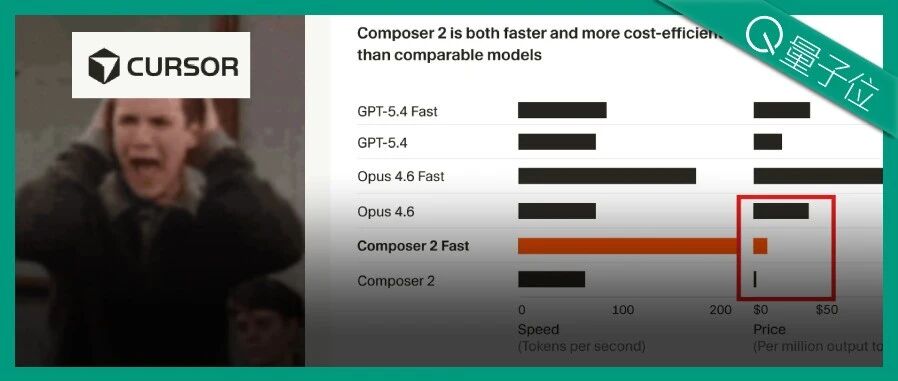
在一项关键的编程基准测试(Terminal-Bench 2.0)上,Composer 2 竟然 反超了 Claude 的旗舰模型 Opus 4.6。 作者 | 木子 站在悬崖边的 Cursor,刚刚发布了自家第二代编程大模型: Composer 2.0 , 且已在 IDE 中上线。 要知道,在 Cursor 拥有自家编程模型 Composer 之前,它长期"外挂"Claude 和 Codex,虽然因此吸了一大波粉,但也饱受质疑有没有核心能力。 而这一次,不仅性能反超,而且价格还 "打一折" ! Cursor 给出的定价是:Fast 版本,每百万输入 token 输入 1.5 美元,每百万输入 token 输出 7.5 美元,比上一代便宜了 57% 左右。 而普通版的价格直接干到了输入 0.5 美元、输出 2.5 美元。相比之下,Claude Opus 4.6 的定价是:输入 5 美元、输出 25 美元——刚好差了整整 10 倍!不过需要说明的是,Anthropic 也指出,在使用缓存与批处理等优化机制时,原则上能把成本最多压到原来的十分之一。 当下, AI 竞争已经卷到了"谁能用更少的钱吐出更多 token" ...


Cursor自研模型反超Opus 4.6!价格脚踝斩,氛围编程沸腾了
量子位· 2026-03-20 03:52
一水 发自 凹非寺 量子位 | 公众号 QbitAI 众所周知,Cursor作为模型提供商,早期还靠供应Claude模型狠狠吸了一波粉。 结果现在,它自己搞出了一款编程模型,而且转身就把Claude拉下马了—— 其最新编程模型 Composer 2 ,不仅能力超越Claude Opus 4.6,关键是价格降了非常多。 就这么说吧,别人降价是"腰斩",它这直接是 "脚踝斩" 。 那么问题来了,Cursor凭啥能在大家都"涨价"的时候把价格打下去呢? 倒反天罡了朋友! Cursor新模型不仅性能超越Claude,而且价格更是直接"脚踝斩" (都不说腰斩了) 。 鉴于"龙虾"爆火后编程消耗的Token用量一路激增,所以Cursor当下只有一个目标—— 答案,Cursor也随之公布了—— 一种新的强化学习方法 。 比Opus 4.6更强,价格还down down down! 先说目前已经在Cursor上线的 Composer 2 。 从名字英译"编曲家"你就能猜出来了,这款模型主打的是"编程家"(bushi。 性价比、性价比、还是性价比。 何谓性价比?自然是"兼顾智能与成本的最优组合"。 (注:随着"龙虾"爆火,全球 ...
Microsoft's Troubled AI Problems Just Got Worse
247Wallst· 2026-03-18 15:39
Core Viewpoint - Microsoft is facing significant challenges in its AI operations, particularly as it falls behind competitors like Google and OpenAI, leading to a potential lawsuit against OpenAI due to a new partnership with Amazon [1][2][6]. Group 1: Microsoft’s AI Challenges - Microsoft's AI product, the Asus ProArt PX13, is reported to be lagging behind competitors such as Google's Gemini and OpenAI's GPT-5.4 [2]. - The company is reorganizing its AI teams to address issues of disjointed user experience and consumer confusion, with some executives being promoted and others demoted [2][7]. - Industry experts have noted that Microsoft may not be able to close the competitive gap due to the rapid evolution of the AI industry [4]. Group 2: OpenAI and Amazon Partnership - Microsoft claims it has an exclusive deal with OpenAI that requires the latter to operate solely on its Azure cloud platform, which is now being challenged by OpenAI's new partnership with Amazon [6]. - The financial implications of the Amazon deal are significant, with a reported price tag of $50 billion [6]. - There are conflicting reports regarding whether Microsoft will pursue legal action against OpenAI and Amazon, indicating uncertainty in the situation [7]. Group 3: Investment and Market Position - Microsoft has invested approximately $135 billion in OpenAI, but disputes over the original deal terms have arisen as OpenAI seeks to modify its contractual obligations [5]. - The ongoing turmoil in Microsoft's AI business is contributing to its perception as falling further behind industry leaders [7].

Microsoft’s Troubled AI Problems Just Got Worse
Yahoo Finance· 2026-03-18 15:39
Core Insights - Microsoft is reorganizing its AI operations due to lagging behind competitors like Google, OpenAI, and Anthropic in the AI product market [2][4] - The company may pursue legal action against OpenAI over a deal with Amazon, which could complicate their existing partnership [6][7] - Microsoft has invested approximately $135 billion in OpenAI, but disputes over contract terms have arisen, with OpenAI seeking more freedom [5][6] Company Developments - Microsoft is restructuring teams responsible for its Copilot AI product to address user experience issues and confusion [2] - Key AI executives at Microsoft have been promoted or demoted as part of this reorganization [2] Competitive Landscape - Industry experts suggest that Microsoft is struggling to keep pace with rapidly evolving AI competitors, which can establish leadership in a matter of weeks [4] - OpenAI's partnership with Amazon, which involves a $50 billion deal, raises questions about Microsoft's exclusive rights to OpenAI's services on its Azure platform [6][7]
梁文锋推迟V4,是为了根治龙虾的健忘症?
虎嗅APP· 2026-03-17 00:08
Core Viewpoint - The article discusses the anticipation surrounding the release of DeepSeek's V4, emphasizing the importance of its Long-Term Memory (LTM) feature, which aims to enhance AI's contextual understanding and memory capabilities, setting it apart from competitors like OpenClaw [7][8][17]. Group 1: V4 Development and Features - DeepSeek's V4 is expected to include a significant architectural overhaul with 1 trillion parameters and native multimodal capabilities, set to be released in April [7][8]. - The core innovation of V4 is the Long-Term Memory (LTM) system, which allows the AI to retain user interactions and preferences over time, improving its contextual understanding [8][11]. - The LTM aims to address the limitations of existing models, particularly OpenClaw, which struggles with memory retention and context management [9][10][22]. Group 2: Challenges and Competitor Analysis - The AI industry is rapidly evolving, with competitors releasing new features and models, putting pressure on DeepSeek to catch up [38]. - DeepSeek currently lacks multimodal capabilities, being primarily a text-based model, while competitors have advanced to support audio and video processing [39][43]. - The company faces challenges in agent capabilities, AI programming, and search functionalities, which are critical for maintaining competitiveness in the market [45][48][51]. Group 3: Memory and Learning Capabilities - Current AI models, including OpenClaw, have significant limitations in memory management, leading to issues with context retention and task continuity [18][30]. - Research indicates that many leading models struggle to learn effectively from context, highlighting a gap in their ability to utilize information dynamically [32][34]. - The development of a robust memory system within V4 could potentially transform how AI learns and interacts, making it more adaptable and user-friendly [30][35].

国产大模型周调用量再超美国
第一财经· 2026-03-16 10:19
Core Insights - The article highlights that domestic AI models in China have surpassed U.S. models in weekly usage for two consecutive weeks, indicating a significant shift in the AI landscape [5][6]. Group 1: Domestic Model Performance - The weekly usage of domestic AI models reached approximately 4.69 trillion tokens, an increase of 11.82% from the previous week [6]. - The top three domestic models by usage are MiniMax M2.5 (1.75T tokens), Step 3.5 Flash (1.34T tokens), and DeepSeek V3.2 (1.04T tokens) [5][6]. - In contrast, U.S. AI models had a weekly usage of 3.294 trillion tokens, which represents a decline of 9.33% [6]. Group 2: Emergence of New Models - The newly launched Hunter Alpha model, with 1 trillion parameters and support for 1 million tokens context, has gained attention for its capabilities in long-term planning and complex reasoning [6][7]. - Hunter Alpha topped the daily ranking on OpenRouter shortly after its release, alongside another model, Healer Alpha, which also made it to the top ten [7]. Group 3: Market Dynamics and Pricing - The increasing demand for domestic models is driven by the rise of intelligent agent scenarios, which require high token consumption, making cost-effective domestic models appealing to overseas developers [7]. - For instance, MiniMax M2.5 offers a competitive pricing structure at $0.3 per million tokens for input and $1.1 for output, significantly lower than the prices of U.S. models like Claude Opus 4.6 [7]. Group 4: Commercialization Challenges - While domestic models are gaining traction in international markets, U.S. models are focusing on pragmatic commercialization, such as discontinuing lower-priced versions and tightening usage limits [8]. - The departure of a key figure from Alibaba's AI division highlights the tension between revenue pressures and open-source strategies [8]. - MiniMax's first financial report indicates a revenue of approximately $79.04 million for 2025, a year-on-year increase of 159%, but also reveals a significant loss of $1.87 billion, up 302% year-on-year [8].

养不起、卸不掉、防不住的“龙虾”:AI狂热背后的算力无底洞与安全黑洞
机器人圈· 2026-03-16 01:41
Core Insights - The article discusses the rapid adoption of OpenClaw, an AI intelligent agent, which has gained popularity in China, leading to significant government investment and support for its deployment [2][4] - However, it highlights the underlying issues of cost and security risks associated with OpenClaw, suggesting that it may evolve from a "digital pet" to a "digital money pit" [4][8] Cost Implications - Users have reported exorbitant costs, with one individual burning through 1.4 billion tokens in a week, leading to expenses exceeding 10,000 yuan in a month [5][7] - The operational model of OpenClaw, which includes a "heartbeat" mechanism, results in continuous token consumption, contrasting with traditional AI models that operate on a query-response basis [7] - The costs associated with hardware and cloud services vary widely, with personal versions costing between 30 to 130 yuan annually, while enterprise versions can range from hundreds to thousands of yuan [6] Security Concerns - OpenClaw has been found to have significant security vulnerabilities, with over 82 reported flaws, including 12 critical vulnerabilities that could allow attackers to gain full control of the system [8] - The exposure of over 270,000 instances of OpenClaw on the public internet raises concerns about data privacy and potential breaches of sensitive information [8] User Experience Challenges - Users face difficulties in uninstalling OpenClaw, which can lead to residual API keys remaining in the system, posing ongoing security risks [9] - The complexity of installation and configuration has created barriers for businesses looking to adopt OpenClaw, with many unsure of the best models and cloud services to use [13] Industry Outlook - The article suggests that the current challenges in cost and security must be addressed for OpenClaw to achieve commercial viability, emphasizing the need for a systematic approach to security architecture [14][19] - Experts believe that the future of AI agents like OpenClaw hinges on creating a sustainable and secure operational framework that can support widespread adoption without overwhelming users with costs or risks [19][16]

暴力上涨的token背后是裁员
小熊跑的快· 2026-03-15 13:14
Core Insights - The article highlights the competitive landscape of AI models, showcasing the usage data and trends among various models across different regions, particularly focusing on the dominance of Chinese models in the market. Group 1: Model Usage and Rankings - The total token usage across platforms reached 78.2 trillion tokens, with Chinese models accounting for 41.9 trillion tokens (53.6%), marking a 34.9% increase compared to the previous period [5] - The top five models based on usage are: 1. MiniMax M2.5 (China): 18.7 trillion tokens (+15%) 2. Gemini 3 Flash (USA): approximately 10 trillion tokens 3. DeepSeek V3.2 (China): 8.3 trillion tokens (+4%) 4. Claude Opus 4.6 (USA): data not fully disclosed 5. Step 3.5 Flash (China): 7.5 trillion tokens (+69%, notable rise) [5] Group 2: Regional Performance - Chinese models have consistently led the market, with a growing gap over American models, which accounted for 36.3 trillion tokens (46.4%), reflecting an 8.5% decrease [5] - The article indicates that the trend of Chinese models gaining market share is expected to continue, further solidifying their position in the AI landscape [5] Group 3: Industry Impacts - The rise in token usage is accompanied by significant layoffs in major tech companies, with Meta potentially cutting up to 20% of its workforce, and Microsoft expected to follow suit with even larger reductions [6]
Claude Opus 4.6与Sonnet 4.6上线百万上下文窗口;上海推出全国首个虚实融合具身智能训练场丨AIGC日报
创业邦· 2026-03-15 06:06
Group 1 - Claude AI chatbot Claude has launched Opus 4.6 and Sonnet 4.6 with a complete context window of 1 million tokens, offering standardized pricing for the entire window, with Opus 4.6 priced at $5/$25 per million tokens and Sonnet 4.6 at $3/$15 per million tokens [2] - Devendra Chaplot, a founding member of Thinking Machines Lab, has joined xAI to collaborate with Elon Musk and his team on developing superintelligence [2] - Shanghai has introduced the country's first virtual-physical integrated intelligent training ground to accelerate the integration of intelligent robots into the real economy, providing data collection and technology validation services for humanoid robots [2] Group 2 - Zhou Hongyi, founder of 360 Group, discussed security issues related to OpenClaw, emphasizing that granting extensive permissions to the AI is akin to handing over the keys to a safe, and that security concerns cannot be resolved merely by using domestic databases [2]

Token出海专题报告:国产模型抢占市场,IDC需求迅速扩张
Guoxin Securities· 2026-03-14 13:09
Investment Rating - The report maintains an "Outperform" rating for the industry [1] Core Insights - The rapid iteration of large models is enhancing application capabilities, with global AI development leading to significant improvements in knowledge Q&A, mathematics, and programming, surpassing human-level performance in various tasks [2][4] - The increase in token usage is elevating the ranking of domestic models, with notable growth in API call volumes for Chinese models, indicating improved performance and cost-effectiveness [2][12] - AI applications are driving growth in the cloud market, leading to an expansion in IDC demand, as domestic internet and cloud companies lag behind their overseas counterparts in capital expenditure on AI infrastructure [2][3] Summary by Sections 1. Rapid Iteration of Large Models - The global large model industry has transitioned from annual to quarterly or even monthly iterations since 2025, with leading companies significantly reducing their model update cycles [11] - Domestic companies like Deepseek and ByteDance are also accelerating their model iterations, enhancing their capabilities and performance [11][12] 2. Increase in Token Usage and Domestic Model Ranking - The launch of viral AI applications like OpenClaw has spurred global AI application growth, leading to record-high token consumption [2] - By March 2026, over 50% of the top ten models on Openrouter were domestic, reflecting a significant rise in the performance and market acceptance of Chinese models [2] 3. AI Applications Driving Cloud Market Growth - The surge in domestic model usage is increasing the demand for local data centers, with a notable gap in capital expenditure on AI infrastructure compared to international firms [2] - As AI applications commercialize and grow rapidly, cloud services are becoming the primary platform for these applications, resulting in increased IaaS demand [2][3]