Epic Games Store

Search documents
沪游观察|90%数字资源不受掌控,欧洲游戏工作室怎么办
Sou Hu Cai Jing· 2026-02-04 07:11
Core Insights - The traditional frameworks for corporate strategic analysis are becoming obsolete in the context of digital industries, where companies are deeply embedded in complex technological networks that significantly influence their operational choices [1][4][8] Group 1: Digital Infrastructure and Dependency - In the European video game industry, over 90% of digital sales occur through non-European platforms, highlighting a structural dependency on external entities [2][3] - More than 75% to 80% of studios utilize two American graphics engines (Unity and Unreal Engine), and over 70% of online game servers rely on non-European cloud services (AWS, Azure, Google Cloud) [3] - The rapid evolution of digital infrastructures outpaces the ability of organizations to adapt, leading to a structural disconnect between infrastructure changes and organizational decision-making [3][4] Group 2: Challenges in Public Investment Policies - Public technology investment programs, such as Horizon Europe, face challenges due to their long-term planning (5 to 10 years) conflicting with the rapid evolution of the digital infrastructure [5] - The economic feasibility of public technology investment projects often depends on external technological systems that evolve at a pace beyond institutional adaptability [5][7] Group 3: Need for Updated Strategic Analysis - The case of the European video game industry illustrates that even with technical expertise and public support, structural vulnerabilities persist if critical infrastructure is controlled by external entities [8] - Continuous and accurate assessment of projects, industries, and public policies is essential in the context of rapidly changing digital architectures [8] - There is a need to integrate the speed of technological infrastructure changes and the resulting dependencies into strategic evaluations, as traditional analysis tools may fail to capture the new competitive landscape [7][8]


SoFi and Templum Launch Exclusive Private Market Opportunity in Epic Games and Stripe
Prnewswire· 2025-12-09 13:45
Core Insights - Templum and SoFi have opened a limited investment window for accredited investors to access Epic Games and Stripe through the Cosmos Fund, available from December 8 to December 19, 2025 [1][2] - This offering follows a successful SpaceX investment earlier in the year, highlighting the growing interest in private market opportunities [2] - The partnership aims to provide trusted access to high-quality private companies and alternative assets, addressing challenges in private markets [3] Company Insights - Templum is focused on modernizing private market investing by offering full investment lifecycle technologies and workflow solutions, aiming to expand access to a broader range of investment opportunities [5] - Templum's vision includes enhancing capital markets by overcoming outdated technology that hinders investments [5] - SoFi serves as Templum's alternative assets partner, emphasizing the importance of streamlining the investment process for eligible investors [3] Industry Insights - Epic Games is a leader in global interactive entertainment, known for its Unreal Engine and developer-friendly Epic Games Store, which supports cross-platform gameplay and offers a generous revenue-sharing model [7] - Stripe is recognized as a category leader in billing solutions, serving over 300,000 companies, including notable clients like OpenAI and Atlassian, and is praised for its developer-first approach and exceptional customer support [7] - Both companies are positioned to drive innovation in their respective sectors, with Epic Games focusing on digital entertainment and Stripe on modern billing operations [7] Future Outlook - Templum and SoFi are preparing a robust calendar for 2026, featuring new investment opportunities across high-growth sectors such as Robotics, FinTech, Defense Tech, and Cloud Infrastructure [4]


Epic CEO谈虚幻引擎未来:堡垒之夜UGC分成超50亿,UE6预计两年半完成
Sou Hu Cai Jing· 2025-12-09 01:21
Core Insights - Epic Games is experiencing significant growth, particularly with the launch of Unreal Engine 5 and its integration into numerous high-profile games, including titles like "ARC Raiders" and "Black Myth: Wukong" [3] - The company has established a robust UGC ecosystem through "Fortnite," which has become one of the largest UGC platforms globally, attracting considerable attention from the industry [3][10] Group 1: Unreal Engine and Development Tools - Epic provides a suite of development tools, including Unreal Engine, MetaHuman, and RealityScan, to support developers [3] - The company plans to launch a cross-platform marketplace called "Fab" in October 2024, allowing asset sharing across various game engines, including Unity and Godot [3] Group 2: Epic Online Services and Social Features - Epic has surpassed 900 million registered accounts and 6 billion connections among friends on its Epic Online Services [3] - Starting next year, Epic will introduce the "Epic Social Overlay" feature across all platforms, enabling developers to easily integrate social functionalities into their games at no cost [5] Group 3: Epic Games Store and Revenue Sharing - Since its launch, Epic has distributed $2.1 billion (approximately 14.8 billion RMB) to developers from the Epic Games Store, maintaining a favorable revenue-sharing model [7] - The mobile version of the Epic Games Store has reached 53 million installations, with expectations to exceed 70 million by the end of the year [9] Group 4: UGC Ecosystem and Creator Economy - Epic has paid UGC creators $722 million (approximately 5.1 billion RMB) since the launch of "Creator Economy 2.0" in 2023, promoting new monetization opportunities through in-game item sales [10] - The total playtime for third-party content created in "Fortnite" has reached 11.2 billion hours, with 260,000 games developed within the platform [9] Group 5: Long-term Vision and Future Developments - Tim Sweeney envisions a metaverse with interoperability, allowing players to transfer their in-game assets across different games, enhancing the gaming experience [10] - Epic is developing a new programming language called Verse and a Scene Graph for better content management, aiming for integration in the next-generation Unreal Engine 6, expected in the next two and a half years [11]

X @Sui
Sui· 2025-12-03 02:13
Game Industry & Technology - Sui is enabling a new standard for shooter games with seamless assets and fast-reflex gameplay [1] - Sui provides speed and scale for games [3] Game Release & Platform - Xociety is now live in Early Access on the Epic Games Store [2] - Xociety is powered by Sui and playable on SuiPlay0X1 [3]
Epic CEO批评Steam:给游戏划分AI标签毫无意义
Sou Hu Cai Jing· 2025-11-28 13:51
Core Viewpoint - Epic Games CEO Tim Sweeney questions the necessity of labeling games that utilize AI during development, suggesting that AI will be an integral part of future game creation, making such labels irrelevant [1][3]. Group 1: AI Labeling in Gaming - Sweeney agrees with a user who argues that the "AI-generated" label is unnecessary for games, as AI will be widely used in game development [3]. - He emphasizes that while AI labels may be useful in art exhibitions and digital content licensing, they hold little significance for game stores [3]. - Sweeney humorously suggests that if transparency is required, developers should also disclose the brands of shampoo they use, highlighting the absurdity of focusing solely on AI usage [3]. Group 2: Steam's AI Disclosure Policy - Starting in early 2024, Steam mandates that developers disclose whether their games use generative AI and describe how it is utilized [5]. - This information will be displayed in a dedicated section on the game's store page, allowing players who may not support AI-generated content to make informed purchasing decisions [5]. - In contrast, Epic Games Store does not have such disclosure requirements, and Sweeney's recent comments indicate that it is unlikely to implement similar policies [5].
飞速扩张20多年后,Steam走向垄断了吗?
3 6 Ke· 2025-11-20 23:59
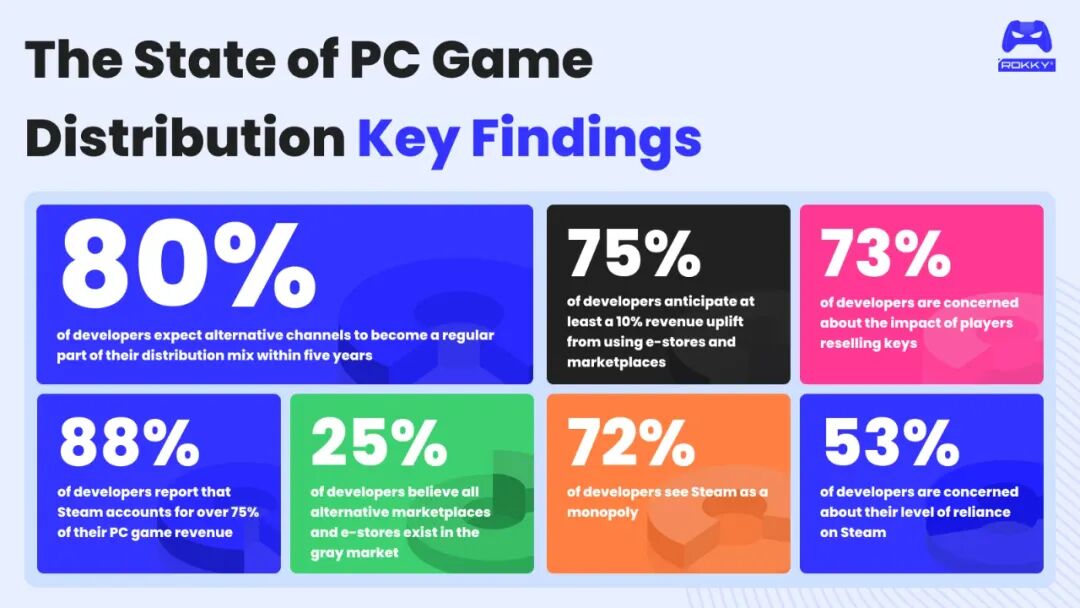
Core Insights - Steam's simultaneous online user count has doubled from 20 million in 2020 to over 40 million, with peak in-game concurrent users surpassing 12 million [1] - In 2024, Steam's game release revenue is expected to reach a historical high, with 224 games generating over $1 million in revenue [1] - However, there are growing concerns about Steam's dominance, with 72% of developers believing it holds a monopoly in the PC gaming market [2] Revenue and Dependency - Steam accounts for over 75% of total revenue for most game studios, leading to a significant dependency on the platform [2] - Many developers express concerns about over-reliance on Steam, indicating a potential risk for the industry [2] Monopoly Allegations - Steam has faced ongoing antitrust lawsuits since 2021, with developers alleging that its 30% commission structure constitutes anti-competitive behavior [4][5] - Wolfire Studios initiated a lawsuit claiming that Valve exploits its dominant position to artificially inflate game prices and impose restrictive terms [4] - The U.S. courts have allowed the case to proceed, indicating a broader potential for collective action against Valve from multiple developers [6] Commission Structure - Steam's commission structure has been criticized for being excessively high, with a standard 30% cut from game sales [10] - Valve's tiered commission model favors larger titles, further exacerbating the financial strain on smaller developers [10][12] Competitive Landscape - Despite the emergence of competitors like Epic Games Store and Microsoft Store, Steam's user base has continued to grow, indicating its strong market position [15] - Epic's attempts to lower commission rates have not significantly impacted Steam's dominance, as it still leads in user engagement and sales volume [15][19] Developer Sentiment - A significant portion of developers believe that platform commission rates should be below 10%, highlighting dissatisfaction with the current structure [13][14] - The challenges faced by competitors in replicating Steam's ecosystem demonstrate the platform's entrenched position in the market [19][22] User Experience and Ecosystem - Steam's ecosystem is not just a game store; it includes social networking, user reviews, and a robust community, making it difficult for competitors to attract users [19][21] - The platform's focus on user experience and continuous improvements has solidified its position, despite criticisms regarding its commission policies [24]
张一鸣要再造一个Steam,Epic未挑战成功Steam字节行吗?
Sou Hu Cai Jing· 2025-11-06 23:08
Core Viewpoint - ByteDance is launching a new gaming distribution platform called GameTop, aimed at overseas markets, which signifies a strategic shift in its gaming business focus from traditional development and distribution to a self-owned platform model [2][6][22]. Group 1: GameTop Platform Launch - GameTop is designed to provide personalized gaming content and integrate game distribution, creation tools, and social features for users [2]. - The platform aims to leverage TikTok's global influence to promote its offerings and reduce reliance on third-party platforms like Google Play and App Store [22][23]. - ByteDance's recruitment for GameTop indicates that the platform is still in its early stages, focusing on user engagement and monetization strategies [19]. Group 2: Strategic Adjustments in Gaming Business - ByteDance's gaming strategy has evolved from aggressive expansion to a more focused approach, emphasizing resource integration and innovation for long-term stability [6][8]. - The company has previously invested heavily in the gaming sector, with over 300 billion yuan spent on 22 investments across 19 gaming companies from 2019 to 2022 [7]. - The management's goal is to potentially achieve an independent IPO for its gaming business while ensuring stable operations rather than seeking short-term explosive growth [6][8]. Group 3: Competitive Landscape - ByteDance's GameTop will face significant competition from established platforms like Steam, which currently holds a dominant market share of approximately 70%-75% in the global PC gaming distribution market [13][14]. - Unlike Steam, which caters primarily to hardcore gamers, GameTop is targeting casual gamers, which may limit its ability to directly compete with Steam's established user base [19]. - The gaming market is witnessing a shift towards mobile platforms, and GameTop aims to capitalize on this trend, potentially positioning itself as a "mobile version of Steam" [20]. Group 4: Market Opportunities - The global gaming market is projected to see substantial growth, with Chinese game exports expected to reach $18.557 billion in 2024, marking a 13.39% increase year-on-year [22]. - ByteDance's GameTop could benefit from the growing trend of game exports, particularly in regions like Southeast Asia and the Middle East, where competition is less intense compared to Western markets [22]. - The platform's focus on casual gaming and social interaction may create new opportunities for user engagement and retention, leveraging TikTok's existing user base [19][22].
Supreme Court Denies Google's Stay Request in Epic Games Case
PYMNTS.com· 2025-10-07 00:29
Core Viewpoint - The Supreme Court has denied Google's request to pause a lower court's ruling requiring changes to its Play app store, which is a significant development in the ongoing antitrust case filed by Epic Games against Google [2][3]. Group 1: Legal Developments - The Supreme Court's denial of Google's request occurred on October 6, 2023, without any comments [2]. - A jury ruled in favor of Epic Games in 2023, leading to a judge's order in October 2024 that mandates Google to allow users to download rival app stores and make its app catalog available to competitors [3]. Group 2: Company Responses - A Google spokesperson expressed concerns that the changes ordered by the U.S. District Court could jeopardize user safety in downloading apps, while also stating that the company would continue its appeal [4]. - Epic Games CEO Tim Sweeney highlighted that the Supreme Court's decision allows developers to direct U.S. Google Play users to out-of-app payments without additional fees or complications, aligning with similar rights for Apple App Store users [4]. Group 3: Market Implications - Sweeney noted that various vendors are preparing to establish deals with developers in the U.S. and potentially the EU, despite challenges from big tech companies [5]. - Epic Games has launched Web Shops, enabling developers to sell in-game content directly to players, which is expected to gain traction in the U.S. following the court's injunction allowing steering [5][6].


Australian court finds Apple, Google abused app store market power
TechCrunch· 2025-08-12 13:00
Core Viewpoint - Epic Games has achieved a significant legal victory against Apple and Google regarding their app store policies, with the Federal Court of Australia ruling that both companies engaged in anti-competitive conduct in app distribution [1]. Group 1: Legal Ruling - The Federal Court of Australia found that Apple and Google abused their dominant market positions to limit competition in app distribution [1]. - The court rejected Epic's claims of "unconscionable conduct" by the tech giants [1]. Group 2: Implications for Epic Games - Following the ruling, Epic Games' CEO Tim Sweeney indicated that the Epic Games Store and Fortnite would soon return to the Apple App Store in Australia [2]. Group 3: Responses from Apple and Google - Google expressed disagreement with the court's characterization of its billing policies and practices, while welcoming the rejection of Epic's demands regarding app store distribution [3]. - Apple stated that its app store is the safest way for users to obtain apps and disagreed with some aspects of the court's ruling on Epic's claims [4].


日经Gaming精选:比肩Apple、Google的游戏商店--Epic Games CEO专访
日经中文网· 2025-08-06 03:01
Core Viewpoint - Epic Games is expanding its Epic Games Store to mobile platforms, particularly targeting the Japanese iOS market by 2025, amidst ongoing disputes with app stores like Apple and Google [4][6]. Group 1: Competitive Advantages - Epic Games Store has a competitive edge in social features and cross-platform compatibility [6]. - The user base for PC on Epic Games Store is projected to reach 295 million by the end of 2024, with an average monthly active user count of 67.2 million, making it the second-largest PC game store after Valve's Steam [6]. Group 2: Developer Support - The fee structure for game sales on Epic Games Store ranges from 0% to 12%, significantly lower than the typical 30% charged by competitors, which encourages more developers and publishers to join the platform [6]. - Since its launch, Epic Games Store has reportedly paid over $2.1 billion to developers and publishers [6]. Group 3: Market Expansion - Epic Games is planning to open iOS stores in Japan, the UK, and Brazil, indicating a strategic move to increase its presence in mobile gaming [7].