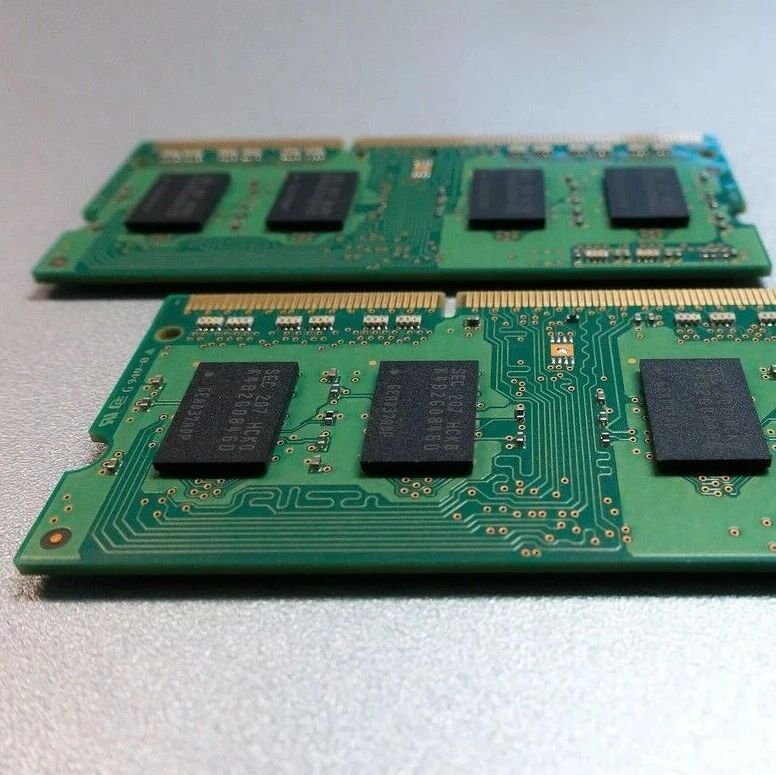
GDDR7内存

Search documents
三大巨头:HBM产能全售罄
半导体行业观察· 2025-10-31 01:35
Core Viewpoint - The semiconductor industry is experiencing a strong recovery driven by surging demand for high-bandwidth memory (HBM) chips, particularly from artificial intelligence (AI) server applications, with major players like Samsung, SK Hynix, and Micron reporting significant sales growth and full order books for upcoming products [2][3][10]. Group 1: Samsung's Performance - Samsung Electronics has begun mass production of HBM3E chips and has sold out its next-generation HBM4 chip production for next year, indicating robust recovery in the global memory market [2]. - The company reported a record quarterly revenue of 26.7 trillion KRW (approximately 18.8 billion USD) for its memory business, driven by strong demand for HBM chips, DDR5 memory, GDDR7 memory, and SSDs for servers [3][5]. - Samsung's device solutions division achieved revenues of 33.1 trillion KRW (approximately 23.5 billion USD) and an operating profit of 7 trillion KRW (approximately 5 billion USD), reflecting year-on-year growth of 13% and 3% respectively [5]. Group 2: SK Hynix's Growth - SK Hynix reported a 39% year-on-year revenue increase to 24.449 trillion KRW (approximately 17.1 billion USD) in Q3 2025, with a net profit of 12.598 trillion KRW (approximately 8.8 billion USD), marking a 118.9% increase [6]. - The company has sold out its chip orders for 2026, with strong sales of HBM3E and DDR5 server memory contributing to its record revenue [6][9]. - SK Hynix plans to increase its storage capacity and expects demand for all DRAM and NAND products to be secured through 2026 [9]. Group 3: Micron's Outlook - Micron Technology has nearly sold out all its HBM orders for next year and anticipates an increase in profit margins [10]. - The company reported a 46% year-on-year revenue growth to 11.32 billion USD in Q4, with a 48% annual revenue increase to 37.4 billion USD [10][11]. - Micron's cloud storage business saw a remarkable 213% revenue growth, reaching 4.5 billion USD, and the gross margin for this segment increased from 49% to 59% [10][11]. Group 4: Market Trends and Future Projections - The demand for memory products is expected to continue growing due to the rapid development of AI technologies and the expansion of AI server infrastructure [8][9]. - Analysts predict that the trend of increasing demand for high-performance memory products, including DDR5 and eSSD, will persist as AI applications expand [9]. - Companies are investing heavily in capacity expansion, with Micron planning to spend 18 billion USD in capital expenditures for FY2025, indicating strong growth potential in the DRAM market [11].


存储巨头,纷纷投靠台积电
半导体芯闻· 2025-09-24 10:47
Core Viewpoint - Micron Technology, as the largest computer memory chip manufacturer in the U.S., has provided an optimistic quarterly performance outlook driven by demand for artificial intelligence devices, indicating a significant role in AI investments [1][4]. Group 1: Financial Performance - For the first quarter of the fiscal year, Micron expects revenue of approximately $12.5 billion, exceeding analysts' average estimate of $11.9 billion [1]. - The projected earnings per share (EPS) is around $3.75, higher than the market's previous estimate of $3.05 [1]. - In the fourth quarter of the fiscal year, Micron reported a 46% year-over-year revenue increase, reaching $11.3 billion, surpassing market expectations of $11.2 billion [3]. Group 2: Product Development - Micron is making progress with its HBM4 12-Hi DRAM solution, which offers over 11 Gbps pin speed and 2.8 TB/s bandwidth, claiming it will outperform competitors in performance and efficiency [1]. - The company plans to collaborate with TSMC to produce the next-generation HBM4E memory, expected to launch in 2027 [2]. - Micron is also focusing on LPDDR memory for data centers, becoming the sole supplier of LPDDR DRAM in this sector, and is working on GDDR7 memory with expected pin speeds exceeding 40 Gbps, a 25% increase from the initially announced 32 Gbps [2]. Group 3: Market Dynamics - Micron anticipates that the supply tightness of memory chips will continue into next year due to growing demand from data center equipment and AI-related businesses [4]. - The company plans to increase capital expenditures to meet market demand, with investments in facilities and equipment reaching $13.8 billion in fiscal year 2025 [4]. - Micron's CEO highlighted the unique advantage of being the only U.S.-based memory manufacturer in capturing AI opportunities, with data center business reaching historical highs [3]. Group 4: Competitive Landscape - Micron has narrowed the gap with market leader Samsung in the HBM sector, launching products closely aligned with NVIDIA's AI processors [5]. - Analysts have expressed optimism about Micron's growth potential in the data center market, leading to significant stock price increases [5].
HBM,碰壁了
半导体行业观察· 2025-09-13 02:48
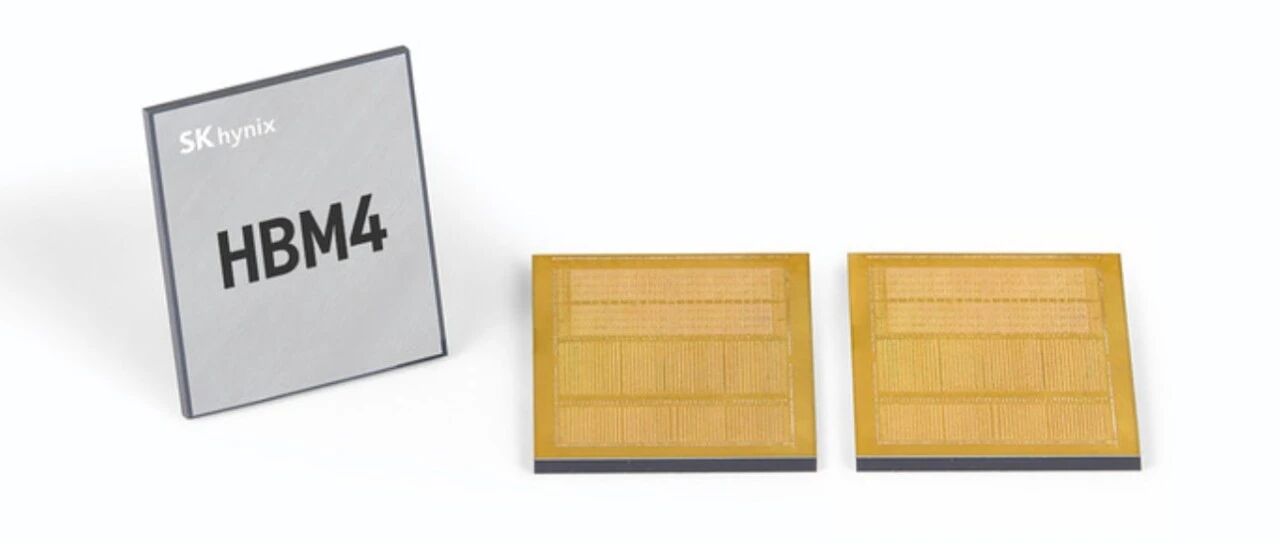
Core Viewpoint - The introduction of NVIDIA's Rubin CPX GPU, which opts for GDDR7 memory instead of the traditional HBM, raises questions about the future of HBM in AI applications and its potential threats from more cost-effective memory solutions [1][7]. Group 1: Rubin CPX GPU Overview - The Rubin CPX GPU was launched on September 10, 2023, specifically designed for long-context AI workloads, emphasizing a new inference acceleration concept called "disaggregated inference" [2]. - This GPU is not a simplified version of the standard Rubin GPU but is deeply optimized for inference performance, indicating a shift in focus from training to inference in AI applications [2][4]. - The Rubin CPX GPU is expected to provide up to 30 PFLOPs of raw computing power with 128 GB of GDDR7 memory, contrasting with the standard Rubin GPU's 50 PFLOPs and 288 GB of HBM4 memory [3]. Group 2: Architectural Differences - The architectural differences between Rubin CPX and standard Rubin GPU highlight a focus on task specialization, with Rubin CPX handling context construction and Rubin GPU managing generation tasks [5][9]. - The overall performance of the system with Rubin CPX is projected to reach 8 ExaFLOPs NVFP4, significantly surpassing previous models [4]. Group 3: Memory Transition and Implications - The shift from HBM4 to GDDR7 is driven by the need to reduce costs while maintaining performance, as GDDR7 provides sufficient bandwidth for the context-building tasks of the Rubin CPX GPU [9]. - This transition is expected to lower the total cost of systems, making AI infrastructure more accessible to a broader range of enterprises [9]. - The demand for GDDR7 is surging, with NVIDIA increasing orders from suppliers like Samsung, which is expanding production capabilities to meet this demand [10][12]. Group 4: Market Dynamics and Future Outlook - The introduction of GDDR7 is seen as a potential threat to HBM, but it also opens new opportunities for memory suppliers, particularly Samsung, which is poised to benefit from increased orders [10][12]. - SK Hynix has announced the completion of HBM4 development, indicating that while GDDR7 is gaining traction, HBM technology continues to evolve and remain relevant in the market [13].

【大涨解读】内存:海外大厂连续涨价,国产存储龙头或将跟进,英伟达最新GPU也转向GDDR内存
Xuan Gu Bao· 2025-09-12 02:46
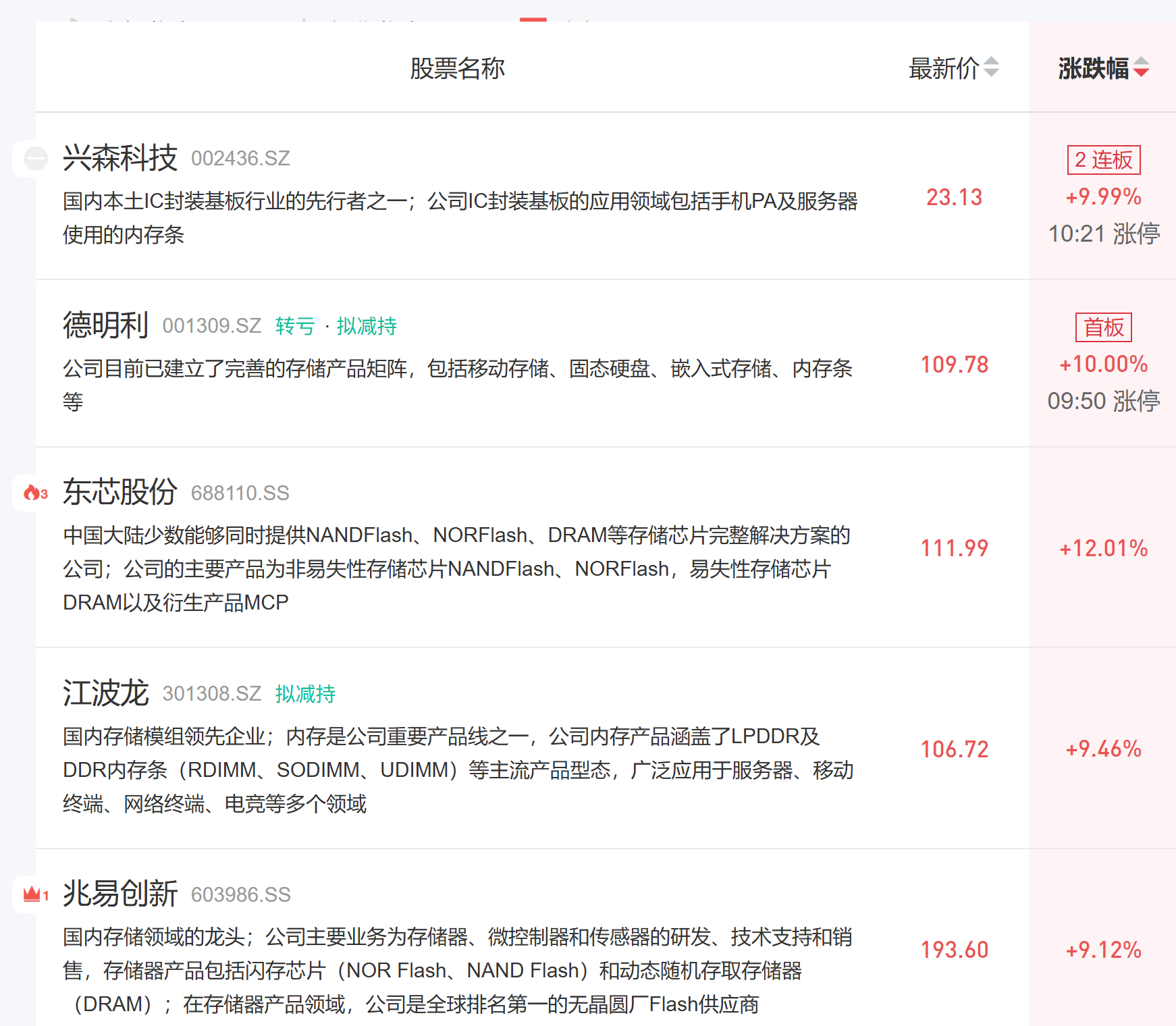
Market Overview - On September 12, the storage sector experienced a significant opening surge, with companies like Deminor hitting the daily limit, and others such as Dongxin Co., Jiangbolong, and others seeing substantial increases [1] Company Insights - **Xingsen Technology (002436.SZ)**: A pioneer in the domestic IC packaging substrate industry, with applications in mobile memory modules [3] - **Deminor (001309.SZ)**: Transitioning from losses and planning to reduce holdings; has established a comprehensive storage product matrix including mobile storage and solid-state drives [3] - **Dongxin Co. (688110.SS)**: One of the few companies in mainland China providing a full range of storage chips including NAND Flash, NOR Flash, and DRAM [3] - **Jiangbolong (301308.SZ)**: A leading domestic storage module company, with memory products covering mainstream types like LDDR memory modules [3] - **Beiyi Innovation (603986.SS)**: A leader in the storage field, focusing on the development and sales of memory chips and microcontrollers, ranking first globally in non-foundry Flash supply [3] Industry Trends - Major US storage leaders like Micron and SanDisk saw collective gains, with SanDisk announcing a 10% price increase across all channels for consumer products, indicating a potential new pricing cycle due to changing supply-demand dynamics [5][6] - The global DRAM market size increased approximately 17% quarter-on-quarter to $30.9 billion in Q2 2025, driven by the rise of generative AI and increasing demand for DRAM contracts and HBM shipments [6] - Nvidia's launch of the RubinCPX GPU aims to enhance speed in handling massive data, utilizing GDDR7 memory, which could lead to increased demand for DRAM [5][6] - The establishment of Changchun's third phase company marks a significant step in China's semiconductor industry, potentially breaking the monopoly of Samsung and SK Hynix in the NAND market [6]