H1人形机器人

Search documents
人形机器人行业点评:宇树科技科创板IPO获受理,开启具身智能产业化元年
Shenwan Hongyuan Securities· 2026-03-22 12:25
Investment Rating - The industry investment rating is "Overweight" indicating a positive outlook for the humanoid robot sector [5]. Core Insights - Yushu Technology is transitioning from laboratory innovations to becoming a global leader in embodied intelligence, having launched its first full-size humanoid robot H1 in 2023 and a mid-sized humanoid robot G1 in 2024 [5]. - Revenue is projected to grow explosively, with figures of 1.23 billion, 1.59 billion, 3.92 billion, and 17.08 billion yuan from 2022 to 2025, respectively, indicating a 335% growth rate in 2025 [5]. - The company is expected to achieve profitability in 2024, with net profit figures of -0.08 billion, -0.18 billion, 0.78 billion, and 6.00 billion yuan from 2022 to 2025 [5]. - The gross margin is improving, rising from 44.9% in 2022 to 59.8% in Q3 2025 [5]. - The cash flow from operating activities is expected to turn positive, moving from -0.30 billion yuan in 2022 to 6.72 billion yuan in 2025 [5]. Summary by Sections Business Overview - Yushu Technology focuses on bionic robots, initially specializing in quadruped robots and later expanding into humanoid robots, marking a significant shift in its product offerings [5]. Financial Performance - The sales of quadruped robots increased from 2,403 units in 2022 to 17,946 units in Q3 2025, with corresponding revenue growth from 0.9 billion to 4.9 billion yuan [5]. - Humanoid robot sales are projected to rise from 5 units in 2023 to over 5,500 units in 2025, with revenue reaching 6.0 billion yuan in the first three quarters of 2025 [5]. Fundraising and Investment - The total amount raised is 4.202 billion yuan, with significant investments allocated to AI and core hardware integration, including 2.022 billion yuan for intelligent robot model development [5]. - The construction of a new manufacturing base is expected to enable the production of 75,000 humanoid robots and 115,000 quadruped robots annually [5]. Market Position and Recommendations - Yushu Technology is positioned as a leader in the domestic embodied intelligence sector, with a recommendation to pay attention to related companies in the robotics supply chain [5].
获专利5天后索赔8000万败诉,“碰瓷”宇树科技的幕后推手什么来头?
3 6 Ke· 2026-02-27 03:07
Core Viewpoint - The recent Supreme Court ruling in favor of Yushu Technology has cleared a significant legal hurdle for the company ahead of its IPO, reinforcing its position as a leading player in the humanoid robotics sector in China [2][11][28]. Company Overview - Yushu Technology, established in 2016, specializes in the research and development of bipedal and quadrupedal robots, with notable products including the H1 humanoid robot and various quadrupedal models [22][24]. - The company has achieved significant sales, with quadrupedal robots alone generating over 1 billion RMB in revenue, accounting for approximately 69.75% of the global market share in 2024 [26]. Legal Developments - The Supreme People's Court ruled that Yushu Technology did not infringe on the patent rights of Hangzhou Luweimei Daily Chemical Co., which had filed a lawsuit against it, thus maintaining the lower court's decision [11][12]. - The lawsuit was characterized by the court as an act of bad faith, with the plaintiff's inconsistent claims and motives being highlighted [10][12]. IPO Progress - Yushu Technology is on track to become the first publicly listed humanoid robotics company in A-shares, having completed its transition to a joint-stock company and finishing its IPO counseling process [28]. - The company is expected to submit its IPO application documents between October and December 2025, following its successful appearances on the Spring Festival Gala, which have significantly boosted its visibility and investor interest [28]. Financial Performance - Yushu Technology has reported continuous profitability since 2020, with annual revenues exceeding 1 billion RMB, and a diverse revenue structure where quadrupedal robots account for 65% of sales, humanoid robots 30%, and components 5% [26][28].

为什么春晚的机器人不“僵”了?具身智能正在经历一场大脑进化
机器人大讲堂· 2026-02-19 00:00
Core Viewpoint - The evolution of humanoid robots is moving from performance in controlled environments to practical applications in real-world scenarios, emphasizing the need for robots to understand and predict physical interactions [5][6][26]. Group 1: Humanoid Robot Performance - The performance of humanoid robots at the Spring Festival Gala has shown significant advancements, with previous years featuring coordinated movements and complex formations [1][2]. - This year's robots demonstrated a level of agility and responsiveness that suggests a breakthrough in their control algorithms and hardware integration [5]. Group 2: Challenges in Real-World Applications - Despite advancements, the transition from staged performances to real-world applications remains challenging, as robots must navigate unpredictable environments like factories and homes [5][6]. - Current humanoid robots lack the ability to understand physical laws, which limits their effectiveness in dynamic settings [13][22]. Group 3: VLA Paradigm and Industry Anxiety - The dominant paradigm for embodied intelligence is the Visual-Language-Action (VLA) model, which is currently highly competitive [7]. - Companies like Ant Group and Horizon are developing advanced VLA models that enhance spatial awareness and adaptability across different robotic configurations [8][10]. Group 4: Transition to World Models - The industry is recognizing the need to evolve from VLA to embodied world models that allow robots to simulate and predict physical interactions [14][15]. - Ant Group's LingBot-World is a notable example, providing a high-fidelity simulation environment for robots to learn and adapt without real-world consequences [16]. Group 5: Impact on Industry Scalability - The shift from action mapping to physical pre-simulation is expected to reduce the data requirements for training new skills significantly, from thousands of examples to just 30-50 [23]. - Robots equipped with predictive capabilities have shown a high success rate in complex tasks, achieving over 91% in multi-task scenarios [24]. Group 6: Conclusion and Future Directions - The journey of humanoid robots is transitioning from mere demonstrations to practical applications, with a focus on understanding physical laws and improving operational capabilities in real-world environments [26][28]. - The ongoing debate about the best approaches for robotic intelligence continues, with various strategies being explored to enhance performance in unpredictable settings [27].

机器人们为何抢着上春晚
21世纪经济报道· 2026-01-30 11:24
Core Viewpoint - The article discusses the increasing competition among leading Chinese robotics companies to showcase their products at the 2026 Spring Festival Gala, highlighting the event's significant impact on brand visibility and market confidence [1][2]. Group 1: Company Highlights - Yushu Technology has been a recurring participant in the Spring Festival Gala, gaining widespread recognition after showcasing its humanoid robot in 2022, which led to a substantial increase in sales, with over 5,500 humanoid robots sold in 2025 [2]. - Magic Atom, a new entrant founded in January 2024 by the core team behind Xiaomi's robotic dog, is competing for a spot at the gala with a diverse product line [1]. - Galaxy General, established in 2023, focuses on creating AI models for robots and has rapidly reached a valuation of $3 billion, indicating strong investor interest [1]. Group 2: Importance of the Spring Festival Gala - The Spring Festival Gala is projected to reach an audience of 16.8 billion people in 2025, making it a powerful platform for brand elevation and market penetration for robotics companies [1]. - Participation in the gala serves as a significant "credit endorsement" for startups, enhancing their appeal to investors and increasing market confidence in the robotics sector [2]. - Following the 2025 gala, there was a notable surge in investor interest in the robotics industry, with previously hesitant investors now eager to fund projects that seemed too costly or impractical before [2]. Group 3: Market Implications - The competition among robotics companies for a spot at the gala has led to intense bidding, with reports suggesting offers in the range of millions to over a billion [3]. - The increasing presence of robots in the gala signifies a pivotal shift for the humanoid robotics industry from experimental phases to real-life applications, enhancing consumer acceptance [4]. - While participation in the gala represents a milestone, companies must focus on cost reduction, product refinement, and expanding real-world applications to sustain long-term success [4].

机器人们为何抢着上春晚?|财经早察
2 1 Shi Ji Jing Ji Bao Dao· 2026-01-30 08:42
Core Viewpoint - The upcoming Spring Festival Gala is expected to serve as a significant platform for the robot industry, with leading companies like Yushu Technology, Magic Atom, and Galaxy General vying for exposure [1][2]. Group 1: Company Highlights - Yushu Technology has a history of participation in the Spring Festival Gala, showcasing its robotic innovations, including the "Niu Niu" in 2021 and the H1 humanoid robot in 2022, which gained widespread recognition [1][2]. - Magic Atom, founded in January 2024 by a core team from Xiaomi, is a rising player in the industry with a diverse product line ranging from quadruped robots to humanoid robots [1]. - Galaxy General, established in 2023, focuses on creating AI brains for robots and has rapidly achieved a valuation of $3 billion due to its innovative approach [1]. Group 2: Importance of Spring Festival Gala - The Spring Festival Gala has a massive reach, with the 2025 event expected to touch 16.8 billion people, providing unparalleled brand exposure for participating companies [2]. - Following its appearance at the 2025 Spring Festival Gala, Yushu Technology transformed from a known industry name to a household name, significantly boosting its sales of humanoid robots, with over 5,500 units sold in 2025 alone [2][3]. Group 3: Investor and Market Implications - Participation in the Spring Festival Gala serves as a strong endorsement for startups, enhancing their credibility and attracting investor interest, especially in a competitive market [3]. - The visibility gained from the Gala can lead to increased brand value, order growth, and improved negotiation power in funding discussions, outweighing the costs of participation [3]. Group 4: Long-term Industry Outlook - The event is seen as a crucial step in making robotic technology more acceptable to the general public, thereby lowering market education costs [4]. - Despite the temporary boost in visibility and interest, companies must focus on cost reduction, product refinement, and expanding real-world applications to ensure long-term success [4].

机器人们为何抢着上春晚?
2 1 Shi Ji Jing Ji Bao Dao· 2026-01-30 08:40
Group 1 - The upcoming Spring Festival Gala is expected to become a significant platform for the robot industry, with companies like Yushu Technology, Magic Atom, and Galaxy General planning to showcase their products [1] - Yushu Technology has a history of participation in the Spring Festival Gala, with their humanoid robot gaining widespread recognition after last year's performance [1][2] - Magic Atom, a new entrant founded in January 2024, and Galaxy General, focusing on AI for robots, are also vying for exposure at the gala [1] Group 2 - The Spring Festival Gala has a massive reach, with the 2025 event expected to touch 16.8 billion people, providing unparalleled brand exposure for participating companies [2] - Following their appearance at the gala, Yushu Technology saw a significant increase in brand recognition and sales, with over 5,500 humanoid robots sold in 2025 [2] - The gala serves as a critical platform for startups to gain credibility and attract investment, as demonstrated by the increased interest in the robot industry post-performance [3] Group 3 - The participation in the gala is not just about brand visibility; it also aims to boost investor confidence and market interest in the robotics sector [3] - Companies are reportedly competing fiercely for a spot at the gala, with bids reaching tens of millions, highlighting the event's perceived value [3] - The Spring Festival Gala is seen as a pivotal moment for the humanoid robot industry, marking a transition from experimental technology to real-world applications [4] Group 4 - The long-term goal for these companies is to make their products acceptable and desirable to ordinary consumers, with the gala serving as a crucial step in building national brand recognition [4] - Despite the potential short-term success from the gala, companies must focus on cost reduction, product refinement, and expanding real-world applications to ensure sustainable growth [4]
春晚舞台的“技术试金石”:首程被投企业以实战力点亮中国智造
Sou Hu Wang· 2026-01-27 06:55
Core Insights - The Spring Festival Gala serves as a critical platform for hard technology companies, showcasing their technological maturity and adaptability to real-world scenarios [1] - The participation of Yushutech and Galaxy General highlights the advancement of China's robotics industry from laboratory settings to public performance [1] Group 1: Technological Challenges and Achievements - The Spring Festival Gala presents stringent requirements for robotic technology, including stability, responsiveness, and autonomous decision-making [2] - Yushutech's H1 humanoid robot is set to perform complex tasks in a dance program, demonstrating industry-leading precision and responsiveness with a 0.001-second servo response technology [2] - Galaxy General's robot will engage in scene recognition and interaction, showcasing its advanced embodied intelligence capabilities [3] Group 2: Investment and Empowerment Logic - Shoucheng Holdings employs a "capital + scene + technology synergy" model to empower its portfolio companies, facilitating the transition from R&D to practical applications [4] - The company focuses on building a robust technical foundation through upstream material investments, addressing industry pain points [4] - Shoucheng Holdings provides diverse real-world testing environments for its portfolio companies, enhancing their technological iterations [4] Group 3: Commercialization and Growth Potential - The Spring Festival Gala acts as a catalyst for accelerating the commercialization of hard technology companies, enhancing their market recognition [6] - Yushutech's post-investment valuation has reached 12 billion yuan, with plans for an IPO, while Galaxy General has completed a 2.1 billion yuan financing round, reaching a valuation of 21 billion yuan [6] - Shoucheng Holdings benefits from the increased valuations and IPO progress of its portfolio companies, achieving over fourfold returns in two years [6] Group 4: Industry Growth Logic - The collaboration between Shoucheng Holdings and its portfolio companies exemplifies the growth logic of China's hard technology sector, emphasizing the need for technologies to withstand both laboratory and real-world testing [7] - The ongoing effects of the Spring Festival Gala will further unlock the technological and commercial value of Shoucheng's portfolio companies [7]
跨界卷王“最浓烟火气” 机器人“最能舞出圈” 潮玩教父“最拿捏情绪”
Nan Fang Du Shi Bao· 2026-01-08 23:12
Core Insights - The business landscape in 2025 is characterized by significant transformations driven by AI, e-commerce, and local services, with major companies like JD.com, Alibaba, and Pop Mart leading the charge [3][4][7] - Key figures in the industry are recognized for their innovative approaches and impactful strategies, earning them accolades such as "most impactful" and "most daring" [3][7][10] Group 1: JD.com and Liu Qiangdong - Liu Qiangdong made a strong public return in 2025, taking on the role of "Chief Experience Officer" and engaging directly with consumers through various initiatives [5][6] - His actions, including cooking live and delivering food, aimed to enhance JD.com's local service offerings and reshape the company's image as more relatable and community-focused [5][6] - JD.com also committed to providing full social insurance for its delivery riders, emphasizing sustainable employee welfare over mere competition on subsidies [6] Group 2: Alibaba and Jiang Fan - Jiang Fan returned to lead Alibaba's e-commerce division, focusing on integrating various business segments under a unified platform to enhance operational efficiency [7][8] - His strategy included the launch of Taobao Flash Purchase, which significantly boosted user engagement and was projected to generate substantial transaction growth in the coming years [8] Group 3: Pop Mart and Wang Ning - Wang Ning, founder of Pop Mart, successfully transformed emotional value into a profitable business model, with the LABUBU IP becoming a top-tier brand [9] - Despite market concerns about sustainability, Pop Mart remains a leading player in the collectible toy industry, with plans to further explore long-term value creation [9] Group 4: AI and Yan Junjie - Yan Junjie, founder of MiniMax, is recognized for his foresight in AI development, having started his venture before the AI boom [15][16] - MiniMax focuses on efficient resource use and innovative algorithms, with a young workforce that emphasizes agility and high performance [16] Group 5: GPU Industry and Zhang Jianzhong - Zhang Jianzhong's company, Moore Threads, successfully launched on the STAR Market, becoming a significant player in the domestic GPU sector [17][18] - The company achieved a remarkable IPO process, with a high stock price and low lottery rate, indicating strong market interest and potential for growth [18][19]


人形机器人板块投资机遇凸显
Zhong Guo Zheng Quan Bao· 2026-01-06 20:42
Core Insights - The humanoid robot industry is approaching a pivotal moment, with significant advancements showcased at CES 2026, highlighting its central role in global technological competition and industrial transformation [1] - The humanoid robot concept index has risen by 12.92% since December 17, 2025, indicating a positive market trend [1] - Analysts predict a broad market potential for embodied robots, with continuous technological breakthroughs and successful commercialization efforts [1] Industry Developments - CES 2026, held in Las Vegas from January 6 to 9, 2026, featured humanoid robots as a key focus, with significant participation from leading global companies [1] - NVIDIA's CEO announced that the robotics field has entered its "ChatGPT moment," emphasizing the shift towards "general-specialized" robots that combine broad knowledge with specialized skills [1] - NVIDIA introduced new models aimed at enhancing robots' understanding of physical properties and spatial relationships [1] Application Scenarios - LG showcased the CLOiD household robot capable of performing various domestic tasks, while Boston Dynamics announced the mass production of its Atlas humanoid robot, set to be deployed in Hyundai's factories starting in 2026 [2] - Numerous domestic humanoid robot manufacturers, including Yushu Technology and Zhiyuan Robotics, presented their latest products at CES 2026, indicating a strong domestic presence in the market [2] Industry Chain Collaboration - A-share listed companies are actively positioning themselves across different segments of the humanoid robot industry, leveraging their technological expertise for diversified development [3] - Key components such as precision reducers and servo systems are being tested and developed by companies like Haozhi Electromechanical and Tongda Power, indicating a focus on enhancing core robotic technologies [3] Market Analysis - The Chinese embodied intelligent robot market is experiencing rapid growth, driven by policy, capital, and industry chain support, transitioning from "technological breakthroughs" to "value realization" [4] - Analysts suggest that the humanoid robot sector will see significant investment and development, with Chinese companies leading in hardware and operational control, while AI technology remains a competitive focal point [4] Future Projections - 2025 is anticipated to be the year of mass production for humanoid robots, with 2026 expected to mark a significant advancement in their practical application [5] - The commercial progress of humanoid robots is accelerating, with potential applications in inspection and navigation expected to expand significantly [5] - The manufacturing and logistics sectors are projected to be the first to adopt humanoid robots at scale, with substantial demand anticipated in automotive and 3C manufacturing by 2028 [6]

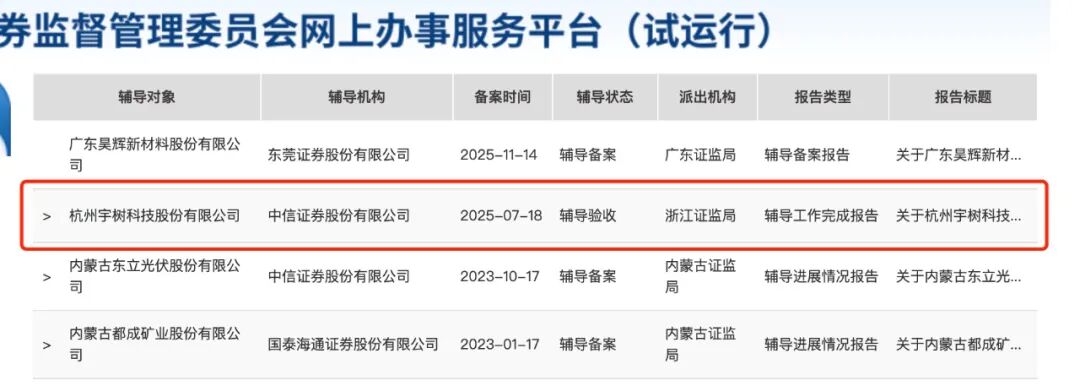
宇树科技IPO辅导“通关”,四个月跑完上市前哨战
3 6 Ke· 2025-11-17 03:40
Core Viewpoint - Yushu Technology Co., Ltd. is accelerating its path to the capital market with plans to apply for an IPO in China, having achieved annual revenue exceeding 1 billion yuan and continuous profitability [1][3][15]. Group 1: IPO Progress - Yushu Technology has completed its IPO counseling work, with CITIC Securities as the counseling institution, confirming that the company has established a sound corporate governance system [3][8]. - The counseling process took four months, starting from July 8 to November 10, indicating a smooth path towards the IPO [4][8]. - The company plans to submit its IPO application documents between October and December 2023, with relevant operational data to be disclosed at that time [6][15]. Group 2: Company Overview - Founded on August 26, 2016, Yushu Technology focuses on the research, production, and sales of consumer and industrial robots, including quadruped robots, humanoid robots, and robotic arms [5][11]. - The company has approximately 1,000 employees and is led by founder Wang Xingxing, who holds a 23.82% stake in the company [5][6]. Group 3: Financial Performance - Yushu Technology's annual revenue has surpassed 1 billion yuan, and it has maintained profitability since 2020 [15][21]. - The company has successfully completed multiple financing rounds, with the latest C round raising nearly 700 million yuan, pushing its valuation to over 12 billion yuan [14][15]. Group 4: Product Portfolio - The company has a diverse product matrix, primarily supported by its quadruped robots and humanoid robots, with the quadruped robots accounting for about 70% of the global market share [18][21]. - Yushu Technology's quadruped robots, such as the Go series, target the consumer market, while the B series focuses on industrial applications [18][19]. - The humanoid robots, H1 and G1, are designed for various applications, with G1 priced at 99,000 yuan, aimed at the consumer and educational markets [19][21]. Group 5: Market Strategy - Yushu Technology has positioned itself well in the market by leveraging over 95% self-developed core hardware and achieving a 60% component reuse rate between its quadruped and humanoid robots [22][23]. - The company has also focused on building a developer ecosystem to support secondary development, enhancing its commercial viability [23][24].