
HDM1002

Search documents
诺和诺德判断:到2030年,口服剂型将拿下全球超1/3的肥胖市场
GLP1减重宝典· 2026-03-31 09:34
Core Viewpoint - The obesity drug market is shifting from a focus on efficacy competition to entry competition, emphasizing the importance of oral formulations as a more accessible starting point for patients [2][3][12]. Group 1: Market Dynamics - The market is expected to see oral formulations capture over one-third of the global obesity market by 2030, indicating a significant shift in how major pharmaceutical companies view oral drugs as essential components rather than mere alternatives to injectables [2][6]. - The key change in the obesity drug market is the transition from efficacy competition to entry competition, where the willingness of patients to start treatment is more critical than the strength of the treatment itself [3][4]. Group 2: Commercial Significance of Oral Formulations - Oral medications are perceived as more manageable and easier to integrate into daily life, making them a more attractive option for patients who may have psychological barriers to injections [3][4]. - The commercial significance of oral formulations lies in their ability to expand the patient base by attracting individuals who might not otherwise consider obesity treatment [4][6]. Group 3: Competitive Landscape - Companies like Novo Nordisk and Eli Lilly are focusing on oral GLP-1 products not just for their competitive data but for their potential to dominate the market entry point, which is crucial for long-term treatment engagement and brand loyalty [6][12]. - Recent data from companies like Structure indicates that oral GLP-1 drugs are moving closer to the efficacy levels previously associated only with injectables, enhancing their market potential [6][12]. Group 4: Market Segmentation - The obesity drug market is likely to evolve into a clear tiered structure, where foundational treatments will focus on integrating more patients into management systems rather than achieving extreme efficacy [7][12]. - There will still be a place for intensive treatments for patients with higher weight and metabolic burdens, indicating that injectables will not disappear but will coexist with oral options [7][12]. Group 5: Challenges for Mid-Tier Assets - Assets that fall into the middle tier, particularly those with decent efficacy but not strong enough to secure a top-tier position, may face challenges as the market matures and expectations rise [8][9]. - Companies with oral products that do not demonstrate significant advantages in efficacy or commercial viability may struggle to define their market position and could be marginalized [10][11]. Group 6: Future Considerations - The market for inexpensive single-target injectable drugs will need to be evaluated separately, as they may still hold value in price-sensitive markets until oral innovations become widely adopted [11]. - The narrative around oral formulations will need to evolve, as the novelty of being an oral option may not suffice for valuation unless they can demonstrate unique, irreplaceable benefits compared to oral small molecules [11].


减肥药市场持续火热:两大巨头口服大战在即
Feng Huang Wang· 2026-02-17 00:51
Core Insights - The global weight loss drug market has undergone significant changes in the past five years, with Novo Nordisk's semaglutide gaining approval for weight loss in the U.S. in 2021, marking the entry of GLP-1 weight loss drugs into the pharmaceutical industry [1] - By 2025, Eli Lilly's tirzepatide is projected to achieve $36.5 billion in sales, highlighting the commercial potential of the weight loss sector [1] - The competition has shifted from injectable forms to oral formulations, with Novo Nordisk's oral semaglutide receiving approval in December 2025, becoming the first oral GLP-1 obesity treatment [1][2] Group 1: Market Dynamics - The approval of oral medications signifies a breakthrough beyond the physical limitations of injection pens, enhancing Novo Nordisk's product line defensively [2] - A surge in prescription volume for oral semaglutide has been observed, with approximately 50,000 prescriptions per week by January 23, 2026 [1] - Eli Lilly is also advancing in the oral GLP-1 space with its orforglipron, which has shown positive results in clinical trials and is expected to launch in mid-2026 [2] Group 2: Competitive Landscape - Novo Nordisk's oral semaglutide is a peptide drug, while Eli Lilly's tirzepatide is a small molecule oral drug, showcasing differentiation in their approaches [3] - Small molecule products are expected to have simpler development processes and better cost control, potentially impacting market competition if safety and efficacy are validated [3] - Other pharmaceutical giants, including AstraZeneca and various domestic companies, are also developing oral GLP-1 drugs, indicating a broadening competitive landscape [3][4] Group 3: Clinical Developments - AstraZeneca's oral GLP-1 receptor agonist, elecoglipron, has achieved positive results in key Phase 2 trials and is moving towards Phase 3 development [3] - Domestic companies like HengRui Medicine and others are advancing their oral GLP-1 drug pipelines, with promising clinical trial results [4] - The oral weight loss drug market is expected to grow, but injectable forms will still play a role in the short term, with rising expectations for their effectiveness and safety [4][5] Group 4: Future Outlook - The core patent for semaglutide will expire in 2026 in several markets, paving the way for a wave of generic versions, which may lead to more affordable options for consumers [5] - The penetration of GLP-1 weight loss drugs is anticipated to expand beyond first-tier cities, reaching broader markets [5]

“药王”更迭 替尔泊肽年销售额超365亿美元登顶
Xin Jing Bao· 2026-02-12 04:54
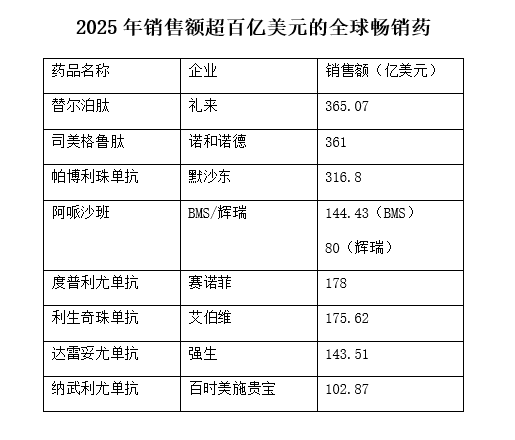
Core Insights - The global pharmaceutical industry is witnessing a significant shift in the rankings of best-selling drugs, with several products surpassing $10 billion in sales for 2025 [1][2]. Group 1: Sales Performance - Novo Nordisk's semaglutide briefly topped the sales chart in Q1 2025 but was ultimately surpassed by Eli Lilly's tirzepatide, with both drugs exceeding $30 billion in sales [1][3]. - Tirzepatide achieved a remarkable year-on-year sales growth of 121%, while semaglutide's growth was only 13% [3]. - The sales figures for semaglutide in the first half of 2025 reached $16.683 billion, maintaining its position as a top-selling drug [3]. Group 2: Competitive Landscape - The GLP-1 drug class is experiencing intense competition, with both tirzepatide and semaglutide being key players [4][5]. - The market is dominated by Novo Nordisk and Eli Lilly, but Chinese pharmaceutical companies are also making significant strides in this area [5][6]. - New GLP-1 drugs are under development, including Novo Nordisk's CagriSema and Eli Lilly's retatrutide, which shows potential for greater weight loss than tirzepatide [5]. Group 3: Oncology and Autoimmune Drugs - The PD-1 inhibitor pembrolizumab (Keytruda) remains a top seller in oncology, with sales reaching $31.68 billion in 2025, despite falling to third place [7]. - Nivolumab (Opdivo) also crossed the $10 billion mark, achieving sales of $10.29 billion [8]. - In the autoimmune disease sector, drugs like dupilumab and risankizumab achieved sales of $17.8 billion and $17.562 billion, respectively [8]. Group 4: Anticoagulants - The anticoagulant apixaban continues to show strong sales growth, with BMS reporting $14.443 billion in sales, a year-on-year increase of 8% [9]. - Pfizer's reported revenue from apixaban reached $8 billion, making it their second-largest selling product [9].
华东医药(000963) - 2026年1月21、22日投资者关系活动记录表
2026-01-23 09:08
Group 1: R&D Progress - DR10624 has shown strong lipid-lowering effects and safety in Phase II clinical trials, with results presented at the AHA Scientific Sessions 2025. It has been included as a breakthrough therapy for severe hypertriglyceridemia by the CDE in January 2026 [1][2] - HDM1002, an oral GLP-1 receptor agonist, has completed patient enrollment for its Phase III trial in weight management, with top-line data expected in Q3 2026. The study has shown good overall safety without liver enzyme elevation [3] - HDM2005 has reported positive preliminary results in Phase I trials for mantle cell lymphoma and classical Hodgkin lymphoma, and is also undergoing trials for diffuse large B-cell lymphoma and solid tumors [4] Group 2: Upcoming Data Releases - Key data releases expected in 2026 include: - HDM1002 weight management Phase III top-line data - HDM1005 weight management Phase III 40-week data - HDM2005 solid tumor Phase I preliminary data - DR10624 for MASLD/MASH Phase II top-line data [5] Group 3: New Product Approvals and Market Outlook - The company anticipates new drug approvals in 2026, including edaravone tablets and various biosimilars, which are expected to enhance revenue contributions [6][7] - The innovative products, such as Ailaha® and Huijiaojing®, are projected to maintain rapid growth due to their clinical value and market strategies [9] Group 4: Industrial Microbiology and Pet Medicine - The industrial microbiology sector is expected to continue its rapid growth, supported by expanding overseas markets and commercialized products [12] - The HDM7006 project for managing obesity in cats is addressing a significant market gap, with a reported obesity rate of 28.1% among pet cats in China. This product is positioned as a safe and effective GLP-1/GIP dual-target weight management solution [16] Group 5: Strategic Collaborations and Licensing - The company is actively pursuing licensing agreements for its self-developed products and is optimistic about future collaborations [8] - A strategic partnership with MC2 for skincare products aims to leverage innovative technology for daily skin care solutions in the Greater China region [14][15]

双核驱动,管线迸发!华东医药HDM1005、HDM2012获突破,彰显创新强劲势头
Quan Jing Wang· 2025-12-15 09:33
Core Insights - The company has achieved significant progress in drug development with its innovative long-acting dual-target agonist HDM1005 and the orphan drug designation for HDM2012, showcasing its strong R&D capabilities in metabolic diseases [1][2][4][10] Group 1: HDM1005 Development - HDM1005 is a first-class chemical new drug targeting GLP-1 and GIP receptors, showing promising results in a Phase II clinical trial for weight management, with a total of 243 participants [2][3] - The trial results indicate that weight loss in the HDM1005 groups (0.5mg, 1.0mg, 2.0mg, 4.0mg) was -7.47%, -9.73%, -13.31%, and -13.28% respectively, significantly outperforming the placebo group at -2.46% [3] - The drug also demonstrated improvements in waist circumference and BMI, with reductions of 6.3-10.3cm and 2.4-4.2kg/m respectively, compared to the placebo group [3] Group 2: HDM2012 Orphan Drug Designation - HDM2012, an ADC targeting MUC-17, has received orphan drug designation from the FDA for gastric and pancreatic cancers, highlighting its innovative potential [1][4][5] - It is the first ADC product targeting MUC-17 and shows promise in treating MUC-17 positive cancers, with clinical trials approved in both China and the U.S. [4][5] Group 3: Market Context and Company Strategy - The obesity and overweight issue in China is a significant health challenge, with adult overweight and obesity rates at 34.3% and 16.4% respectively, affecting approximately 600 million people [3] - The company is advancing its clinical development of HDM1005 and has a systematic approach to expanding indications, indicating a robust global clinical development framework [4][10] - The company has established a comprehensive pipeline around GLP-1 targets, including both oral and injectable formulations, enhancing its competitive edge in metabolic treatments [6][8] Group 4: Future Outlook - The dual breakthroughs of HDM1005 and HDM2012 signify the company's transition into a phase of scalable output in its innovation system [10] - The company is expected to continue leveraging its forward-looking target layout and differentiated R&D strategies to deliver more advanced treatment options for global patients [10]
中国创新药突破!华东医药FIC三重激动剂DR10624临床数据在AHA大会 Late-Breaking 惊艳开场
Quan Jing Wang· 2025-11-09 13:30
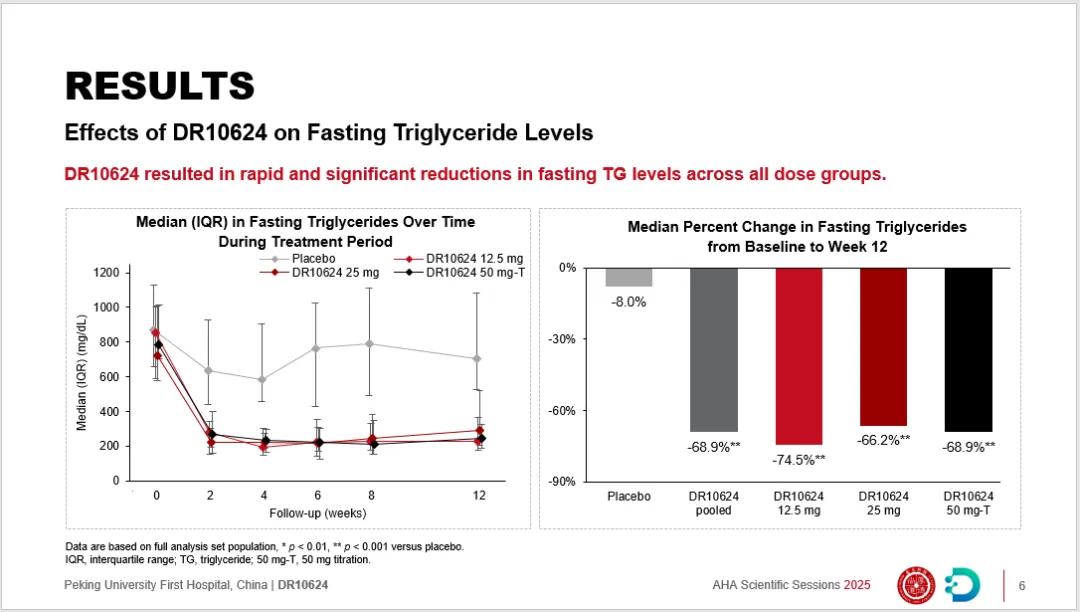
Core Insights - The article highlights the significant achievements of Huadong Medicine's subsidiary, Zhejiang Daor Bio, in the development of DR10624, a first-in-class long-acting triple agonist for treating severe hypertriglyceridemia (SHTG), which was showcased at the AHA 2025 conference [1][3] Group 1: Clinical Trial Results - DR10624 demonstrated a rapid and significant reduction in triglyceride levels, atherosclerotic lipids, and liver fat content in patients with SHTG during its Phase II clinical trial [1][3] - The trial results indicated that 89.5% of patients treated with DR10624 achieved triglyceride levels below 500 mg/dL, and 19.1% reached levels below 150 mg/dL, with a median percentage reduction in triglycerides of up to 75% [6][9] - After 12 weeks of treatment, DR10624 significantly reduced liver fat content, with a median percentage reduction of up to 67% compared to the placebo group [8] Group 2: Mechanism of Action - DR10624 is designed as a long-acting triple-target agonist, uniquely targeting FGFR1c/Klothoβ, GLP-1R, and GCGR, which allows it to intervene in metabolic regulation from multiple dimensions [2][10] - The drug enhances lipid oxidation, suppresses fat generation, improves insulin sensitivity, promotes fat breakdown, and effectively suppresses appetite, showcasing its unique advantages in treating metabolic diseases [2][10] Group 3: Strategic Positioning and Market Potential - The recognition of DR10624 at the AHA conference marks a historic breakthrough for Chinese scholars in cardiovascular research and drug development [3][10] - Huadong Medicine's focus on the FGF21 target, which has high barriers to entry and limited competition, positions the company favorably in the metabolic disease treatment landscape [10][11] - The global interest in FGF21 has led to significant investments from major pharmaceutical companies, indicating a strong consensus on its potential as a core target for metabolic disease therapies [10][11] Group 4: Future Developments - Huadong Medicine is preparing for Phase III clinical trials for DR10624, having submitted clinical trial applications to the FDA and received approvals for various indications [9][12] - The company is expanding its product pipeline, including multiple GLP-1 related products, which are progressing through clinical development for diabetes and weight management [12][13]
百亿减重药市场迎角逐战
2 1 Shi Ji Jing Ji Bao Dao· 2025-10-28 14:22
Core Viewpoint - The recent announcement by Innovent Biologics regarding the successful completion of the primary endpoint in the Phase III clinical trial of its dual receptor agonist, Masitide, highlights the rapid development of domestic GLP-1 drugs in China, with multiple companies actively participating in this market [1] Industry Overview - The GLP-1 drug market is characterized by a "dual oligopoly" with Novo Nordisk and Eli Lilly dominating the majority of market share and industry influence [2] - The global obesity and metabolic drug market is projected to exceed $100 billion by 2030, with GLP-1 drugs being a key driver of this growth [1] - The domestic weight loss injection market is entering an accelerated expansion phase due to strong positioning by multinational pharmaceutical companies and favorable weight management policies [1] Company Developments - Domestic companies such as Hengrui Medicine and East China Pharmaceutical are actively developing next-generation GLP-1 drugs, with Hengrui's HRS9531 showing promising results in Phase III trials [4] - East China Pharmaceutical is advancing its oral small molecule GLP-1 receptor agonist HDM1002 through clinical trials, with significant progress reported [3] - The competitive landscape is intensifying as more domestic players enter the GLP-1 space, necessitating strategies for differentiation and market penetration [5] Market Potential - The market for weight loss drugs in China is expected to exceed 12 billion yuan by 2025, driven by a growing population of overweight and obese individuals [3] - The expansion of indications beyond type 2 diabetes, including obesity and other conditions, is becoming a focal point for pharmaceutical companies [5] - Companies that can provide cost-effective alternatives while maintaining similar efficacy are likely to capture significant market share [5]
玛仕度肽“头对头”完胜司美格鲁肽,百亿减重药市场格局生变
2 1 Shi Ji Jing Ji Bao Dao· 2025-10-28 09:02
Core Insights - The article highlights the success of the domestic weight-loss drug Mazdutide, developed by Innovent Biologics, in a head-to-head clinical trial against the international product Semaglutide, marking a significant achievement for local innovation in the metabolic disease sector [1][2]. Group 1: Clinical Trial Results - The DREAMS-3 trial demonstrated that 49.7% of patients treated with Mazdutide achieved both blood sugar control (HbA1c < 7.0%) and a weight loss of ≥10%, significantly outperforming the 21.0% in the Semaglutide group [1]. - Mazdutide showed superior results in various cardiovascular metabolic risk factors, including fasting blood sugar, waist circumference, systolic blood pressure, and triglycerides [1]. - The trial was notable for being the first direct comparison of a domestic GCG/GLP-1 dual receptor agonist with Semaglutide in the diabetes treatment field [1]. Group 2: Market Context and Competition - The global market for obesity and metabolic drugs is projected to exceed $100 billion by 2030, with GLP-1 drugs being a key driver of this growth [3]. - The domestic weight-loss injection market is entering an accelerated expansion phase, driven by strong competition from multinational pharmaceutical companies and favorable weight management policies [4]. - The competitive landscape is characterized by a "dual oligopoly" with Novo Nordisk's Semaglutide and Eli Lilly's Tirzepatide dominating the market share [9]. Group 3: Industry Trends and Future Outlook - Domestic pharmaceutical companies are rapidly advancing in GLP-1 drug development, with several firms, including Hengrui Medicine and East China Pharmaceutical, actively pursuing innovative products [2][11]. - The market potential for weight-loss drugs is substantial, with projections indicating that by 2025, the compliant market for weight-loss medications in China could exceed 12 billion yuan [10]. - The increasing number of entrants in the GLP-1 space is expected to intensify competition, with companies needing to focus on differentiation, pricing strategies, and expanding indications beyond type 2 diabetes to capture market share [12][13].

调研速递|华东医药接受花旗银行等15家机构调研 透露多项业务关键数据与创新药研发进展
Xin Lang Cai Jing· 2025-09-26 08:21
Core Insights - Huadong Medicine hosted an on-site investor meeting with 15 institutions, including Citibank and Carlyle, on September 25, 2023 [1] Company Overview - Established in 1993 and listed in 1999, Huadong Medicine operates across the entire pharmaceutical industry chain, with four main business segments: pharmaceutical manufacturing, pharmaceutical commerce, medical aesthetics, and industrial microbiology [2] - In the first half of 2025, the company reported revenue of 21.675 billion yuan and a net profit of 1.815 billion yuan, maintaining its position on the Fortune China 500 for 16 consecutive years [2] - The company has received high ESG ratings, including AA from WIND ESG and A from MSCI ESG [2] Business Segments Performance - **Pharmaceutical Manufacturing**: Focuses on specialized, chronic, and special medications, with R&D investment of 1.484 billion yuan in the first half of 2025, accounting for 15.97% of the segment's revenue [2] - **Pharmaceutical Commerce**: Based in Zhejiang, ranked among the top two in the province and top ten nationally, with revenue of 13.947 billion yuan and a net profit of 226 million yuan in the first half of 2025 [2] - **Medical Aesthetics**: Operates globally with its subsidiary Sinclair, generating revenue of 1.112 billion yuan in the first half of 2025, with over 20 products launched and more than ten innovative products in development [2] - **Industrial Microbiology**: Focuses on international markets, achieving sales of 368 million yuan, a 29% increase year-on-year [2] Innovation and R&D - The innovation drug R&D center is advancing over 80 drug product pipelines, targeting endocrine/metabolic, autoimmune, and oncology fields, with plans to expand into cardiovascular and renal diseases [3] - The company has 15 ADC pipelines, with the product Somatuzumab injection approved domestically, and key projects like HDM2005 and HDM2020 at various clinical stages [3] - The obesity drug market shows significant potential due to rising obesity rates in China, with HDM1005 and HDM1002 making progress in clinical trials [3] - Revenue from innovative products reached 1.084 billion yuan in the first half of 2025, a 59% increase year-on-year, accounting for nearly 15% of the pharmaceutical manufacturing segment's total revenue [3]
华东医药(000963) - 2025年9月25日投资者关系活动记录表
2025-09-26 07:56
Company Overview - Huadong Medicine Co., Ltd. has over 30 years of development, covering the entire pharmaceutical industry chain. In the first half of 2025, the company achieved total revenue of 216.75 billion CNY and a net profit of 18.15 billion CNY [1] - The company is listed on the Shenzhen Stock Exchange and has four major business segments: pharmaceutical manufacturing, pharmaceutical commerce, medical aesthetics, and industrial microbiology [1] Financial Performance - Pharmaceutical manufacturing revenue in the first half of 2025 reached 73.17 billion CNY, with a net profit of 15.80 billion CNY [2] - Pharmaceutical commerce achieved revenue of 139.47 billion CNY and a net profit of 2.26 billion CNY in the same period [2] - The company’s innovative product business revenue reached 10.84 billion CNY, a year-on-year increase of 59%, accounting for nearly 15% of the total revenue from the pharmaceutical manufacturing segment [15] Research and Development - The company is advancing over 80 innovative drug candidates, focusing on endocrine, autoimmune, and oncology fields [2][4] - R&D investment in the pharmaceutical manufacturing sector for the first half of 2025 was 14.84 billion CNY, with direct R&D expenses of 11.74 billion CNY, representing 15.97% of the pharmaceutical manufacturing revenue [2] - The company has 15 ADC (Antibody-Drug Conjugate) pipelines, with significant progress in clinical trials for various cancer treatments [6][7] Medical Aesthetics - The medical aesthetics segment generated 11.12 billion CNY in revenue in the first half of 2025, with a focus on global operations and innovative product development [3] - The subsidiary Sinclair is a key player in the global medical aesthetics market, with over 20 products launched and more than 10 innovative products in development [3] Market Potential and Challenges - The company sees significant market potential for obesity drugs in China, despite current limitations in national insurance coverage for obesity treatment [11] - The medical aesthetics business is currently under pressure but is expected to grow with the approval of several key products [17]