
KGD(已知合格芯片)

Search documents
华强北不知何为“AI泡沫”
Jing Ji Guan Cha Wang· 2026-01-30 14:06
Core Viewpoint - The prices of server-related hardware, particularly storage chips and graphics cards, have surged dramatically due to supply constraints and increased demand driven by investments in AI infrastructure. This has led to significant price volatility in the market, affecting both buyers and sellers [2][3][5][12]. Price Trends - A server equipped with eight NVIDIA RTX 5090 graphics cards has seen its price rise from 300,000 yuan to 400,000 yuan within a month, indicating a 33.3% increase [2]. - The price of DDR4 64G server memory has doubled from approximately 1,500 yuan to 3,100 yuan in two months [3]. - High-frequency DDR5 memory prices have exceeded 13,000 yuan for second-hand parts, while new products are priced above 25,000 yuan (approximately 18,000 yuan) [6]. Market Behavior - Sellers are hesitant to stock inventory due to unpredictable price fluctuations, leading to a shift from traditional order placements to same-day pricing [3][4]. - Buyers are resorting to alternative strategies, such as purchasing second-hand laptops to extract valuable memory components, reflecting the high value of memory compared to other parts [4]. Supply Chain Dynamics - Major semiconductor companies are issuing price hikes for various products, with increases ranging from 15% to 80% due to rising costs and supply chain pressures [12][13]. - The demand for AI-related chips is causing a structural imbalance in supply, with companies like TSMC and SK Hynix reporting record revenues while others, like Intel, struggle with production issues [18][21][22]. Future Outlook - The ongoing price increases are expected to persist throughout 2026, with significant impacts on consumer electronics, including potential reductions in laptop shipments by 9.4% [22][23]. - The rising costs of storage and memory components may force manufacturers to either increase product prices by 10% to 20% or downgrade specifications to maintain cost balance [16].

多重因素推动国内半导体价格上涨
Jin Rong Shi Bao· 2026-01-30 00:49
Core Viewpoint - The semiconductor industry is experiencing significant price increases due to supply-demand imbalances and rising costs, with companies like Zhongwei Semiconductor and Guokewi announcing substantial price hikes for their products [1][2][4]. Group 1: Price Increases - Zhongwei Semiconductor has announced price increases of 15% to 50% for products such as MCUs and Nor Flash, effective January 27 [1]. - Guokewi plans to raise prices for KGD products by 40% to 80% starting January 2026, with adjustments based on future cost changes [1][3]. - The stock market reacted positively to Zhongwei's announcement, with shares rising by 19.47% to 54.61 yuan per share on January 28 [1]. Group 2: Cost Pressures - The semiconductor industry is facing high cost pressures from raw materials, manufacturing, and R&D, leading to a new round of price adjustments [2][5]. - Major companies like Texas Instruments and ADI have already initiated price hikes, indicating a broader trend in the industry [2]. Group 3: Company Performance - Zhongwei Semiconductor expects a revenue of approximately 1.122 billion yuan for 2025, a year-on-year increase of about 23.07%, and a net profit of approximately 284 million yuan, up 107.55% [2]. - Guokewi anticipates a net loss for 2025, contrasting with profitability in 2024, due to increased R&D and operational costs, along with declining revenue [3]. Group 4: Market Trends - The current price increases are attributed to a combination of supply-demand dynamics, rising costs, and industry cycles [4]. - The semiconductor sector has seen a significant performance boost, with the semiconductor index rising over 28% since early December 2025 [5].
芯片涨价!两家上市公司率先调价
Jin Rong Shi Bao· 2026-01-29 02:48
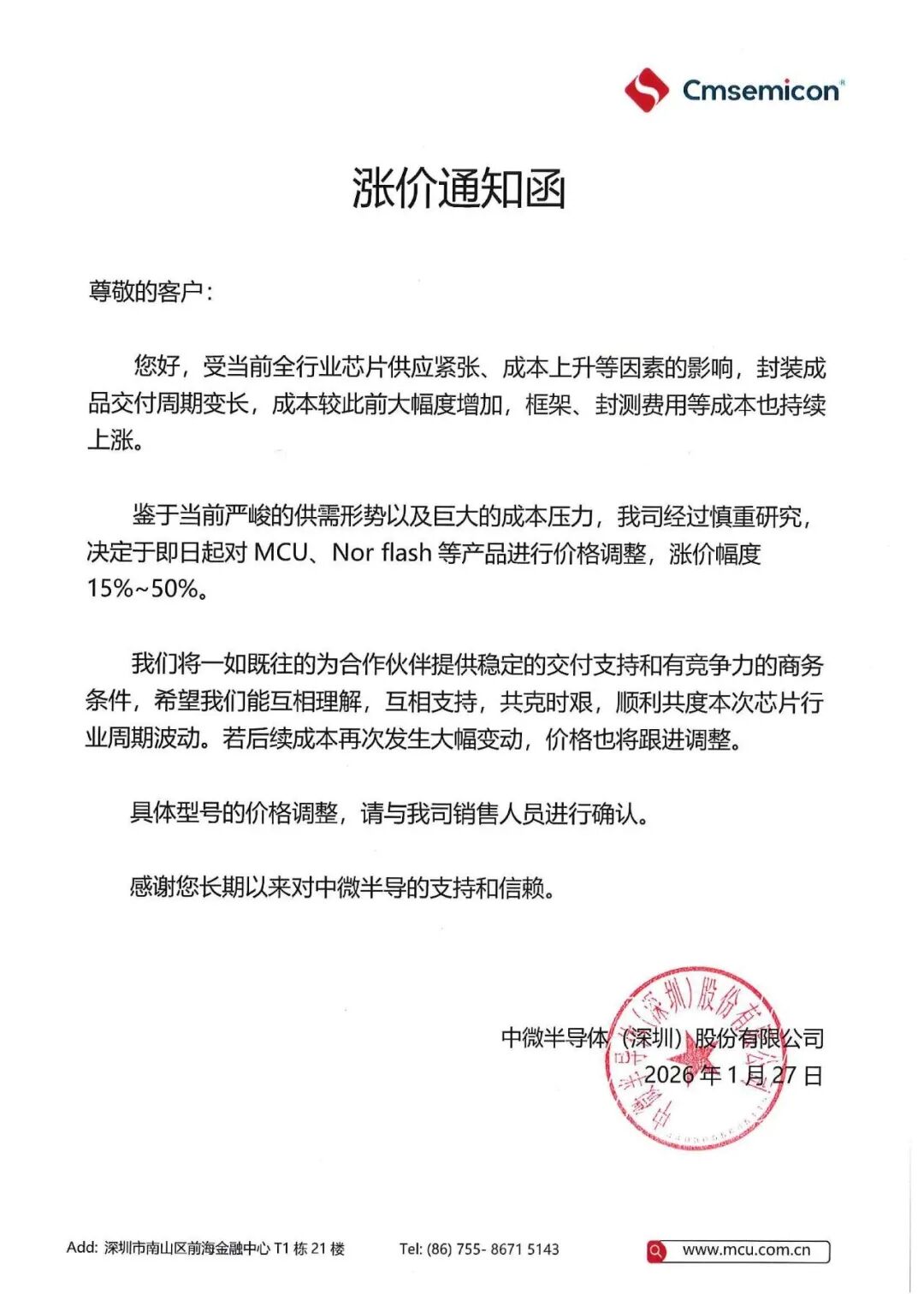
Core Viewpoint - The semiconductor industry is experiencing significant price increases due to supply shortages and rising costs, with companies like Zhongwei Semiconductor and Guokewi announcing price hikes of 15%-50% and 40%-80% respectively for various products [1][8][9]. Group 1: Price Adjustments - Zhongwei Semiconductor has issued a price adjustment notice, increasing prices for MCU and Nor Flash products by 15%-50% due to industry-wide chip supply constraints and rising costs [1][3]. - Guokewi has announced price increases for its KGD products, with hikes of 40%, 60%, and 80% for different memory capacities starting January 2026 [8][10]. Group 2: Market Reactions - Following the price announcement, Zhongwei Semiconductor's stock reached a peak increase of 19.47%, closing at 54.61 yuan per share, while Guokewi's stock saw a slight decline of 0.76% [8][9]. Group 3: Industry Context - The semiconductor sector is facing a "supply-demand imbalance" and high costs from raw materials and manufacturing, prompting a new round of price adjustments across the industry [9][11]. - Major semiconductor companies, including Texas Instruments and ADI, have already initiated price increases, indicating a broader trend in the market [9][11]. Group 4: Company Performance - Zhongwei Semiconductor expects a revenue of approximately 1.122 billion yuan for 2025, a year-on-year increase of about 23.07%, and a net profit of around 284 million yuan, reflecting a growth of approximately 107.55% [9][10]. - In contrast, Guokewi anticipates a net loss of 180 million to 250 million yuan for 2025, attributed to increased R&D and operational costs, alongside a decrease in revenue [10]. Group 5: Factors Driving Price Increases - The price hikes are driven by a combination of rising costs across the supply chain, structural supply-demand imbalances, and increased demand for AI-related semiconductor products [11][12]. - Analysts note that the demand for AI computing is significantly impacting the semiconductor market, leading to a surge in prices for certain chip categories [11][12].
存储芯片超级周期爆发!气派科技20CM涨停,国内两大存储芯片巨头宣布涨价,存储芯片的供应紧张局面可能持续至2027年甚至2028年
Jin Rong Jie· 2026-01-28 01:53
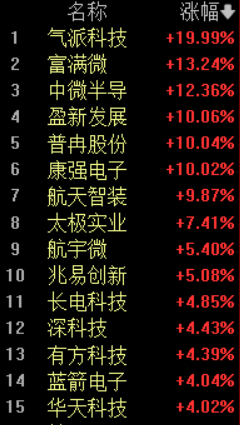
Core Viewpoint - The storage chip sector is experiencing a strong rally driven by a super cycle, supported by surging AI demand and domestic substitution, leading to significant price increases and robust performance across the industry [2][3]. Market Performance - Notable stocks in the storage chip sector include: - Qipai Technology: +19.99% - Zhongwei Semiconductor: +12.36% - Yingxin Development: +10.06% - Puran Shares: +10.04% - Kangqiang Electronics: +10.02% [2]. Industry Dynamics - The storage chip market is expected to maintain a tight supply until at least 2027, with AI demand outpacing capacity expansion. Price increases are anticipated to continue, with significant hikes already observed in contracts with major companies like Samsung and SK Hynix [3][4]. - Domestic companies such as Zhongwei Semiconductor and Guokewai have announced price increases ranging from 15% to 100% for various products due to rising costs and supply constraints [3]. Future Projections - The global storage chip market value is projected to reach $842.7 billion by 2027, with semiconductor equipment sales expected to exceed $150 billion, positioning China as the largest market [4]. - The expansion plans of major players like Micron are likely to stimulate demand for upstream semiconductor equipment, benefiting domestic suppliers [4]. Sector Opportunities - Storage chip design firms are set to benefit from the price surge, with AI-driven demand for high-end storage driving revenue growth [5]. - The storage testing and packaging sector will see increased order volumes and pricing due to the expansion of domestic and international storage manufacturers [5]. - The demand for high-capacity storage modules is expected to rise significantly, providing opportunities for domestic manufacturers amid the trend of domestic substitution [5]. - The expansion in storage chip production will boost demand for upstream materials and equipment, offering growth prospects for domestic suppliers in these segments [5].



2家半导体公司部分芯片涨价,机构称本轮存储超级周期至少延续至2027年(附概念股)
Zhi Tong Cai Jing· 2026-01-28 00:35
Group 1 - Two semiconductor companies, Zhongwei Semiconductor and Guokewi, have announced price increases for their chip products due to tight supply and rising costs, with price adjustments ranging from 15% to 80% depending on the product [1] - The price surge in storage chips is primarily driven by the explosive demand for AI servers, leading to a structural shortage in traditional consumer electronics and industrial control chip supplies [1] - TrendForce reports that DDR5 DRAM chip prices have increased by 314% year-on-year in Q4, with expectations of a further 55% to 60% rise in traditional DRAM contract prices in the current quarter [2][3] Group 2 - Analysts predict that the current storage supercycle will last until at least 2027, with significant new supply not expected until early 2028, suggesting strong demand and tight supply conditions will persist [3] - Major companies like Samsung and SK Hynix plan to raise server DRAM prices by 60% to 70% in Q1 2026, indicating a trend of price increases across the semiconductor industry [2][3] - Companies such as SMIC and Hua Hong Semiconductor reported revenue growth, with SMIC achieving $2.382 billion in Q3, a 9.7% year-on-year increase, and Hua Hong Semiconductor reaching $635.2 million, a 20.7% increase [4]