Kyber架构

Search documents
2026年,AI服务器贵贵贵
3 6 Ke· 2025-12-11 11:51
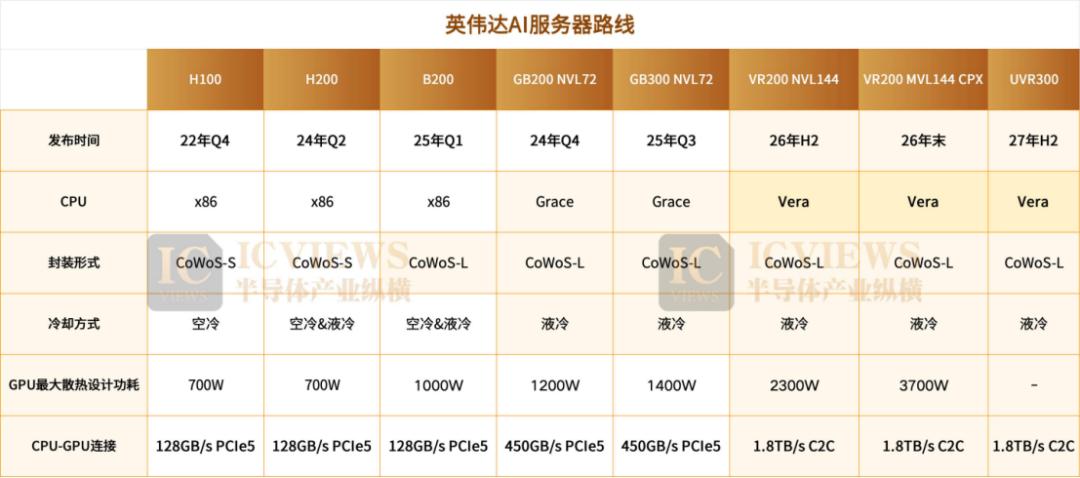
Core Insights - The AI server hardware is undergoing a significant design upgrade driven by GPUs and ASICs, with new platforms from NVIDIA and AMD expected to enhance computing power and cabinet density by 2026 [1][4] - The demand for AI servers is surging, with NVIDIA's platform projected to see cabinet demand more than double from approximately 28,000 units in 2025 to at least 60,000 units in 2026 [2] - The transition to advanced cooling and power solutions is essential as GPU power consumption increases, leading to a complex engineering system for future AI data centers [4][5] AI Server Demand - The demand for AI servers continues to rise, with NVIDIA's platform expected to see cabinet demand increase significantly [2] - AMD's Helios server rack project is also making progress, further intensifying the market demand for advanced AI hardware [2] NVIDIA AI Server Roadmap - NVIDIA's upcoming AI server platforms include the GB300 and Vera Rubin series, with increasing power consumption from 700W for H100 to 3700W for the upcoming VR200 platform [4][22] - The GB200 platform is currently the core driver of the AI server market [3] Supply Chain and Production - Major ODM manufacturers like Hon Hai, Quanta, Wistron, and Wiwynn are key suppliers for NVIDIA's AI server cabinets, with Hon Hai leading in production [10] - Hon Hai's AI server cabinet shipments increased by 300% quarter-over-quarter, with expectations to exceed NT$1 trillion in revenue by 2025 [10] Revenue and Market Share - In November, Quanta, Wistron, and Wiwynn reported record monthly revenues, with significant year-over-year growth [12] - By 2025, Hon Hai is expected to capture over 40% of the AI server market share, with GB200 and GB300 platforms dominating shipments [12] Industry Upgrades - The shift to NVIDIA's GB300 and Vera Rubin platforms represents a new cycle in AI hardware, prompting a reevaluation of supply chain components [13] - The power supply and cooling systems are undergoing significant changes to accommodate the increasing power demands of AI workloads [14][16] Power Supply Innovations - NVIDIA's Kyber power supply strategy aims to redefine data center power architecture, with projected values for Rubin Ultra cabinets expected to exceed ten times that of current GB200 cabinets by 2027 [16] - The transition to 800V DC power solutions is critical for meeting the demands of modern AI data centers [14][16] Cooling Solutions - NVIDIA's cooling technology is evolving from air cooling to liquid cooling solutions to manage the rising thermal demands of high-performance GPUs [17][22] - The value of cooling components for AI servers is expected to increase significantly, with projections indicating a 17% rise for the next generation of cooling modules [22] PCB Demand Surge - The upgrade of AI servers is driving a surge in demand for high-end PCBs, with manufacturers increasing production capacity for advanced multi-layer boards [23][24] - The market for high-end PCBs is expected to grow significantly, with prices for advanced boards potentially doubling due to increased complexity [23] CSP Capital Expenditure - Major cloud service providers (CSPs) are ramping up capital expenditures to support the growing demand for AI infrastructure, with projected increases in spending for 2025 and 2026 [26][29] - The total capital expenditure for the eight major CSPs is expected to exceed $600 billion in 2026, reflecting strong long-term growth potential in AI infrastructure [26][29]


2026年,AI服务器贵、贵、贵
Tai Mei Ti A P P· 2025-12-11 11:01
Core Insights - 2026 is identified as a critical window for AI server system upgrades, driven by significant design changes in GPU and ASIC technologies [1][4] - The demand for AI servers is expected to surge, with NVIDIA's platform projected to see cabinet demand more than double from approximately 28,000 units in 2025 to at least 60,000 units in 2026 [2][26] - The overall cost of AI servers is anticipated to rise significantly due to advancements in power supply, cooling solutions, and PCB requirements [5][26] Group 1: AI Server Hardware Upgrades - NVIDIA is set to launch the GB300, Vera Rubin platform, and Kyber architecture in 2026, enhancing computational power and cabinet density [1][4] - The GPU power design is evolving, with TDP increasing from 700W for H100 to 3700W for VR200 NVL44 CPX by late 2026, necessitating a shift to liquid cooling solutions [4][23] - The transition to more efficient power systems is underway, moving from 12V VRM to 48V DC bus systems to reduce conversion losses [4][14] Group 2: Market Demand and Supply Chain Dynamics - ODM manufacturers like Hon Hai, Quanta, Wistron, and Wiwynn are ramping up production, with Hon Hai's AI server cabinet shipments increasing by 300% quarter-over-quarter [10][12] - In November, Quanta and Wistron reported record monthly revenues, with Wistron showing a remarkable 194.6% year-over-year growth [12] - The market share for AI server cabinets in 2025 is projected to see Hon Hai holding over 52%, with Quanta and Wistron at approximately 19% and 21%, respectively [13] Group 3: Power and Cooling Solutions - NVIDIA's Kyber project aims to redefine power supply architecture for AI data centers, with a target to produce new power solutions by the end of 2026 [15][17] - The cooling technology is evolving from air cooling to liquid cooling, with the GB300 adopting a full cold plate liquid cooling solution to handle up to 1400W [18][23] - The cost of cooling components is expected to rise, with the total value of cooling components for the next-generation Vera Rubin platform projected to increase by 17% [23] Group 4: PCB and Component Upgrades - The demand for high-end PCBs is surging, with the number of layers and material quality increasing significantly due to the enhanced functionality of AI servers [24][25] - The global PCB market is expected to grow, with high-end HDI boards and multi-layer boards seeing demand increases of 14.2% and 18.5%, respectively [25] - The price of PCBs is anticipated to double with each upgrade cycle, reflecting the growing complexity and performance requirements of AI hardware [25] Group 5: Capital Expenditure Trends - Major cloud service providers (CSPs) are increasing their capital expenditures, with a projected total of over $600 billion in 2026, reflecting a 40% year-over-year growth [26][29] - CSPs like Google, Meta, and Amazon are significantly raising their capital expenditure forecasts for 2025, indicating strong demand for AI infrastructure [29] - The ongoing investment from CSPs provides a solid foundation for the rising costs associated with AI server upgrades [26][29]
⼤摩:2026将是AI科技硬件之年
硬AI· 2025-11-03 09:20
Core Insights - Morgan Stanley predicts that 2026 will be a pivotal year for explosive growth in AI hardware, driven primarily by strong demand for AI server hardware [2][3] - The report highlights a significant redesign upgrade in AI server hardware, propelled by GPU and ASIC advancements, with notable upcoming releases from NVIDIA and AMD [2][4] AI Server Rack Demand Surge - The demand for AI server racks is expected to surge from approximately 28,000 units in 2025 to at least 60,000 units in 2026, representing over 100% growth [7] - The transition from the H100/H200 era to the new cycle driven by NVIDIA's GB200/300 and Vera Rubin platforms is emphasized [4] Power Consumption and Cooling Solutions - The report identifies power and cooling challenges as significant opportunities for suppliers, with power solutions expected to transition to 800V high-voltage direct current (HVDC) architecture [11][13] - By 2027, the value of power solutions for Rubin Ultra cabinets is projected to exceed ten times the current value of GB200 server cabinets [13] Liquid Cooling as a Standard - Liquid cooling has shifted from an optional solution to a necessity, with the total value of cooling components for a GB300 cabinet estimated at approximately $49,860, increasing to $55,710 for the next-generation Vera Rubin platform [15][16] PCB and Interconnect Upgrades - The upgrade of AI platforms is expected to have a profound impact on printed circuit boards (PCBs) and interconnect components, with increasing requirements for layer counts and material grades [20][21] - The transition from ultra-low-loss to extreme low-loss materials in PCB manufacturing is anticipated to create structural growth opportunities for suppliers with the necessary technical capabilities [22][23]