
Mate 80 系列

Search documents
群智咨询:2025年全球智能手机出货量约为12.0亿部 同比增长1.0%
智通财经网· 2026-01-30 13:23
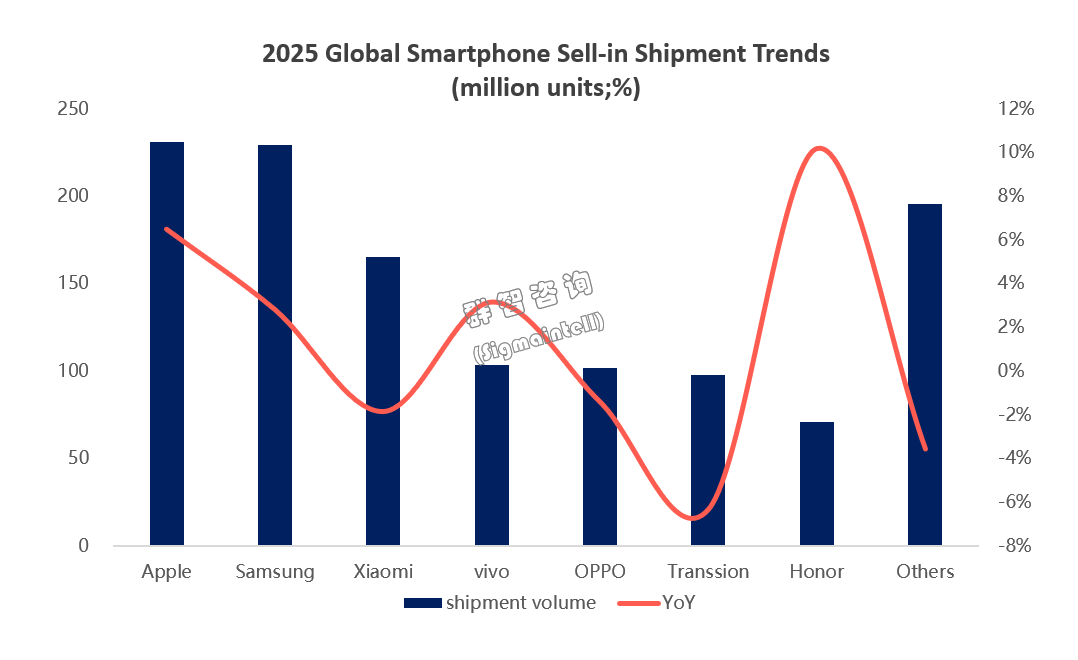
Global Market: Micro Growth and Core Drivers - The global smartphone shipment volume is projected to reach approximately 1.2 billion units in 2025, reflecting a year-on-year growth of 1.0% [2] - High-end models are identified as the main growth driver, with Apple expected to ship around 231 million units, marking a 6.5% increase [2] - Samsung is anticipated to ship about 230 million units, showing a 2.8% growth, supported by its self-developed storage and comprehensive supply chain [2] - Vivo and OPPO are expected to maintain stable shipment volumes of approximately 104 million and 102 million units, respectively, leveraging supply chain advantages [2] Domestic Market: Competition Among Leading Brands - The domestic smartphone shipment volume is estimated at 280 million units in 2025, with a slight decline of 0.2% year-on-year [6] - Huawei is projected to lead the domestic market with approximately 46.9 million units shipped, benefiting from strategic pricing adjustments [6][8] - Apple is expected to ship around 46.8 million units domestically, achieving an 8.8% growth due to a strong competitive strategy [6][8] - Vivo's domestic shipment is estimated at 46.4 million units, facing a decline of 5.4% year-on-year, while Xiaomi and OPPO are expected to ship 43.8 million and 43.6 million units, respectively [8] Future Outlook: Market Pressure and Transformation - The global smartphone shipment volume is forecasted to decline to approximately 1.14 billion units in 2026, representing a 4.4% decrease [9][10] - Continued high storage prices are expected to exert cost pressures on manufacturers, prompting further optimization of product structures and operational efficiencies [9] - The competitive landscape is shifting from hardware specifications to a focus on cross-device experiences and service capabilities, with ecosystems like Huawei's HarmonyOS and Apple's iOS becoming increasingly important [9]


东海证券晨会纪要-20251208
Donghai Securities· 2025-12-08 05:13
Group 1: Key Recommendations - The report highlights the expectation of a dollar interest rate cut and a yen interest rate hike, suggesting a rebalancing of assets in search of certainty [5][7] - It emphasizes the strong performance of the domestic equity market, particularly in sectors such as non-ferrous metals, communication, and defense [6][10] - The semiconductor industry is experiencing a recovery, with domestic wafer fabs operating at full capacity and significant growth in AI-related products [10][15] Group 2: Market Overview - Global stock markets mostly rose in the week ending December 5, with A-shares performing relatively well; commodities like copper and crude oil saw price increases, while gold prices fell [5][6] - The report notes that the average daily trading volume in the domestic equity market was 16,843 billion yuan, with 17 sectors rising and 14 falling [6][23] - The report indicates that the yield on 10-year Chinese government bonds rose to 1.848%, while the yield on 10-year U.S. Treasuries increased to 4.14% [5][25] Group 3: Semiconductor Industry Insights - The semiconductor industry showed continued improvement in November, with demand for PCs and smartphones slightly increasing, and rapid growth in TWS headphones and smart home devices [10][12] - The report mentions that the global semiconductor sales in September increased by 25.13% year-on-year, indicating a recovery in demand [12][13] - Domestic wafer fabs are expected to maintain full capacity, with significant revenue growth reported by major companies like Huahong and SMIC [15][16] Group 4: Economic and Policy Developments - The report discusses the Chinese government's focus on energy conservation and carbon reduction as part of its economic strategy [17] - It highlights a video call between Chinese and U.S. officials aimed at enhancing economic cooperation and addressing mutual concerns [17][18] - The report notes that China's foreign exchange reserves increased by 0.09% in November, with the central bank continuing to accumulate gold for the 13th consecutive month [19][20]
余承东测试华为 FreeBuds Pro 5 悦彰耳机:支持星闪连接,150 米也不断联
Xin Lang Cai Jing· 2025-12-05 12:56
Core Viewpoint - Huawei has demonstrated the long-distance connectivity performance of its new FreeBuds Pro 5 headphones, showcasing stable audio transmission at a distance of 150 meters from the connected device [1][8]. Group 1: Product Features - The FreeBuds Pro 5 is equipped with the Kirin A3 chip and Starry Flash E 2.0 technology, which offers low power consumption (60% lower than Bluetooth) and a latency of 0.2 milliseconds [3][10]. - The headphones support dual-engine AI noise cancellation and deliver lossless audio quality at 4.6 Mbps [3][10]. Group 2: Compatibility - The Starry Flash audio feature requires specific Huawei models, currently only supporting the Mate 80 series and Mate X7 series [7][13]. - Other brand smartphones and non-designated Huawei models can connect via Bluetooth 5.3, supporting basic features such as dual-device connectivity and smart noise cancellation [7][13].

Counterpoint Research:苹果(AAPL.US)推动中国双11期间智能手机销量同比增长3%
Zhi Tong Cai Jing· 2025-12-04 02:34
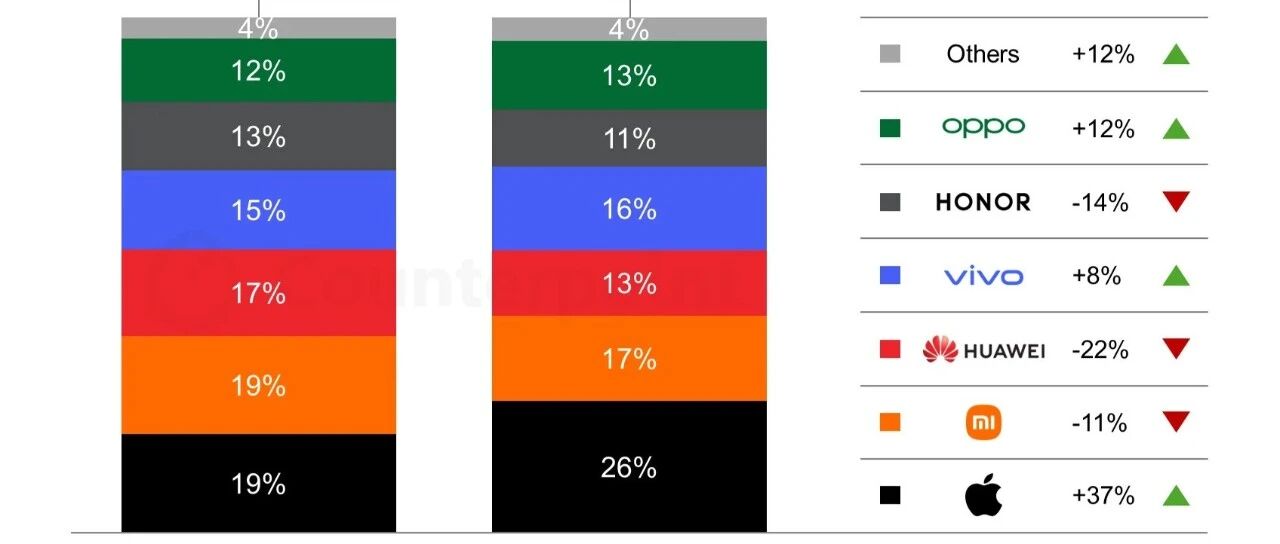
Group 1 - The core viewpoint of the articles highlights that Apple's iPhone 17 series significantly boosted smartphone sales in China during the Double 11 shopping period, leading to a 3% year-on-year increase in overall smartphone sales [1] - The iPhone 17 base model saw over a 100% increase in sales compared to the previous year, while the Pro and Pro Max models also experienced mid to high double-digit growth, aided by a promotional discount of 300 RMB [1] - Excluding Apple, the smartphone market in China experienced a 5% decline year-on-year, indicating a cautious consumer environment and weak momentum heading into Q4 [1] Group 2 - Huawei faced the largest decline in performance due to the delayed launch of its flagship Mate 80 series, which was released two weeks after Double 11 [2] - Xiaomi's sales dropped by 11% year-on-year, primarily due to the early release of its Xiaomi 17 series, which shifted the sales peak forward by a month, coupled with weaker performance of older models [2]
苹果推动中国双 11 期间智能手机销量同比增长 3%
Counterpoint Research· 2025-12-04 01:03
Core Insights - The article highlights that the smartphone sales in China during the Double 11 shopping festival saw a year-on-year increase of 3%, primarily driven by strong demand for the Apple iPhone 17 series [4][5][7]. Smartphone Market Performance - The iPhone 17 series, particularly the base model, has shown remarkable performance with sales more than doubling year-on-year, while the Pro and Pro Max models also experienced mid to high double-digit growth [5][8]. - Excluding Apple, the overall smartphone market in China declined by 5% year-on-year, indicating a more cautious consumer environment and weak momentum at the start of Q4 [7][8]. - Huawei faced the largest decline among major smartphone brands due to the delayed launch of its flagship Mate 80 series, which missed the Double 11 sales period [7][8]. - Xiaomi's sales dropped by 11% year-on-year, attributed to the early release of the Xiaomi 17 series, which shifted the sales peak forward by a month [7][8]. Strategic Shifts in the Industry - Major smartphone brands are shifting their focus towards newly launched high-end models, which has further suppressed overall sales [8]. - The early launch of the Xiaomi 17 series and the strong performance of the previous generation Xiaomi 15 series during the Double 11 period highlight the impact of product timing on sales performance [8].
——策略周专题(2025年11月第3期):海外波动加剧,拖累国内市场
EBSCN· 2025-11-23 09:38
Group 1 - The A-share market experienced a pullback this week, with major indices declining due to decreased market risk appetite. The Shanghai Composite Index fell by 2.7%, while the ChiNext Index dropped by 6.2%. The overall valuation of the entire A-share market is at the 83rd percentile since 2010 [1][10][12] - In terms of industry performance, the banking, media, and food and beverage sectors showed relatively smaller declines, with respective changes of -0.9%, -1.3%, and -1.4%. In contrast, sectors such as power equipment, comprehensive, and basic chemicals faced larger declines, with changes of -10.5%, -9.2%, and -7.5% [1][10][14] Group 2 - Recent significant events include China's stern diplomatic response to Japan's remarks, the Netherlands suspending an administrative order against ASML, and Russia's announcement of a visa-free policy for Chinese citizens [2][19][20] - Economic data released this week showed that the one-year and five-year LPR rates in China remained unchanged at 3.0% and 3.5%, respectively. In the U.S., September's non-farm payrolls exceeded expectations, with an increase of 119,000 jobs, leading to speculation that the Fed may delay interest rate cuts in December [2][21] Group 3 - The market is still in a bull phase, but short-term fluctuations are expected. The Shanghai Composite Index saw a weekly decline of 3.9%, while the STAR 50 Index dropped by 5.54%. The volatility in the A-share market is influenced by fluctuations in overseas markets, particularly in the tech sector [3][24][25] - The current market position may represent the starting point of a long-term bull market, supported by improving fundamentals and industry highlights. However, short-term catalysts may be lacking, leading to a phase of consolidation [3][25] Group 4 - Short-term investment focus should be on defensive and consumer sectors, while mid-term attention should remain on TMT (Technology, Media, and Telecommunications) and advanced manufacturing sectors. High-dividend and consumer stocks are expected to perform better during market fluctuations [3][35][38] - The TMT sector currently has several catalysts, including Alibaba's launch of a new AI model and Oracle's significant growth in remaining performance obligations. If the market shifts to a fundamentals-driven phase, advanced manufacturing is likely to become a key focus [3][40][43]