Micro LED芯片

Search documents
研报 | 錼创科技将并购Lumiode,以加速近眼显示Micro LED发展
TrendForce集邦· 2025-12-19 06:40
Core Insights - PlayNitride announced the acquisition of 100% of Lumiode, Inc. for $2 million, aiming to enhance its technology and patent portfolio while expanding its North American customer base and sales channels [2][4] Group 1: Acquisition Details - The acquisition is expected to be completed by the end of 2025, which will add new feasibility for Micro LED in near-eye display applications [4] - PlayNitride aims to develop Micro LED AR glasses without being limited by existing CMOS solutions [4] Group 2: Market Position and Technology - PlayNitride plays a significant role in the Micro LED industry, providing services including Micro LED chips, COC processes, mass transfer technology, and turnkey solutions [3] - Lumiode focuses on near-eye display and medical markets with its unique Active TFT Thin Film technology, which may replace costly CMOS wafer bonding solutions [3][4] Group 3: Market Projections - TrendForce estimates that global shipments of Micro LED AR glasses will reach 21 million units by 2030, with a penetration rate of 65% for Micro LED technology in overall AR glasses [4][11]

TrendForce:预计2029年Micro LED芯片产值将达4.608亿美元
Zhi Tong Cai Jing· 2025-12-01 06:57
Core Insights - The Micro LED chip market is projected to reach $460.8 million by 2029, driven by advancements in large display manufacturing processes and the introduction of new AR glasses and smartwatches [1] - Micro LED technology is expanding beyond consumer electronics into the optical interconnects sector, particularly due to increased demand from AI servers, which may enhance technology development and chip demand [1] Display Applications - Micro LED is gradually penetrating the market, benefiting from improved manufacturing processes and yield rates, as well as the expansion of automotive products [1] - Despite high power consumption and costs, Micro LED has the potential to meet the extreme brightness demands of outdoor sports watches and can integrate physiological sensing capabilities [3] - Long-term optimization and market maturation are necessary for Micro LED to achieve large-scale application and compete with more established OLED technology [3] Non-Display Applications - In the optical communications field, the demand for data centers is driving the search for more cost-effective light sources, with Micro LED offering low power consumption, higher data transmission density, and better temperature stability [4] - The display industry is expected to facilitate rapid cost reductions for Micro LED due to economies of scale in the coming years [4]
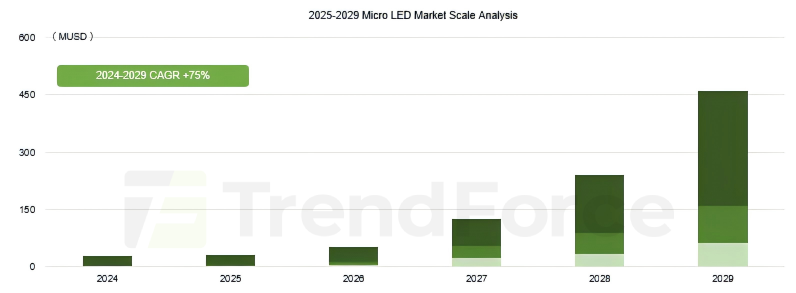
显示与非显示应用拓展驱动,预计2029年Micro LED芯片产值将达4.608亿美元
TrendForce集邦· 2025-12-01 06:43
Core Insights - Micro LED technology is gradually penetrating various display applications, benefiting from improved manufacturing processes and the introduction of new products like AR glasses and smartwatches, with the chip value expected to reach $4.608 billion by 2029 [2] - In non-display applications, Micro LED is expanding into the optical interconnects sector, driven by AI server demand, which may enhance technology advancement and chip demand [2] Display Applications - The launch of Garmin's first Micro LED smartwatch, Fenix 8 Pro, signifies the industry's initial steps into high-value applications, although high power consumption and costs pose challenges for market acceptance compared to OLED [4] - Long-term trends indicate that Micro LED can meet the high brightness demands of outdoor environments for sports watches and has potential for integration with health monitoring and navigation features [4] Optical Interconnects - The increasing demand for data centers is driving the search for more economical light sources, with Micro LED offering low power efficiency, higher data transmission density, and better temperature stability, potentially leading to rapid cost reductions in the coming years [6]
乾照光电(300102):乾照光电2025年三季度报点评:精益管理优化效益,新型显示+商业航天布局未来
Changjiang Securities· 2025-11-17 13:15
Investment Rating - The investment rating for the company is "Buy" and is maintained [7]. Core Insights - The company reported a significant increase in revenue and profit for the first three quarters of 2025, achieving a total revenue of 2.75 billion yuan, a year-on-year increase of 46.36%, and a net profit attributable to shareholders of 88 million yuan, up 80.17% year-on-year [2][4]. - In Q3 2025, the company achieved a revenue of 1.007 billion yuan, a substantial year-on-year increase of 65.80%, and a net profit of 19 million yuan, reflecting a year-on-year growth of 56.01% [2][4]. - The company is focusing on lean management optimization and has made strategic advancements in new display technologies and commercial aerospace [2][4]. Financial Performance - The company’s gross profit margin has faced pressure due to demand fluctuations and price changes, but effective cost control has led to an increase in return on equity (ROE) by 0.15 percentage points to 0.44% in Q3 2025 [12]. - Inventory turnover ratio improved by 18.58% year-on-year and 53.83% quarter-on-quarter, reaching 3.74 times, indicating enhanced inventory management and operational efficiency [12]. Business Development - The company has made significant breakthroughs in Mini/Micro LED technologies, with the Mini LED backlight business experiencing explosive growth due to collaboration with its major shareholder, Hisense [12]. - The Micro LED sector has also seen key advancements, with the Micro MIP chip receiving mass production certification from leading clients [12]. - The company is actively developing AR micro-display products and has seen substantial growth in its gallium arsenide solar cells, particularly in the commercial aerospace sector [12]. Future Outlook - The company’s asset structure continues to optimize, with a debt-to-asset ratio decreasing to 34.31%, down 2.81 percentage points year-on-year, indicating robust solvency [12]. - The projected net profit attributable to shareholders for 2025-2027 is expected to reach 121 million, 212 million, and 302 million yuan, corresponding to price-to-earnings (PE) ratios of 104X, 59X, and 41X respectively [12].

深康佳A:聚焦Micro LED及Mini LED芯片、巨量转移、显示三大业务板块进行布局
Ge Long Hui· 2025-10-14 07:24
Core Viewpoint - The company is focusing on the semiconductor optoelectronics sector, particularly in Micro LED and Mini LED chips, mass transfer, and display business segments, transitioning its optoelectronic operations from technology research and development to industrialization [1] Group 1 - The company has made strategic investments in the semiconductor optoelectronics field [1] - Key areas of focus include Micro LED and Mini LED chips, mass transfer technology, and display business [1] - The company aims to shift its optoelectronic business towards industrialization [1]

深康佳A(000016.SZ):聚焦Micro LED及Mini LED芯片、巨量转移、显示三大业务板块进行布局
Ge Long Hui· 2025-10-14 07:23
Core Viewpoint - The company is focusing on the semiconductor optoelectronics sector, particularly in Micro LED and Mini LED chips, mass transfer, and display business segments, transitioning its optoelectronic business from technology research and development to industrialization [1] Group 1 - The company has made strategic investments in the semiconductor optoelectronics field [1] - Key areas of focus include Micro LED and Mini LED chips, mass transfer, and display [1] - The company aims to shift its optoelectronic business towards industrialization [1]

智能眼镜出货量暴增,光峰科技、利亚德等A股企业竞逐AR光学赛道
Xin Lang Cai Jing· 2025-09-25 09:11
Core Insights - The global smart glasses market is experiencing a significant surge, with shipments expected to increase by 110% year-on-year in the first half of 2025, and AI-enabled smart glasses accounting for 78% of this growth [1][4] - Major companies in the AR and AI glasses sector, including Guangfeng Technology, Liyade, and BOE, are launching innovative products and solutions that address industry pain points and enhance user experience [1][2] Company Developments - Guangfeng Technology introduced a pioneering "LCoS + PVG optical solution" for AR glasses, which utilizes a single optical engine to drive dual displays, potentially disrupting the current pricing structure of AR glasses [1] - Liyade has developed AR glasses that integrate Micro LED technology with AI capabilities, focusing on B2B applications in sectors like tourism and healthcare, and aims to provide customized solutions [1][2] - BOE's Huacan showcased a 0.13-inch Micro LED display module, emphasizing low power consumption and high brightness, alongside a 6.2-inch full-color HUD for automotive applications [1][2] - NewXiangwei is expanding its product matrix to include high-end display chips for AR glasses, with a focus on domestic and automotive applications [2] - Omnivision's LCoS microdisplay technology is being utilized in Meta's first AR glasses, indicating a strategic partnership in the XR technology space [2] - GoerTek announced a capital increase to enhance its micro-nano optical capabilities, strengthening its competitive position in the VR/AR market [2] - Jiahe Intelligent's acquisition of Beyerdynamic aims to enhance its AR/AI glasses business through synergies in audio technology [2] - Luxshare Precision showcased a new generation of full-color AR glasses and has initiated mass production of PVG polarized AR glasses designed for outdoor use [2] - Lens Technology is positioning itself as a core supplier for AI glasses, with significant involvement in the assembly and supply chain for major clients [2] - Crystal Optoelectronics reported a 79% revenue increase in automotive AR applications, highlighting its growth in the next-generation terminal market [2][3] Industry Trends - The AR optical technology landscape is dominated by reflective waveguides and surface relief gratings, with the former leading in efficiency but facing manufacturing challenges [3] - The industry is transitioning from conceptual exploration to mass production, with a notable increase in demand for AI glasses, particularly in the Chinese market [4]


深康佳A半导体业务半年增17.38%,华润入主助力Micro LED产业化
Jin Rong Jie· 2025-09-19 08:22
Core Viewpoint - The acquisition of Shenzhen Konka by China Resources Group marks a significant turning point for the company, particularly in its semiconductor business development, which is now a focus area for investors [1][4]. Group 1: Company Transition and Financial Performance - Shenzhen Konka A reported a revenue of 5.248 billion yuan in the first half of 2025, a year-on-year decrease of 3.05%, while the net profit attributable to shareholders was -383 million yuan, indicating a significant reduction in losses by 64.75% compared to the same period last year [2]. - The semiconductor business segment showed a notable performance with a revenue growth of 17.38% year-on-year, highlighting its role as a bright spot in the company's business structure [2]. Group 2: Semiconductor Business Development - The company is focusing on three main areas in its semiconductor business: Micro LED and Mini LED chips, mass transfer technology, and display products, aiming to transition from technology research and development to industrialization [1][5]. - Chongqing Konka Optoelectronics, a subsidiary, has achieved a direct laser transfer yield of 99.996% and a transfer speed exceeding 47 million pieces per hour, laying a solid foundation for future large-scale production [3]. Group 3: Strategic Focus and Market Positioning - The strategic focus on Micro LED and Mini LED technologies aligns with global semiconductor industry trends, offering high brightness, high contrast, and low power consumption advantages, which are crucial for applications in consumer electronics and commercial displays [5]. - Mastery of mass transfer technology is essential for the mass production of Micro LED and Mini LED products, enhancing production efficiency and product quality while reducing costs [5].
深康佳A:半导体业务重点聚焦Micro LED及Mini LED芯片、巨量转移、显示三大业务板块
Zheng Quan Ri Bao Wang· 2025-09-17 12:13
Core Viewpoint - The company is focusing its semiconductor business on three main areas: Micro LED and Mini LED chips, mass transfer technology, and display technology, transitioning from R&D to industrialization [1] Group 1 - The company is currently emphasizing the development of Micro LED and Mini LED chips [1] - The company is advancing its optical business towards industrialization [1] - Investors are encouraged to refer to the company's regular reports for detailed business information [1]
000559,三连板!A股这一概念,突然异动拉升!
Zheng Quan Shi Bao Wang· 2025-09-17 04:01
Group 1: Robotics Sector - The robotics concept stocks are actively rising, with Wanxiang Qianchao (000559) hitting the limit up for three consecutive days [5] - Other companies in the robotics sector, such as Jingxing Paper Industry and Luxiao Technology, also reached the limit up, while Hongchang Technology, Hanwei Technology, Dongshan Precision, and Shoukai Co. followed suit [5] - CITIC Securities reports that 2025 will be the year of mass production for embodied intelligent robots, indicating a deep integration of artificial intelligence and robotics, which is expected to drive a new industrial revolution [7] Group 2: Photovoltaic Sector - The photovoltaic sector saw significant activity, with Yijing Photovoltaic hitting the limit up, and other companies like Jiazhe New Energy, Shuangliang Energy, and Tongwei Co. also experiencing gains [8] - Recent data from the photovoltaic industry indicates a noticeable price increase in several upstream sectors, with the price of silicon wafers in Yunnan reported at 1.2 yuan per piece, and polysilicon prices in Inner Mongolia at 36 yuan per kilogram [8] Group 3: Semiconductor Sector - Chip stocks are showing strong performance, with SMIC's A-shares rising over 10% and H-shares increasing over 5%, both reaching historical highs [10] - A report from Shanghai Securities indicates that global semiconductor equipment shipments are expected to reach $33.07 billion in Q2 2025, a 24% year-on-year increase [10] Group 4: Hong Kong Technology Stocks - The Hang Seng Technology Index opened high and rose over 2%, surpassing the March high of this year, with Baidu and Alibaba seeing significant gains [11][12] - The overall market capitalization of Hong Kong stocks has returned to 3 trillion HKD, with a nearly 100% increase year-to-date [11]